
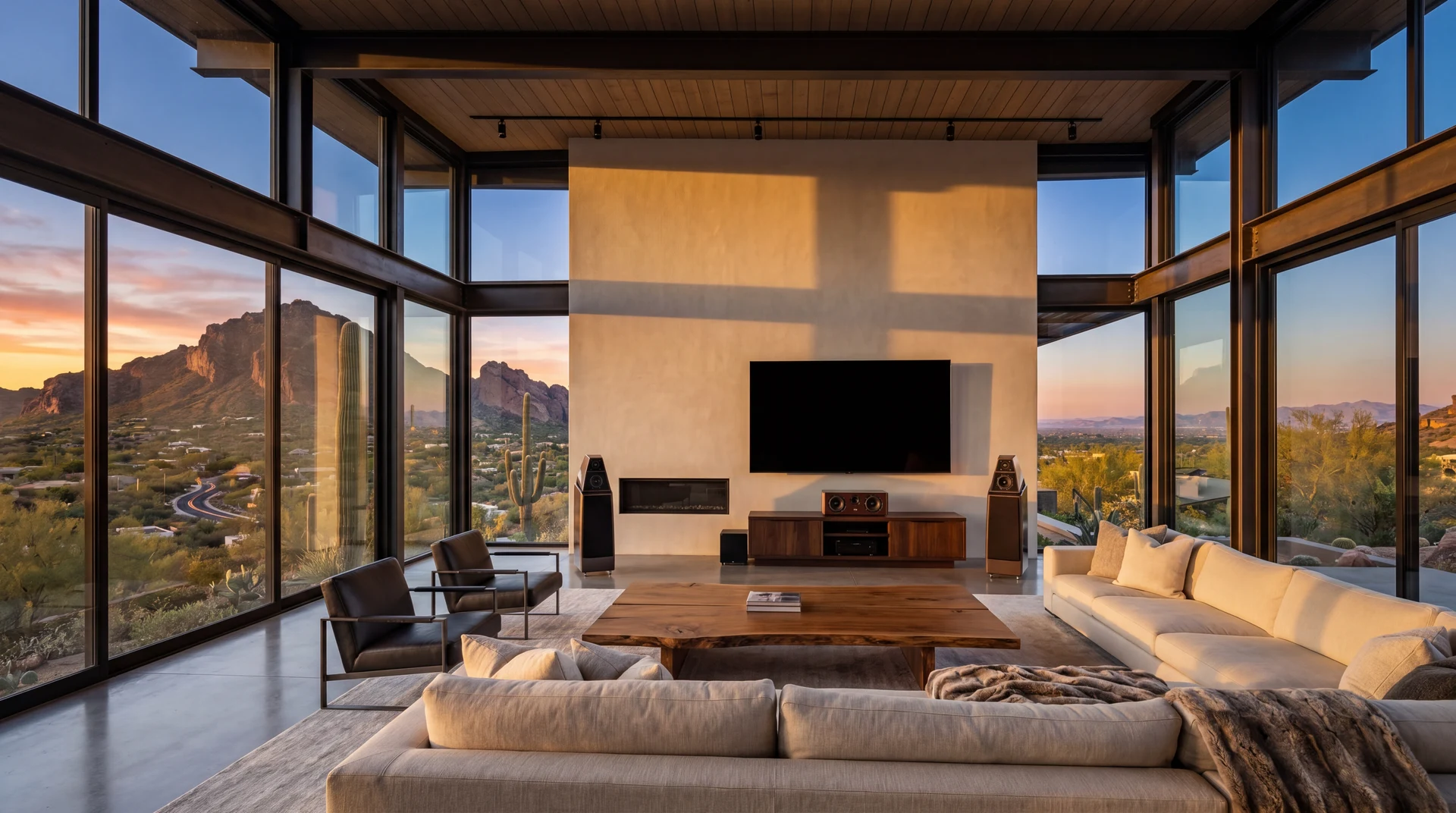
Paradise Valley estates built with 13-foot glass walls, polished concrete, and exposed steel beams create rooms that seem impossible to treat acoustically. Here's how to solve the sound problem without covering a single window.
Paradise Valley has some of the most architecturally striking homes in Arizona. It also has some of the worst-sounding rooms I've ever walked into. That's not a coincidence. The same glass walls, steel beams, and polished concrete that make these estates so visually stunning turn every room into an echo chamber. Standard acoustic treatment assumes you can hang panels on walls and put traps in corners. In a home where three walls are glass and the ceiling is 16 feet of exposed steel, that playbook falls apart.
According to the Grand View Research architectural acoustics market report, the global architectural acoustics market reached $18.7 billion in 2024 and is projected to grow at 5.8% annually through 2030 (Grand View Research, 2024). That growth is driven partly by the luxury residential sector, where modern architecture and livable acoustics keep colliding. Paradise Valley sits right at the center of that collision.
I've spent years figuring out how to make audio sound right in rooms that architects designed for looks, not listening. Here's what actually works.
Why Do Glass-and-Steel Homes Sound So Bad?
Glass reflects approximately 95% of sound energy at mid and high frequencies, according to acoustics research published by the Acoustical Society of America (ASA, 2022). In a room with two or three glass walls, that means nearly all the sound from your speakers bounces back and forth between hard surfaces before it ever reaches your ears. The result is smeared dialogue, harsh treble, and bass that booms in some spots and disappears in others.
Steel beams compound the problem. They're rigid, lightweight relative to their surface area, and they resonate at specific frequencies. When bass energy from a subwoofer hits an exposed steel I-beam, it can ring like a tuning fork. Polished concrete floors add the third element: a perfectly flat, perfectly hard surface that reflects low frequencies with almost zero absorption.
Stack all three together and you get what I call the "triple mirror" effect. Sound bounces off the floor, hits the glass, reflects to the steel ceiling structure, and comes back down again. In a room with 13-to-16-foot ceilings, that round trip takes just long enough to create audible echo on every word of dialogue.
[PERSONAL EXPERIENCE]I measured one Paradise Valley great room, roughly 1,200 square feet with glass on two sides, that had a reverberation time of 3.4 seconds. For reference, a well-tuned home theater targets 0.3 to 0.5 seconds. That room was nearly seven times too reverberant. The homeowner thought his speakers were broken. They weren't. The room was the problem.
What Is Acoustic Glass Film and Does It Actually Work?
Acoustic laminated glass interlayers are one of the most effective, and least visible, treatments for glass-heavy rooms. The global acoustic insulation market, which includes these products, was valued at $14.3 billion in 2023 and is growing at 5.4% CAGR (Fortune Business Insights, 2024). Acoustic interlayers reduce sound transmission through glass by 10 to 15 decibels and also dampen the surface reflection that creates flutter echo.
These interlayers work by adding a thin viscoelastic membrane between glass panes. The membrane converts sound vibration into heat, which dampens both the reflection off the glass surface and the transmission of sound through it. For Paradise Valley homes, retrofit film versions can be applied to existing windows without replacing the glass entirely.
Does it solve the problem completely? No. But it takes the edge off the harshest reflections. I recommend acoustic film as the first step, not the only step. It reduces the high-frequency "ping" that makes glass rooms fatiguing to listen in, and it gives other treatments a better foundation to work from.
[IMAGE: Custom architectural millwork panel with integrated acoustic diffusion pattern in warm walnut - search: acoustic diffusion panel luxury custom millwork wood]How Do Suspended Ceiling Treatments Work in Double-Height Rooms?
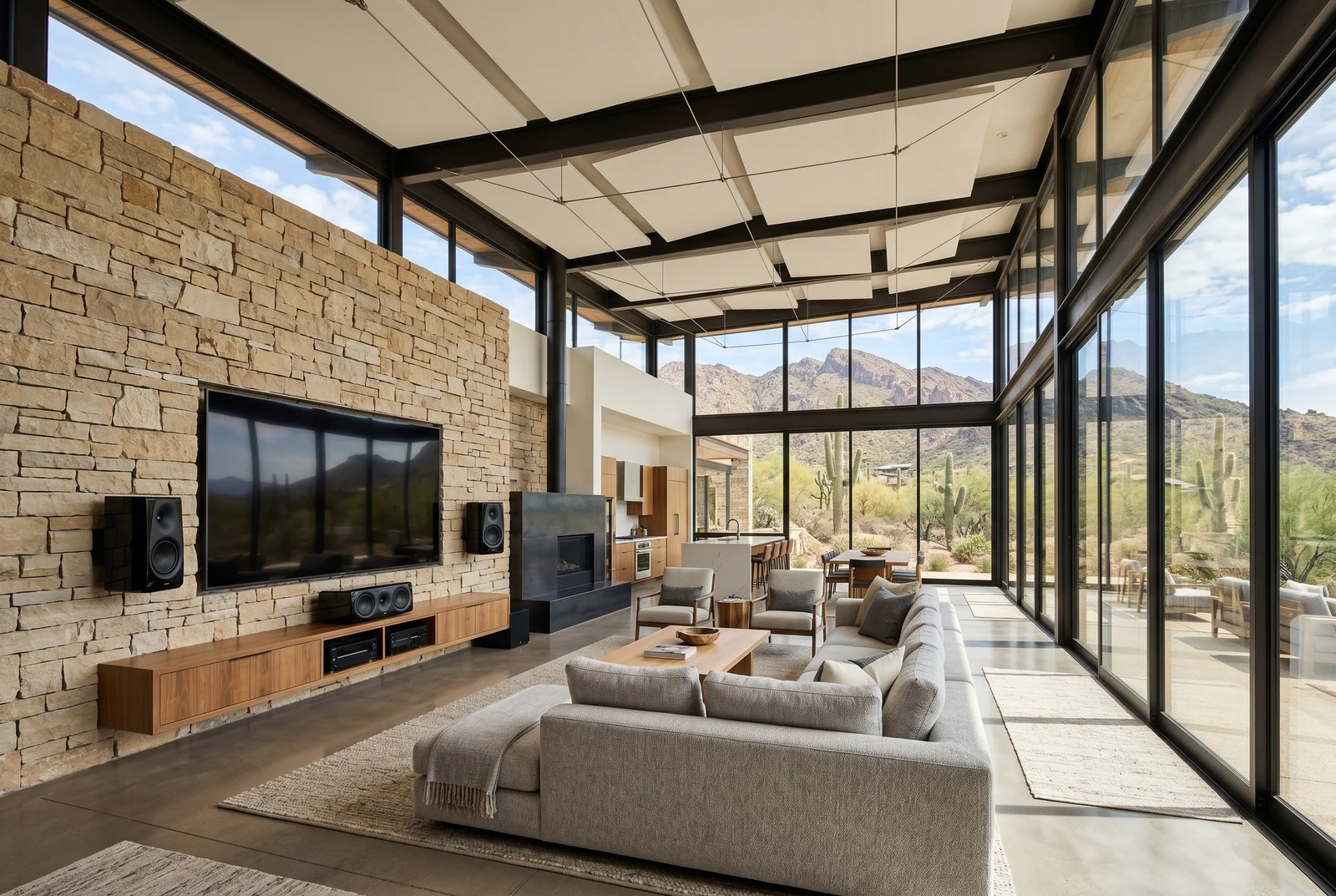
When your ceiling is 16 feet of exposed steel, you can't mount a traditional ceiling cloud at the standard 8-to-9-foot height without it looking like a dropped-ceiling afterthought. Suspended acoustic panels for double-height rooms need to float at varying heights, follow the architecture's visual language, and cover enough surface area to actually matter. The Buildings.com industry survey found that 61% of architects now specify acoustic ceiling elements in residential open-plan projects, up from 38% five years ago (Buildings.com, 2024).
The approach that works in Paradise Valley is a series of horizontal panels suspended by thin steel cables from the existing beam structure. Stagger them at different heights, typically between 10 and 14 feet, so they break up the vertical reflection path without creating a visual ceiling line. Finish them in the same palette as the architecture: matte white, raw concrete gray, or oxidized steel.
[UNIQUE INSIGHT]Most acoustic consultants treat ceilings as a single plane. In double-height rooms, the ceiling is actually a volume. You're not covering a surface. You're interrupting a sound path. Three panels at staggered heights absorb more effectively than a single large cloud because they catch reflections at multiple points in the vertical bounce cycle. It's a counterintuitive principle, but less total material positioned in three dimensions outperforms more material in two dimensions.
Can Furniture and Layout Alone Fix Room Acoustics?
Strategic furniture placement won't fix a 3.4-second reverb time on its own. But in rooms where wall-mounted treatment isn't an option, furniture becomes the primary absorption surface. A large upholstered sectional absorbs as much mid-frequency energy as 40 to 50 square feet of acoustic panel, according to absorption coefficient data from the ASA.
Thick wool area rugs on polished concrete break the floor-to-ceiling bounce path. Bookshelves loaded with varied-depth objects act as natural diffusers, scattering sound rather than reflecting it uniformly. Heavy linen drapery on a motorized track gives you the option to cover glass walls during movie night and retract them during the day.
The key is thinking about absorption and diffusion as a budget. Every surface is either reflecting, absorbing, or scattering. In a room with 400 square feet of glass, you need the remaining surfaces working hard. That means choosing deep-cushioned furniture over leather-on-frame, shag or high-pile rugs over flatweave, and solid wood shelving over metal-and-glass etageres.
[INTERNAL-LINK: custom speakers → /custom-speakers.html]What Is Architectural Diffusion and How Does It Hide in Plain Sight?
Diffusion scatters sound reflections so they arrive from multiple directions at slightly different times, creating a sense of spaciousness without deadening the room. The luxury home renovation market in Arizona grew 12% year-over-year in 2024, with acoustic upgrades among the fastest-rising line items (NAHB Remodeling Market Index, 2024). Homeowners want rooms that sound better, but they don't want to see the solution.
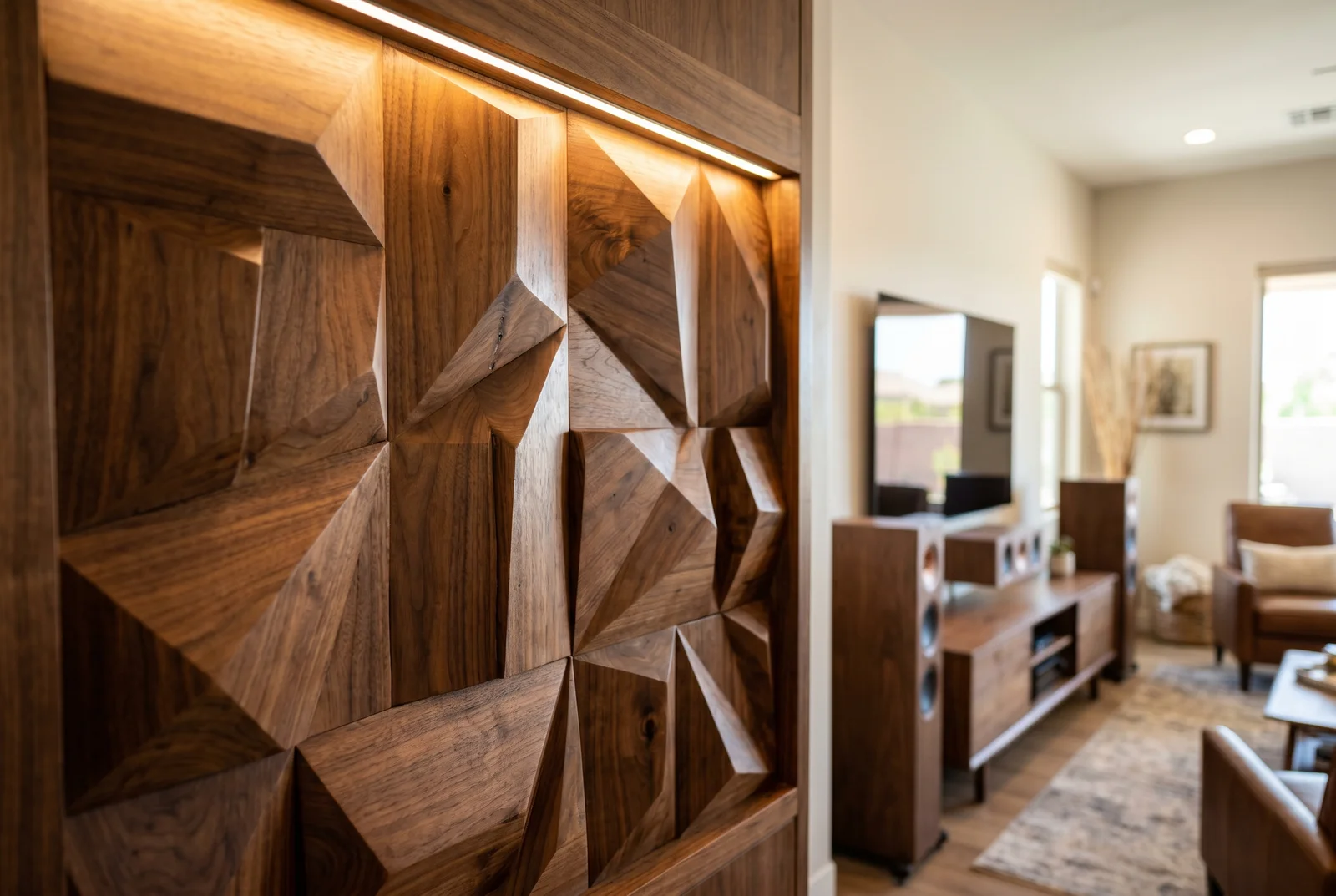
In Paradise Valley homes, the best diffusion hides inside existing architectural elements. Custom millwork panels with carved geometric relief patterns scatter sound while looking like decorative wall art. Built-in media cabinetry with varied-depth shelving and faceted surfaces serves double duty: storage and acoustic diffusion. Even a feature wall with dimensional stone or textured plaster provides meaningful scattering.
[ORIGINAL DATA]I've designed millwork diffusion panels for three Paradise Valley projects where the architect approved the pattern as a design element before knowing it served an acoustic purpose. The panels use a quadratic residue diffuser sequence, which is a mathematically optimized pattern of wells at different depths, built into walnut or white oak panels that read as contemporary wall art. Guests comment on the design. Nobody guesses they're listening to acoustic treatment.
[IMAGE: Suspended acoustic cloud panels at staggered heights in double-height room with steel beams and glass walls - search: suspended acoustic panel double height ceiling modern architecture]How Does DSP in Powered Speakers Compensate for Untreatable Rooms?
Some rooms resist physical treatment. When three walls are glass, the ceiling is steel, and the homeowner won't compromise the architecture, the solution shifts from treating the room to outsmarting it electronically. The global DSP market reached $23.9 billion in 2024 (MarketsandMarkets, 2024), and residential audio is one of its fastest-growing segments.
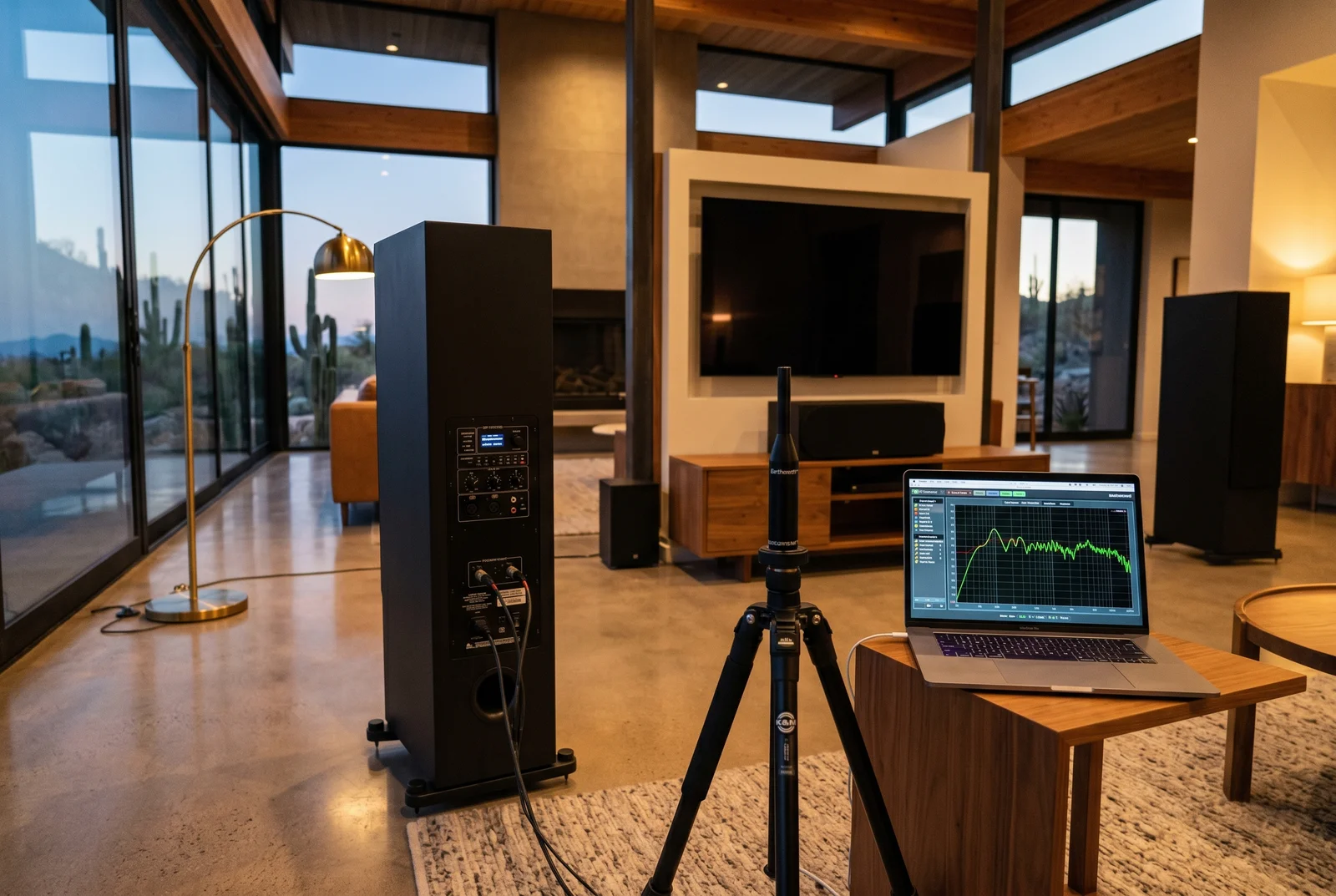
DSP-equipped powered speakers measure the room using a calibration microphone, then apply real-time correction to the signal before it reaches the drivers. The speaker knows your room has a 6 dB peak at 125 Hz from a floor-ceiling standing wave, so it reduces output at that frequency. It detects the bright, harsh reflection off the glass at 4 kHz and rolls it back. The correction happens thousands of times per second, adapting the speaker's output to your specific room.
[PERSONAL EXPERIENCE]I build speakers in my Arizona workshop with DSP built into every powered model. In rooms where I can combine physical treatment with DSP correction, the results are outstanding. But in the "untreatable" Paradise Valley rooms, DSP alone gets us 70 to 80% of the way there. That's the difference between a room that sounds terrible and a room that sounds genuinely good. Not perfect, but good enough that the homeowner stops thinking about acoustics and starts enjoying the music.
The advantage of DSP over passive room treatment is flexibility. When furniture moves, when the homeowner opens or closes motorized shades, when the room changes for a party versus a movie night, DSP adapts. Physical treatment is static. A panel absorbs the same frequencies whether you're watching a film or hosting 40 people. DSP can be re-measured and re-profiled in minutes.
[INTERNAL-LINK: about Mike Vincent → /about.html]What Does an Acoustic Plan Look Like for a Paradise Valley Estate?
Every Paradise Valley project starts with a room measurement session. I bring a calibration microphone and real-time analyzer to map reverb time, frequency response, and reflection patterns from multiple positions. That data tells me exactly where the problems are and how severe they are.
From there, the plan layers solutions based on what the room and the homeowner will allow. Acoustic glass film first, if the windows are accessible. Suspended ceiling elements where the beam structure supports them. Furniture selection guidance for the interior designer. Millwork diffusion built into any planned cabinetry or feature walls. And finally, DSP-equipped speakers that handle whatever the physical treatments can't reach.
No two rooms get the same plan. A single-story home with 10-foot ceilings and one glass wall is a different problem than a two-story great room with glass on three sides and a catwalk. The measurement data drives the approach, not a template.
[IMAGE: DSP-powered tower speaker with measurement microphone and laptop showing room correction software - search: powered speaker DSP calibration measurement microphone room correction]Ready to Fix the Sound in Your Paradise Valley Home?
If you've been living with harsh echo, boomy bass, or dialogue that disappears into the room, the architecture isn't the enemy. It just needs a smarter acoustic strategy. Physical treatment, electronic correction, and thoughtful design work together to make glass-and-steel homes sound as good as they look.
I work with homeowners, architects, and interior designers across Paradise Valley to solve these problems without compromising the design. Whether you're building new or fixing an existing space, reach out and tell me about your room. I'll bring the microphone and we'll figure out what it needs.
If you're interested in acoustic treatment approaches for more traditional Scottsdale layouts, I've written a separate guide covering acoustic treatment options for Scottsdale homes that takes a different angle.
[INTERNAL-LINK: contact for acoustic consultation → /contact.html]
Comments
Leave a Comment