
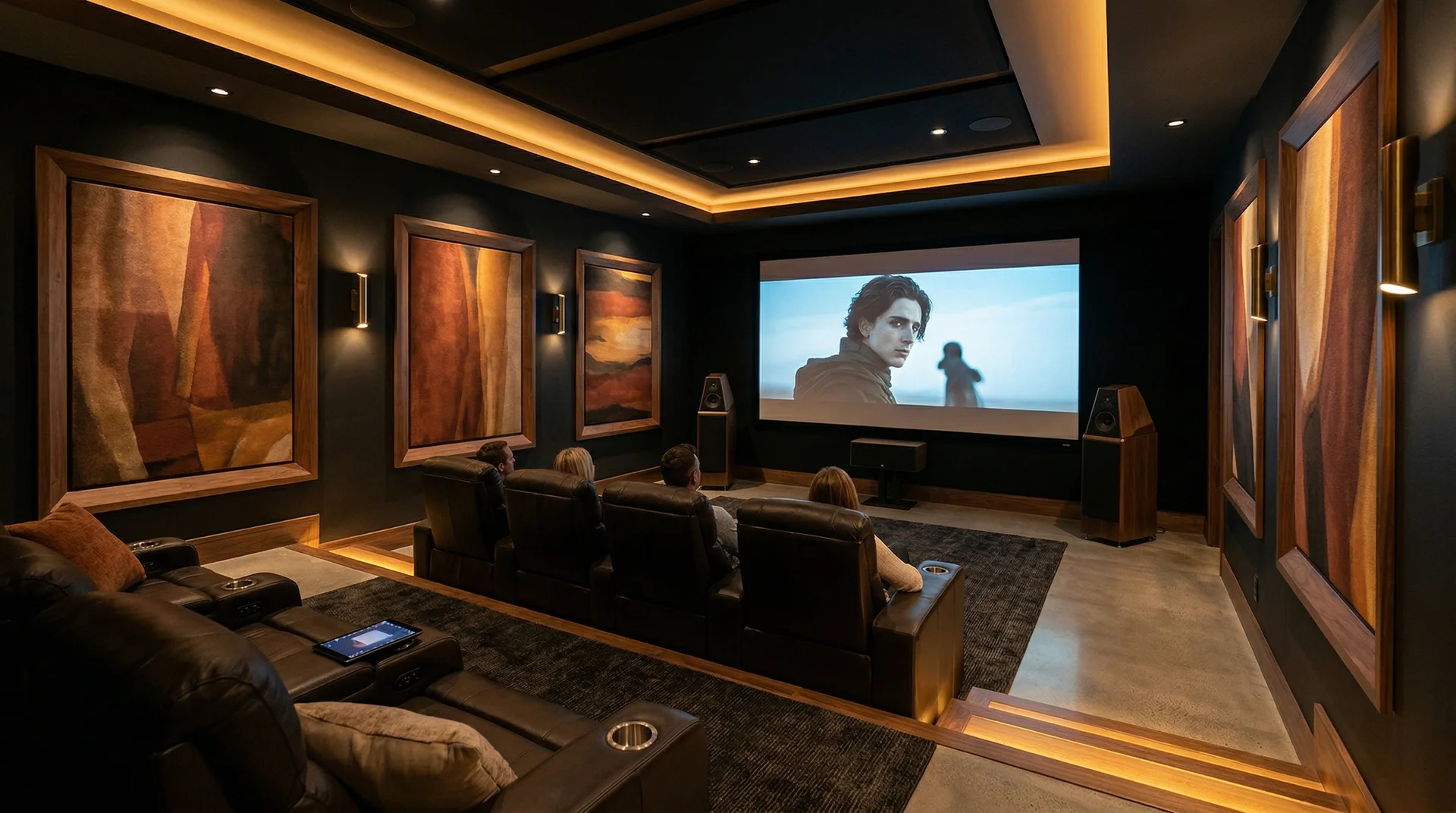
Acoustic treatment doesn't have to look like a recording studio. In Scottsdale's luxury homes, fabric-wrapped panels, wood slat diffusers, and hidden bass traps control sound while complementing the interior design. Here's how it works.
Acoustic treatment is what separates a room that looks like a theater from one that actually sounds like one. In Scottsdale homes, where tile floors, glass walls, and vaulted ceilings are standard, untreated rooms create harsh reflections and muddy bass that no amount of speaker quality can fix. The good news: treatment doesn't have to look like a recording studio. It can look like your interior designer picked it out, because in many cases, they did.
The global home theater market hit $13.67 billion in 2025 and is projected to reach $28.29 billion by 2034 (Fortune Business Insights, 2025). That kind of growth means more homeowners are investing in dedicated rooms. But the ones getting real results are treating the room itself, not just filling it with expensive gear.
What Does Acoustic Treatment Actually Do in a Home Theater?
Acoustic treatment controls how sound behaves after it leaves your speakers. According to ASTM C423 standards, an ideal home theater targets an RT60 (reverberation time) of 0.2 to 0.4 seconds. Untreated rooms typically measure 1.0 to 2.0+ seconds, meaning sound bounces around five to ten times longer than it should.
That excess reverberation smears dialogue, bloats bass, and kills the precision of a well-designed speaker system. I build custom speakers with tight driver alignment and controlled dispersion. If the room fights those speakers with hard parallel surfaces and unchecked reflections, you're hearing the room, not the system.
Treatment falls into three categories: absorption (panels that soak up excess energy), diffusion (surfaces that scatter sound evenly), and bass management (traps that tame low-frequency buildup in corners). A proper theater uses all three. The trick in a luxury Scottsdale home is making each one invisible.
Why Do Scottsdale Homes Need Special Attention for Acoustics?
U.S. homeowners are expected to spend a record $524 billion on remodeling in early 2026 (Harvard JCHS, 2025). Much of that money goes into high-end finishes that happen to be acoustically terrible. Scottsdale's desert modern style is the perfect storm.
Polished concrete. Floor-to-ceiling glass. Stone accent walls. These surfaces reflect sound almost perfectly, which means they amplify every echo and standing wave in the room. A 20-foot great room in DC Ranch with a tile floor and exposed steel beams can have an RT60 above 2.5 seconds. That's closer to a gymnasium than a theater.
Traditional acoustic foam or industrial panels would clash with a $5 million interior. So I don't use them. Every treatment I specify is selected to complement the existing design, not contradict it.
How Can Acoustic Panels Look Like Art Instead of Studio Gear?
The global wall art market reached $66.89 billion in 2025, growing at 9.39% annually (Fortune Business Insights, 2025). People spend real money on what goes on their walls. Acoustic panels should be part of that conversation, not an afterthought hidden behind it.
Fabric-wrapped acoustic panels are the workhorse. The core is rigid fiberglass or mineral wool, typically 2 to 4 inches thick. The outer wrap can be any fabric the client chooses. I've done Italian linen, cashmere blends, and printed canvas matching the room's color palette. Mounted in beveled hardwood frames, they look like oversized art pieces.
Canvas prints with acoustic absorber behind them are another option. The client picks an image, a landscape, an abstract piece, a family photograph. It gets printed on acoustically transparent canvas stretched over an absorptive core. From three feet away, it's indistinguishable from gallery art. From the listening position, it's killing a first reflection point.
What Are the Best Hidden Treatment Options for Luxury Interiors?
About 54% of U.S. homeowners renovated in 2024, with the top 10% spending $140,000 or more on their projects (Houzz, 2025). At that budget level, visible acoustic treatment isn't acceptable. It needs to disappear into the architecture.
Here's what I use most often in Scottsdale projects:
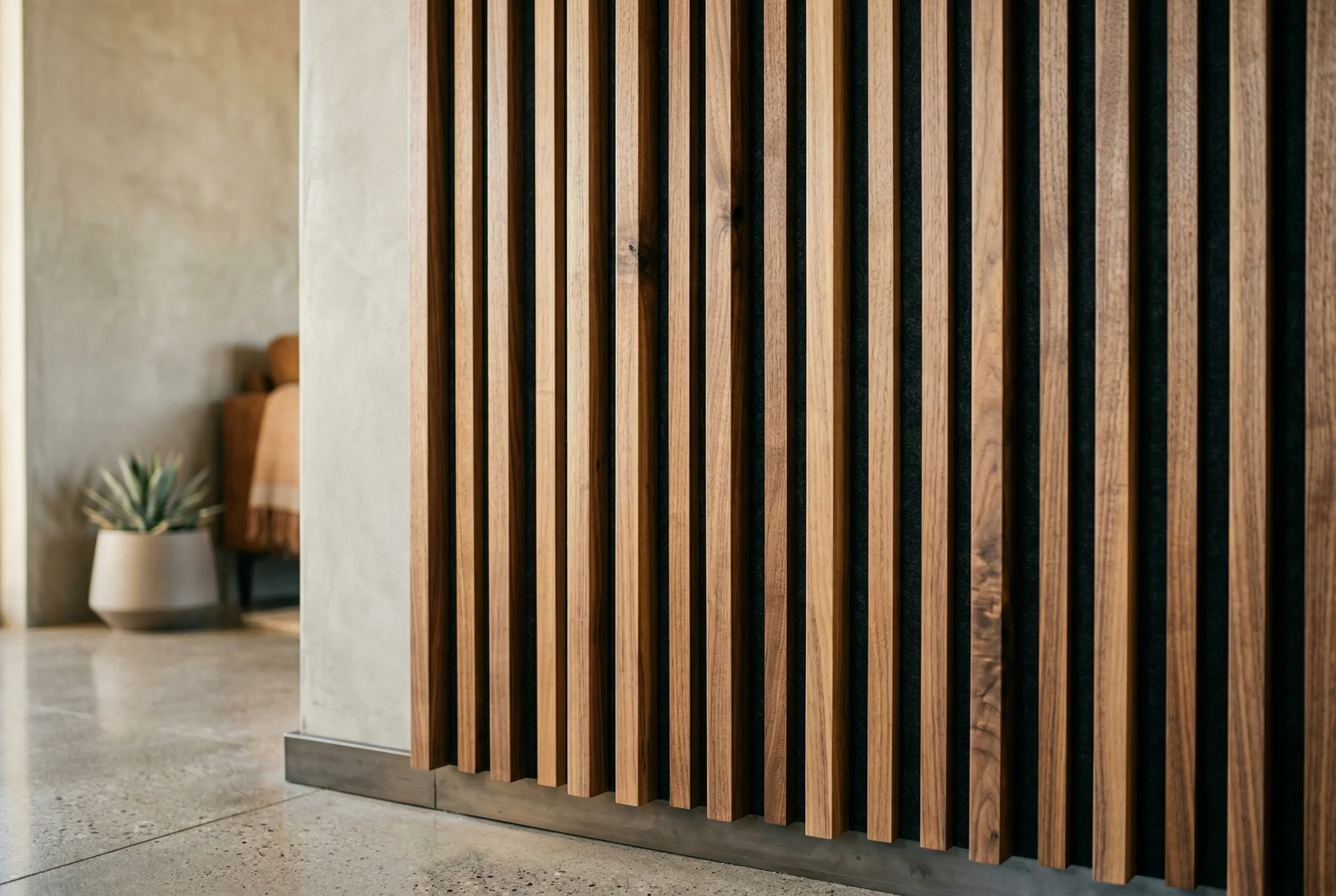
- Decorative wood slat diffusers. Vertical or horizontal hardwood slats over an absorptive backing. They look like a modern accent wall. They function as combination absorber-diffusers that break up flutter echo and scatter mid-high frequencies. Walnut, white oak, and rift-sawn maple are popular in North Scottsdale interiors.
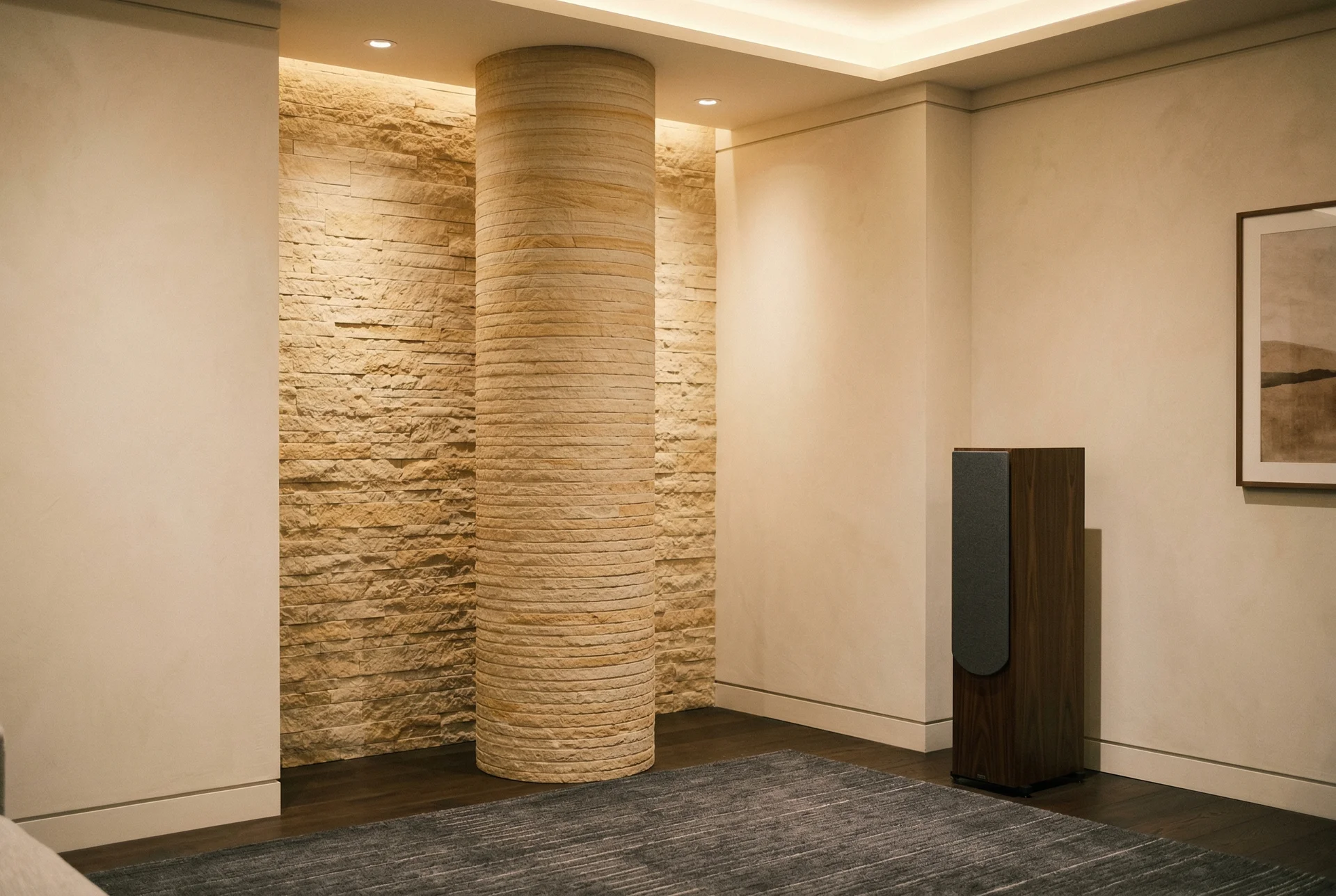
- Corner bass traps as architectural columns. Low-frequency energy piles up in room corners. Cylindrical or rectangular bass traps wrapped in matching wall fabric or clad in the same stone veneer as the room look like structural columns or built-in cabinetry.
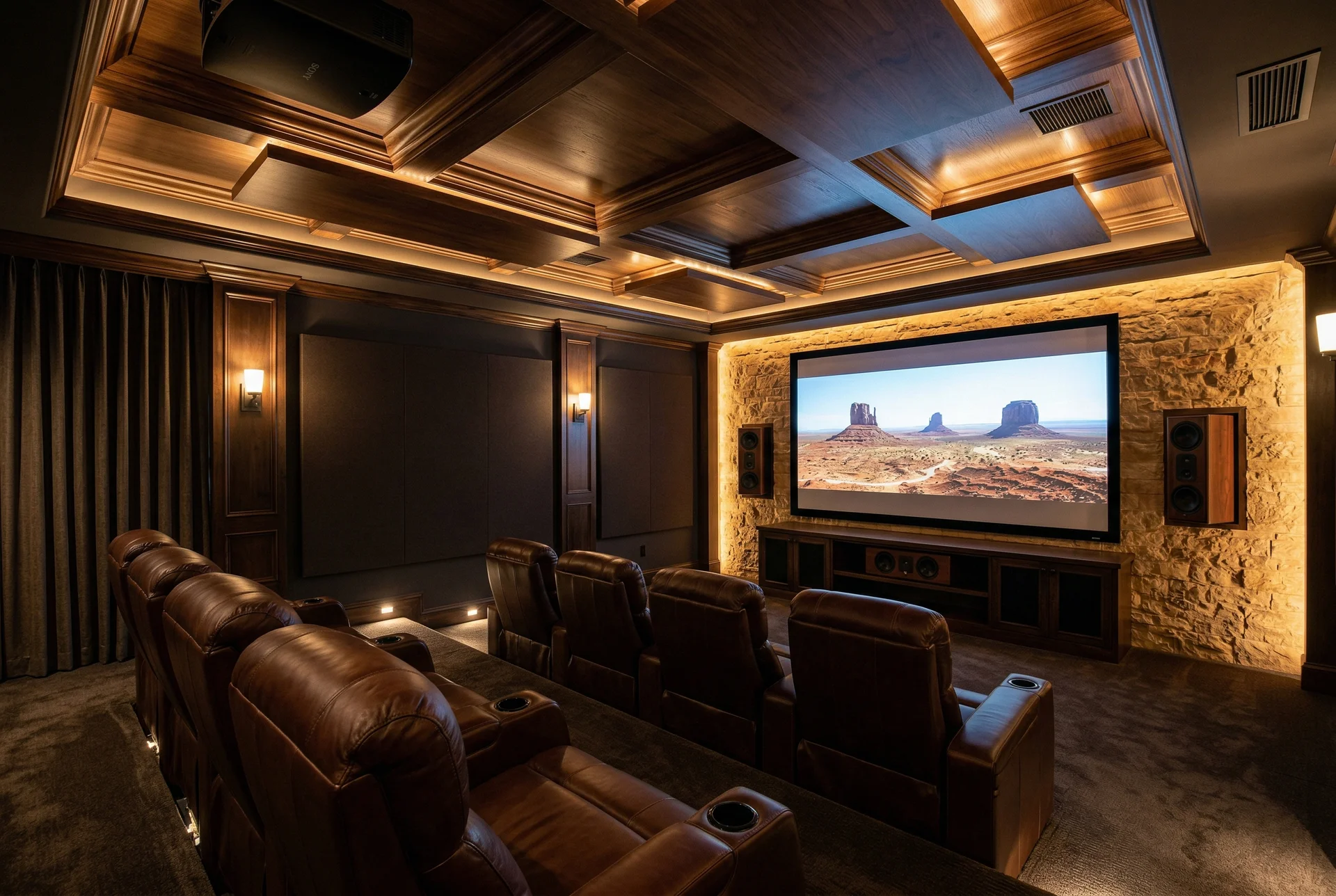
- Ceiling clouds as architectural features. Floating wood panels, coffered ceiling inserts, or suspended fabric panels handle first-reflection points overhead. In a Troon or Silverleaf theater, these get finished to match the ceiling detail, so they read as intentional design elements.
- Acoustic treatment behind perforated surfaces. Perforated leather, metal mesh, or woven fabric wall coverings installed over absorptive material. Sound passes through the perforations and gets absorbed. The visible surface is pure interior design.
- Heavyweight acoustic drapery. Triple-layered curtains in fabrics like mohair velvet or wool blend serve double duty as light control and broadband absorption. They're especially effective on glass walls, which are common in desert modern architecture.
What Are First Reflection Points, and Why Do They Matter Most?
Not every wall needs treatment. The most critical surfaces are first reflection points, the spots where sound bounces off a wall or ceiling and reaches your ears within milliseconds of the direct signal. Treating these few locations delivers roughly 80% of the acoustic improvement in most rooms.
I find first reflection points using the mirror trick during the measurement phase. Someone holds a mirror flat against the wall while I sit in the primary listening position. Anywhere I can see a speaker in the mirror is a first reflection point. It's simple, it's accurate, and it tells me exactly where panels need to go.
In a typical Scottsdale theater room, that means two to four wall panels, one or two ceiling panels, and bass traps in the front corners. That's it. Not floor-to-ceiling foam. Not a padded cell. Targeted treatment at the points that matter, finished to match the room.
How Does the Measurement and Design Process Work?
Nearly 69.5% of custom integration projects now include multipurpose rooms (CE Pro, 2025). That statistic matters because multipurpose spaces, a media room that's also a lounge, a great room that doubles as a listening room, require more careful treatment design than a sealed box.
My process starts with a site visit and room measurements. I use a calibration microphone and measurement software to capture the room's frequency response, RT60 at multiple positions, and reflection mapping. This gives me hard data, not guesswork, on where the problems are.
From those measurements, I create a treatment plan that specifies panel type, thickness, and placement for every surface that needs attention. If the client has an interior designer, and most Scottsdale clients do, I work directly with them on materials. I handle the acoustic specifications. They handle the aesthetic choices. We both sign off before anything goes on a wall.
The measurement process also calibrates the speaker system itself, dialing in crossover points, delay times, and equalization to work with the treated room rather than fighting the untreated one.
Working With Scottsdale Interior Designers
This is where most audio companies drop the ball. They show up after the designer is done, slap foam panels over the finished surfaces, and wonder why the client is upset. I've been collaborating with designers in the Scottsdale and Paradise Valley market long enough to know that acoustic treatment has to be part of the design conversation from the start.
During new construction or major remodels, I provide acoustic specifications early, before drywall goes up. That gives the design team time to integrate treatment into the room's material palette. Want the absorption panels in the same fabric as the sectional? Done. Want the bass traps clad in the room's stone accent? We can do that.
For finished rooms, I bring fabric samples, wood species options, and finish mockups so the designer can approve everything before fabrication starts. Speaker builds take 6 to 12 weeks or more. Treatment fabrication runs on a similar timeline. Coordinating both with the design schedule prevents surprises. See our process for how a typical project comes together.
If you're building or renovating a theater room in Scottsdale and want it to sound as good as it looks, I'd like to hear about the project. Every room is different, and the treatment plan should be too. Get in touch and we'll start with a conversation about your space.
Comments
Leave a Comment