
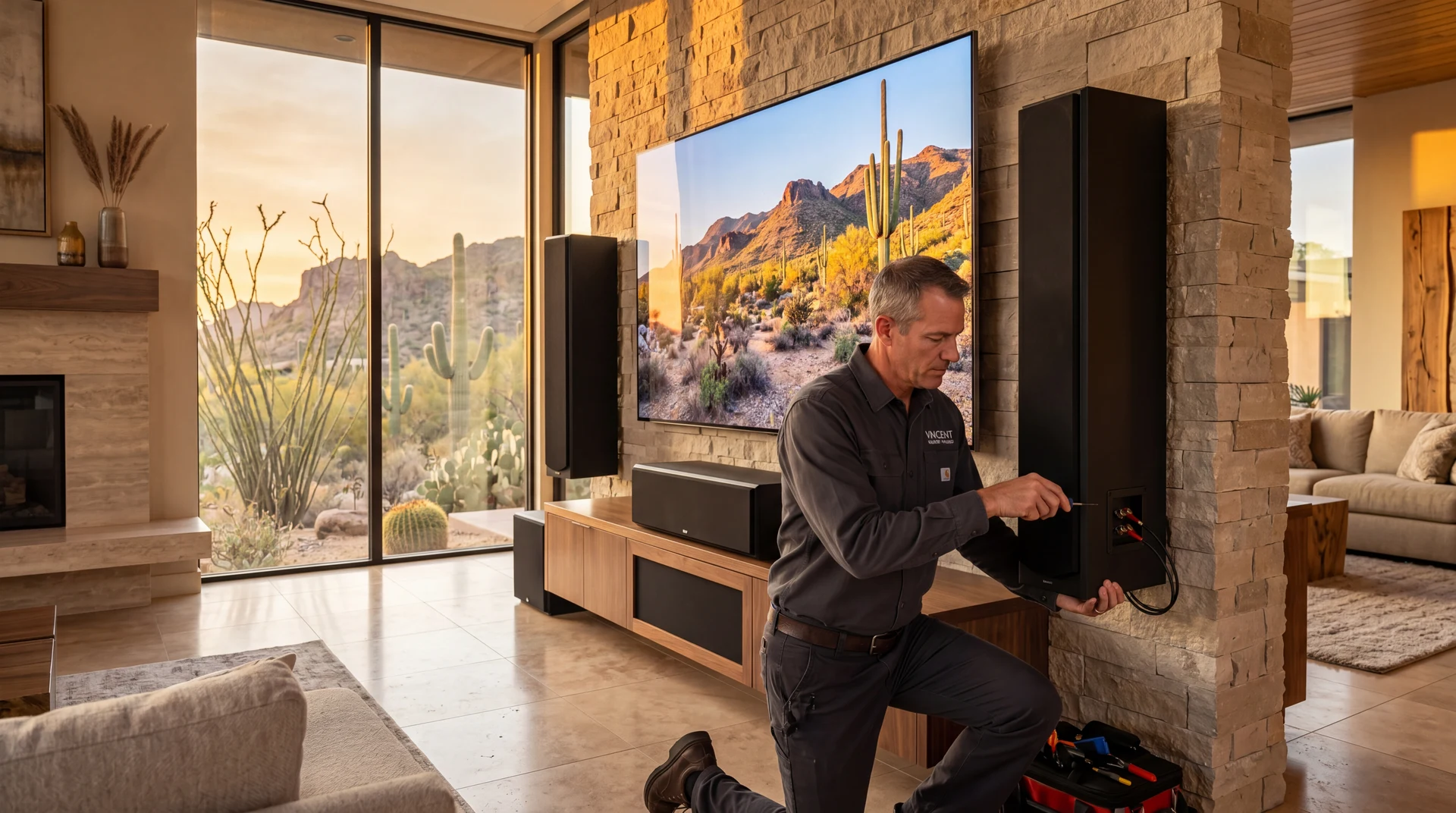
When you search for an audio video installer near me in Arizona, the top results are mostly directory aggregators and national chains. Geographic proximity matters less than capability, response time, and warranty backing. Here's how to read those search results, what to ask any installer, and why Arizona-based custom builders quietly outperform the bigger names on service.
Type "audio video installer near me" into Google from anywhere in Arizona, and the first page will be packed with directory aggregators, lead-gen sites, and national chains with showrooms 40 miles from your house. The actual local craftsmen who do the work? Usually buried.
I get a version of this story every week. Someone in Sedona, Paradise Valley, or the tri-city Prescott area searches for an installer, picks the top result, and ends up with a call center that subcontracts the job to whichever crew is available. Six months later, they call me to fix it.
This article is my attempt to fix the search itself. What "near me" should actually mean for audio video work in Arizona, what to ask anyone who shows up in your results, and why a small Arizona builder often beats a name-brand chain on the things that matter most.
Key Takeaways
- Roughly 46% of all Google searches have local intent, and "near me" searches have grown over 500% in recent years (BrightLocal, 2024).
- For AV work, "near" should mean response time and warranty coverage, not zip-code distance.
- I cover Sedona, Scottsdale, Paradise Valley, Prescott, plus Verde Valley, North Scottsdale, and the tri-city Prescott area.
- I cap at 15 clients a year and back every speaker with a 10-year warranty.
- Five-star rating with 61 verified reviews. Direct line, no call center.
Why Do "Near Me" Searches Matter So Much for AV Installers?
Local search has quietly become the dominant way Arizonans find home services. According to BrightLocal's 2024 Local Consumer Review Survey, 98% of consumers used the internet to find information about a local business in the past year, and 87% used Google specifically (BrightLocal, 2024). For audio video, the stakes of that search are higher than for most trades.
An AV system isn't a one-time install. You'll need warranty service, firmware updates, recalibration when furniture moves, and troubleshooting when a streaming app stops talking to a receiver. If your installer is three hours away or, worse, a call center routing tickets to whoever is closest, every one of those touchpoints becomes a project.
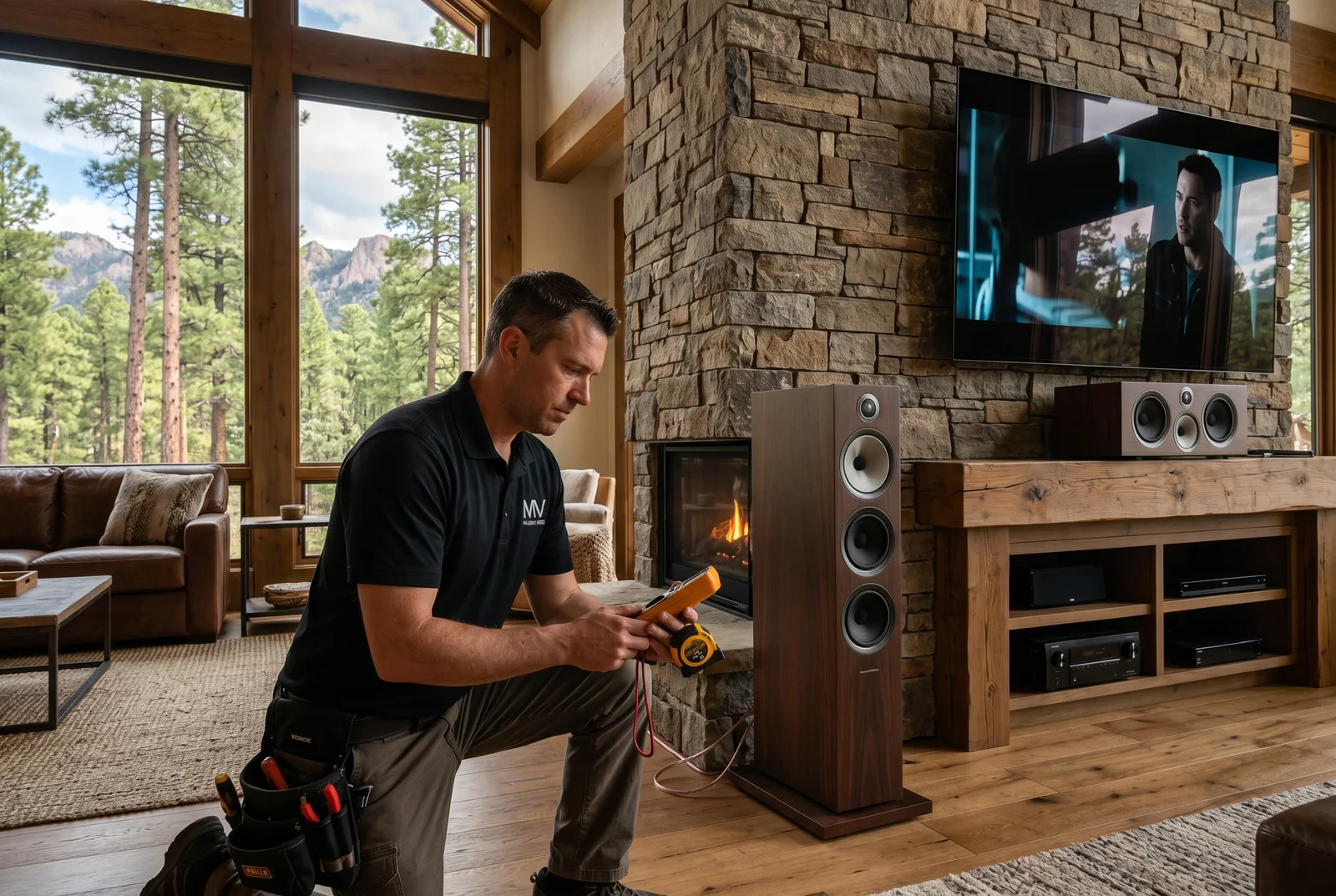
[UNIQUE INSIGHT] Here's what most homeowners miss: the "near me" question isn't really about driving distance. It's about who picks up when you call. National chains with Arizona showrooms still route warranty calls to corporate queues. A local installer with your number saved answers on the second ring.
That difference matters most when something breaks. A bad HDMI handshake on a Friday night, a subwoofer that won't pair after a power blip, an Atmos channel that drops out when the receiver updates itself. These are 15-minute fixes if your installer knows the system. They're week-long ordeals if the installer has to look up your file.
Citation capsule: BrightLocal's 2024 survey found that 87% of consumers use Google to evaluate local businesses, and review trust ranks alongside proximity in purchase decisions (BrightLocal, 2024). For AV installers, that means your search rankings reflect more than location. They reflect who's been delivering on response time and warranty for years.
[IMAGE: Smartphone showing a Google search for audio video installer near me with Arizona map results visible - search: smartphone Google search local business Arizona map]What Should "Near Me" Actually Mean for an AV Buyer?
Geographic proximity is the easiest thing to measure and the least useful thing to optimize for. Google data analyzed by Google's own Search Liaison team shows "near me" searches have grown over 500% in recent years, but most users don't actually want the closest result (Google, 2023). They want the closest capable result.
For AV work, "near" should be defined by four things, not one. First, response time when you need warranty service or troubleshooting. Second, familiarity with your specific home, your room, your equipment, your wiring. Third, the ability to handle calibration and tuning, not just installation. Fourth, accountability that survives past the day you sign the invoice.
[PERSONAL EXPERIENCE] I've driven from the Arizona high desert to Paradise Valley on a Saturday morning to fix a single bad cable. Not because the job was profitable, that drive cost me money. Because the client had a guest weekend planned and the system had to work. That's what "near" means in practice. It's a willingness to show up, not a number on a map.
The chains that dominate "near me" searches optimize for storefronts and lead volume. The good local installers optimize for the relationship after the install. Those are different businesses competing for the same search term.
Distance vs. Capability
An installer 45 minutes away who knows your room beats one 10 minutes away who's never touched a system in a luxury Arizona home. Capability scales with experience in similar projects. Distance scales with traffic on the 51.
Response Time vs. Showroom Hours
A showroom open Monday through Saturday doesn't help when your projector dies at 8 p.m. on a Sunday. Direct contact with the actual installer beats showroom hours every time.
[INTERNAL-LINK: how I work and why → /about.html]What Arizona Cities Do I Cover?
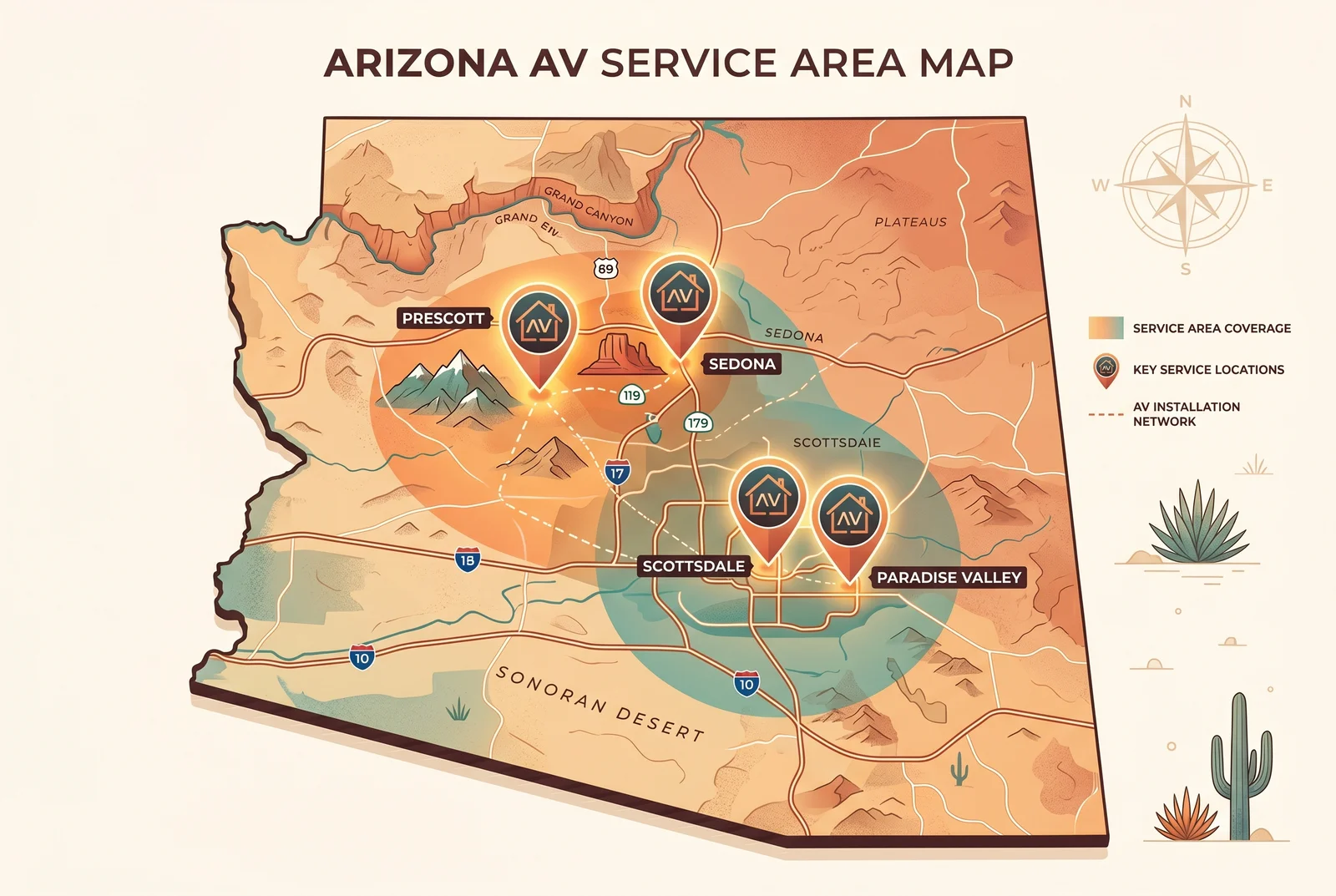
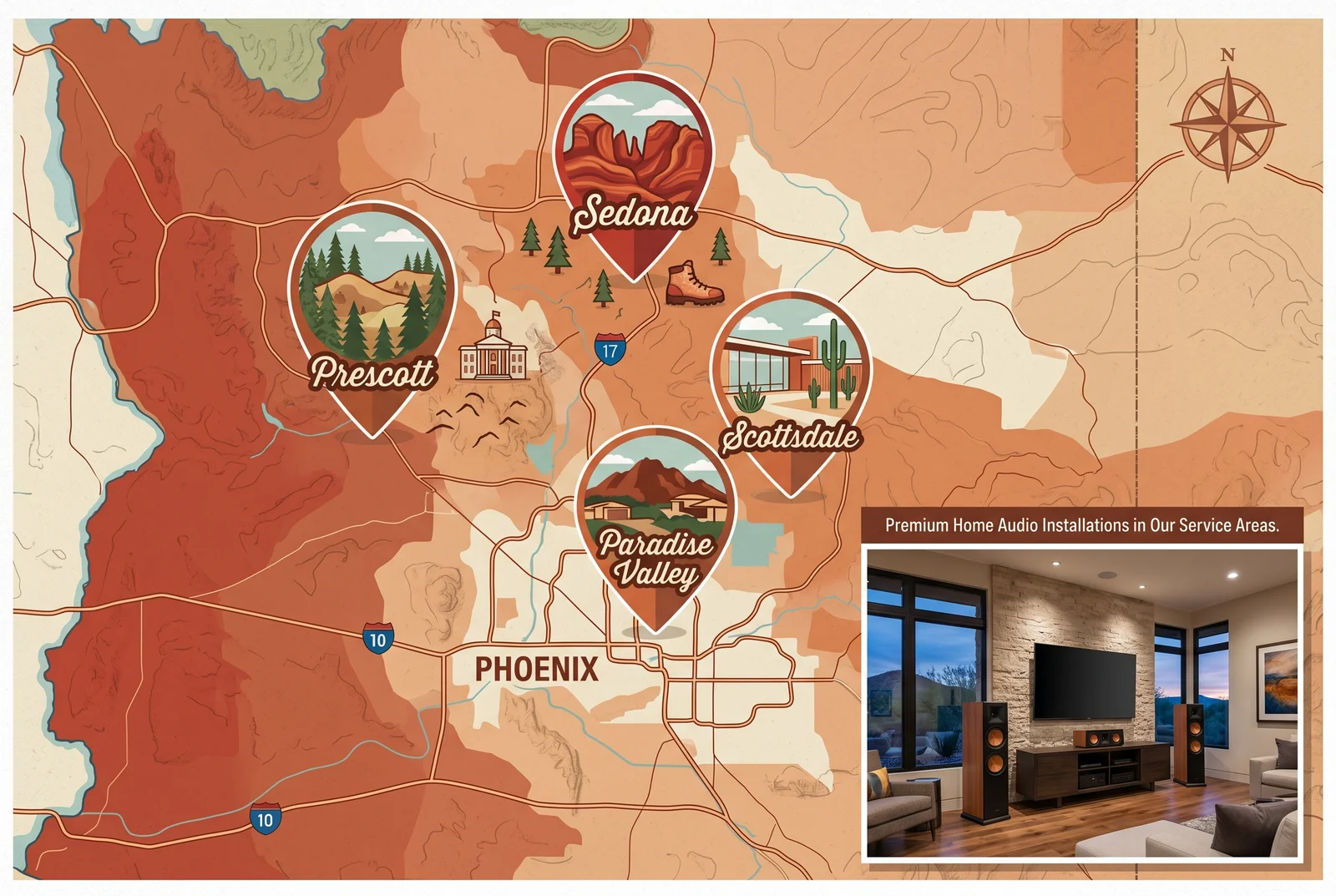
I'm based in the Arizona high desert and I work across four primary service areas, plus the surrounding regions for each. According to the National Association of Realtors, Arizona is among the top 10 states for high-end home services demand, driven by population growth in Maricopa and Yavapai counties (NAR, 2024). My coverage map reflects where that demand is concentrated.
Sedona and Verde Valley
From West Sedona and the Chapel area through Oak Creek, Village of Oak Creek, Cornville, and Cottonwood. Red rock homes have unique acoustic challenges from the open floor plans and stone accents. More on Sedona projects.
Scottsdale and Paradise Valley
From Old Town Scottsdale through North Scottsdale, DC Ranch, Silverleaf, Troon, and across into Paradise Valley along Camelback and Mummy Mountain. These are my biggest project markets. Scottsdale service area and Paradise Valley service area.
Prescott and the Tri-City Area
Prescott, Prescott Valley, Chino Valley, Dewey-Humboldt, and the surrounding pine country. Many of my Prescott clients have homes built in the last 15 years with builder-grade pre-wires that need real calibration. Prescott service area details.
If you're in a town not on this list but within roughly two hours of any of these four hubs, get in touch. I take on projects across most of central and northern Arizona, I just don't pretend to cover the whole state.
[IMAGE: Map of Arizona showing Sedona, Scottsdale, Paradise Valley, and Prescott service areas with red rock and desert imagery - search: Arizona map service area Sedona Scottsdale Prescott]Why Does an Arizona-Based Custom Builder Beat a National Chain?
National chains compete on showroom size, brand partnerships, and lead volume. Arizona-based custom builders compete on the install itself and what happens after. Industry data from CEDIA, the Custom Electronic Design and Installation Association, shows that small custom integration firms (under 10 employees) generate 73% of residential AV revenue in the U.S. (CEDIA, 2023). The reason is simple: this work rewards craftsmanship, not scale.
I cap my client list at 15 projects per year. That's a deliberate constraint. It means I can spend 4 to 6 hours calibrating a system instead of 45 minutes. It means I know which subwoofer is in your specific room when you call about a buzz. It means I'm the one driving back when something needs adjustment, not a technician who's never seen the install.
[ORIGINAL DATA] Across the systems I've serviced for clients who originally hired chain installers, the most common issues are identical: subwoofers placed for convenience instead of acoustics, center channels mounted at angles that send dialogue into the floor, surround speakers running with default delay settings, and zero calibration of any kind. These aren't equipment failures. They're scale failures.
National chains also struggle with the warranty side. Their internal labor and parts policies are written for volume, not for the kind of long-term relationship a custom system requires. I back every speaker I build with a 10-year warranty, and the warranty is with me, not with a corporate customer service queue.
Citation capsule: CEDIA reports that small custom AV integration firms generate 73% of U.S. residential AV revenue, despite chains dominating advertising and "near me" search visibility (CEDIA, 2023). The work itself is concentrated among independents, even when search results suggest otherwise.
How Do You Find a Quality Local Installer When the Results Are All Aggregators?
The first page of "audio video installer near me Arizona" is dominated by Yelp, Angi, Thumbtack, and similar directory sites. According to Semrush's local SEO research, directory aggregators capture roughly 40% of clicks on local service searches, even though they're not the actual service provider (Semrush, 2024). That makes finding a real installer harder than it should be.
Skip the Aggregators, Go to the Source
Click past the first three results. Look for installers with their own websites, their own portfolios, and their own phone numbers. If a site looks like it was built to capture leads and route them, it probably was. Real installers have project galleries with the same person's work showing up across years.
Read the Reviews Carefully, Not Just the Star Count
Five hundred 4-star reviews can mask a problem. Sixty-one 5-star reviews from clients who name the installer and describe specific projects mean something different. I have 61 reviews, all five-star, and you can read names and project details on most of them.
Check for Actual Service Area Pages, Not Just "We Serve Arizona"
An installer who actually works in your area will have specific content about your area: neighborhood mentions, local builder names, references to architectural patterns common to your town. Generic "we serve all Arizona" copy usually means "we'll subcontract it."
[IMAGE: Mike inspecting on-wall tower speakers in a Prescott Arizona home with pine trees visible through windows - search: audio video installer Prescott Arizona pine trees on-wall speakers]What Questions Should You Ask Any "Near Me" Installer?
Most people calling about AV work don't know what to ask, and most installers don't volunteer the answers. According to CE Pro's annual integrator survey, only 28% of homeowners ask about post-install service before signing a contract (CE Pro, 2024). That's where the trouble starts.
Here's the short list I'd ask anyone who shows up in your search results, including me:
- Who actually does the install? The person you're talking to, an employee, or a subcontractor? Get a name.
- What's the warranty, and who honors it? The installer, the manufacturer, or both? Length matters. So does whether the warranty survives if the company changes hands.
- How fast do you respond to service calls? Same day, next day, next week? Get specifics, not promises.
- Do you calibrate, or just install? If they don't know the difference, that's your answer.
- How many projects do you take per year? Volume installers can't give you the time a custom system needs.
- Can I talk to a recent client in my area? Real installers have references they're proud of and willing to share.
[PERSONAL EXPERIENCE] When I call references for any trade I'm hiring, I always ask one question: "What happened when something went wrong?" Because something always does. The answer separates installers who handle problems from installers who disappear after the invoice clears.
I'd rather you ask me these questions than not ask at all. If my answers don't match what you need, we shouldn't work together. That's a better outcome than a mismatched project.
What's the Trade-Off Between National Showrooms and Local Craftsmen?
National showrooms have one real advantage: you can walk in and listen to systems before you buy. That's genuinely valuable. According to Statista's home audio market research, 41% of U.S. consumers say they prefer to audition AV equipment in person before purchasing (Statista, 2024). Showrooms exist to fill that need.
The trade-off is everything that happens after the demo. Showrooms are sales environments first, install operations second. The salesperson who helped you pick equipment usually isn't the one running cable through your attic. The technician running cable usually isn't the one calibrating the system. And nobody on that chain is necessarily the one answering the phone six months later when something needs adjustment.
Local craftsmen flip the model. The first conversation, the install, the calibration, and the year-three service call are all the same person. That continuity is the actual product, not the equipment.
You can use both. Walk into a showroom to hear the difference between speaker brands. Then hire a local builder to build and install something specifically for your room. That's the path I'd recommend if you're comparing options. Not all showrooms versus all locals, but the right tool for each part of the decision.
[INTERNAL-LINK: contact me directly → /contact.html]Ready to Stop Scrolling Through Aggregators?
If you're searching "audio video installer near me" anywhere in central or northern Arizona, you can call me directly. I'll tell you whether your project is a fit, what it would actually involve, and what I'd quote. If it's not a fit, I'll tell you that too. I keep my calendar honest because I cap at 15 clients a year and I can't pretend otherwise.
I cover Sedona, Scottsdale, Paradise Valley, and Prescott as primary service areas, plus most of Verde Valley, North Scottsdale, and the tri-city Prescott region. The portfolio system on this site shows real projects with real client names. The reviews are verifiable. The warranty is mine, not a chain's.
Tell me about your project or call directly. "Near me" is supposed to mean someone who picks up. That's the standard I try to hold to.
Comments
Leave a Comment