
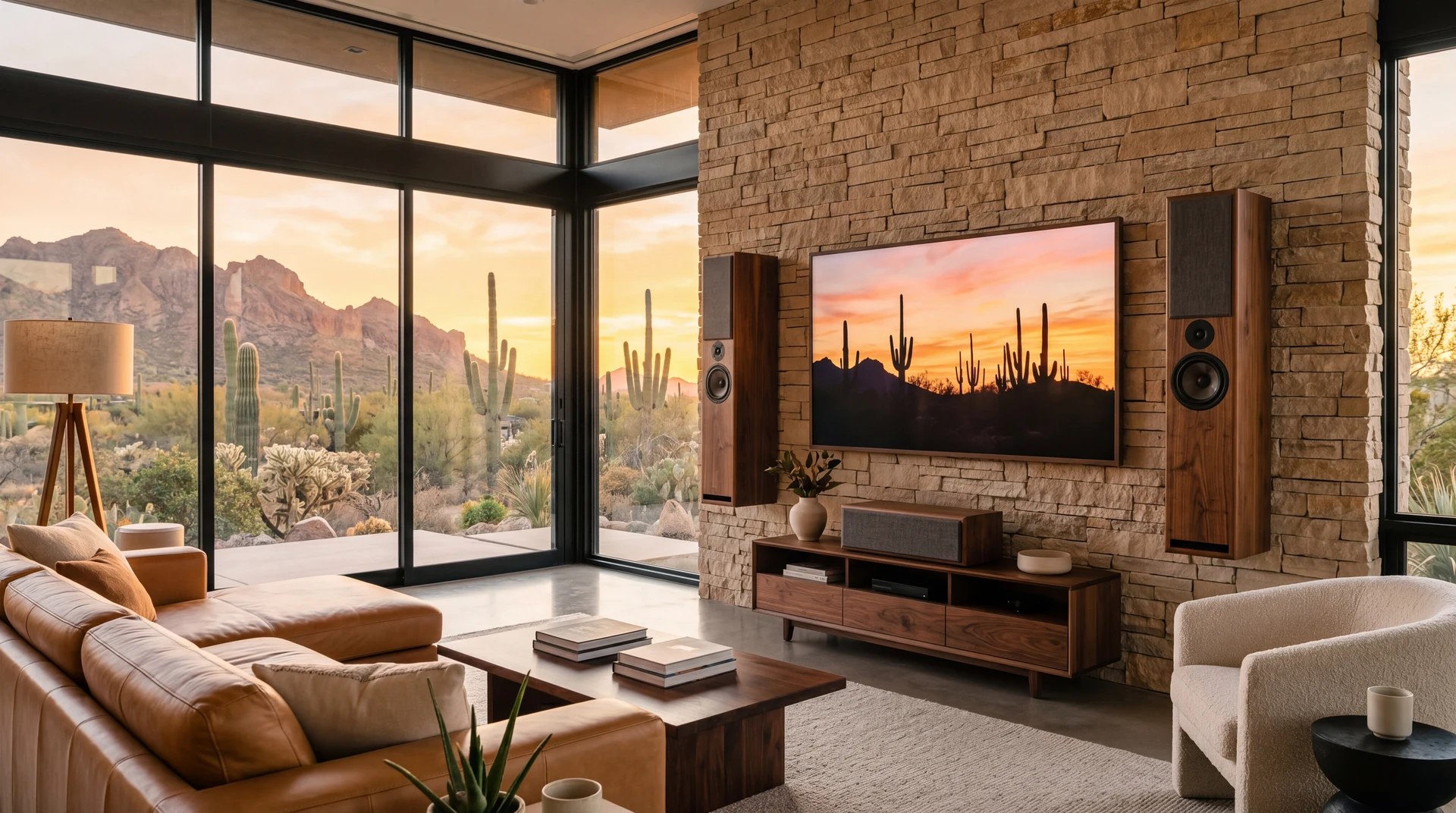
Most homeowners hire a custom installer without understanding what the next two to three months actually look like. Here's exactly what happens from your first phone call through final calibration and beyond, walked through phase by phase the way I run it from my Arizona workshop.
Hiring a custom home theater builder is a real commitment. Two to three months of decisions, deliveries, and dust. Most homeowners I talk to have never been through the process before, so they have no idea what they're signing up for. They just know they want something better than what the big-box installer is offering.
This article walks through my actual build process, phase by phase, from the first phone call through the final calibration session. According to CEDIA's 2024 Integrated Home Market Analysis, the average custom AV integration project runs 8 to 14 weeks from contract to handoff (CEDIA, 2024). My builds typically land in the 6 to 12 week window, depending on cabinet size, finish complexity, and how fast we make decisions together.
I'm Mike Vincent. I build custom speakers and design home theater systems out of my workshop in the Arizona high desert. Here's exactly what happens between your first call and the day I hand you the remote.
Phase 1: The Free Phone Consultation (15 to 30 Minutes)
The first phone call is free, runs 15 to 30 minutes, and decides whether we're a fit. According to a Houzz 2024 Home Renovation Trends study, 71% of homeowners abandon custom AV projects within the first month because of poor early communication (Houzz, 2024). I'd rather find out on the phone than three weeks into design.
Here's what I want to understand on that first call: the room you want to upgrade, what you watch and listen to, what's frustrating about your current setup, and roughly what you're hoping to spend. I'll also ask about timing. Some projects need to land before a holiday or a renovation deadline. Others can breathe.
I've found that the most useful question is also the simplest: "What does success sound like?" Some clients want concert-level impact. Others want crystal dialogue at low volume so they can watch films after the kids are asleep. These are different builds. Knowing the answer up front saves weeks of redesign later.
What you should have ready before calling
Rough room dimensions help. So does a sense of where your seating is, where the TV will live, and whether you've already pre-wired the room. If you have inspiration photos or a list of equipment you already own, send those before the call. The more concrete your starting point, the faster we get to the real conversation.
Citation capsule: CEDIA's 2024 Integrated Home Market Analysis reports that custom AV integration projects average 8 to 14 weeks from contract to handoff, with luxury builds frequently extending past the 12-week mark when cabinet fabrication and finish work are part of the scope (CEDIA, 2024).
[INTERNAL-LINK: contact and schedule a call → /contact.html]Phase 2: The In-Home Demonstration and Site Survey ($250, Credited to Project)
The second step is an in-home demonstration. I bring real reference speakers to your house and play them in the actual room they'd live in. The cost is $250, fully credited back if we move forward. According to CE Pro's 2024 State of the Industry report, 64% of high-end AV buyers cite "hearing the system in their own room" as the deciding factor in choosing an installer (CE Pro, 2024).
This visit accomplishes three things at once. You hear what the speakers actually sound like in your room, not in a showroom. I measure the space (dimensions, ceiling height, reflective surfaces, electrical, existing wiring). And we talk through placement options while standing in the room, which is dramatically more useful than working from photos.
What I measure during the site survey
Room volume in cubic feet. Distance from primary seating to the front wall. Ceiling height and any tray or coffer geometry. Window and glass area. Floor surface. Existing speaker and subwoofer locations if applicable. Power circuit availability near the equipment rack. Cable run paths from rack to each speaker location.
[IMAGE: Mike with measurement tools in a luxury Arizona home, taking room dimensions with on-wall speaker mounted nearby, natural daylight - search: home theater installer measuring room luxury Arizona]If I think the project isn't a fit (room is too small for what you're describing, expectations don't match budget, or the architecture won't support the design), I'll tell you that day. Better to know in week one than week six.
Phase 3: Custom Design Phase (1 to 3 Weeks)
Once we've agreed on direction and signed an agreement, design begins. This phase runs 1 to 3 weeks, with most projects landing around 2. The American Institute of Architects reports that AV-integrated luxury rooms now account for 41% of new high-end residential design projects nationally (AIA, 2025), which means I'm coordinating with architects and interior designers more often than not.
Design starts with CAD modeling of the cabinets. I draw the speakers in 3D so you can see exactly how they'll sit on the wall, how tall the towers will stand next to your seating, and how the proportions work against your TV size. Renderings get revised until the geometry feels right.
Finish selection and sample approval
Wood species, veneer pattern, stain color, grille fabric, and any metal accents get specified during design. I send physical finish samples by mail. Photos lie. Real samples in your actual room lighting tell the truth. If your interior designer has a finish palette they're working from, I match against their samples directly.
[UNIQUE INSIGHT]Here's something most installers won't tell you: the finish phase is where projects stall. Not the build, the finish decision. I've had clients spend three weeks deciding between two stain colors that, in the final product, were practically indistinguishable. I now require finish lock-in before fabrication starts, because a one-week design delay turns into a one-week build delay turns into a missed move-in date.
[INTERNAL-LINK: custom speaker design approach → /custom-speakers.html]Phase 4: CNC Fabrication in Our Arizona Workshop (3 to 6 Weeks)
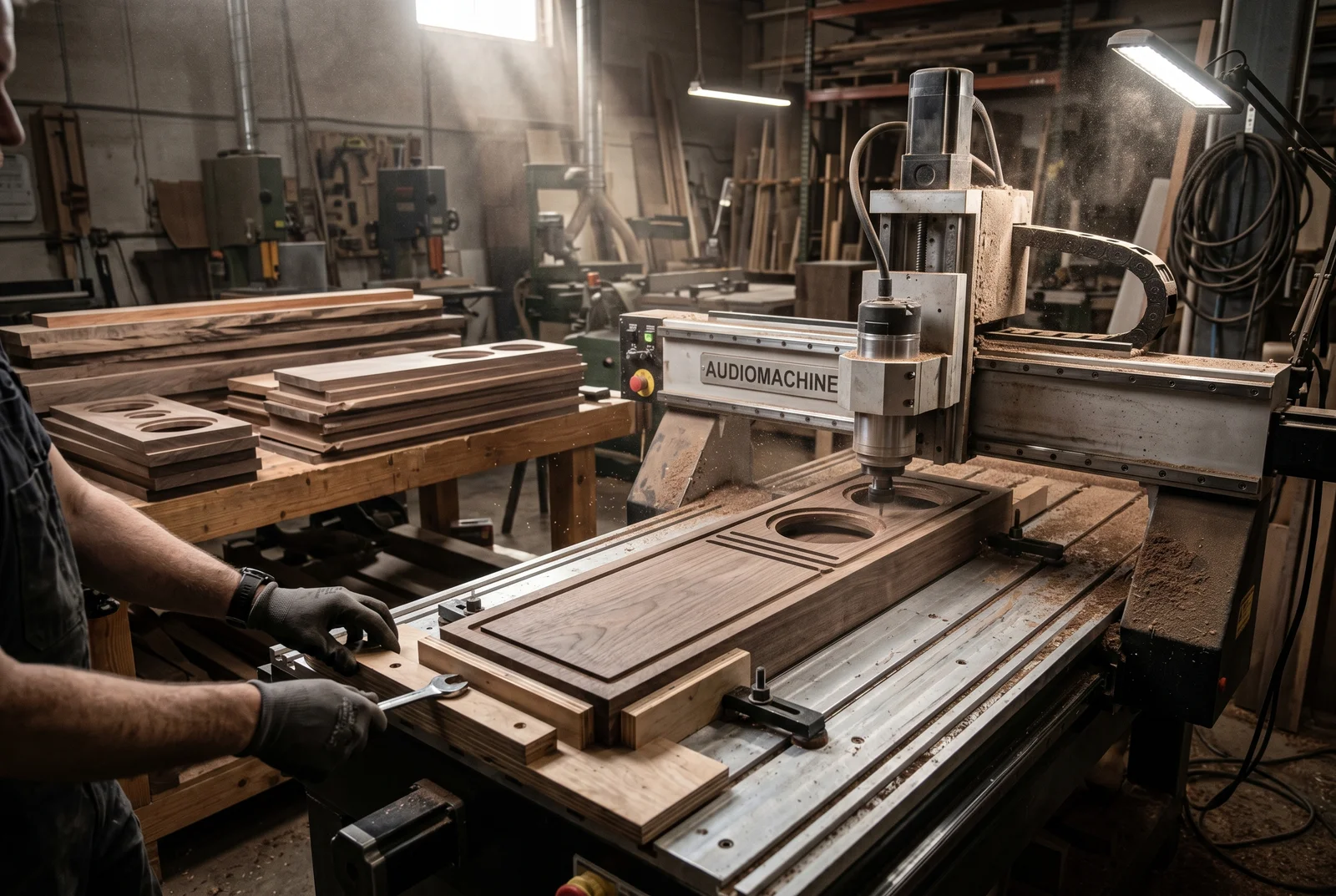
This is the longest phase, and the one most clients underestimate. CNC cabinet fabrication, assembly, sanding, and finishing runs 3 to 6 weeks depending on cabinet size, finish complexity, and how many speakers are in the build. According to a Woodworking Network 2024 industry report, custom hardwood cabinet fabrication averages 4.2 weeks for premium residential projects (Woodworking Network, 2024).
Here's what's actually happening during those weeks. CNC machining of cabinet panels from raw stock. Hand assembly with internal bracing tuned to the speaker's resonant behavior. Multiple rounds of sanding (typically four to six grits). Finish application in stages with dry time between coats. Final hand-polishing of the finish. Hardware fitment. Driver integration prep.
How you follow the build
I don't host workshop visits. The shop is private and the work flow is tight. Instead, you track your build through the online portfolio system. I post photos as your cabinets move through each stage. You see the raw panels, the assembly, the first finish coat, the polished final piece. Most clients tell me this is more engaging than visiting would have been, because they get to watch the process unfold over weeks.
[IMAGE: CNC machine cutting cabinet panels in workshop with sawdust and wood grain visible, focused workshop lighting - search: CNC machining custom speaker cabinet workshop hardwood]Citation capsule: The Woodworking Network's 2024 industry report on premium residential cabinetry found that custom hardwood fabrication for high-end projects averages 4.2 weeks from material selection to finished cabinet, with finish complexity adding 1 to 2 weeks for multi-stage stain and clear coat work (Woodworking Network, 2024).
[INTERNAL-LINK: see real workshop builds → /portfolio/]Phase 5: Driver Integration and DSP Programming (1 Week)
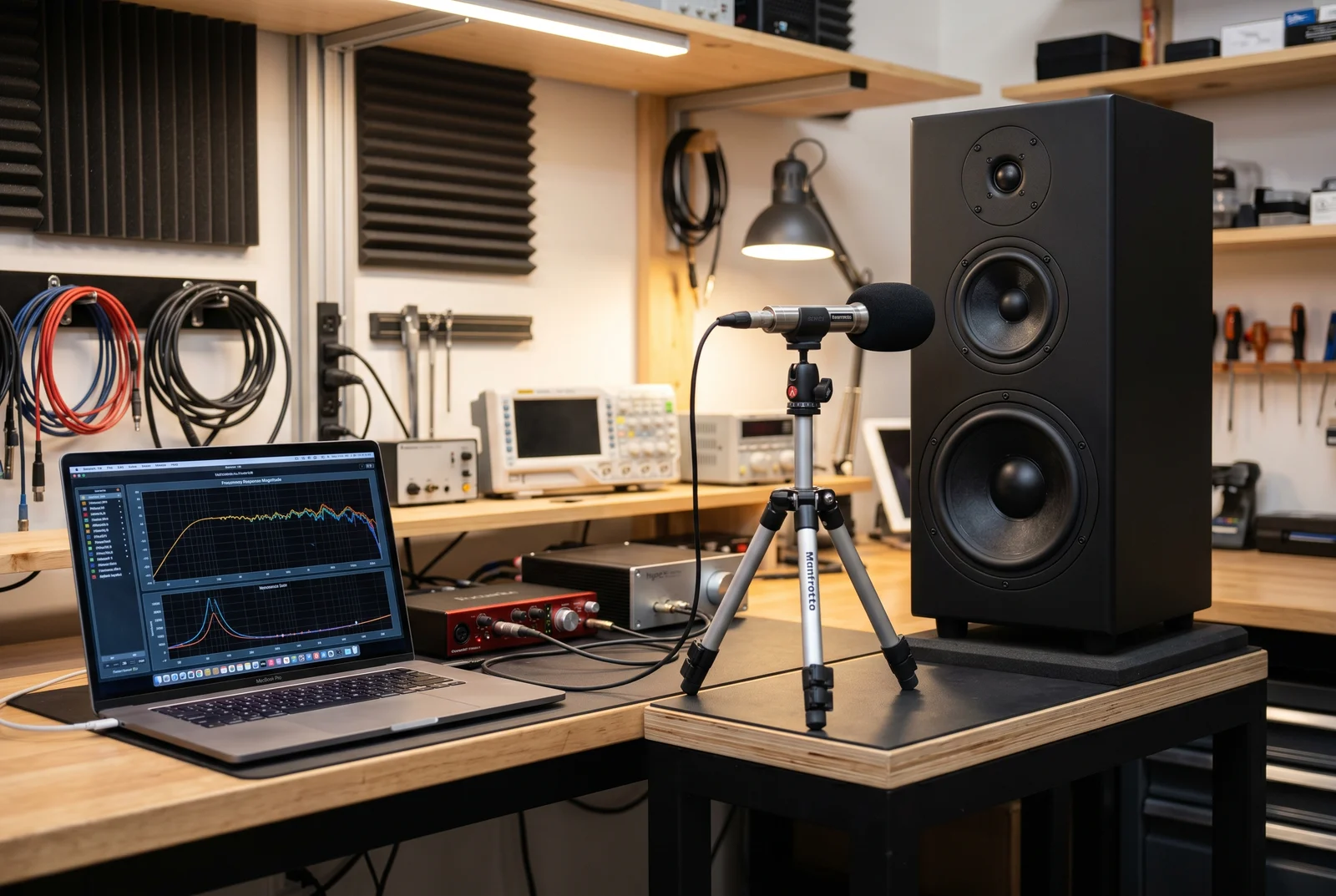
Once cabinets are finished, drivers go in. This phase runs about a week and is entirely bench work. According to Audioholics' 2024 loudspeaker engineering survey, fewer than 12% of custom installers do bench-level DSP tuning before delivery (Audioholics, 2024). I do, because tuning a speaker on a bench in a controlled environment is the only way to know it's right before it hits your room.
Each driver gets installed with the appropriate gasketing, wiring, and bracing. Crossover networks (passive or active depending on the design) get integrated. Then every speaker hits the measurement bench. I run frequency sweeps, distortion measurements, and impedance plots. If a tweeter is out of spec, I find it now, not after it's in your wall.
DSP programming and pair matching
If your build uses active DSP (most of mine do), this is where I program the per-speaker filters. Stereo pairs get matched within 0.5 dB across the audible band. The center channel gets its own profile, tuned for dialogue intelligibility rather than musical balance. Subwoofers get their starting EQ targets set, knowing they'll be re-tuned in your room during calibration.
[IMAGE: Speaker on test bench with measurement microphone and laptop showing frequency response curves, workshop equipment visible - search: speaker measurement bench testing audio engineering frequency analyzer]Phase 6: Installation Week (1 to 3 Days On-Site)
Installation week is the most visible phase but actually one of the shortest. Most installations run 1 to 3 days on-site depending on complexity. The CEDIA 2024 Labor Standards report sets the average residential AV installation at 2.4 days for projects with 5 to 9 speakers (CEDIA, 2024). Mine track right against that average.
Day one is typically rough installation. Speaker mounts, cable pulls (or termination if pre-wire is in place), equipment rack assembly, and source component placement. Day two is integration and test fire. Every cable gets traced and labeled. Every speaker gets confirmed for polarity and channel assignment. The system gets powered up for the first time in your room.
What clean cable management actually means
I don't leave wires hanging. Cable runs go inside walls, under floors, or through purpose-built raceways. Equipment racks get fully terminated with labeled cables, service loops, and clean dressing. The back of your rack should look as intentional as the front. If a future tech ever has to service the system, they should be able to read the wiring at a glance.
[PERSONAL EXPERIENCE]I've walked into too many builder-installed systems where the rack looked like a bird's nest. Service calls on those systems take three times as long because nothing is labeled. Spending an extra two hours on day two to dress cables properly saves dozens of hours over the life of the system.
Phase 7: Manual Calibration (4 to 6 Hours)
Calibration is where the system goes from working to sounding right. CEDIA field data indicates 87% of audio quality issues in luxury homes trace back to setup, not equipment (CEDIA, 2024). My calibration sessions run 4 to 6 hours and are entirely manual, no auto-calibration shortcuts.
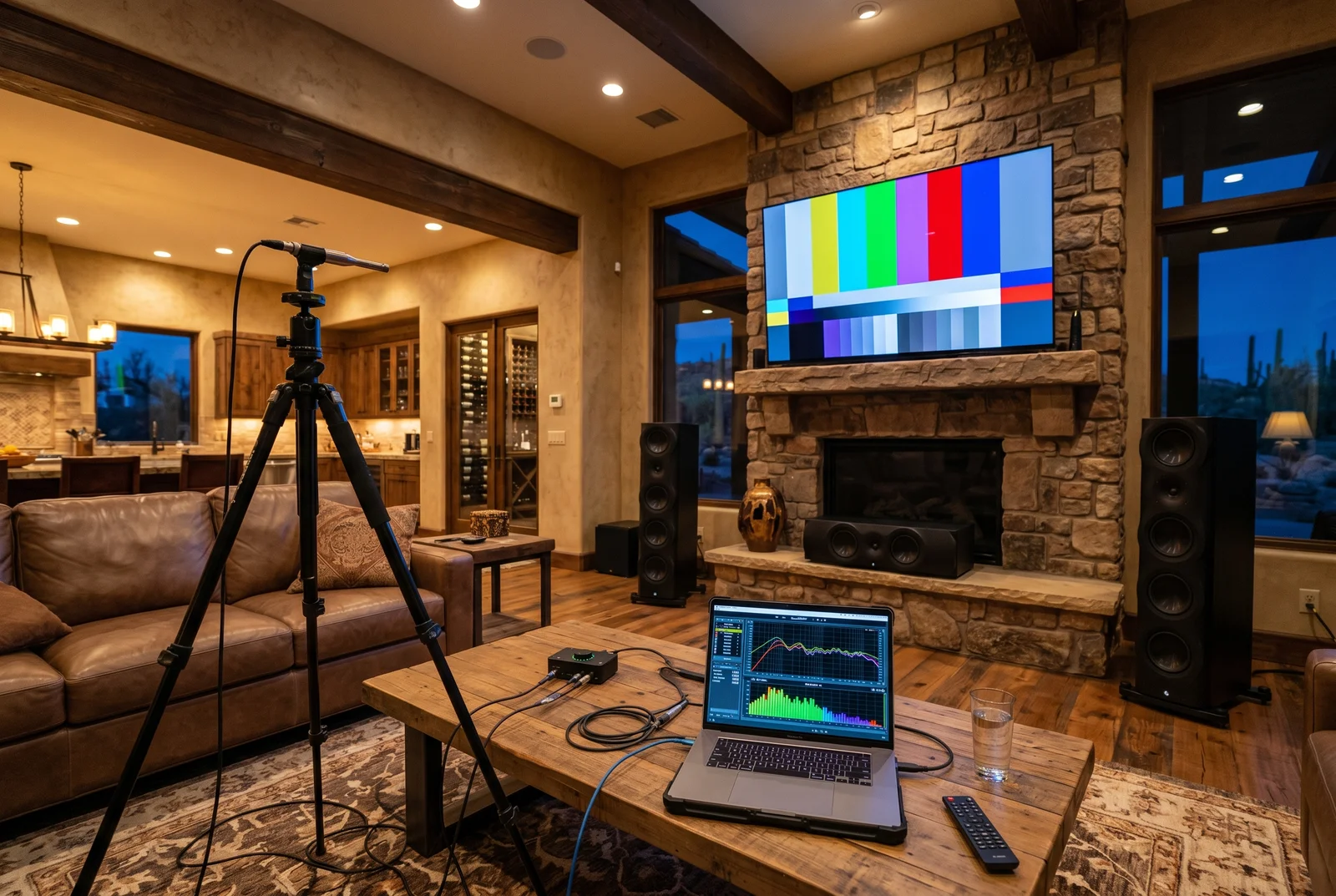
I set up a measurement microphone on a tripod at the primary listening position and run through a structured sequence. Speaker level matching using pink noise and an SPL meter. Distance and delay calibration so every channel arrives at your ears at the same time. Per-driver EQ adjustments based on real-time analyzer (RTA) measurements. Subwoofer phase, level, and crossover tuning against actual room response.
Why I don't trust auto-calibration in oversized rooms
Auto-calibration is built around assumptions that fall apart in luxury Arizona homes. Vaulted ceilings, stone fireplace walls, expansive glass, and 25-foot listening distances are not in the auto-cal training data. I take measurements from 6 to 10 listening positions in larger rooms to build a complete acoustic picture, then make adjustments that an algorithm couldn't.
[IMAGE: Calibrated measurement microphone on tripod in luxury Arizona living room with on-wall tower speakers, laptop showing RTA curves on coffee table - search: home theater calibration measurement microphone luxury room] [INTERNAL-LINK: about Mike and his calibration approach → /about.html]Phase 8: Walkthrough, Birth Certificates, and Handoff
The handoff session usually runs 60 to 90 minutes. According to a J.D. Power 2024 home services satisfaction study, 58% of luxury home service clients rate "clear handoff training" as a top-three driver of long-term satisfaction (J.D. Power, 2024). I treat this session as part of the deliverable, not an afterthought.
I walk you through the remote, the source switching, the volume reference levels for movies versus music, and how to use any DSP presets we built. I leave you with a printed quick-reference card. Then we cover the documentation.
What you receive at handoff
Birth certificates for every custom speaker, signed and dated, listing the driver serial numbers, finish specs, and bench measurements. Warranty documentation covering the 10-year speaker warranty and 2-year unlimited service call window. A wiring diagram of your system. The calibration measurement files. And contact info for the next two years of support.
[INTERNAL-LINK: warranty and service details → /warranty.html]Phase 9: The Ongoing Relationship (Years, Not Weeks)
The build ends at handoff. The relationship doesn't. The CE Pro 2024 service revenue report notes that 73% of high-end AV clients call their original installer within the first 18 months for adjustments, additions, or service (CE Pro, 2024). I plan for that.
Every build includes 2 years of unlimited service calls. If something stops working, sounds different, or you've forgotten how a feature works, you call. No charge, no service-fee meter running. After year two, service calls move to a flat hourly rate, but the 10-year speaker warranty stays in effect the whole time.
Recalibration and the WubGrade Program
I recommend recalibration every 2 to 3 years, or whenever you make significant changes to the room. New furniture, new flooring, new window treatments, or seasonal use changes all shift the acoustic profile. The WubGrade Program lets long-term clients trade in or upgrade drivers and DSP boards as the technology evolves, without replacing the cabinets you already love.
Citation capsule: CE Pro's 2024 service revenue report found that 73% of high-end residential AV clients contact their original installer within 18 months of project completion, most often for room adjustments, system additions, or training refreshers, which is why a multi-year service window is the standard for premium custom installers (CE Pro, 2024).
[IMAGE: Pair of finished tower speakers in client's Arizona living room with custom wood finish, evening lighting, lifestyle shot - search: custom tower speakers finished Arizona luxury living room evening]Why Does the Whole Process Take 6 to 12 Weeks?
Because real custom work has a real timeline. Off-the-shelf installations skip design, skip fabrication, skip bench tuning, and often skip calibration entirely. That's how a builder's electrician finishes a "home theater" in two days. It's also why those systems sound the way they do.
The 6 to 12 week window is roughly: 1 week of consultation and demo, 1 to 3 weeks of design and finish selection, 3 to 6 weeks of fabrication, 1 week of bench tuning, and 1 to 2 weeks of installation, calibration, and handoff scheduling. Larger systems with more cabinets push the upper end. Simpler builds with stock finishes land closer to 6 weeks.
Most clients tell me afterward that the timeline felt right. The decisions that mattered got real time. The fabrication happened in a controlled environment instead of in the back of a van. And the system that walked through their door at the end actually sounded the way it was supposed to.
[INTERNAL-LINK: Paradise Valley service area → /paradise-valley.html] [INTERNAL-LINK: Scottsdale service area → /scottsdale.html] [INTERNAL-LINK: Sedona service area → /sedona.html] [INTERNAL-LINK: Prescott service area → /prescott.html]Ready to Start the Conversation?
If you're thinking about a custom home theater build in Arizona, the first call is free. We'll spend 15 to 30 minutes on the phone, talk through your room, your goals, and your budget, and figure out whether a custom build is the right path for you. If it isn't, I'll tell you. If it is, we'll book the in-home demonstration and start the clock.
Tell me about your project and we'll go from there.
Comments
Leave a Comment