
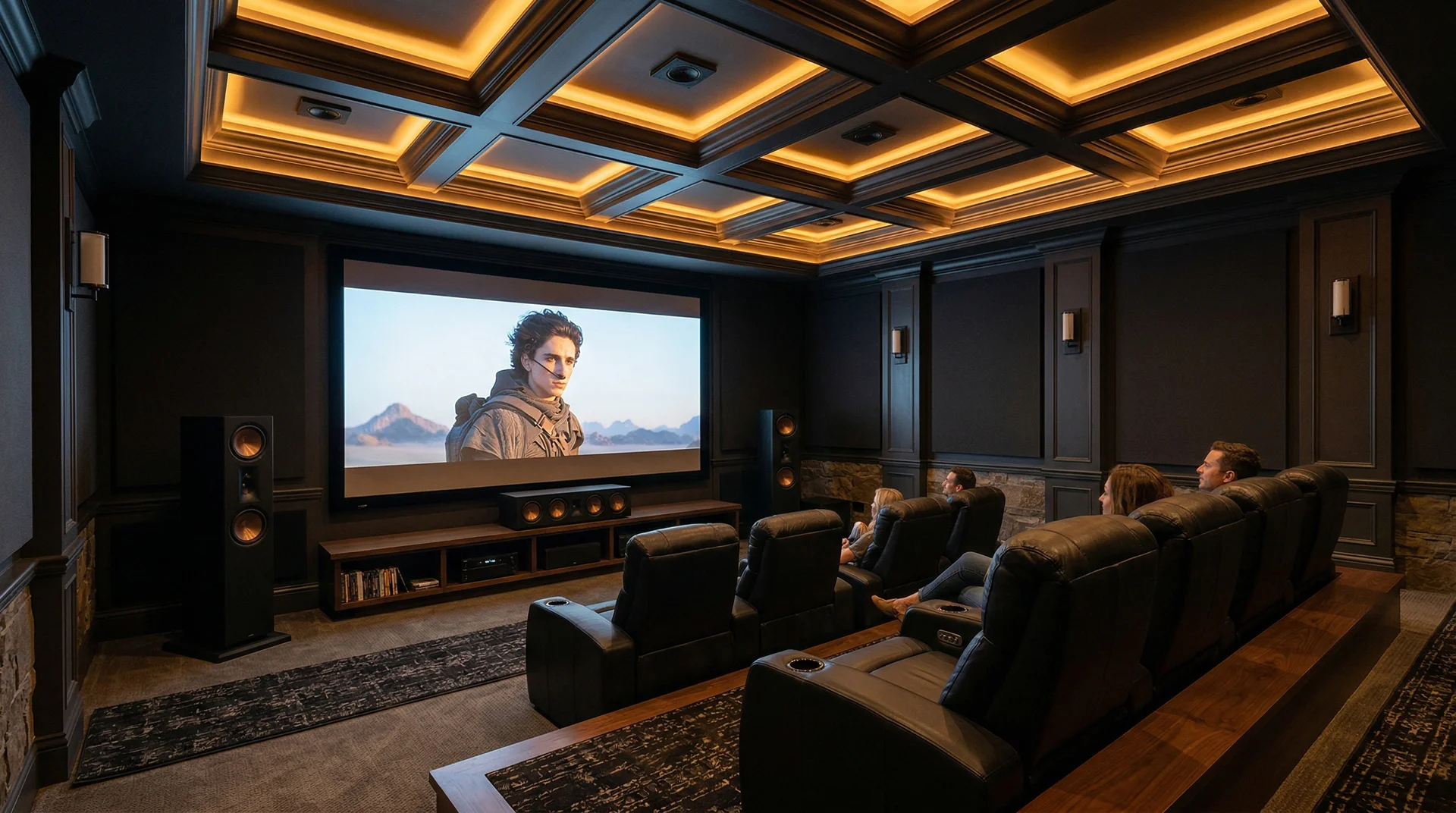
Most Dolby Atmos installations in Scottsdale homes use cheap ceiling speakers and skip calibration. Here is what actually makes immersive audio work in a dedicated theater room, from speaker placement to room acoustics.
Most Dolby Atmos installations I see in Scottsdale don't actually deliver immersive audio. They deliver ceiling speakers. There's a difference, and it's one that costs homeowners thousands of dollars in wasted potential.
The global immersive audio market is projected to reach $6.8 billion by 2030, growing at 13.2% annually (Allied Market Research, 2024). That growth is driven by streaming platforms, gaming, and homeowners who want theater-quality sound in dedicated rooms. But the technology only works when it's installed correctly. And in my experience, most residential Atmos setups fall short because installers focus on speaker count instead of speaker quality and room acoustics.
What Is Dolby Atmos and Why Does It Matter for Home Theater?
Dolby Atmos adds a height dimension to surround sound, placing audio objects in three-dimensional space around and above the listener. Since its consumer launch in 2014, Atmos-compatible devices have exceeded 200 million worldwide (Dolby Laboratories, 2023). For dedicated theater rooms in Scottsdale homes, this technology creates a genuinely immersive experience when the foundation is built right.
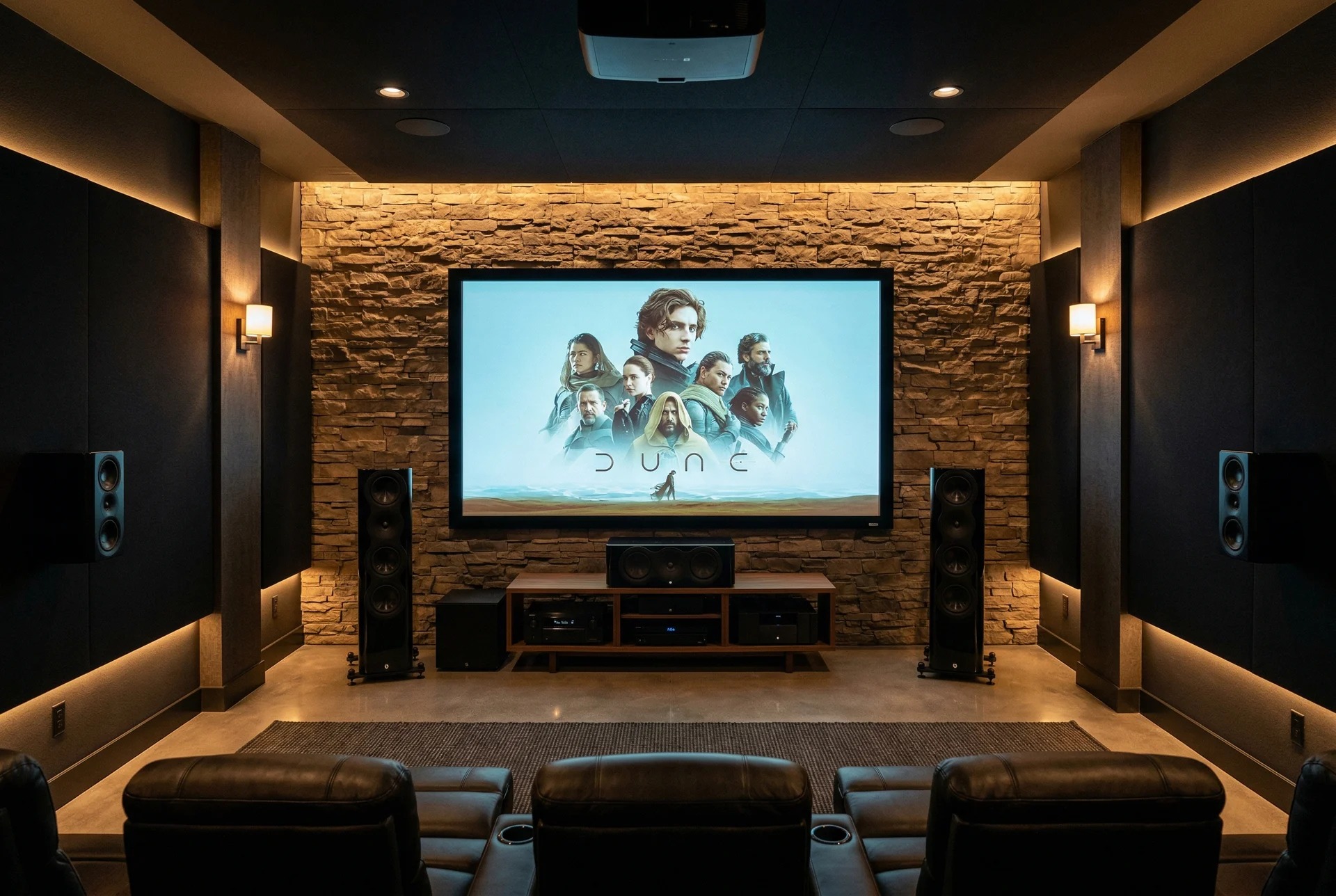
Traditional surround sound operates on a flat plane. You have speakers at ear level arranged around the room. Atmos breaks that ceiling, literally. Height channels above the listening position let sound designers place rain overhead, helicopters moving across the room, or ambient environmental audio that wraps around you. It's the difference between watching a movie and feeling like you're inside it.
But here's where most installations go wrong. Atmos is a system, not a feature you bolt on. The height channels are only as good as the foundation beneath them.
Why Do Most Dolby Atmos Installations Underperform?
According to CEDIA's 2024 Benchmarking Survey, 68% of integrators reported increased demand for immersive audio formats like Atmos and DTS:X (CEDIA, 2024). Yet demand and execution are two different things. Most residential Atmos installs I've evaluated in Scottsdale share the same problems, and they all start with the same shortcut.
The typical approach goes like this. An installer drops four to eight cheap in-ceiling speakers into the drywall, connects them to an Atmos-capable receiver, and calls it done. The homeowner hears some sound from above. The installer gets paid. Everyone moves on.
What's actually missing is everything that makes Atmos work.
The bed layer problem
In any Atmos configuration, the "bed layer" refers to your ear-level speakers. These handle roughly 80% of the audio content in any movie or music mix. Five speakers in a 5.1.2 setup. Seven in a 7.1.4. If these speakers are mediocre, no amount of ceiling magic will save the system. I've walked into Scottsdale theaters where the homeowner spent more on the ceiling speakers than on the front three channels. That's backward.
The calibration gap
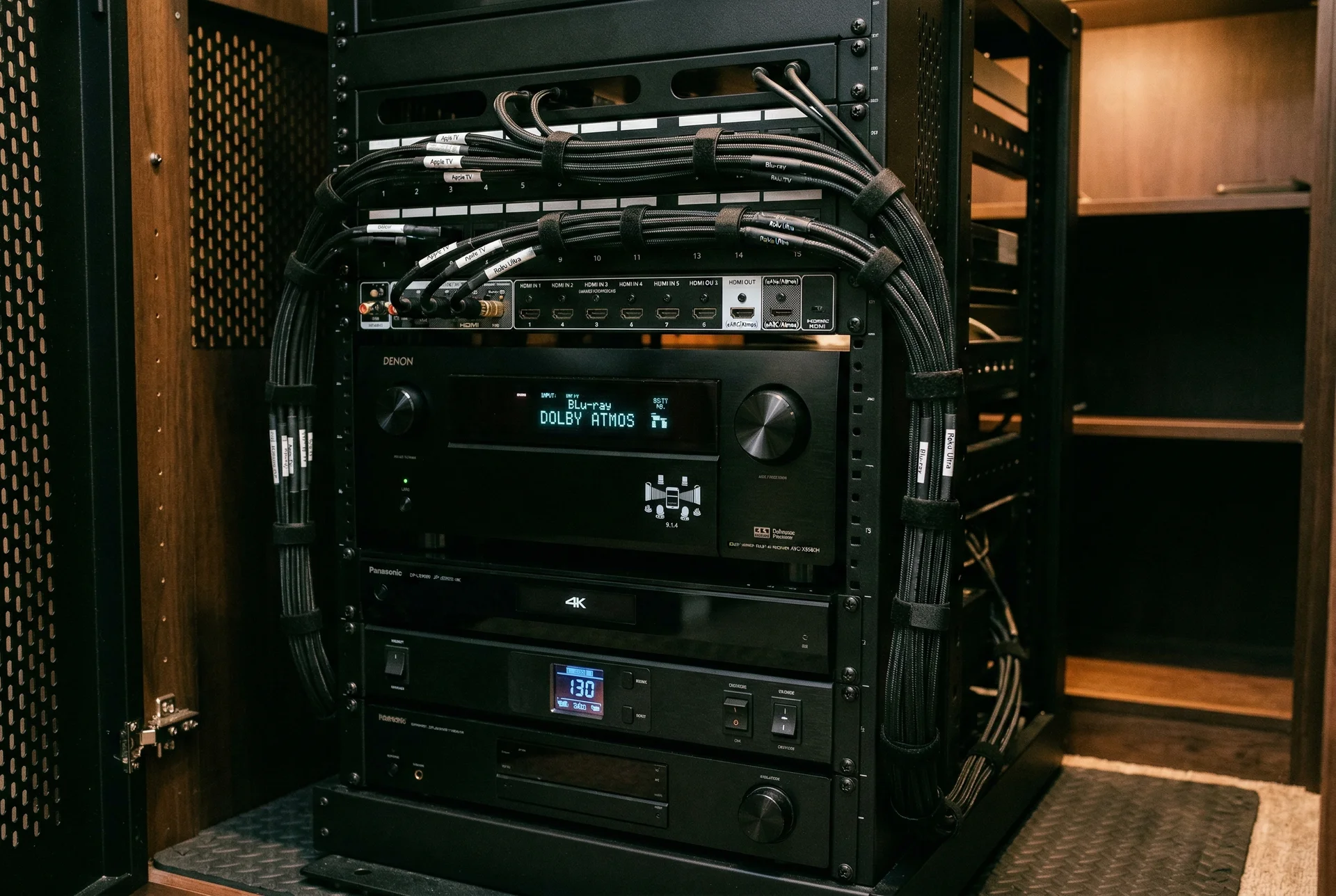
Professional calibration is where Atmos comes alive. Each speaker needs precise level matching, delay timing, and crossover settings so the processor can accurately place sounds in 3D space. Running the receiver's auto-calibration mic and calling it done is like buying a sports car and never getting it aligned. It'll drive, but it won't perform.
What Does a Proper Dolby Atmos Speaker Setup Look Like?
A well-designed Atmos system starts at ear level with high-quality on-wall or tower speakers and adds height channels as the finishing layer. The Dolby specification supports configurations from 5.1.2 up to 9.1.6, but for residential dedicated theaters, two formats cover nearly every scenario.
5.1.2: The foundation
Five ear-level speakers (left, center, right, two surrounds), one subwoofer, and two ceiling height speakers. This is the entry point for Atmos and works well in smaller dedicated rooms between 150 and 250 square feet. The two overhead channels create a basic height layer that's noticeable on well-mixed content.
7.1.4: The sweet spot
Seven ear-level speakers (adding two rear surrounds), one or two subwoofers, and four ceiling height speakers. For Scottsdale dedicated theaters in the 250 to 500 square foot range, this is where I land on most projects. Four ceiling channels give the processor enough overhead points to create convincing movement and spatial effects.
What about going bigger? Configurations like 9.1.6 exist on paper, but I haven't found a residential room in Arizona where the added complexity justifies the cost. Diminishing returns kick in hard past 7.1.4 in rooms under 600 square feet.
Why Does Ceiling Speaker Quality Matter So Much?
The global loudspeaker market reached $9.2 billion in 2024 and is forecast to grow at 5.7% CAGR through 2032 (Fortune Business Insights, 2024). That range includes everything from $30 commodity drivers to reference-grade monitors. For Atmos height channels, where you land on that spectrum determines whether overhead effects sound real or like noise from the attic.
Cheap ceiling speakers share a common flaw. They're designed for background music, not directional audio. Atmos height channels need to produce tight, focused sound that the processor can aim at specific seats. A $50 ceiling speaker spraying diffuse audio in all directions defeats the purpose.
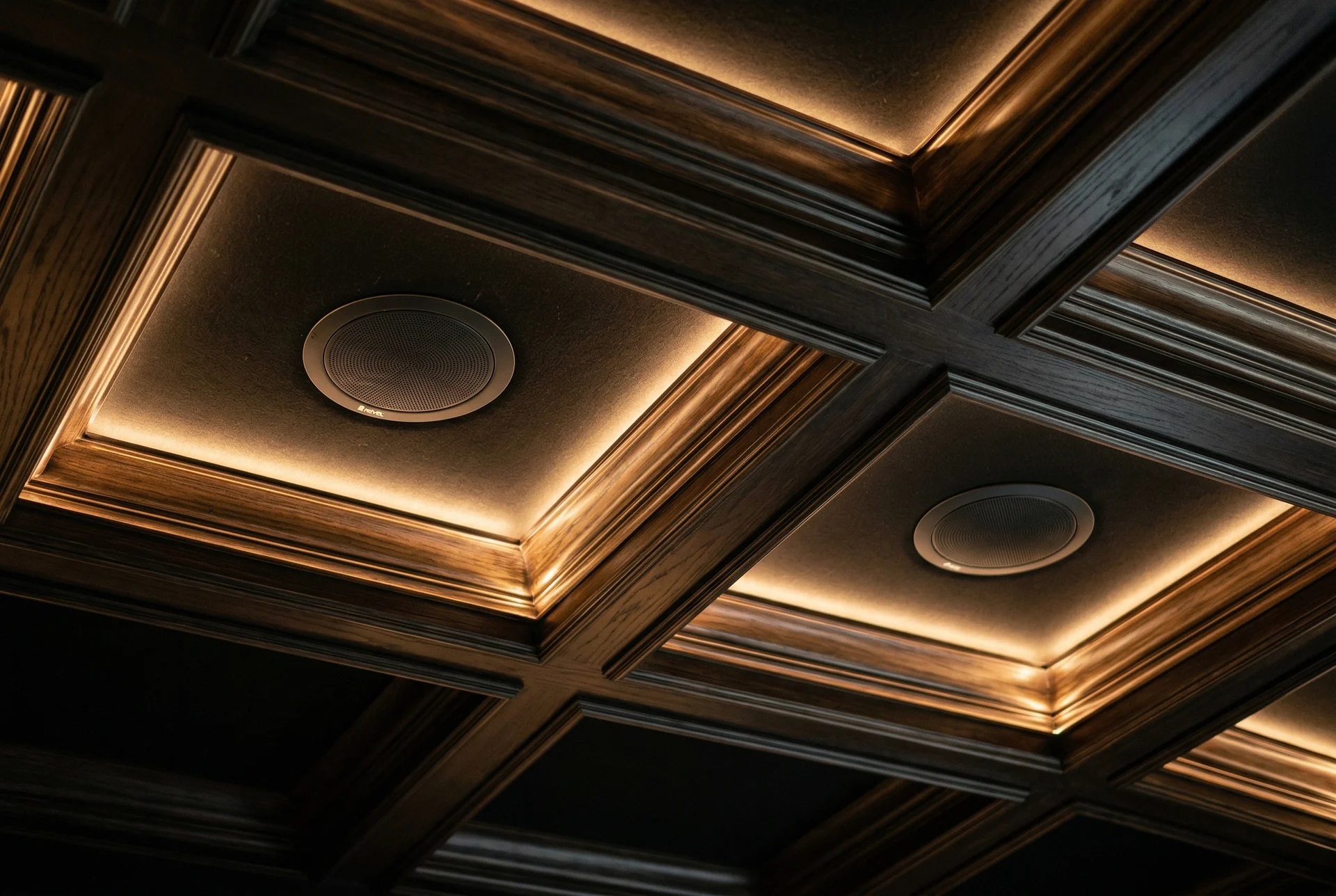
I use ceiling speakers with controlled dispersion patterns and frequency response that matches my bed layer speakers. Tonal matching between the ceiling and the ear-level speakers is critical. If the overhead channels sound different from the main speakers, your brain registers the mismatch instantly. The illusion breaks.
How Does the Room Affect Dolby Atmos Performance?
Room acoustics account for roughly 60% of what you hear in any speaker system, according to acoustic research from the Audio Engineering Society (AES). For Atmos, the room matters even more because the overhead effects rely on precise reflections and direct sound arriving at the correct time at each seat.
Scottsdale's architectural preferences create specific challenges for dedicated theater rooms. Tile floors, stone accent walls, and large glass elements are common even in rooms designated for home theater use. Every hard surface creates reflections that smear the spatial precision Atmos depends on.
Acoustic treatment isn't optional for Atmos. First-reflection points on walls and ceiling need absorption panels. Bass traps in corners manage low-frequency buildup that muddies dialogue. And the ceiling itself, where your height speakers live, needs careful treatment to avoid flutter echo between parallel surfaces.
Have you ever been in a room where clapping produces a metallic ring? That's flutter echo. Now imagine asking a speaker system to place a raindrop precisely two feet above your left shoulder in a room that rings like that. It can't. The room has to cooperate.
Is Dolby Atmos Worth the Investment for Scottsdale Homeowners?
Streaming platforms now offer substantial Atmos content libraries. Apple TV+ delivers nearly all original content in Atmos, and Netflix has expanded its Atmos catalog to over 700 titles (What Hi-Fi?, 2025). Disney+, Amazon Prime Video, and HBO Max also support the format. If you watch movies or prestige TV at home, the content is there.
The question isn't whether Atmos is worth it. It's whether your specific room and budget support doing it right. A 7.1.4 system with custom on-wall and tower speakers, four quality ceiling channels, proper acoustic treatment, and professional calibration represents a significant investment. But it delivers something a soundbar or basic surround system physically cannot: sound that exists in three dimensions around you.
For Scottsdale homeowners building or renovating a dedicated theater room, Atmos is the standard I recommend. Not because it's a buzzword, but because it's what the content is mixed for. When the speakers and the room are right, you hear things in movies you've never noticed before. That's not marketing. That's physics.
Why I Don't Install Atmos in Living Rooms
This might seem like a strange position for someone who installs Atmos systems. But I won't put Atmos in a living room, and I think anyone who does is setting their client up for disappointment.
Living rooms have open floor plans, windows, foot traffic, and furniture arrangements that change. Atmos requires controlled acoustics, fixed speaker positions relative to the listening area, and a room where you can actually treat the surfaces. A living room with a cathedral ceiling and a wall of glass facing Camelback Mountain is a beautiful space. It's a terrible Atmos room.
For living rooms, I design high-quality stereo or traditional surround systems that sound excellent without requiring the acoustic precision Atmos demands. Save Atmos for a room where you can do it justice.
Frequently Asked Questions
What is the difference between 5.1.2 and 7.1.4 Dolby Atmos?
A 5.1.2 system uses five ear-level speakers, one subwoofer, and two ceiling height channels. A 7.1.4 adds two more surround speakers and two more ceiling channels. For most Scottsdale dedicated theater rooms between 250 and 400 square feet, 7.1.4 is the sweet spot for full immersion without overcrowding the space.
Can I add Dolby Atmos to my existing home theater?
Yes, if the room allows it. Adding two or four ceiling speakers for height channels is often possible in existing dedicated theater rooms. The bigger question is whether your current bed layer speakers are good enough to anchor the system. I evaluate the full signal chain before recommending an Atmos upgrade. Reach out for a consultation.
Why do you limit ceiling speakers to four?
Diminishing returns. Four properly placed and calibrated ceiling speakers create a convincing overhead sound field in rooms up to about 500 square feet. Beyond four, you're adding cost and complexity without meaningful improvement. The bed layer, your on-wall and tower speakers at ear level, does the heavy lifting in any Atmos system.
Do you install Dolby Atmos in living rooms?
No. I reserve Atmos for dedicated theater rooms where I can control acoustics, lighting, and speaker placement. Living rooms have too many compromises: open floor plans, windows, traffic patterns, and reflective surfaces that undermine the precision Atmos requires. For living spaces, I design high-quality stereo or surround systems instead.
How long does a Dolby Atmos theater installation take?
From design to final calibration, expect 6 to 12 weeks or more depending on complexity. Custom speaker fabrication accounts for most of that timeline. The physical installation in your Scottsdale home typically takes three to five days, followed by a dedicated calibration session. Schedule a consultation to discuss your project timeline.
Ready to Build a Real Atmos Theater?
If you're planning a dedicated theater room in your Scottsdale home, Dolby Atmos done right will transform how you experience movies, music, and gaming. But "done right" means quality speakers at every position, professional acoustic treatment, and calibration that puts every sound exactly where it belongs.
I'd enjoy talking through what's possible in your space. I take on about 15 projects a year, and each one gets my personal attention from the first conversation through final calibration.
Schedule a free consultation or learn more about my home theater systems and custom speakers.
Comments
Leave a Comment