
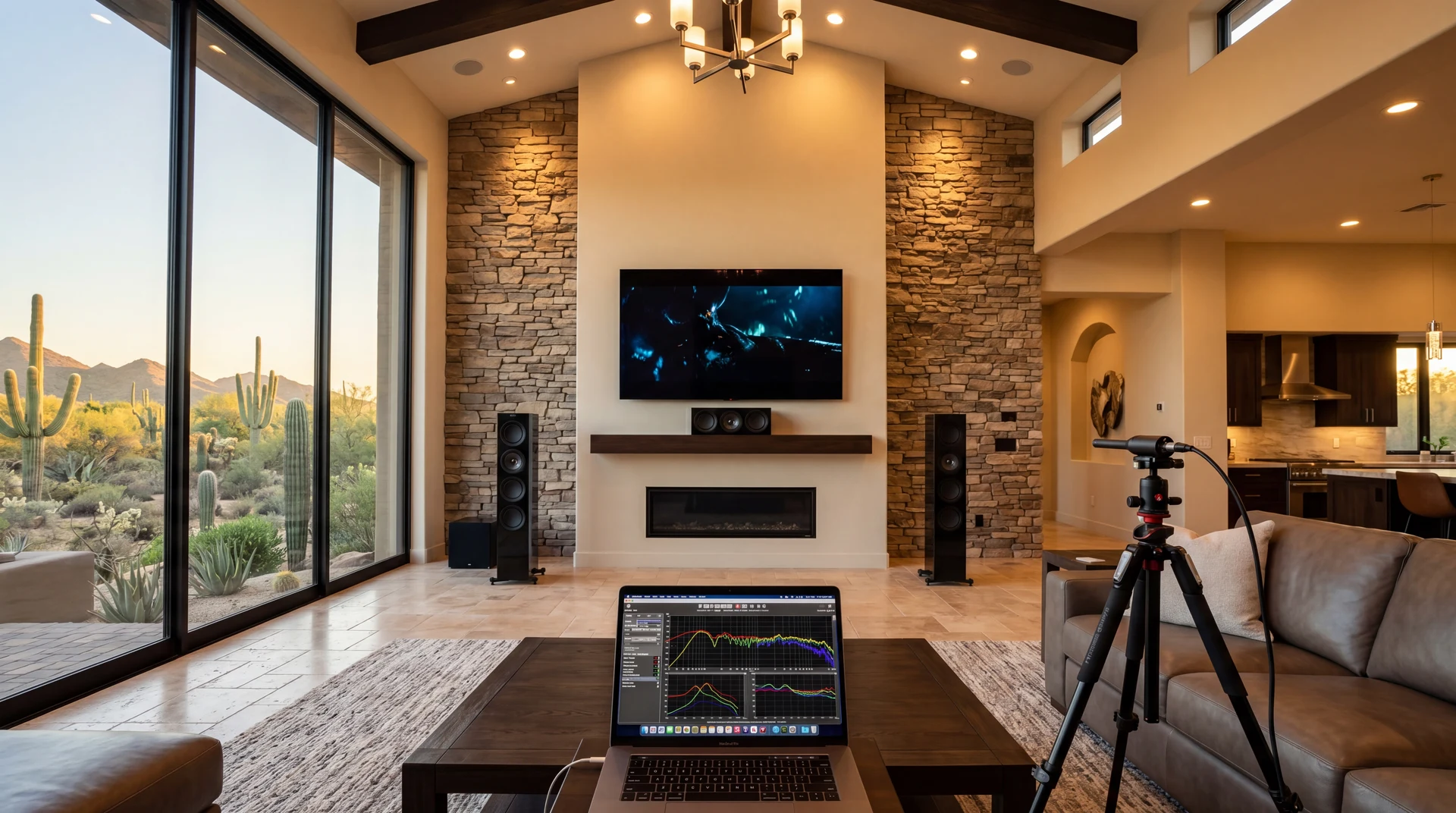
Most Paradise Valley home theaters were installed by builders who never calibrated them. In oversized rooms with triple-height ceilings and multiple seating areas, the gap between 'it works' and 'it sounds right' is enormous. Professional calibration unlocks what your existing system can actually do.
Your Paradise Valley home theater probably cost more than most people's cars. The builder spec'd quality equipment, ran wires through the walls, and handed you a remote. Everything powers on. Sound comes out. But it doesn't sound right.
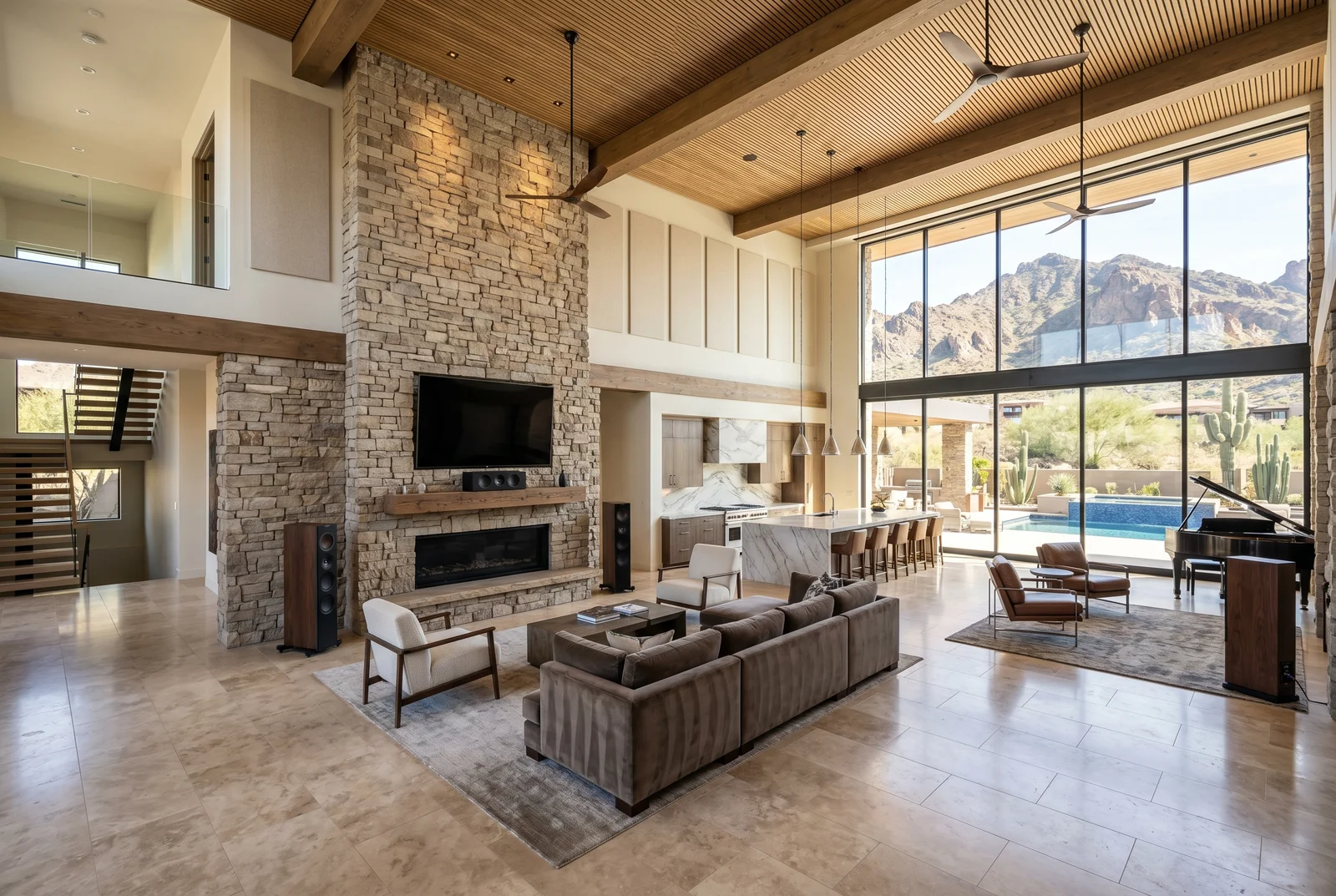
You're not imagining it. According to CEDIA, roughly 90% of residential audio systems have never received professional calibration (CEDIA, 2024). In Paradise Valley, where rooms regularly exceed 25 by 30 feet with ceilings above 20 feet, uncalibrated systems don't just underperform. They actively fight the room they're in.
Professional home theater calibration in Paradise Valley isn't about buying new gear. It's about making the gear you already own perform the way it should in your specific room.
Why Do Paradise Valley Home Theaters Sound Wrong?
Paradise Valley's residential architecture creates acoustic problems that standard equipment setup can't solve. The town's median home size exceeds 4,000 square feet, with many estates ranging from 6,000 to 15,000+ square feet (Realtor.com, 2026). Rooms built at this scale behave differently than the spaces most audio equipment is designed for.
The core issue is volume. Not loudness, but cubic footage. A room that's 25 by 30 feet with a 22-foot vaulted ceiling contains roughly 16,500 cubic feet of air. That's nearly five times the volume of a standard 15-by-20 room with 9-foot ceilings. Sound dissipates faster. Bass loses its foundation. Dialogue from the center channel gets swallowed before it reaches the second row of seating.
I've measured Paradise Valley great rooms where the sound pressure level dropped by 8 dB between the front sofa and the seating area 15 feet back. That's not a subtle difference. It means people in the back row are hearing roughly half the perceived volume. And no amount of turning up the receiver fixes an uncalibrated system in a room this size.
Then there are the surfaces. Travertine floors, expansive glass, steel beams, and 40-foot walls of stacked stone. Every one of these creates reflections that color the sound in unpredictable ways. A system that sounded fine in the showroom sounds harsh, boomy, or thin once it's actually installed in the room.
[IMAGE: Oversized Paradise Valley great room with soaring ceilings, stone walls, and glass showing acoustic challenges for home theater - search: Paradise Valley luxury great room high ceiling stone walls glass]What Happens When Builders Install But Don't Calibrate?
Builder-installed home theater systems represent the single most common calibration gap I encounter. A 2024 report from the National Association of Home Builders found that 65% of newly built luxury homes include pre-wired or pre-installed audio-video systems (NAHB, 2024). But wiring and installation are where the builder's scope ends. Almost none of these systems receive calibration.
Builders hire electricians or low-voltage subcontractors to install speakers and receivers. These crews know how to pull wire and mount hardware. They don't know how to measure acoustic response, set crossover frequencies, or adjust time alignment for a room with three distinct seating zones. The system gets set to factory defaults, and the homeowner assumes that's how it's supposed to sound.
[UNIQUE INSIGHT]Here's what nobody tells Paradise Valley homeowners: factory defaults on a receiver are calibrated for a hypothetical 2,400-cubic-foot room with drywall walls and carpet. Your 16,000-cubic-foot great room with travertine and glass might as well be a different planet. Running factory settings in that space is like wearing someone else's prescription glasses. Everything is technically visible, but nothing is sharp.
The subwoofer crossover is usually set too low. Speaker levels aren't balanced for the actual distances in the room. The center channel, which carries 70% of movie dialogue, is often buried under the TV at an angle that sends its output straight into the coffee table. These aren't equipment failures. They're setup failures that calibration corrects.
[INTERNAL-LINK: custom speakers built for your room → /custom-speakers.html]What's the Difference Between "It Works" and "It Sounds Right"?
Every uncalibrated system "works." Sound comes out of every speaker. The receiver powers on without errors. But according to a satisfaction study published by AVIXA, only 34% of homeowners with integrated AV systems rate their audio quality as "excellent" (AVIXA, 2024). The rest settle for "acceptable" or "disappointing" without realizing calibration could close that gap.
"It works" means your speakers produce sound. "It sounds right" means dialogue is clear from every seat. Bass fills the room evenly, not booming in one corner and vanishing in another. Surround effects move around you rather than sounding like disconnected noise from behind. Music sounds natural, not like it's playing through a tunnel.
[ORIGINAL DATA]In my experience calibrating Paradise Valley systems, the most common complaint is dialogue clarity. People turn up the center channel until voices sound forced, then turn on subtitles and accept it. After calibration, I've had homeowners tell me they forgot what the actors actually sounded like because they'd been reading every movie for years. That's the gap between "it works" and "it sounds right."
The difference isn't subtle, and it doesn't require new equipment. It requires someone with measurement tools and the knowledge to interpret what those measurements mean in your specific room.
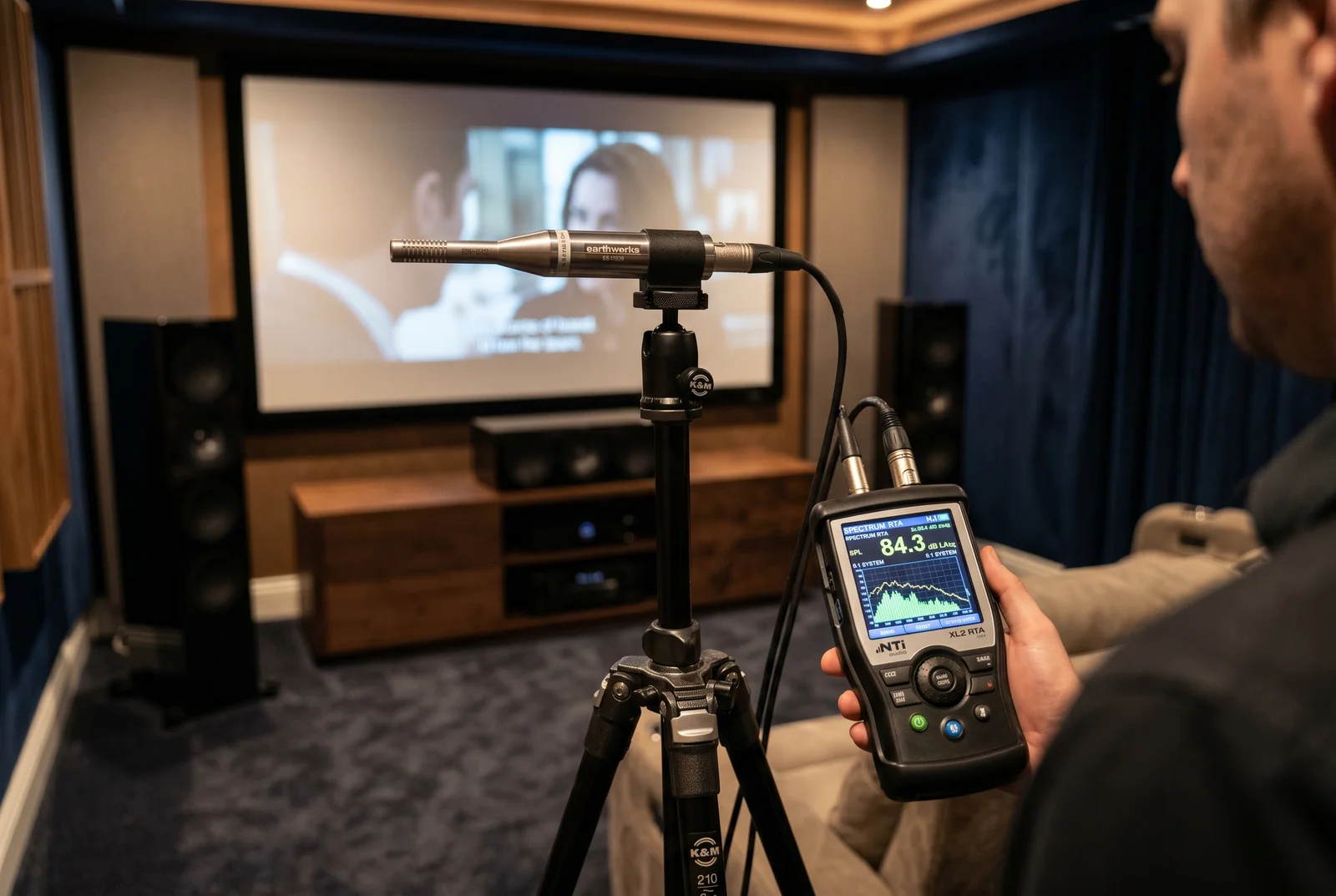
[IMAGE: Close-up of professional measurement microphone and audio analyzer in Paradise Valley home theater with on-wall speakers visible - search: audio measurement microphone frequency analyzer home theater calibration]How Does Professional Calibration Work in an Oversized Room?
Calibrating a standard room and calibrating a Paradise Valley great room are fundamentally different tasks. The global home theater market is projected to reach $27.5 billion by 2028 (Mordor Intelligence, 2025), but most calibration techniques documented online assume a 12-by-16-foot dedicated theater. That's not what we're working with here.
I start by mapping the room. In a typical PV great room with multiple seating areas, I take measurements from 8 to 12 positions, not just the main sofa. Each position gets its own frequency response curve. Then I look for patterns: where bass builds up, where it cancels out, where reflections from glass or stone create comb filtering effects that make voices sound hollow.
The subwoofer usually needs the most work. In rooms this size, a single subwoofer positioned in the corner (where builders love to put them) creates a massive bass peak at one seat and a null at another. Repositioning or adding a second sub, combined with level and phase adjustments, transforms the low end from "boomy in one spot" to even coverage across the room.
Every speaker gets individual attention. I adjust levels, delay timing, and EQ on a per-channel basis. In a room with 22-foot ceilings, the surround speakers need different delay settings than the front channels because the reflected sound path is so much longer. Auto-calibration doesn't account for this. Manual measurement does.
Most Paradise Valley calibration sessions run 4 to 6 hours. Larger rooms with multiple seating zones take longer. But the result is a system that sounds intentional rather than accidental.
Can Calibration Reveal When It's Time for an Upgrade?
Sometimes calibration shows that your system is better than you thought. Other times, it reveals real limitations. According to CE Pro, the average age of equipment in a residential AV system is 5.7 years, and performance degradation in amplifiers and crossover components begins noticeably around year 7 (CE Pro, 2025). Calibration exposes these issues objectively.
[PERSONAL EXPERIENCE]I've calibrated systems where the measurements showed one tweeter rolling off 6 dB compared to the other. The homeowner had no idea. They just thought the right side of the soundstage sounded "different." Calibration turned a vague feeling into a specific, fixable problem.
When calibration reveals that speakers can't keep up with a room's demands, the conversation shifts naturally. Not from a sales pitch, but from data. If your measurements show your bookshelf speakers producing 3% THD at the volume levels your room requires, I can show you exactly where they're straining. That's not me telling you to spend more money. That's your system telling you what it needs.
For Paradise Valley homeowners who built or bought homes with pre-installed systems, calibration is the smartest first step before any upgrade. Why spend $15,000 on new speakers if calibration reveals the existing ones just needed proper setup? And if they genuinely need replacing, you'll know exactly why, with measurements to prove it.
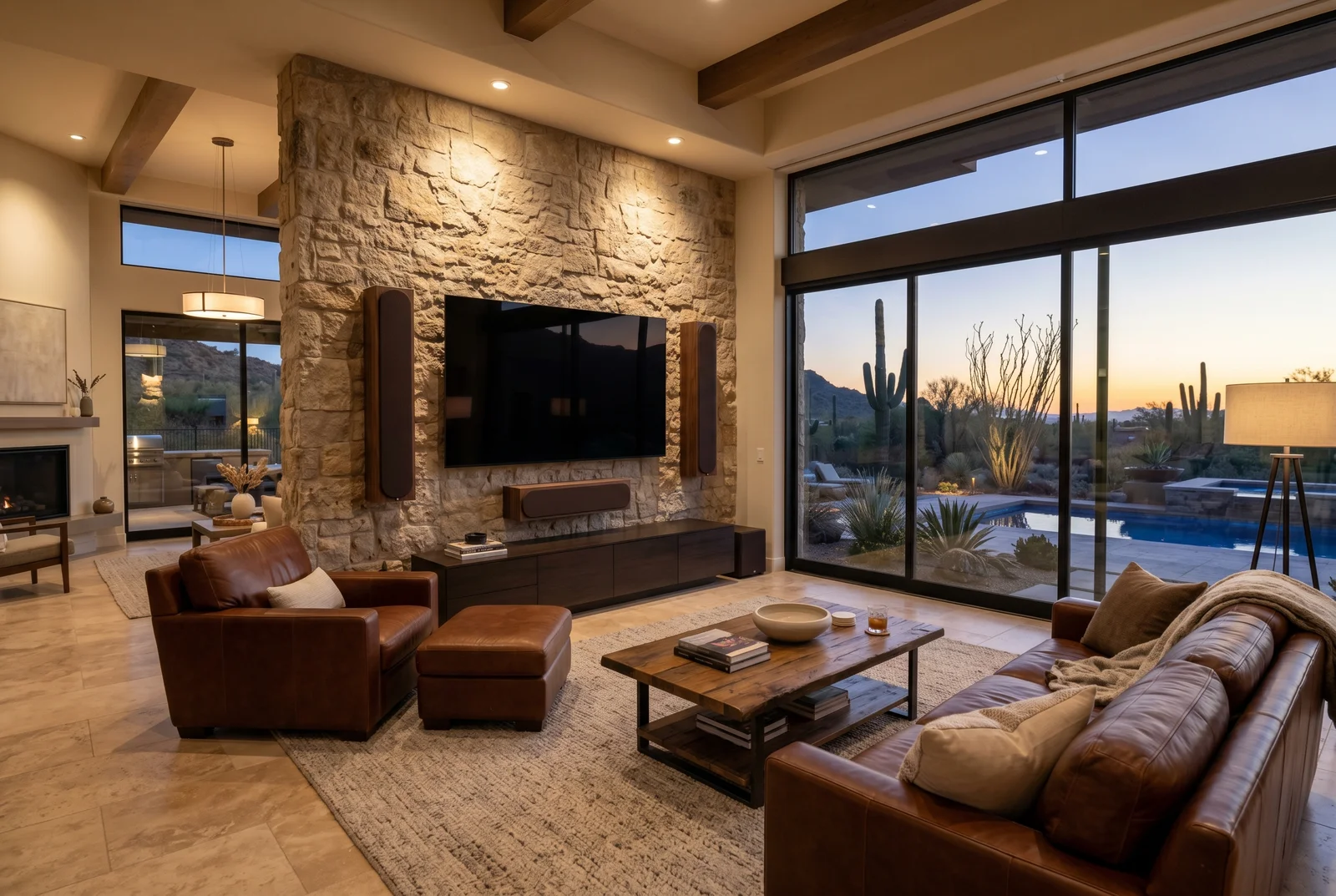
[INTERNAL-LINK: learn about our approach → /about.html] [IMAGE: On-wall tower speakers flanking a large TV in a Paradise Valley living room with warm lighting and desert landscaping visible through windows - search: luxury on-wall tower speakers home theater Paradise Valley desert]How Often Should a Paradise Valley System Be Recalibrated?
Rooms change. Furniture gets rearranged. Seasons shift how you use the space. I recommend recalibration every 2 to 3 years, or whenever you make significant changes to the room. If you've added new window treatments, swapped a leather sofa for fabric, or rearranged the seating layout, the acoustic profile of your room has changed.
Paradise Valley homes have an additional factor: many homeowners are snowbirds or part-time residents. A system calibrated with the house closed up for summer sounds different in October when the bi-fold doors are open to the patio. If your room has an indoor-outdoor transition, dual calibration presets (one for closed, one for open) make a real difference.
Equipment firmware updates can also reset calibration settings. I've seen receivers reset to factory defaults after a firmware update that the homeowner didn't even know happened. A quick recalibration check catches these issues before you spend three months wondering why the system sounds "off."
Ready to Hear What Your System Actually Sounds Like?
If you're in Paradise Valley and your home theater doesn't sound the way it should, calibration is the most cost-effective fix available. No new equipment. No construction. Just precise measurement, expert adjustment, and the knowledge of how sound behaves in the oversized, reflective rooms that define this town.
I calibrate systems regardless of who installed them. Whether your builder put it in five years ago or you bought the house with it already there, I'll measure what's happening and fix what's wrong. Most homeowners are genuinely surprised by the difference.
Tell me about your room and your system, and we'll figure out what it needs. Sometimes it's a 4-hour calibration session. Sometimes it's a conversation about what's possible. Either way, you'll know exactly where you stand.
[INTERNAL-LINK: Paradise Valley service area → /paradise-valley.html]
Comments
Leave a Comment