
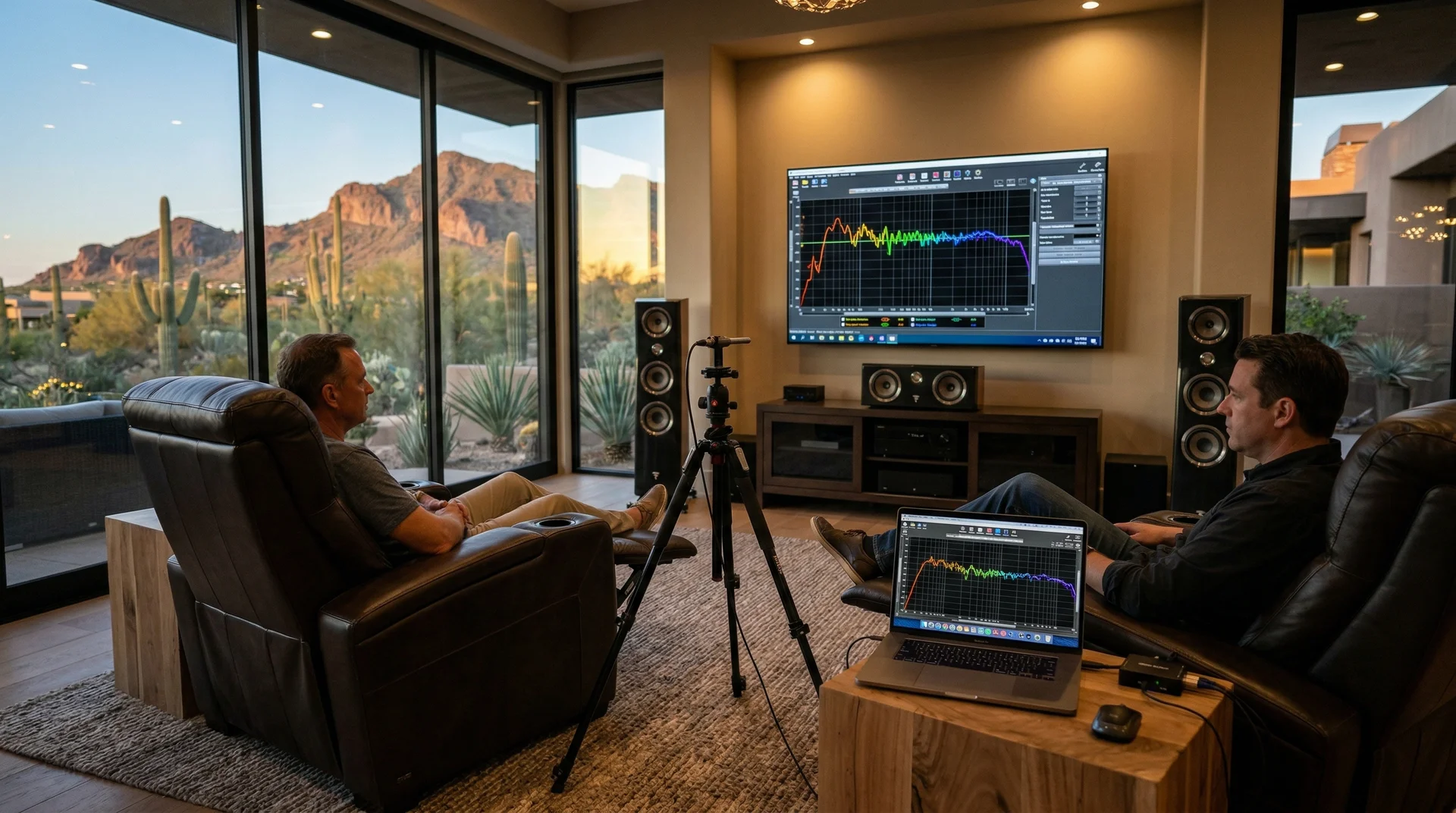
Most Scottsdale home theaters are running on auto-calibration that guesses wrong. Professional calibration with measurement microphones fixes dialogue clarity, bass response, and surround imaging in rooms where glass walls and open floor plans confuse automated systems.
You spent real money on your home theater. The receiver is solid. The speakers look great. But something sounds off, and you can't figure out why. Dialogue gets lost. Bass feels boomy in one seat and thin in another. The surround channels seem disconnected from the screen.
Here's what's probably happening: your system was never properly calibrated. According to THX Ltd., fewer than 20% of home theater systems receive professional calibration (THX, 2024). That means four out of five systems are running on factory defaults or auto-calibration guesses. In Scottsdale, where open floor plans, glass walls, and tile floors create some of the most challenging acoustic environments in residential construction, that gap between potential and performance is even wider.
Professional home theater calibration in Scottsdale isn't about spending more on equipment. It's about unlocking what your existing equipment can actually do.
What Is Home Theater Calibration and Why Does It Matter?
Home theater calibration is the process of measuring and adjusting every speaker in your system to perform correctly within your specific room. The global professional audio equipment market reached $9.8 billion in 2024, growing at 6.2% annually (Allied Market Research, 2024). That growth reflects a broader recognition that equipment alone isn't enough.
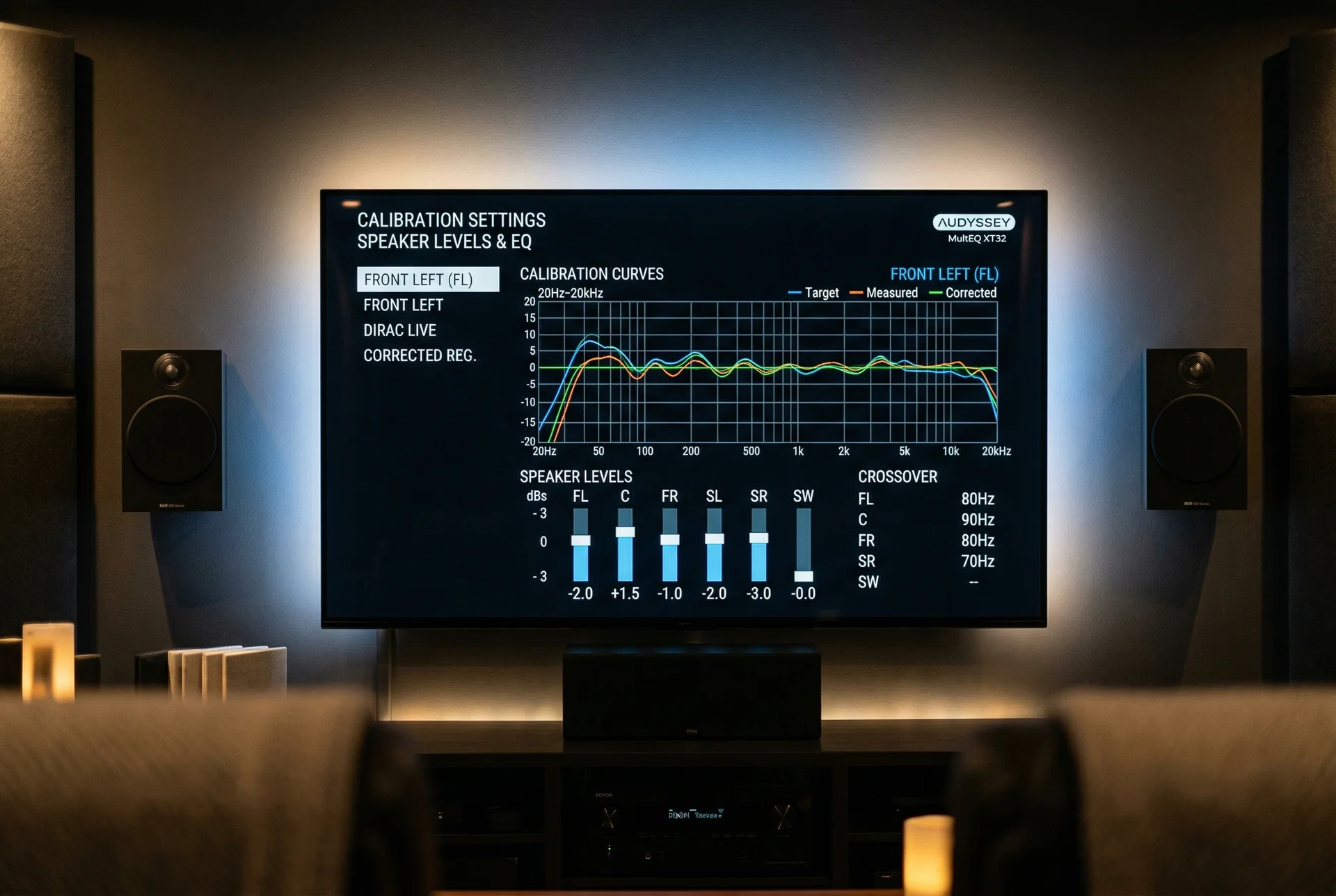
Calibration covers three core areas: speaker levels (how loud each channel plays relative to the others), distance and delay settings (so sound from all speakers arrives at your ears simultaneously), and frequency response correction (taming room-induced peaks and dips in bass, midrange, and treble). Without calibration, even a $50,000 speaker system sounds like it's fighting the room instead of working with it.
I've walked into Scottsdale homes with $30,000 worth of audio equipment where the owner was ready to rip it all out. After a proper calibration session, they couldn't believe it was the same system. The hardware wasn't the problem. The setup was.
Why Does Auto-Calibration Get It Wrong in Scottsdale Homes?
Every major receiver brand ships with an auto-calibration system, whether it's Audyssey, YPAO, or MCACC. These systems use a single microphone at the primary listening position to measure room response. According to the Consumer Technology Association, US consumer technology revenue reached $512 billion in 2024 (CTA, 2025), yet most of that equipment ships with calibration tools designed for average rooms, not Scottsdale living rooms.
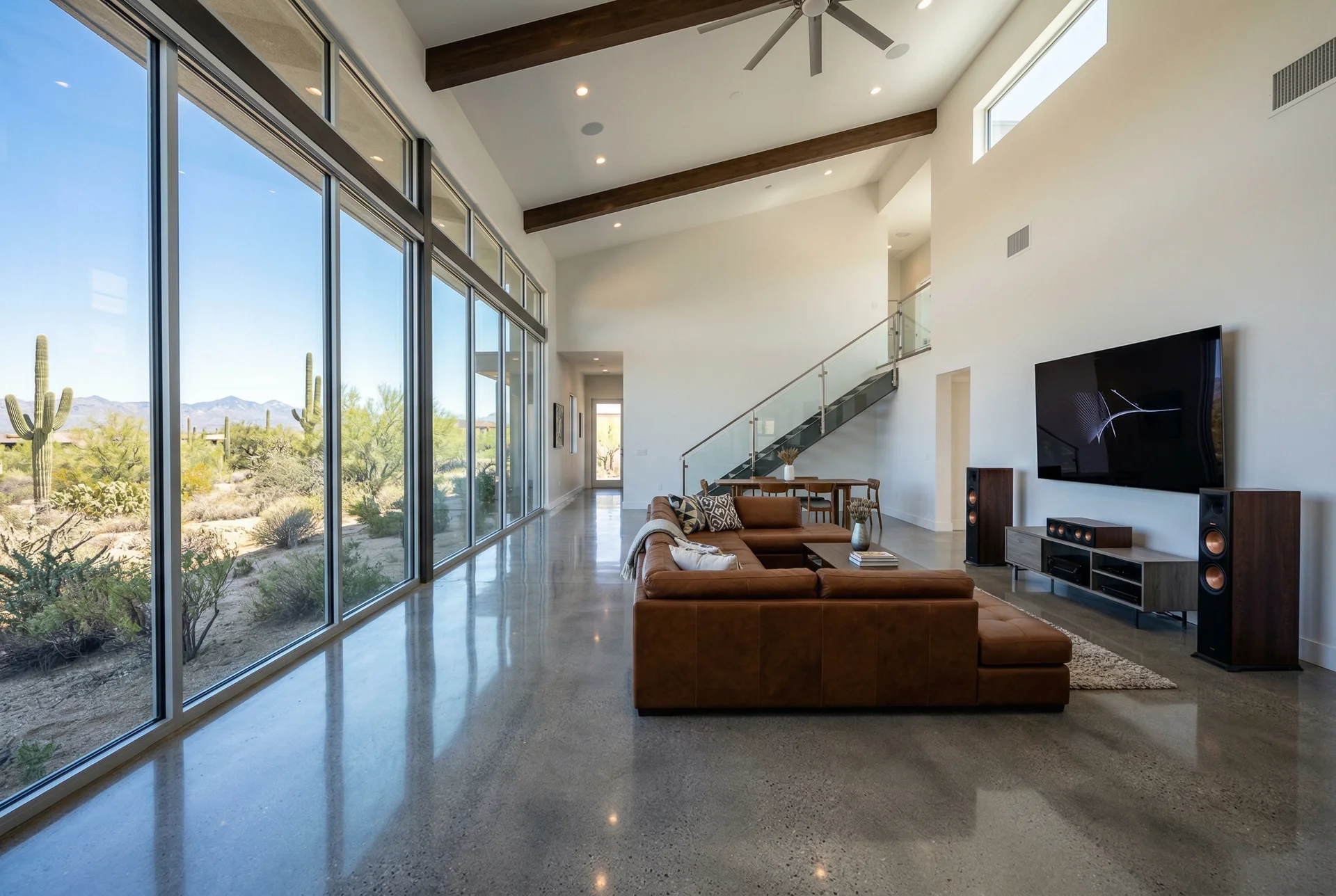
The fundamental problem is that auto-cal measures from one spot and assumes the room has standard geometry. Scottsdale homes frequently feature 12-to-20-foot ceilings, open layouts connecting kitchen to living to dining, floor-to-ceiling glass, and polished tile or concrete flooring. These surfaces create reflections and standing waves that a single-point measurement can't characterize.
Auto-calibration typically makes three specific mistakes in these environments. First, it overcompensates for bass by detecting room modes at the measurement position but creating worse problems elsewhere. Second, it applies excessive high-frequency correction because it reads glass reflections as direct sound. Third, it sets incorrect distance values when open floor plans confuse the algorithm's boundary detection.
What Does Professional Home Theater Calibration Actually Involve?
Professional calibration starts where auto-cal stops, with multiple measurement positions and per-driver analysis. The Imaging Science Foundation reports that certified calibrators achieve an average 40% improvement in measured system performance compared to auto-calibration alone (ISF, 2023). That's not a subtle difference. It's the gap between "something sounds off" and "this sounds right."
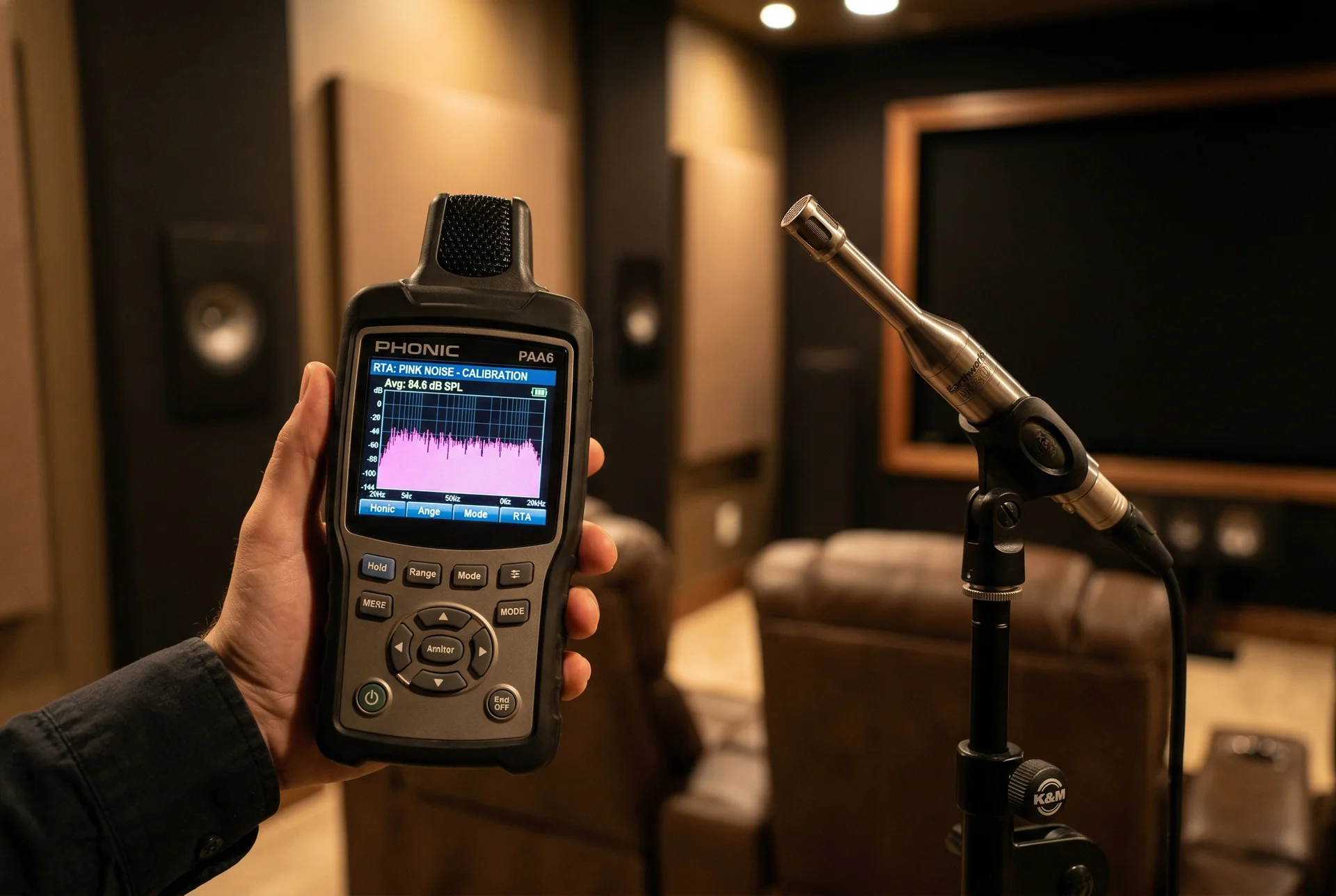
My process uses a Phonic PAA6 real-time audio analyzer along with a calibrated measurement microphone. I measure from the primary listening position first, then from at least four additional seats. This gives me a complete picture of how sound behaves across the entire seating area, not just one sweet spot.
For each speaker, I check individual driver response, crossover behavior, and phase alignment. Then I adjust the receiver's parametric EQ on a per-channel basis. Auto-cal uses broad strokes. Manual calibration uses a scalpel. I'm correcting specific problems at specific frequencies for specific speakers.
The process also includes setting proper crossover points between your main speakers and subwoofer, adjusting lip-sync delay for your video source, and verifying that surround channels are time-aligned to the primary listening position. Most sessions run 3 to 5 hours depending on system complexity.
How Do Scottsdale's Room Acoustics Affect Home Theater Sound?
Scottsdale's residential architecture creates a specific set of acoustic challenges that don't exist in traditional enclosed media rooms. The City of Scottsdale issued over 4,200 residential building permits in fiscal year 2024-25 (City of Scottsdale, 2025), and the vast majority of new construction follows the open-concept, glass-forward design that defines the area.
Glass is the biggest offender. It reflects high frequencies almost perfectly, creating a bright, harsh sound signature that makes dialogue fatiguing. Open floor plans mean your "room" has no defined back wall, so bass energy escapes into the kitchen and hallway instead of pressurizing the listening area. Tile and polished concrete floors add another layer of reflections that muddy the midrange.
Here's what most people don't realize: these rooms aren't bad for home theater. They just need different calibration strategies than a dedicated theater room. I approach Scottsdale great rooms as semi-outdoor environments acoustically. That means I don't try to make the room behave like a sealed box. Instead, I calibrate for the room's actual behavior, compensating for bass rolloff rather than fighting room modes, and using speaker placement and toe-in to minimize glass reflections rather than relying on EQ alone.
What's the Difference Between Calibration and Acoustic Treatment?
Calibration and acoustic treatment work together but solve different problems. A 2024 survey by CE Pro found that 73% of custom integrators now recommend acoustic treatment as part of any theater installation (CE Pro, 2024). But treatment and calibration aren't interchangeable, and doing one without the other leaves performance on the table.
Acoustic treatment, such as absorption panels, bass traps, and diffusers, changes how the room itself responds to sound. It reduces reflections, tames echo, and controls bass buildup. Calibration then optimizes the electronic signal going to each speaker based on the room's treated (or untreated) acoustic signature.
Think of it this way: treatment is remodeling the kitchen. Calibration is adjusting the recipe for your specific oven. You want both, but if you can only do one, calibration gives you the bigger immediate improvement because it addresses every speaker individually.
In Scottsdale homes where homeowners don't want visible panels on their walls (understandable given the design investment), calibration becomes even more critical. It's the invisible solution to acoustic problems.
How Do I Know If My Scottsdale Home Theater Needs Calibration?
If you're turning up the center channel to hear dialogue, your system needs calibration. If bass sounds different depending on where you sit, your system needs calibration. According to a 2024 homeowner satisfaction survey, 68% of home theater owners who reported dissatisfaction with their system cited audio quality issues that professional calibration typically resolves (CE Pro, 2024).
Common symptoms include dialogue that disappears during action scenes, bass that booms from the couch but vanishes in the loveseat, surround effects that sound disconnected or too loud, music that sounds thin or harsh compared to headphones, and a general sense that the system "doesn't sound like the showroom." Every one of these is a calibration issue, not an equipment issue.
The flip side is even more common. Homeowners with quality receivers and speakers accept their system's sound as "just how it sounds" because they've never heard it properly calibrated. The difference after calibration isn't subtle. People hear it immediately.
Why Choose Manual Calibration Over a Room Correction Upgrade?
Some homeowners consider upgrading to a receiver with a more advanced room correction system, like Dirac Live, instead of hiring a calibrator. While better room correction software helps, it doesn't eliminate the need for professional setup. Even Dirac's own documentation recommends professional measurement and target curve adjustment for optimal results.
I've calibrated systems running every major room correction platform. The software is a tool, not a solution. Dirac Live with a professional setup sounds outstanding. Dirac Live with factory defaults in a Scottsdale great room still sounds like a system that's guessing. The human ear and professional measurement equipment catch things algorithms miss, like a resonance in a specific cabinet panel, or a reflection off a particular window at a particular frequency.
Spending $1,500 on a receiver upgrade for better auto-calibration gives you a marginally better guess. Spending that same budget on professional calibration of your existing receiver gives you a system that's actually dialed in for your room.
Ready to Hear What Your System Can Actually Do?
Most Scottsdale home theater owners are listening to a fraction of what their equipment can deliver. Auto-calibration got you started, but it didn't finish the job. Professional calibration with measurement microphones and real-time analysis transforms how your system sounds in your specific room, from your specific seats.
Whether you have a system I built or one installed by someone else, calibration is one of the highest-value investments you can make in your home theater. No new equipment required. Just the right measurements and the expertise to act on them.
If you're in Scottsdale or the surrounding area and your system doesn't sound the way you expected, I'd love to talk about what calibration can do for your setup. See our process for how we approach every project, and check out our warranty covering all work we perform.
Comments
Leave a Comment