
Building a custom home in Scottsdale? The biggest home theater mistake happens before drywall goes up. Here's when to involve your AV installer and exactly what to pre-wire during construction.
Building a custom home in Scottsdale? The single most expensive home theater mistake happens before drywall ever goes up. Pre-wiring during construction costs roughly $1 to $3 per square foot, while retrofitting the same wiring after walls are closed runs $8 to $15 per square foot (CEDIA, 2024). That's a 5x to 8x cost multiplier for the same result. And wiring is just one piece of it.
I'm Mike Vincent, owner of Mike Knows Audio Video. I've worked with custom home builders across Scottsdale and north Phoenix on new construction theater projects, and the pattern is always the same. The homeowners who involve me at schematic design get dramatically better systems for less money than those who call after the certificate of occupancy.
Why Does Timing Matter for Home Theater Pre-Wire in Scottsdale New Construction?
Arizona authorized 64,589 new housing units in 2023, ranking fifth nationally for new residential construction (US Census Bureau, 2024). A significant share of that building activity is concentrated in Scottsdale, where custom homes in communities like DC Ranch, Silverleaf, and the McDowell Mountain corridor routinely include dedicated media rooms. Yet most AV companies don't get the call until cabinets are being installed.
That's too late. Here's why. Once drywall is up, every cable run means cutting holes, fishing wire through insulation, patching drywall, repainting, and hoping you didn't hit a pipe or duct along the way. What takes an electrician 20 minutes during rough-in takes a retrofit crew half a day.
In my experience, homeowners who call after drywall spend 40-60% more on wiring and cable management alone compared to those who planned the pre-wire from the start. That number doesn't include the cosmetic repairs.
When Should You Call Your AV Installer?
The ideal time is during schematic design, before the architect finalizes floor plans. According to the National Association of Home Builders, 91% of builders report that integrated smart home technology increases a home's perceived value (NAHB, 2024). But "integrated" means planned from the start, not bolted on after the fact.
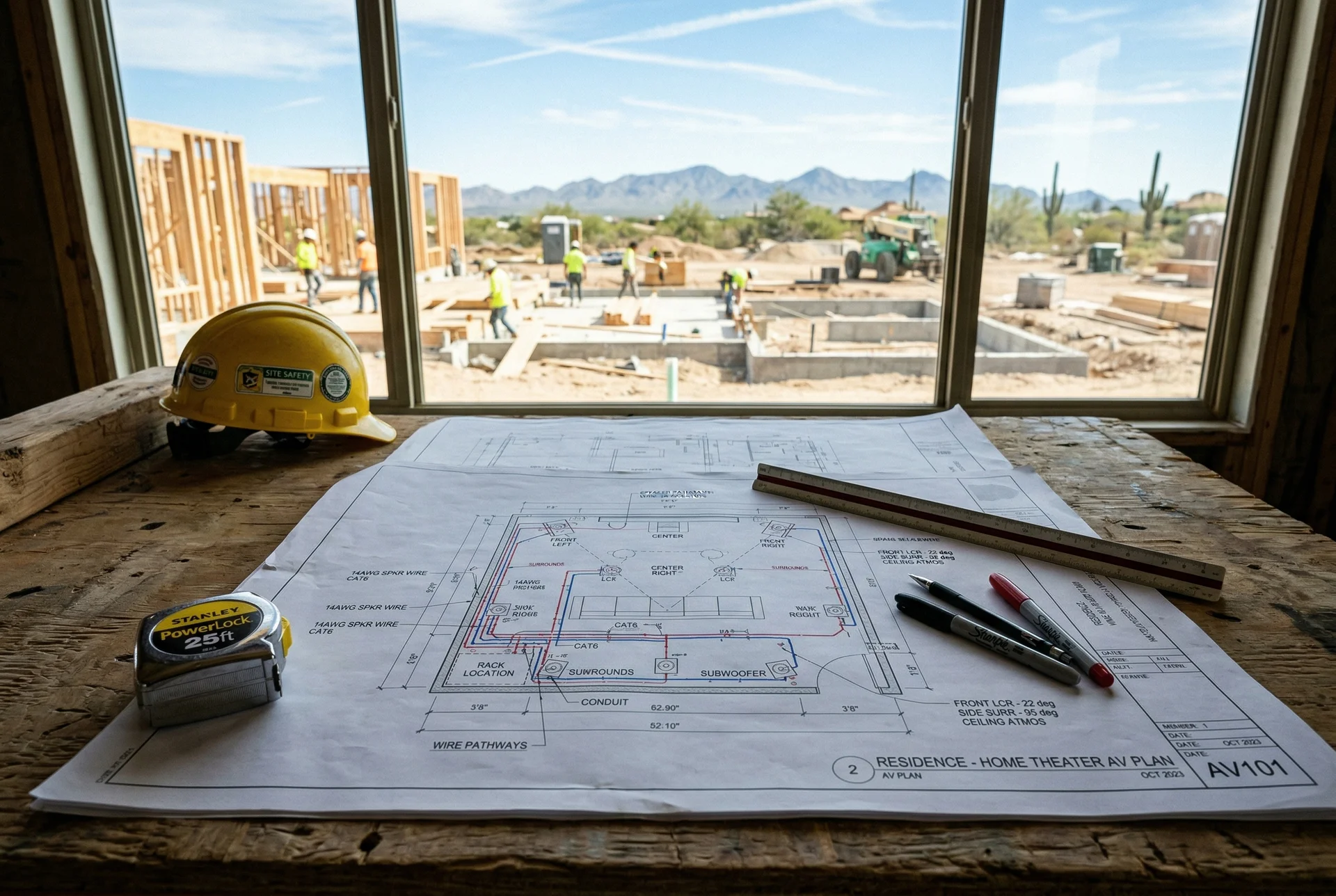
I review floor plans before framing begins. That means I can confirm room dimensions for acoustic performance, identify ideal speaker positions, plan conduit routes between rooms, and coordinate dedicated electrical circuits with the builder's electrician. None of this is possible once walls are closed.
Here's the timeline I recommend for Scottsdale new builds:
Schematic Design Phase
Review floor plans with your AV installer. Confirm theater room dimensions, ceiling height, and adjacencies. Flag any acoustic concerns (shared walls with bedrooms, HVAC routing above the theater, etc.).
Construction Documents Phase
Finalize speaker layout, conduit routing, electrical circuit placement, and low-voltage box locations. These get added to the electrical plans so the builder's team knows exactly what goes where.
Rough-In / Framing Phase
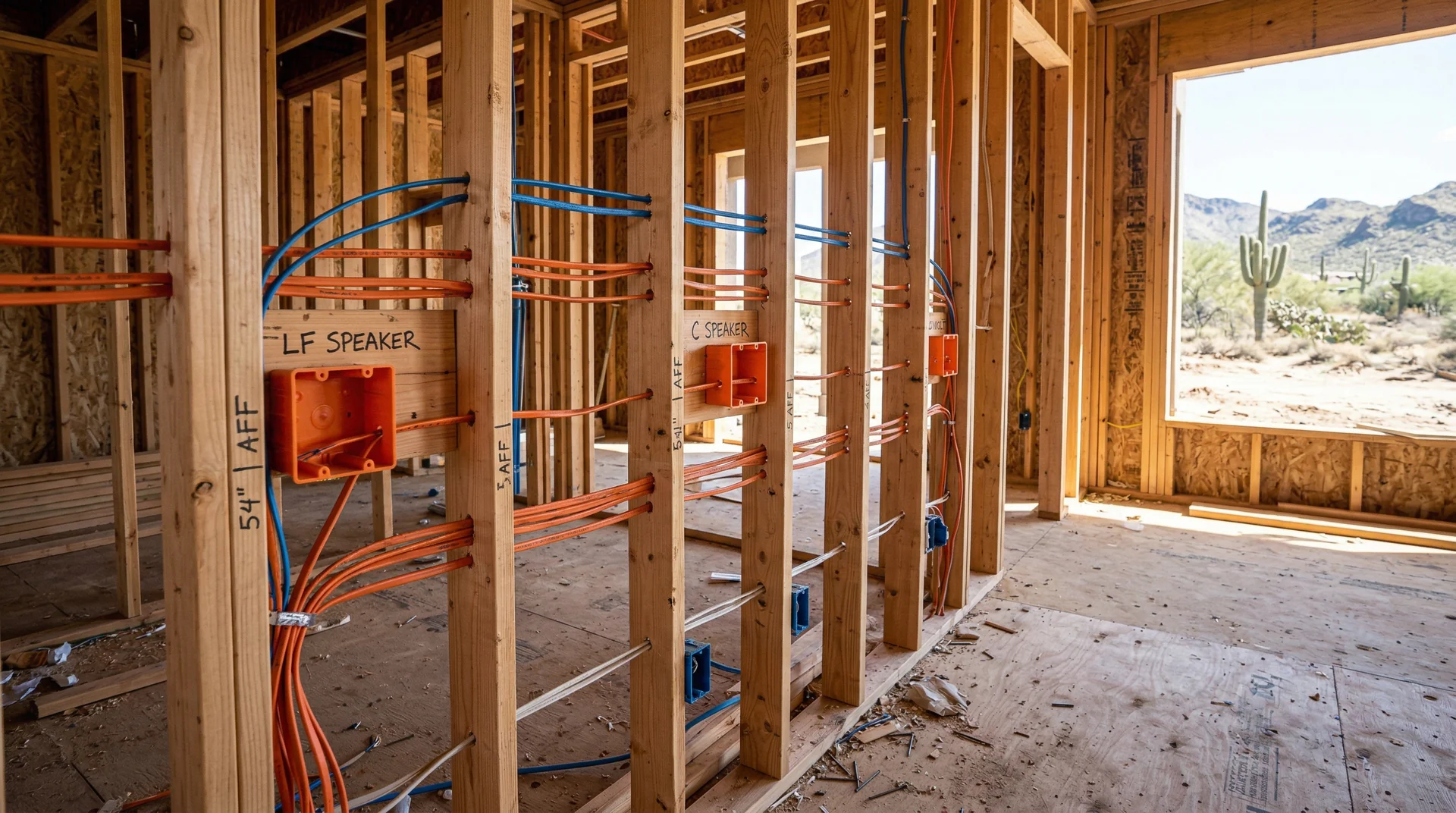
Your AV installer does a site walk during framing to verify stud placement, confirm low-voltage box heights, and pull or verify cable runs before insulation goes in. This is the last chance to make changes without major cost.
The Complete Pre-Wire Checklist for New Construction
A typical Scottsdale custom home theater pre-wire involves more than just speaker cables. Homes with structured wiring and dedicated AV infrastructure sell for 3-5% more on average, according to the National Association of Realtors (NAR, 2024). But even if resale value isn't your concern, getting the infrastructure right now saves headaches for decades.
Here's what I specify on every new construction project:
Speaker cable runs. In-wall CL2/CL3 rated cable from the equipment location to every speaker position. For a 5.1 system, that's a minimum of six runs (five speakers plus one subwoofer). For systems with ceiling channels, add two to four more runs to the ceiling.
Conduit pathways. This is the single most overlooked item. A 1.5-inch conduit from the equipment rack to the display wall lets you pull HDMI, fiber, or whatever cable comes next without touching drywall. I also run conduit between floors and to outdoor speaker locations. Conduit costs almost nothing during construction and is priceless later.
Dedicated electrical circuits. At minimum, two dedicated 20-amp circuits for the theater: one for the equipment rack and one for amplification. Sharing circuits with kitchen appliances or HVAC equipment introduces noise and risks breaker trips during movie night.
Network drops. Cat6A to the equipment rack, the display location, and any spot where a streaming device or game console might live. Wireless is fine for phones. It's not reliable enough for 4K streaming to your main theater display.
Low-voltage boxes. Pre-positioned at the correct height for TV mounting, equipment rack, and speaker locations that need wall plates. Getting the height right now means no visible cable drops later.
How Does Acoustic Planning Work During Construction?
Scottsdale authorized 1,972 single-family building permits in the city alone in 2023 (US Census Bureau, 2024). Many of those homes include a dedicated media room or bonus room that could become a theater. But a room is only as good as its acoustic foundation, and that foundation is far cheaper to build during construction than to fix afterward.
Most builders think "acoustic treatment" means foam panels on the walls after move-in. That's surface treatment. Real acoustic planning happens inside the walls during framing, and it addresses two separate problems: keeping sound in (isolation) and making sound accurate inside the room (treatment).
Sound Isolation (During Framing)
Staggered-stud or double-stud wall construction on shared walls breaks the vibration path between rooms. Adding resilient channel between studs and drywall further decouples the wall surfaces. Fill the cavities with acoustic insulation like Roxul Safe'n'Sound. Install a solid-core door with proper weather seals. These steps happen during framing and insulation and cost a fraction of what they'd cost as a retrofit.
Room Dimensions and Shape
Not every room makes a great theater. I look for ceiling heights of at least 9 feet, rectangular proportions (avoid perfect cubes or squares), and minimal window area on the screen wall. In Scottsdale's desert modern architecture, floor-to-ceiling glass is everywhere. That's beautiful for a great room. It's challenging for a dedicated theater. I work with architects to balance natural light and acoustic performance.
Surface Treatment (After Drywall)
Acoustic panels, bass traps, and diffusers come after the room is finished. But their placement is planned during design. I identify first reflection points and bass node locations on the floor plan so the builder can pre-install blocking for panel mounting. Won't a well-isolated room with planned treatment positions outperform a room where you're guessing after the fact? Every time.
What About Working With Scottsdale Builders and Architects?
With 91% of builders confirming that smart home technology boosts perceived home value (NAHB, 2024), most Scottsdale custom builders already expect AV coordination on high-end projects. Firms specializing in luxury desert modern, Spanish colonial, and contemporary ranch styles across the McDowell Mountain, Pinnacle Peak, and Carefree corridor areas welcome outside AV specialists. Many prefer it because it removes AV design liability from their scope.
I've coordinated with builders and architects on projects from Troon North to Desert Mountain. The process is straightforward when it starts early. I provide a scope document that lists every low-voltage box, cable run, conduit pathway, and circuit requirement. That document gets incorporated into the electrical plans. The builder's electrician handles the physical pull. I do the site walk during rough-in to verify placement and routing.
The critical step is the rough-in verification walk. This happens after framing and before insulation. I check every box location, every cable run, every conduit termination. If something's wrong, it takes minutes to fix at this stage. After insulation and drywall, the same correction could cost hundreds or thousands of dollars.
Common Pre-Wire Mistakes in Scottsdale Custom Homes
The National Association of Home Builders found that the median price of a new single-family home sold in the West region reached $522,100 in 2023 (NAHB, 2024). In Scottsdale's custom market, that figure is often three to ten times higher. At that investment level, skipping AV pre-wire planning is leaving performance and money on the table.
Here are the mistakes I see most often:
Relying on the builder's "smart home package." Many production builders offer a technology package that includes in-ceiling speakers and a basic control system. These are typically the lowest-cost components available and get installed by the electrical subcontractor, not an AV specialist. The result is a system that technically works but sounds mediocre. For a custom home, you deserve better than that.
Skipping conduit. Conduit is the cheapest insurance policy in new construction. HDMI standards change. Cable types evolve. Conduit lets you pull new cable in 15 minutes instead of tearing into finished walls. Every equipment-to-display connection should have conduit.
Choosing in-wall speakers for sound quality. I know this is a strong opinion, but on-wall and tower speakers outperform in-wall models in virtually every measurable way. In-wall speakers compromise cabinet volume, driver size, and baffle design to fit inside a wall cavity. Purpose-built on-wall speakers, like the ones I build in my Arizona workshop, deliver full-range performance without those compromises.
Forgetting the subwoofer location. Bass management is half the battle in home theater. If you don't plan the subwoofer position and its power/signal connection during framing, you're stuck with wherever a cable can reach later. I plan subwoofer locations based on room dimensions and standing wave calculations.
How Does This Apply to Scottsdale's Desert Modern Architecture?
With nearly 2,000 new single-family permits issued in 2023 alone (US Census Bureau, 2024), Scottsdale's architectural trends lean heavily toward open floor plans, large glass expanses, polished concrete or tile floors, and exposed structural elements. These are gorgeous design choices. They're also acoustically challenging. Hard, reflective surfaces bounce sound around, and open floor plans let theater audio bleed into adjacent living spaces.
The best time to solve these challenges is during construction, not after. I've found that builders are surprisingly receptive to acoustic recommendations when they're presented as construction details rather than AV jargon. A resilient channel detail on a shared wall reads like any other framing specification. Acoustic insulation between joists is just another insulation call-out. The key is translating AV requirements into builder language.
For open-concept homes where a dedicated sealed theater room isn't practical, I focus on the elements we can control. Dedicated circuits prevent electrical noise. Conduit future-proofs cable runs. Strategic furniture and rug placement (specified by the interior designer) can tame first reflections. And speaker selection matters enormously. WubWub Audio on-wall speakers with built-in DSP can compensate for room acoustics in ways that passive in-wall speakers simply cannot.
A Typical Scottsdale New Construction Pre-Wire Scope
With pre-wire costs running $1-$3 per square foot versus $8-$15 for retrofit (CEDIA, 2024), the scope of a new construction pre-wire is worth understanding in detail. Every project is different, but here's a typical scope for a dedicated home theater in a Scottsdale custom build.
Theater room (dedicated): Five on-wall speaker positions (left, center, right, two surrounds) with cable runs to equipment location. Two to four ceiling speaker positions with cable runs. One or two subwoofer positions with power and signal cable. Conduit from equipment rack to screen wall. Two dedicated 20-amp circuits. Cat6A network drops. Acoustic insulation in all shared walls and ceiling. Solid-core door with seals.
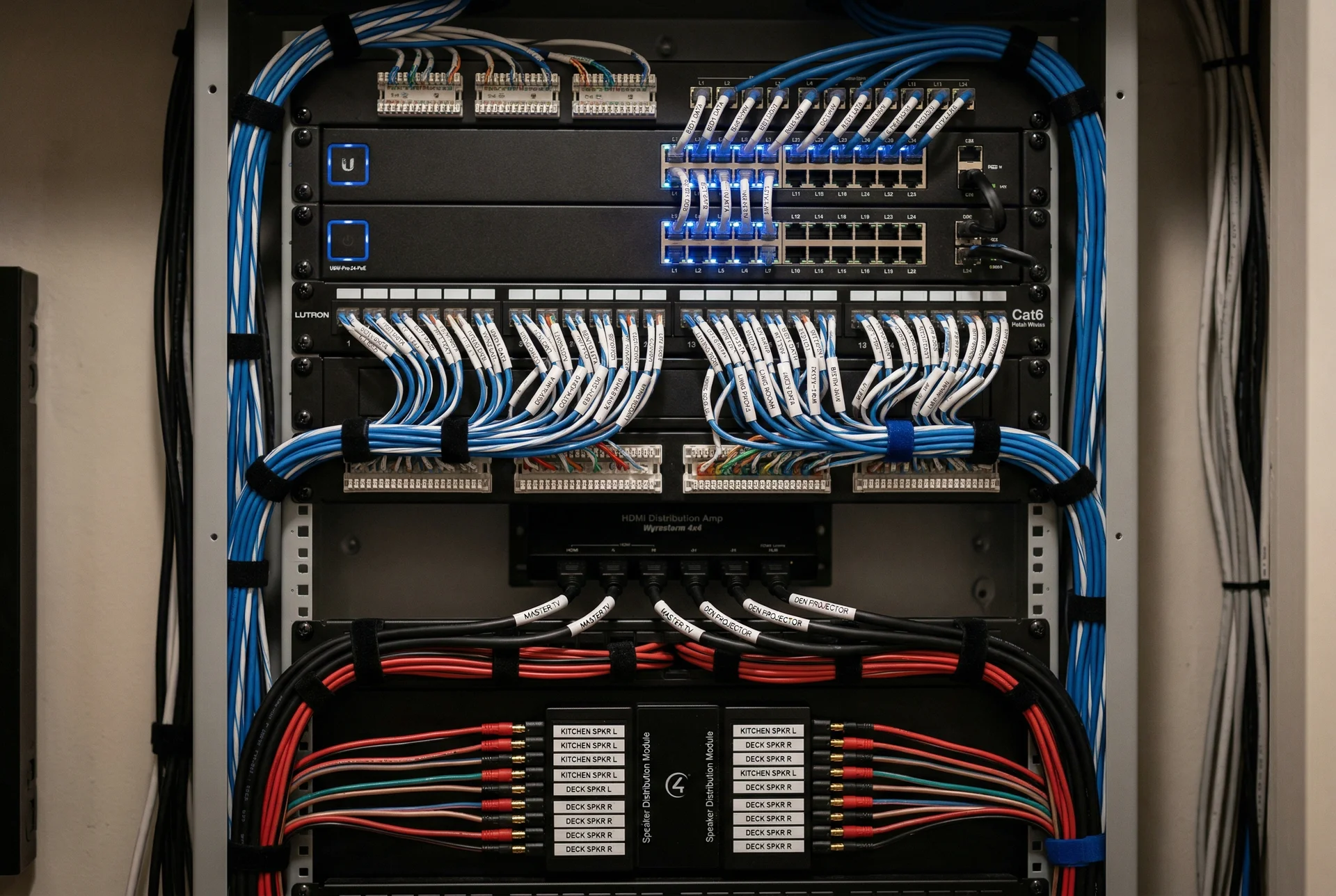
Equipment location: Ventilated closet or dedicated rack space with power, network, and conduit access to all zones. This is the brain of the system, and it needs to be planned during construction so it doesn't end up crammed into a coat closet after the fact.
Build timeline: The pre-wire coordination adds no time to the construction schedule if it's planned from the start. Speaker systems from my workshop typically take 6 to 12 weeks or more depending on complexity, so I start the build process during the construction phase. By the time the home is ready for finish work, your speakers are ready to install.
Frequently Asked Questions
How much does it cost to pre-wire a home theater during new construction?
Pre-wiring during construction typically runs $1 to $3 per square foot for the home theater space, covering speaker cable runs, conduit, dedicated circuits, and network drops. Retrofitting the same wiring after drywall costs $8 to $15 per square foot because walls have to be opened, patched, and repainted (CEDIA, 2024). For a 400-square-foot theater room, that's the difference between $400-$1,200 and $3,200-$6,000 for wiring alone.
When should I contact an AV installer during the building process?
Contact your AV installer during schematic design, before framing begins. I need to review floor plans to confirm room dimensions, ceiling heights, speaker placement, conduit routing, and dedicated circuit locations. Once framing starts, I do a site walk to verify everything before insulation and drywall go in. Waiting until after drywall means expensive retrofits.
What should be pre-wired for a home theater in new construction?
At minimum: speaker cable runs for all channels (including ceiling speakers if applicable), a conduit pathway for future upgrades, at least two dedicated 20-amp circuits, Cat6A network drops, and low-voltage boxes at the TV and equipment locations. I also recommend conduit between the equipment rack location and the display wall for HDMI and future cable pulls.
Can acoustic treatment be built into new construction?
Absolutely, and it's dramatically cheaper during construction. Staggered-stud or double-stud walls with resilient channel, acoustic insulation like Roxul Safe'n'Sound between studs, a solid-core door with proper seals, and isolated ceiling joists can be integrated at a fraction of the retrofit cost. These steps reduce sound transmission between rooms and improve audio clarity inside the theater.
Do Scottsdale custom builders work with outside AV installers?
Most reputable Scottsdale custom builders welcome outside AV specialists. Many prefer it because it removes AV liability from their scope. I coordinate directly with the builder's project manager and electrician to schedule pre-wire walks, confirm box placements, and verify conduit runs before insulation goes in. The key is getting involved early enough in the build schedule.
Ready to Plan Your Scottsdale New Build Theater?
If you're building a custom home in Scottsdale and want a home theater that's planned from the foundation up, I'd love to review your floor plans. The earlier we start the conversation, the better the result and the lower the cost. I work directly with your builder and architect to make the AV coordination painless.
Get in touch here or call (928) 440-1950. Let's build something worth listening to.
Comments
Leave a Comment