
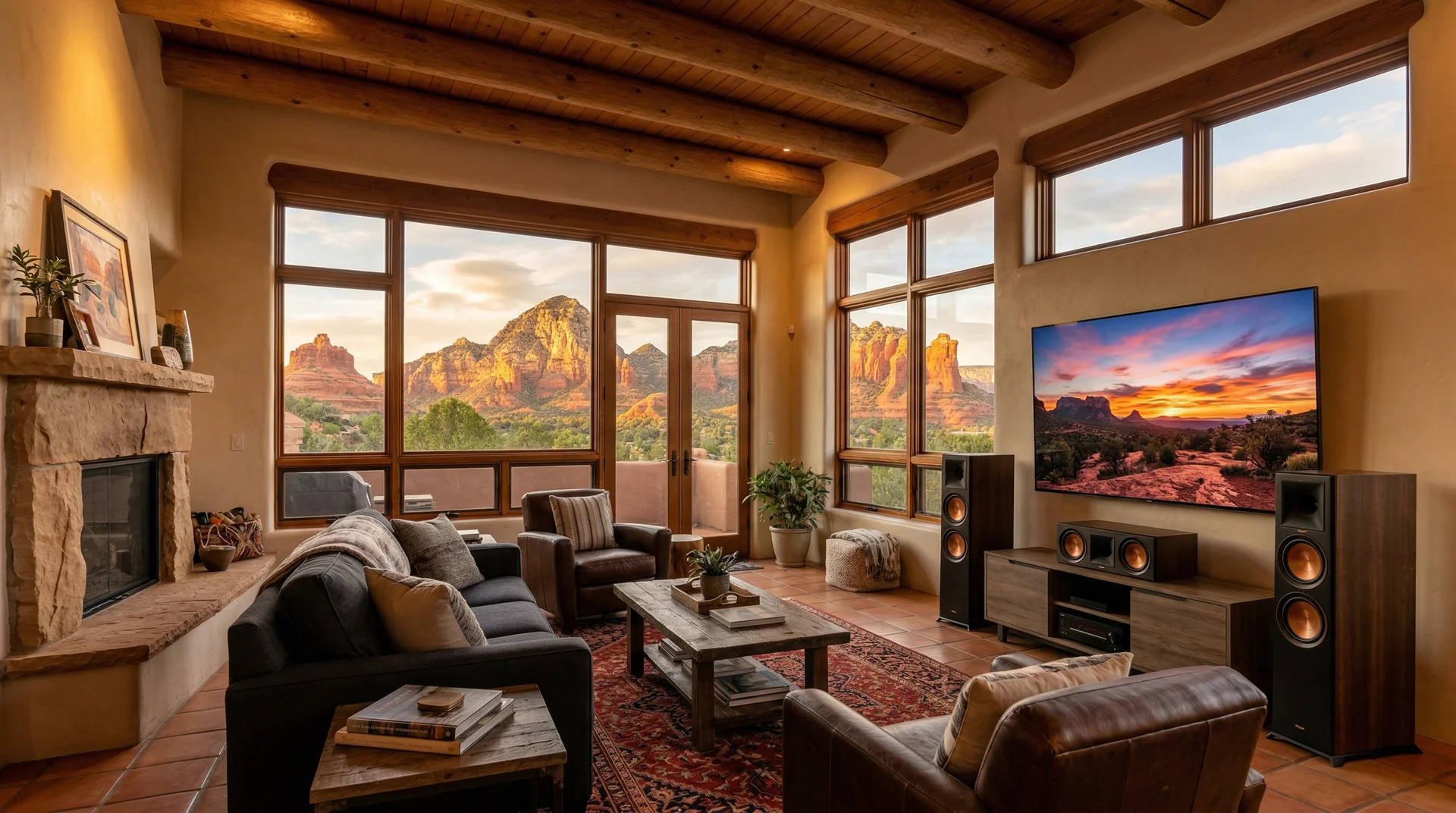
Village of Oak Creek and Big Park are where Sedona's year-round residents actually live. Here's what it takes to build a home theater that sounds right in VOC's mix of traditional Southwest homes, golf course properties, and contemporary builds along the red rock corridor.
If you live in Village of Oak Creek or Big Park, you already know something most visitors don't. This is where a huge share of Sedona-area residents actually settle down. Not the tourist corridor along 89A. Not the short-term rental belt of West Sedona. The 86351 ZIP code is full of year-round homeowners who chose red rock views without the red rock price tag, and who want their homes dialed in.
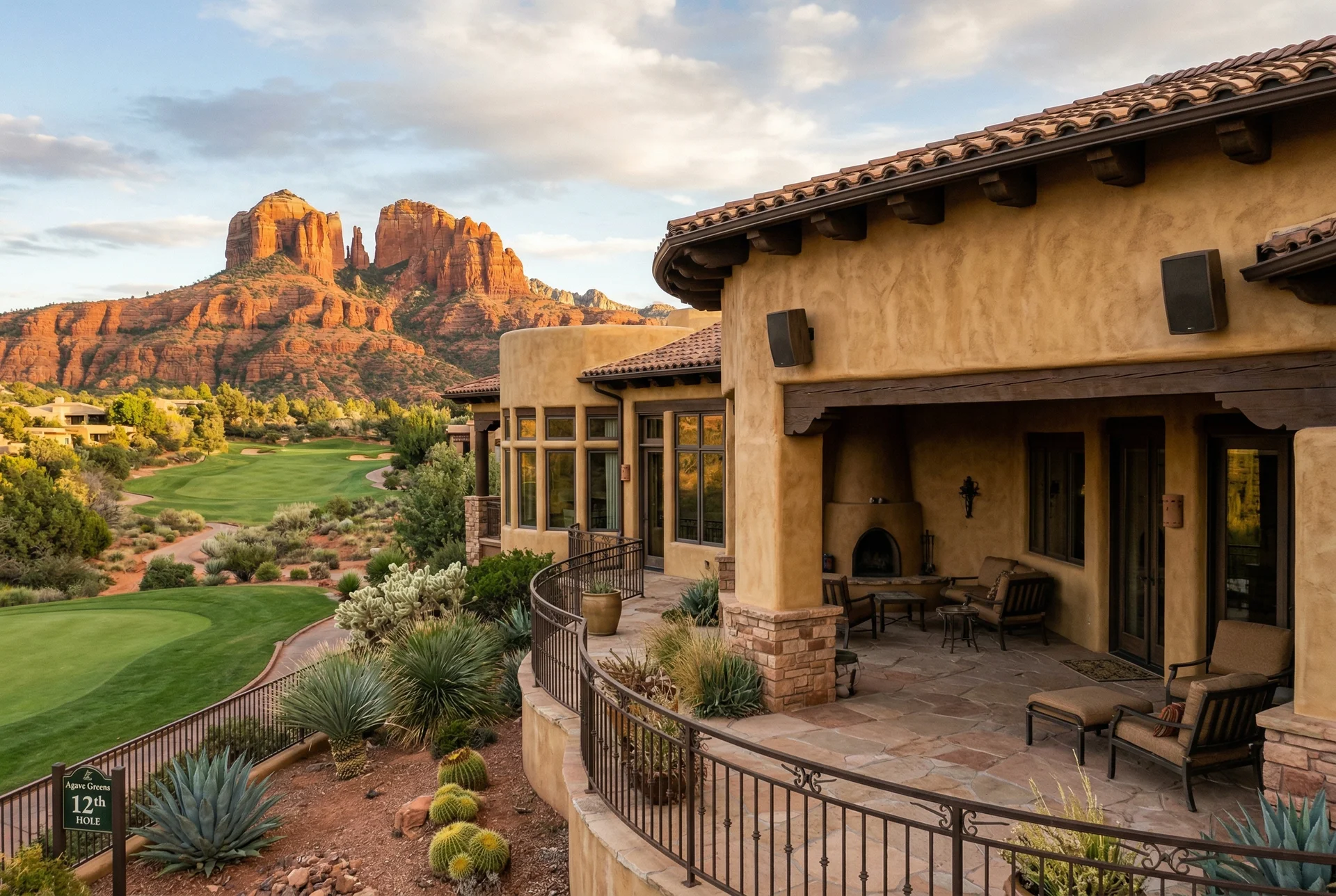
I'm Mike, owner of Mike Knows Audio Video. I build custom speakers and install home theater systems across Northern Arizona, including the greater Sedona area. Village of Oak Creek and Big Park present a different set of challenges and opportunities than Sedona proper, and I want to walk through what that means for your audio system.
Why Is Village of Oak Creek Different from Sedona for Home Theater?
The Village of Oak Creek census-designated place has roughly 6,500 residents, making it one of the most populated communities in the Sedona area (U.S. Census Bureau, 2020). That population density matters for audio work. VOC has more gated subdivisions, more traditional floor plans, and more full-time residents than you'll find in the vacation-rental-heavy neighborhoods closer to uptown Sedona.
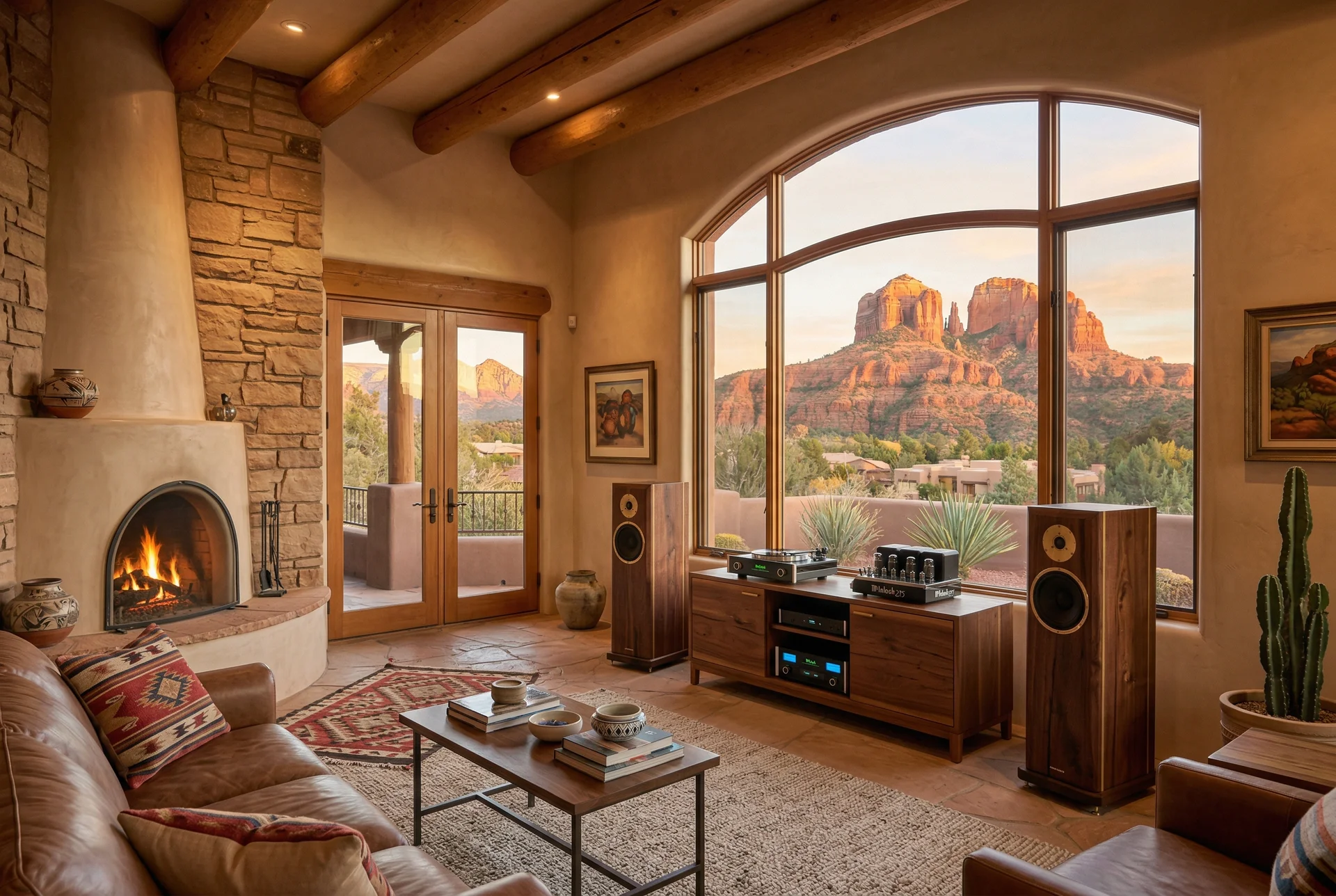
Architecturally, VOC homes sit in a sweet spot. You'll find Territorial and Santa Fe styles in Las Piedras and Pine Valley. Contemporary builds in Mystic Hills. Ranch-style homes along the golf course at Oakcreek Country Club. This mix means no two rooms sound the same. A vaulted great room in a Territorial home behaves nothing like a flat-ceiling living room in a single-story rancher.
That variety is actually an advantage. It means I'm not solving the same acoustic problem over and over. Every VOC home gets its own assessment, its own speaker configuration, and its own calibration. That's the only way to get it right.
What Acoustic Challenges Do VOC Homes Present?
The median home sale price in the Sedona 86351 ZIP code reached $735,000 in late 2025, reflecting steady demand for the area's mix of retirement and primary residences (Redfin, 2025). At that price point, homeowners are investing in quality finishes: tile floors, stone accent walls, stucco interiors, and large windows facing Bell Rock or Courthouse Butte.
Every one of those materials reflects sound. Hard floors bounce bass around the room. Stone walls create harsh reflections in the upper frequencies. Large windows facing west bring in gorgeous light and terrible acoustic behavior. Most off-the-shelf speaker systems can't compensate for these conditions. The speakers aren't the problem. The room is.
I handle this two ways. First, I assess the room before recommending any equipment. I listen to how the space responds to sound at different frequencies and identify where reflections, bass buildup, and dead spots are occurring. Second, I build custom on-wall and tower speakers that are voiced for the specific room they'll live in. Not a generic product pulled from a shelf. A speaker built for your space.
How Does Golf Course Living Affect Audio Design?
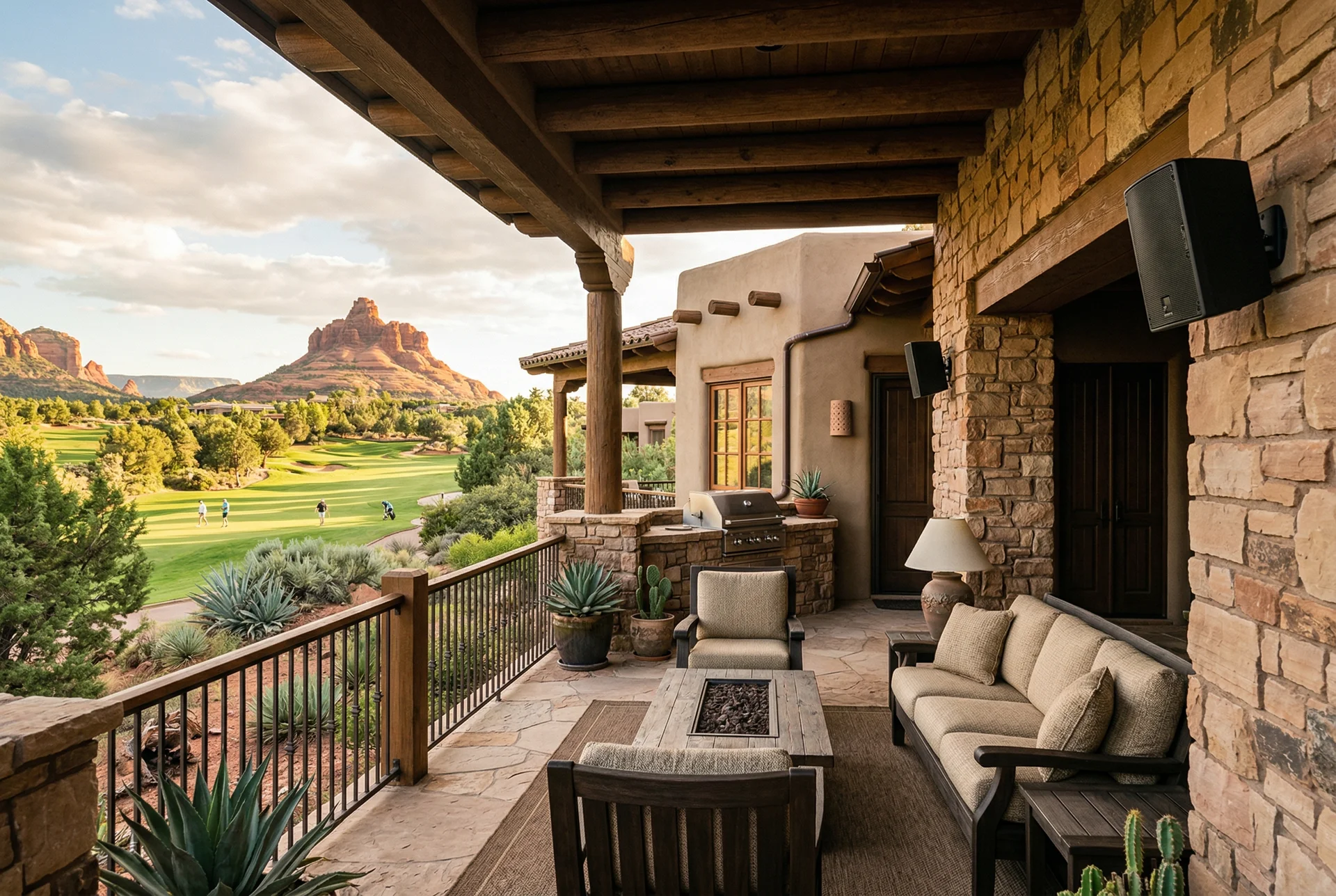
Oakcreek Country Club is one of Sedona's few private golf communities, and its homes line the fairways between Bell Rock and Cathedral Rock. Golf and resort properties in the Sedona area accounted for roughly 18% of residential sales in 2025 (Russ Lyon Sotheby's Sedona, 2025). These homes tend to share a few audio-relevant features: open-concept main floors, large sliding glass doors to patios overlooking the course, and living rooms designed for entertaining.
Open floor plans are the hardest rooms to get right. When your kitchen, dining area, and living room share one continuous space, sound has nowhere to land. Dialogue from a movie gets swallowed by the volume of the room. Music loses definition. Bass either overwhelms the space or disappears entirely depending on where you're sitting.
My approach for these rooms is strategic speaker placement with on-wall speakers positioned to direct sound toward the listening area rather than fighting the entire open space. A properly placed center channel under the TV handles 70% of movie dialogue. Tower speakers or on-wall left and right channels fill the stereo image. And a subwoofer in the right corner smooths out the bass response across the seating area. No speakers in the ceiling for a living room setup. That's not how you get good sound.
What About the Neighborhoods: Las Piedras, Pine Valley, Mystic Hills?
Around 42% of Yavapai County residents are age 55 or older, well above the national average, and many of those retirees cluster in communities like VOC and Big Park (U.S. Census Bureau ACS, 2023). That demographic matters because retired homeowners tend to use their systems differently. More music listening during the day. More two-channel stereo. More emphasis on dialogue clarity for movies and TV. Less interest in shaking the walls with bass.
Las Piedras is a gated community with Territorial-style homes, many with enclosed courtyards and separate casitas. These homes often have dedicated media rooms or dens that are actually sized well for a proper home theater. Pine Valley sits higher up with views toward the Mogollon Rim. Homes there tend to have more traditional layouts with defined rooms rather than wide-open great rooms.
Mystic Hills skews more contemporary. Larger windows, more angular architecture, and open sight lines to the red rocks. These homes behave acoustically more like what I see in West Sedona: reflective, bright, and challenging. They need more careful speaker placement and sometimes acoustic treatment to tame the room.
Big Park, south of the Bell Rock corridor, has larger lots and more space between homes. If you're considering outdoor audio here, you have more flexibility than in a tightly packed gated community. Fewer neighbor concerns, more room for landscape speakers, and bigger patios to fill with sound.
What Does a Custom Home Theater in VOC Actually Include?
Americans now stream an average of 3 hours and 50 minutes of video content per day, with adults over 55 watching the most TV of any age group (Nielsen, 2025). If you're spending that kind of time with your system, it should sound right.
A typical home theater installation in Village of Oak Creek with me looks like this:
- In-home acoustic assessment - I visit your home, listen to the room, and evaluate how sound interacts with your specific walls, floors, windows, and furniture
- Custom speaker design - On-wall or tower speakers built in my Arizona workshop, voiced for your room's dimensions and materials
- Subwoofer placement - Positioned to deliver even bass across your seating area, not just one sweet spot
- Display selection and mounting - TV sized and mounted for your viewing distance, calibrated for Arizona's intense natural light
- Professional calibration - Every speaker measured and tuned in your room after installation
- System programming - One remote or app controls everything, no confusion
Build time for custom speakers runs 6 to 12 weeks depending on the configuration and finish. I take on roughly 15 projects a year across the region, so every system gets the time and attention it needs. No rushing, no subcontractors.
How Do I Get Started?
It starts with a phone call or a message through my contact page. I'll ask about your room, what you're hoping to accomplish, and what you've liked or disliked about audio systems you've owned before. If it sounds like a good fit, we'll schedule an in-home visit so I can see and hear the space firsthand.
There's no hard sell. No pressure to commit on the spot. I'll give you honest recommendations, real pricing, and a clear timeline. If you want to think it over, that's fine. Most of my clients come back when they're ready because they know the plan is solid.
Whether you're in a Las Piedras courtyard home, a Mystic Hills contemporary, a ranch along the Oakcreek Country Club fairways, or a Big Park property with room to breathe, the goal is the same: audio that fits your home, your habits, and the way you actually live.
Schedule a free consultation or call (928) 440-1950 to talk about your Village of Oak Creek or Big Park project.
Frequently Asked Questions
How much does a home theater cost in Village of Oak Creek?
It depends on the room and what you're after. A solid 5.1 system with custom-built on-wall speakers typically starts around $10,000 to $15,000 installed and calibrated. Most VOC clients land in the $15,000 to $25,000 range for a larger system with speakers finished to complement their home's materials. I'll give you real numbers during a free phone call before you commit to anything.
Do you use in-wall speakers?
No. I build on-wall and tower speakers exclusively. In-wall speakers sacrifice sound quality for invisibility, and I'm not willing to make that trade. My custom speakers are designed to look intentional in your room, with finishes that match your decor, while delivering sound that in-wall models simply can't.
Can you work with my builder or designer?
I prefer it. Getting involved during the design or construction phase means we can plan wire runs, speaker locations, and acoustic treatment around the architecture rather than forcing it in afterward. I work with builders and designers regularly across the Sedona area. Reach out early for the best results.
How long does installation take?
Custom speaker builds take 6 to 12 weeks depending on size and finish. The on-site installation itself usually runs one to two days for a standard system. I handle everything from mounting and wiring to final calibration, and I don't leave until the system sounds right in your room.
Comments
Leave a Comment