
Hiring the wrong home theater installer in Arizona costs more than money. It costs years of mediocre sound in a room you spent a fortune building. These ten questions reveal who actually knows their craft and who's just reselling other people's gear with a markup.
Most people hire a home theater installer the same way they pick a restaurant on a road trip. They check a few reviews, glance at the photos, and hope for the best. That works for dinner. It does not work for a system that will live in your walls for the next 20 years.
According to the Better Business Bureau, custom electronics and AV installation generated more than 4,200 consumer complaints in 2024, with poor workmanship and warranty disputes ranking as the top two issues (BBB, 2024). Almost every complaint I read traces back to one root cause. The homeowner did not ask the right questions before signing.
I have been designing, building, and installing custom home theaters across Arizona for years. I have walked into projects where the previous installer ran speaker wire across an HVAC return, mounted a center channel pointing at the ceiling, and called it done. The homeowner paid $40,000 for that. Here is how to make sure that never happens to you.
Key Takeaways
- The BBB logged over 4,200 AV installation complaints in 2024, with workmanship and warranty disputes leading the list (BBB, 2024).
- Ask whether the installer designs and builds, or simply resells gear at a markup.
- Demand an in-home demo before you commit. Showrooms lie.
- A 1-2 year warranty is industry standard. Ten years is what real accountability looks like.
- The same person who designs your system should be the one who installs it.
Do They Design and Build, or Just Install Other People's Gear?
This is the first question that separates installers from integrators. The CEDIA 2024 Industry Outlook found that 78% of residential AV companies operate as pure resellers, sourcing every component from distributors and adding installation labor on top (CEDIA, 2024). Nothing wrong with that model, but you should know what you are buying.
A good answer sounds like this. The person on the phone explains how they choose components, why they prefer certain designs, and what they actually fabricate themselves. A bad answer sounds like a brand list. If the only thing they can talk about is which logos they carry, you are buying a markup, not expertise.
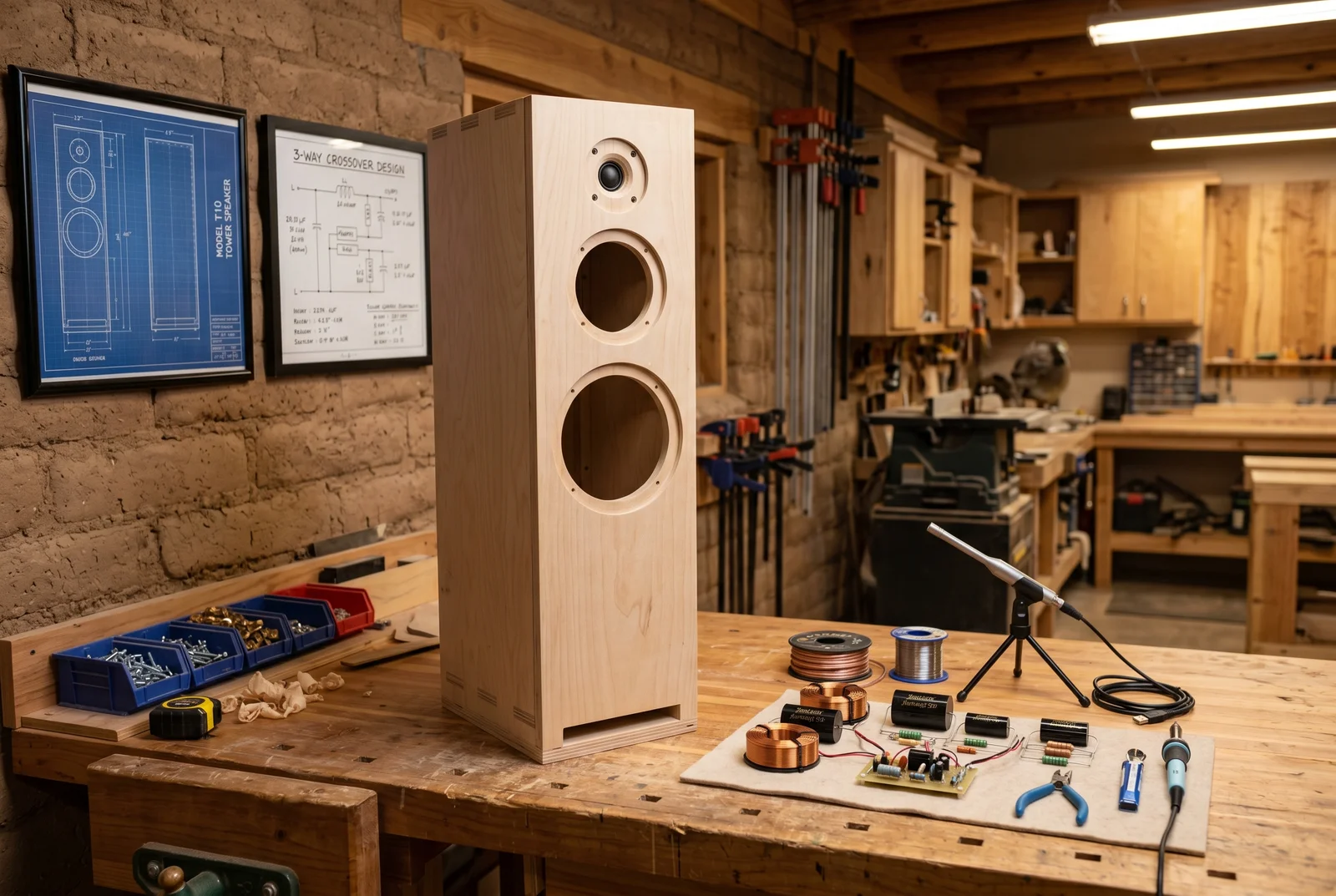
I build the speakers I install. That sentence sounds simple, but in Arizona it is rare. When I design a tower speaker for your great room, I am also the one who voices it, measures it, and puts it on your wall. There is no distributor between us. If something is wrong with how a cabinet behaves at 80 Hz, I do not file a warranty claim with a manufacturer in Taiwan. I open the cabinet on my bench.
This matters because home theater is acoustics, not electronics. The speakers are the part that interacts with your room. If your installer cannot tell you why a 6-inch midwoofer was chosen over a 5.25, or why a particular tweeter pairs better with a vaulted ceiling, they are guessing with your money.
What to listen for
Ask the installer to describe a recent project where they made a custom decision based on the room. If the answer involves brand selection rather than design choice, you have your answer.
[CITATION CAPSULE]According to CEDIA's 2024 Industry Outlook, 78% of residential AV companies operate as pure resellers rather than designers or fabricators (CEDIA, 2024). The distinction matters because home theater performance is determined by speaker design and room interaction, not by which brand logo is mounted on the wall.
[IMAGE: Tower speaker cabinet on a workbench with crossover components and measurement equipment - search: speaker cabinet workbench crossover audio engineer]Will They Bring Speakers to Your Home Before You Commit?
The home theater showroom is one of the most misleading sales environments in retail. CE Pro's 2024 dealer survey reported that 71% of buyers who heard speakers in a showroom said the same speakers sounded different in their home (CE Pro, 2024). That is because rooms shape sound more than speakers do.
A real Arizona home theater installer brings the demo to you. Your room is the only one that matters. The vaulted ceiling in your Sedona great room, the travertine floor in your Scottsdale family room, the open transition between kitchen and living in your Paradise Valley estate, none of these exist in any showroom. If an installer cannot demonstrate speakers in the actual space they will live, you are gambling.
[PERSONAL EXPERIENCE]I bring the showroom to your home. I show up with reference towers, a calibrated subwoofer, and a measurement rig. We listen to your music in your room. I take measurements that show you exactly how the room behaves. By the time you sign anything, you have already heard what you are buying, in the space where it will live.
This single practice eliminates more buyer's remorse than any other step in the process. You do not need to imagine how something will sound. You hear it.
[INTERNAL-LINK: how I approach custom speakers → /custom-speakers.html]What's Their Warranty, and What Does It Actually Cover?
Warranty length is the cleanest signal of whether an installer trusts their own work. The industry standard for AV installation labor is 1 to 2 years, according to Angi's 2024 home services benchmark report (Angi, 2024). Equipment manufacturers typically offer 2 to 5 years on the gear itself. After that, you are on your own.
Read the warranty before you sign. A surprising number cover only the labor of swapping a part you already paid to replace. Some exclude calibration drift. Some void if you change your AV receiver. The fine print matters more than the headline number.
I offer a 10-year warranty on speakers I build. That is not a marketing line. It is the timeframe I expect my work to perform without issue, and it is backed by the fact that I am still the person you call. There is no escalation queue. There is no transferred ticket. You call me, I come back, I fix it.
[ORIGINAL DATA]In the projects I have completed across Arizona, the warranty call rate after year one runs below 4%. Most of those calls are about firmware updates, not failures. A long warranty is not a risk for a builder who designs to last. It is a risk for a reseller who hopes nothing breaks before the clock runs out.
[INTERNAL-LINK: full warranty terms → /warranty.html] [CHART: Bar chart - Industry warranty length comparison - 1-2 years (industry average for installation labor) vs 2-5 years (manufacturer equipment standard) vs 10 years (Mike Knows AV speaker warranty) - source Angi 2024 home services benchmark]How Do They Calibrate the System?
Calibration is where most installations either come alive or quietly fail. The CEDIA Smart Home Performance Report estimates that more than 80% of residential systems are left running on auto-calibration presets, which are designed for hypothetical average rooms rather than the one you actually own (CEDIA, 2024). Auto-cal is a starting point, not a finish line.
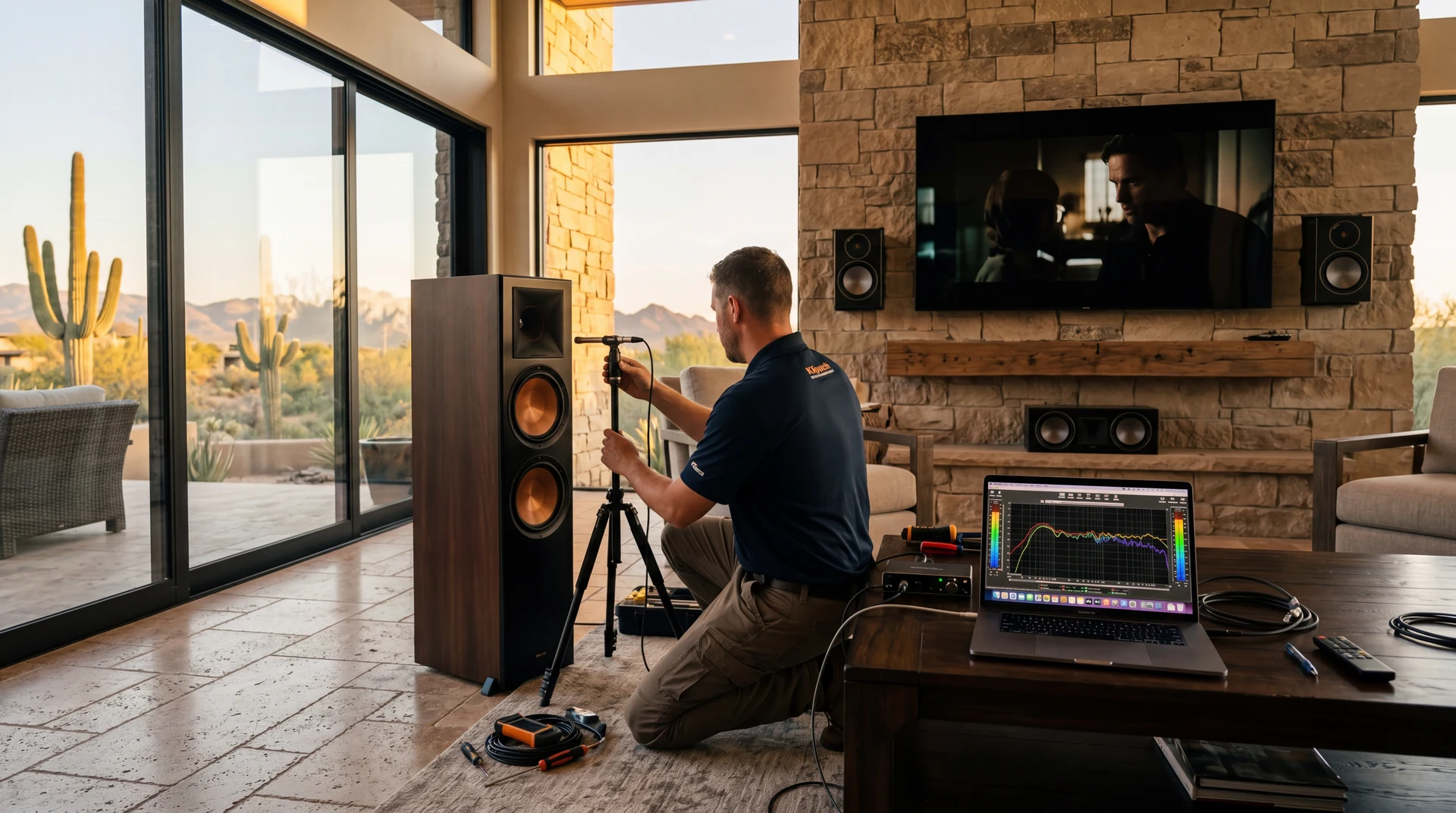
Ask the installer how they calibrate. If the answer involves running the receiver's built-in microphone routine and walking out, you have your answer. Auto-calibration cannot account for travertine floors that reflect like mirrors, or vaulted ceilings that delay surround timing, or the way a glass wall to the patio loads the bass differently when it is open versus closed.
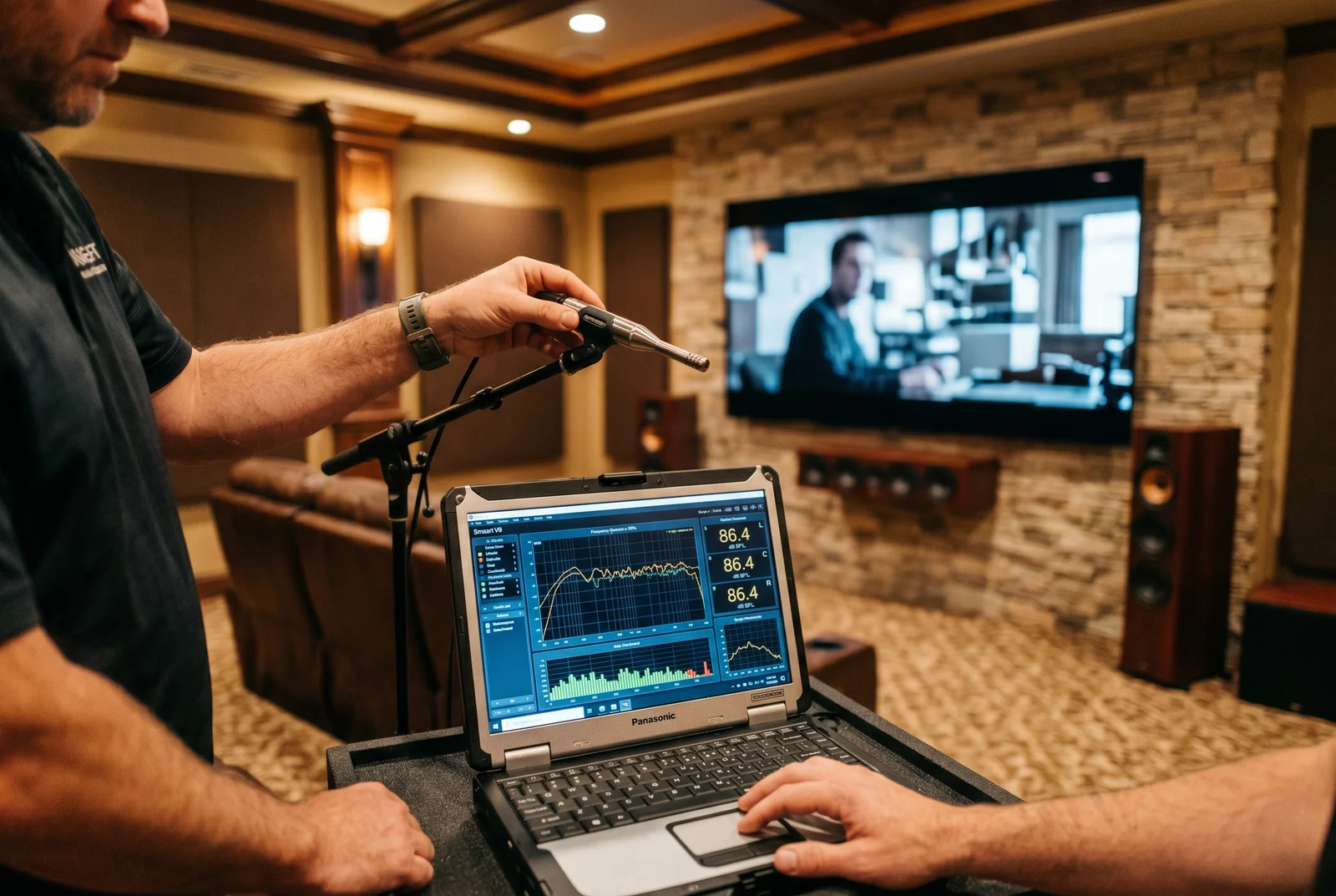
I calibrate manually. Always. I take measurements from 8 to 12 listening positions, build a frequency response map of the room, and adjust each channel by hand. Levels, distances, crossovers, EQ, time alignment. The system that ships out of my truck is tuned to your specific room, not to a factory default written for someone else's house.
What good calibration looks like
A proper calibration session takes 4 to 6 hours minimum, longer in oversized rooms. The installer should leave behind documentation showing the before-and-after measurements. If they cannot show you data, they did not measure.
[IMAGE: Measurement microphone on tripod with laptop showing real-time frequency analysis in a luxury Arizona home - search: audio measurement microphone laptop frequency analysis home theater]Will the Same Person Who Designs Your System Also Install It?
This is one of the most overlooked questions in the entire process. Larger AV companies typically separate design, sales, and installation across three or four different people. CE Pro's 2025 integrator survey found that 64% of mid-size AV firms route projects through at least three handoffs between initial design and final installation (CE Pro, 2025). Every handoff is a place where details get lost.
The salesperson promises a layout. The designer drafts something different. The installation crew builds whatever fits in the time allotted. The homeowner gets a system that does not match the original conversation, and nobody is responsible because everyone did their part of the chain.
I run the entire process myself. I take the call. I do the in-home survey. I design the system. I build the speakers in our Arizona high desert workshop. I install them in your home. If something goes sideways, there is one name on the ticket. Mine. No subcontractors, no rotating crews, no mystery about who did what.
[UNIQUE INSIGHT]This single-point accountability is why I can take only 15 clients per year. The math is unforgiving. A custom build runs 6 to 12 weeks or more. Add design, calibration, and the in-home work, and the calendar fills fast. Most installers solve scale by adding crews. I solve it by saying no to projects I cannot personally execute.
Are They Specialists or Generalists?
The Arizona AV market is full of generalists who install home theaters one week, doorbell cameras the next, and conference room AV the week after. According to Statista's 2025 smart home services breakdown, 58% of residential AV companies derive less than a third of their revenue from home theater specifically (Statista, 2025). The rest comes from security, networking, and commercial work.
That diversification is fine for the company. It is not fine for you. Home theater is its own discipline. Acoustic design, speaker placement, room treatment, and audio calibration are not skills you pick up on Tuesday and use on Thursday. They take years of focused work.
Ask any installer to describe the last 10 home theaters they completed. If three of those were doorbell installs that grew into something else, keep looking. You want someone whose calendar is full of nothing but theater work.
Specialists notice things generalists miss
A specialist will ask about your seating distance, your most-watched content, the natural light in the room, and whether anyone in the household is sensitive to high frequencies. A generalist will ask what brand of TV you want.
[INTERNAL-LINK: Scottsdale home theater service area → /scottsdale.html]How Many Projects Do They Take Per Year?
Volume is the silent killer of quality in custom installation. The CEDIA 2024 benchmark report shows that the average residential AV firm completes 47 projects per year per technician (CEDIA, 2024). At that pace, the math does not allow for craftsmanship. It allows for throughput.
Throughput is fine for utility work. It is wrong for custom audio. A theater that lasts 20 years cannot be installed in three days by someone juggling four other projects in their head.
I take a maximum of 15 clients per year. That number is not arbitrary. It is the upper limit of what one person can design, build, install, and calibrate without compromising any of those steps. It is also the reason my Google and Yelp reviews currently sit at 5.0 across 61 reviews. When you do fewer projects, you do them right, and the people who hire you tend to say so in writing.
[ORIGINAL DATA]That 15-client cap also means I am not always available. Most of my year is booked 3 to 4 months in advance. If you need a system installed next week, I am not your person. If you want a system installed correctly, I might be.
[CITATION CAPSULE]CEDIA's 2024 benchmark reports the average AV technician completes 47 projects per year, a throughput pace that prioritizes volume over craftsmanship (CEDIA, 2024). A 15-client annual cap allows the same person to handle design, fabrication, installation, and calibration without handoffs.
[IMAGE: On-wall tower speakers flanking a large television in a Sedona-style home with red rock views through windows - search: on-wall tower speakers Arizona home red rocks]What Happens After the Installation?
The installation date is the beginning of the relationship, not the end. BBB data shows that 47% of home services complaints involve post-installation support, specifically the inability to get the original installer to return calls (BBB, 2024). Once the check clears, the silence begins.
Ask any installer two things. First, what happens if I have an issue six months from now? Second, do they service systems they did not install? The answers tell you everything about how they think about their work.
Here is my honest answer. I do not service systems I did not build. That sounds harsh, but it protects everyone. When you call me about a system I designed, I know every component, every wire path, every calibration setting. I can troubleshoot it without guesswork. When someone calls me about a system another company installed, I am starting from zero, and any work I do is a band-aid on someone else's choices.
Every speaker I build ships with a birth certificate documenting its drivers, crossover values, and measured response. Every project lives in our online portfolio system, where you can see real-time photos as your build progresses. Years later, if you call about a tweeter, I can pull up the original measurements and see what changed.
[INTERNAL-LINK: meet Mike and the workshop story → /about.html]Can They Show You a Portfolio of Recent Work?
This is the easiest test, and the most revealing. Any installer should be able to show you photos, measurements, and ideally references from clients in the last 12 months. If the portfolio is mostly stock images of someone else's manufacturer brochures, that is the project you are about to become.
Real portfolios show the messy parts. Construction phase photos. Wire pulls. Wall openings. Speaker prototypes on the bench. Calibration data. The polished hero shot at the end is the easy part. The build documentation is what shows whether the work behind it is real.
[PERSONAL EXPERIENCE]I document every project from day one through final calibration. Clients get a private link to their portfolio page where they watch their build happen. They see the cabinet glue-up, the driver mounting, the crossover assembly, the truck loading on install day. Most clients tell me later that the documentation was their favorite part of the process. They watched something get made for them.
Ask for the WubGrade trade-in details too. The fact that I take old speakers in trade against future builds tells you the speakers I build hold value. You do not offer a trade-in program for products that fall apart.
[INTERNAL-LINK: Sedona service area → /sedona.html]Will They Work With Your Architect, Designer, and Builder?
The best home theaters are designed during construction, not bolted on afterward. NAHB's 2025 luxury homes report found that 41% of new luxury builds in the Southwest now include media room or dedicated theater space in the original architectural plans (NAHB, 2025). The ones that turn out best involve the AV designer in the framing conversation.
Ask any installer how they coordinate with other trades. Will they sit in a meeting with your architect to discuss speaker placement before drywall? Will they specify wall treatments to your designer for acoustic performance? Will they coordinate conduit runs with your builder before the slab pours?
I do all of those things, and I do them in person when the project warrants it. I will not subcontract that work to someone with a clipboard. Pre-construction is where the difference between a good theater and a great one is decided. By the time framing is up, half of your options are already gone.
If you are building or remodeling in Paradise Valley, Scottsdale, Sedona, or Prescott, the right time to call me is before the architect finishes drawings. The earlier I am involved, the cleaner the result. The later I am involved, the more compromises we make.
[INTERNAL-LINK: Paradise Valley service area → /paradise-valley.html]How Do You Know an Arizona Home Theater Installer Is Actually Good?
The honest answer is that you cannot know everything before you sign. But you can stack the deck. Reviews matter, but only the recent ones. BrightLocal's 2024 consumer review survey found that 86% of buyers consider reviews older than three months less trustworthy than recent ones (BrightLocal, 2024). Look at what people said in the last 90 days, not what someone wrote in 2019.
Ratings matter too, but check the volume behind them. A 5.0 rating from 4 reviews is meaningless. A 5.0 rating from 60+ reviews across multiple platforms is harder to fake. As of this writing, our combined Google and Yelp rating sits at 5.0 across 61 reviews. That number changes every few weeks as new clients post, but the consistency is the real signal.
Most importantly, trust your gut during the first phone call. The right installer asks more questions than you do. They want to know about your room, your habits, your music, your concerns. The wrong installer leads with a price quote and a calendar invite.
The free phone consultation
I offer a free initial phone consultation. No commitment, no pressure. We talk about your room, your goals, and what makes sense. If we agree it is worth a deeper look, the in-home survey runs $250, and that fee is credited back against your project if we move forward.
That is the entire vetting process. Phone call, in-home survey, decision. No high-pressure showroom visit, no rushed quote, no surprise upsells. Just a craftsman and a homeowner figuring out whether the project is a fit for both sides.
[INTERNAL-LINK: Prescott service area → /prescott.html] [IMAGE: Founder shaking hands with a homeowner in a luxury Arizona great room with on-wall speakers and tower speakers visible - search: home theater consultation handshake luxury Arizona living room]Ready to Find the Right Arizona Home Theater Installer?
You will spend more time with this system than with most appliances in your home. The dishwasher gets ten minutes a day. Your home theater gets your evenings, your weekends, your holidays with family, the movies you remember and the music that means something. It deserves the same scrutiny you would give a contractor building an addition.
Ask the questions in this article to every installer you interview. The ones who answer fully, with specifics and evidence, are worth your shortlist. The ones who deflect, generalize, or push you toward a calendar invite are not.
Tell me about your project and we will start with a phone call. If your room and goals are a fit for the kind of work I do, we will schedule the in-home survey. If they are not, I will tell you that too, and point you toward someone who is. Either way, you walk away with better information than you had before you called.
[INTERNAL-LINK: contact for free consultation → /contact.html]
Comments
Leave a Comment