
Barrett-Jackson just moved $195 million in Scottsdale. The car culture here is real — and so are the garages. If you’ve built a climate-controlled, epoxy-floored showcase space for your collection, the audio should match. Here’s how to get it right.
Barrett-Jackson’s January 2026 Scottsdale auction moved $195 million across 1,911 vehicles with 6,500 registered bidders and a 100% sell-through rate (duPont Registry, 2026). That tells you something about the density of serious car people in this market. And serious car people build serious garages.
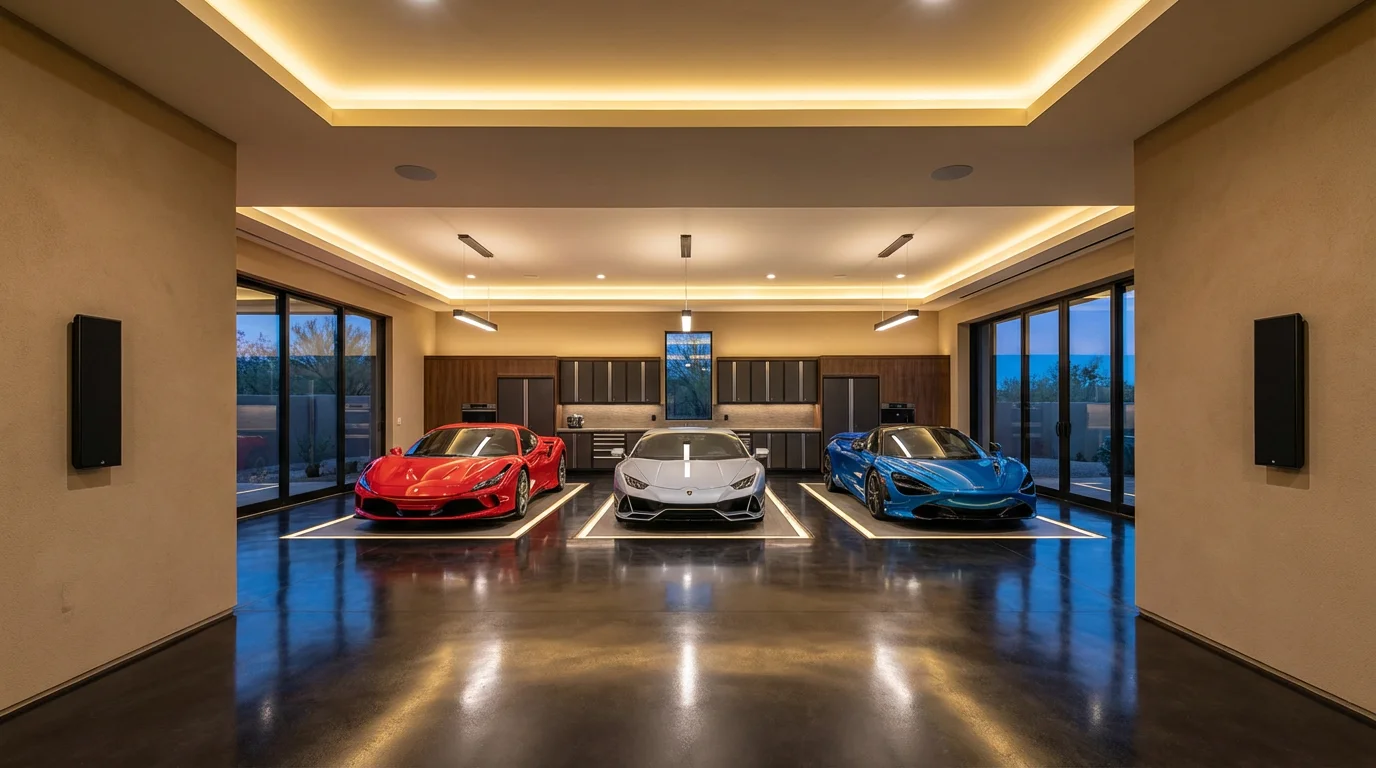
Not the kind with exposed drywall and a bare bulb hanging from the ceiling. I’m talking about climate-controlled, epoxy-floored, LED-lit showcase spaces with custom cabinetry, lifts, detail bays, and lounge areas. Spaces where the finish level matches the rest of the house — because in north Scottsdale and Paradise Valley, the garage often is the house for the people who use it most.
I’m Mike, owner of Mike Knows Audio Video. I design and install luxury garage audio systems that match the investment these homeowners have already made in the space — clean, powerful, and built for how people actually use a high-end garage.
- A finished luxury garage is an extension of the home — the audio should reflect the same level of thought as the lighting, flooring, and cabinetry
- Collector car auction sales hit $4.8 billion in 2025, up 10% (Hagerty, 2025) — the hobby is growing and so are the spaces that house it
- Garages have unique acoustic challenges: hard reflective surfaces everywhere, open volumes, and mechanical noise to compete with
- On-wall and ceiling speakers with independent zone control let you tailor audio for the showroom floor, the workbench, and the lounge separately
Why a Luxury Garage Needs Purpose-Built Audio
A Bluetooth speaker on the workbench is fine for a standard garage. But you didn’t spend six figures on epoxy floors, custom lifts, and climate control to listen to a three-inch driver rattling on a steel shelf. The same homeowners who wouldn’t tolerate a cheap speaker in their living room somehow accept one in the room where they spend their Saturday mornings.
The issue isn’t just quality — it’s coverage. A luxury garage is a big, open, acoustically challenging space. Concrete floors. Metal doors. Glass display cases. Drywall or metal panel walls. Every surface is hard and reflective. Sound bounces everywhere, which means a single speaker source creates echoes, dead spots, and a muddy mess at any real volume.
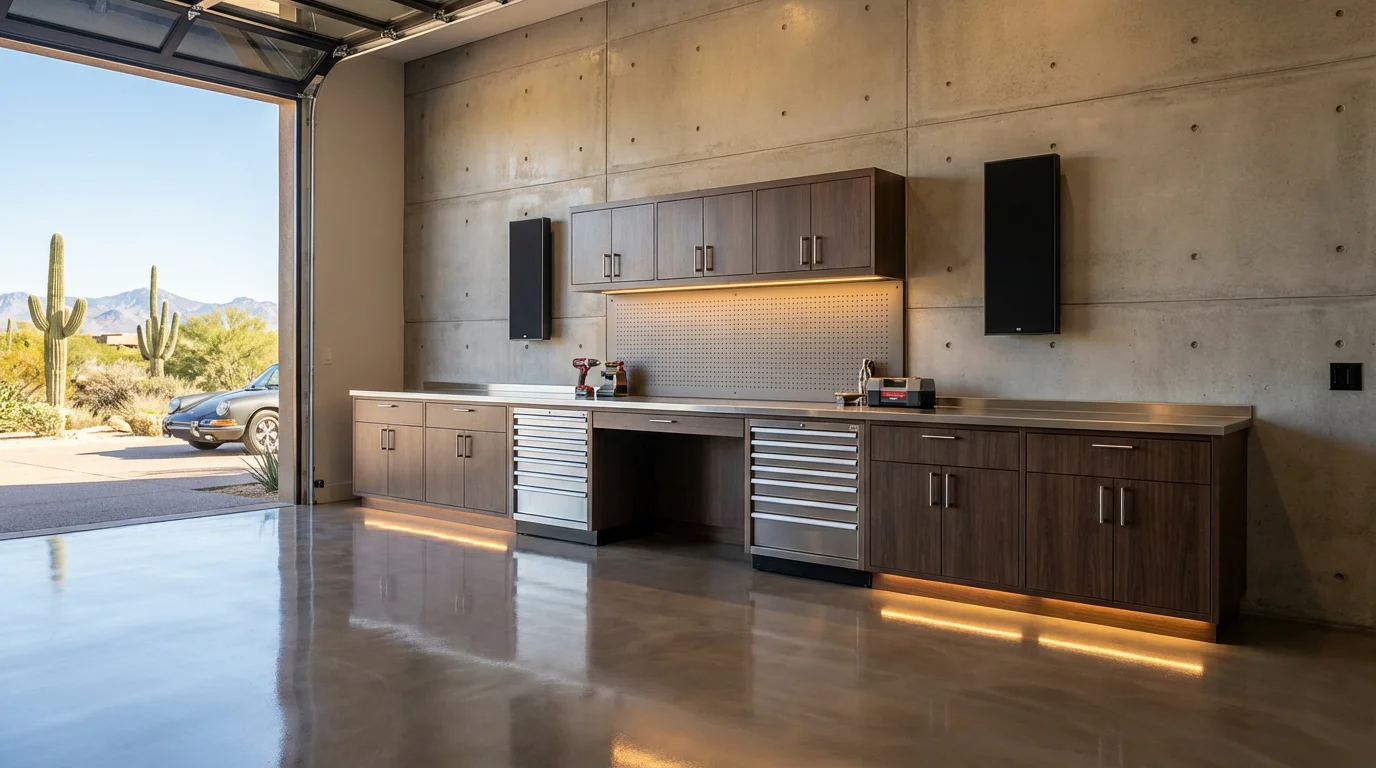
A purpose-built garage audio system solves this with proper speaker placement, enough drivers to cover the full space evenly, and calibration tuned for the room’s specific surfaces and dimensions.
How I Design a Luxury Garage Audio System in Scottsdale
US consumers spent $52.65 billion on specialty automotive equipment in 2024 (SEMA, 2025). Audio for the space that houses the collection is a natural extension of that investment. Here’s how I approach it.
Every garage project starts with understanding how you actually use the space. That sounds obvious, but it matters more here than in almost any other room. A garage that’s primarily a showroom for friends and guests has different needs than one that’s a working detail bay. A garage with a lounge area in the back needs a separate zone from the main floor. Some clients want background music while they wrench; others want concert-level sound for Saturday morning listening sessions with the bay doors open.
From that conversation, I design a zone-based system:
Main Floor / Showroom
This is the biggest area and the one guests see first. I mount weather-rated on-wall speakers along the perimeter walls, positioned to project sound evenly across the full floor without creating hot spots or echo clusters. The on-wall format keeps speakers off the floor where they’d compete with cars, lifts, and cabinetry for space. Up to four ceiling speakers supplement the on-walls for ambient fill if the ceiling height allows, but the on-walls do the heavy lifting.
Workbench / Detail Bay
If you have a dedicated work area, it gets its own zone with a pair of compact on-wall speakers aimed at the bench. Independent volume control means you can have focused music at the workbench while keeping the main floor quieter — or off entirely. This is the zone you’ll use most on weekday evenings when it’s just you and a project.
Lounge Area
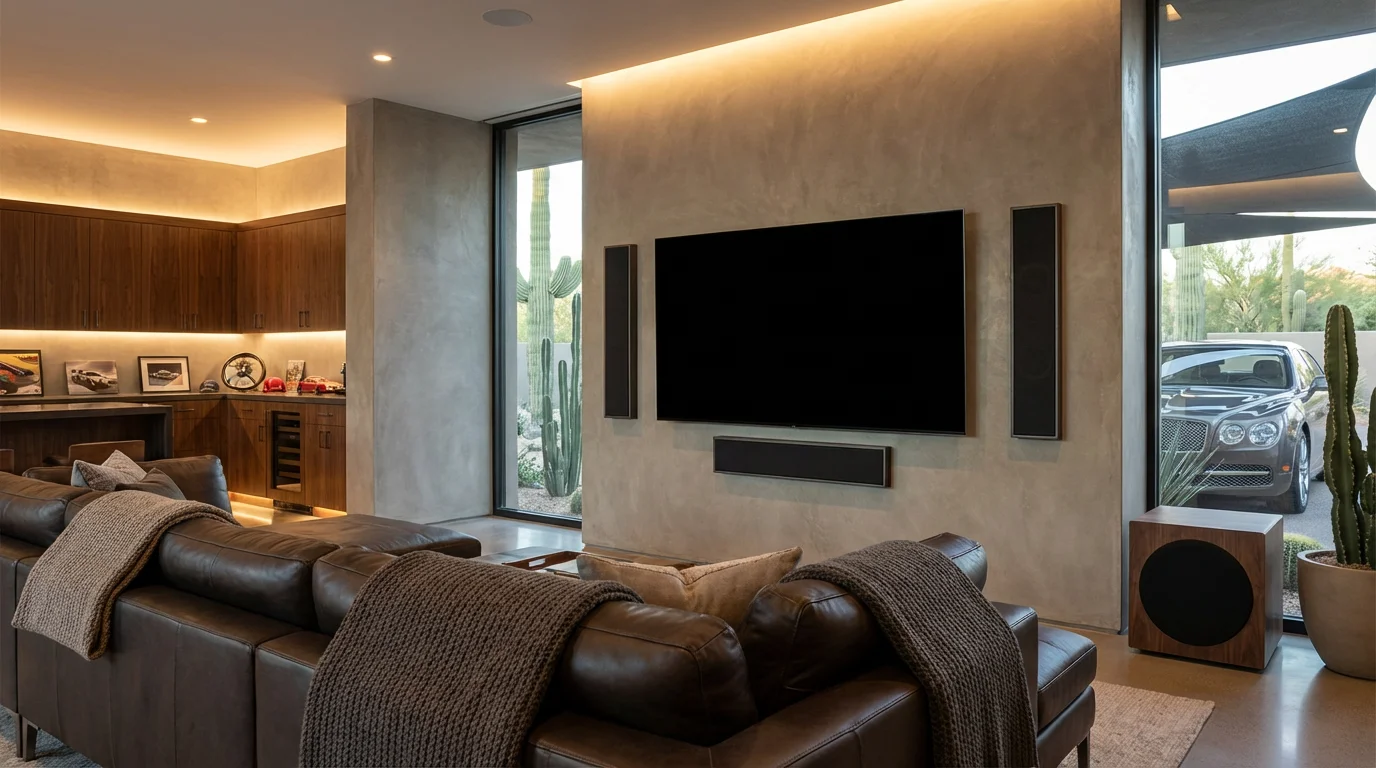
A lot of high-end Scottsdale and Paradise Valley garages include a sitting area — a couch, a mini fridge, a TV, maybe a bar top. This zone gets its own pair of on-wall speakers and, if you want, a small subwoofer tucked in a corner for music depth. It’s essentially a small listening room within the larger garage, and I treat it that way acoustically.
The Acoustic Challenges of a Garage
Garages fight audio harder than most rooms in the house. Here’s why, and what I do about it:
- Concrete and epoxy floors — These are perfectly reflective surfaces. Sound bounces off them with almost zero absorption. I compensate with speaker positioning angles that minimize floor reflections and with DSP calibration that accounts for the room’s reflective character
- Metal garage doors — When closed, these act as massive reflective panels. When open, the room acoustics change completely. I tune systems for the closed-door condition (how you’ll use it most) and design speaker placement that still sounds good with doors open
- High ceilings and open volume — Most luxury garages have 10- to 14-foot ceilings. Sound dissipates quickly in tall open spaces, which means you need more speaker coverage than a standard-height room. Ceiling speakers help fill the vertical space while on-walls handle the horizontal
- Mechanical noise — Lifts, compressors, HVAC systems, and the occasional engine start all compete with the audio. A properly powered system with clean headroom handles this without distortion — it doesn’t have to strain to be heard over a compressor cycling on
What About Open Bay Doors?
This comes up in every Scottsdale garage project. The answer is: it depends on how you use them.
When you open a garage bay door, you lose one wall of the room. Acoustically, you’re now playing into an open-air space, which means low frequencies disappear fast and the overall volume drops. If you regularly have the doors open — detailing with natural light, hosting guests with the bay doors up — I design for that scenario specifically. Speakers angled to project inward rather than toward the opening. Extra coverage from ceiling speakers to maintain fill when the room changes shape. And the system gets calibrated for both configurations so you can switch a preset instead of fighting the volume knob.
If the doors are almost always closed and the garage is a sealed, climate-controlled showcase, the design is simpler and the sound quality is actually better because the room behaves predictably.
Integration with the Rest of the House
I design garage audio as part of the whole-home system, not as an isolated installation. That means:
- The garage zones appear in the same app you use for the living room, patio, and bedroom
- You can group the garage with the patio for a party or keep it independent
- Music follows you from the kitchen to the garage to the patio without switching apps or sources
- A TV in the garage lounge area can be integrated for game day or background viewing while working
No separate Bluetooth pairing. No standalone system with its own remote. Just another zone in the house that happens to have cars in it.
Scottsdale’s Car Culture Deserves Better Audio
Collector car auction sales hit $4.8 billion in 2025, up 10% year-over-year, with seven-figure sales alone cracking $1 billion for the first time (Hagerty via Motorious, 2025). Scottsdale is the epicenter of that culture — Barrett-Jackson, Arizona Concours, Cars and Coffee every weekend. The people who live here and collect at this level take their garages as seriously as any room in the house. The audio should hold up to that standard.
Frequently Asked Questions
How much does a luxury garage audio system cost?
It depends on the size of the garage, the number of zones, and the speaker quality. A single-zone system for a 3-car garage is significantly less than a multi-zone installation with a lounge area and whole-home integration. I provide a detailed quote after walking the space. Schedule a consultation and I’ll give you a clear picture.
Will the speakers survive Arizona garage heat?
If your garage is climate-controlled — and most luxury garages in Scottsdale are — standard high-quality speakers handle the environment fine. For non-climate-controlled garages or transition areas near bay doors, I use weather-rated speakers built for temperature extremes. Either way, the speakers I install are chosen for this specific environment.
Can I add a TV or display to the garage system?
Yes. A lot of my garage projects include a display in the lounge area for game day, detailing tutorials, or just background viewing while working. I integrate it into the same audio system so the TV audio plays through the proper speakers, not its own built-in ones.
Can the garage audio connect to the patio if I open the bay doors?
Absolutely. If your patio or driveway area has its own outdoor audio zone, I can group it with the garage so the music extends right outside when the doors are up. When you close them, the zones separate again automatically or with one tap.
Do you serve Paradise Valley for garage audio?
Yes. Paradise Valley has some of the most impressive private garages in the state — multi-bay builds with car lifts, detail bays, and lounge areas that rival any commercial showroom. I’d enjoy seeing your space. Get in touch to set up a walk-through.
Your Garage Is a Room — Treat It Like One
You didn’t cut corners on the floor, the lighting, the lifts, or the climate control. The audio is the finishing touch that turns a beautiful garage into a space you actually want to spend time in — whether that’s an hour on a Saturday or every evening after work.
Schedule a free consultation or visit the Scottsdale service area page to learn more about what I do in the area.
Comments
Leave a Comment