
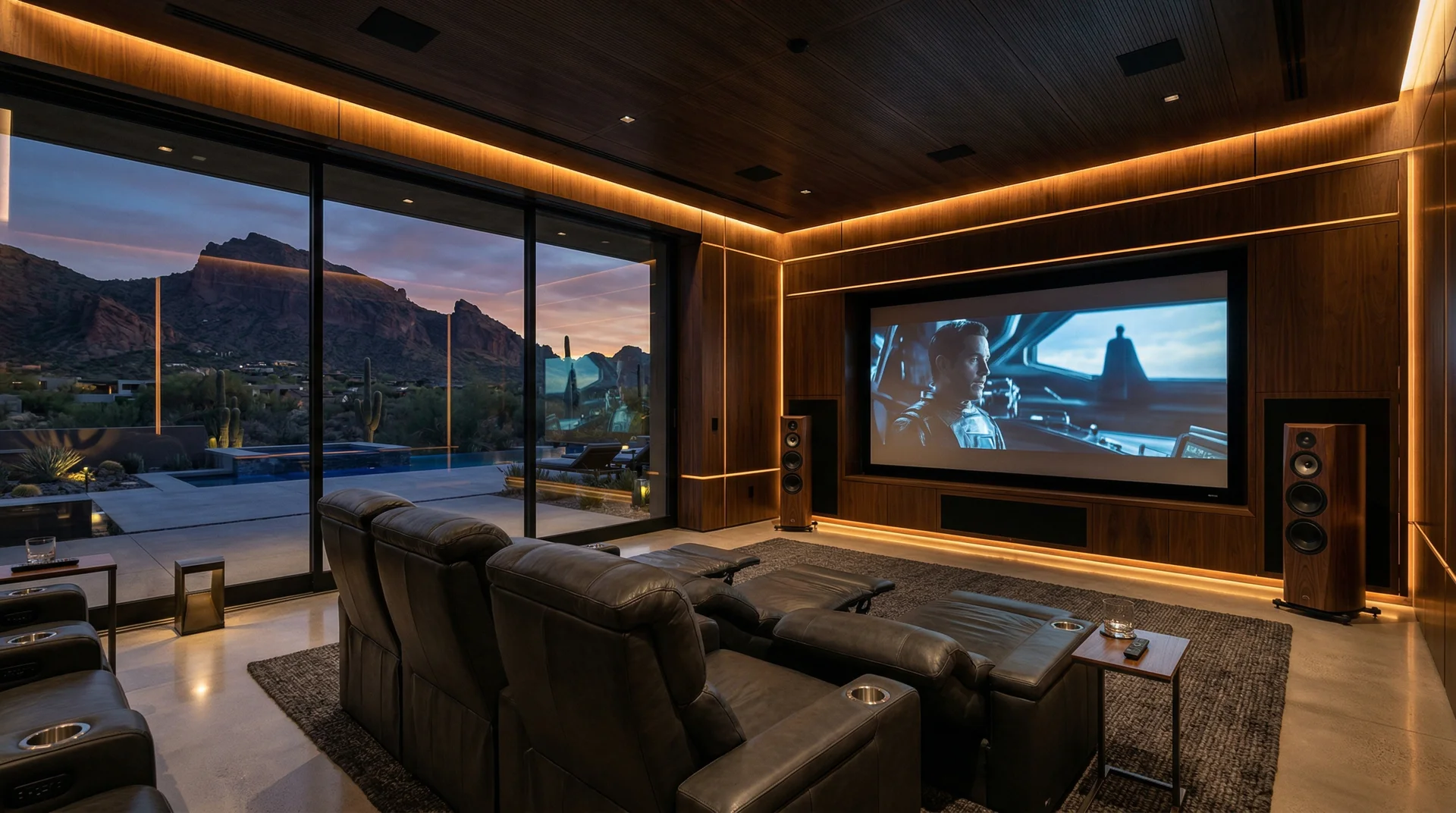
Each Scottsdale luxury community presents different acoustic challenges. DC Ranch's open contemporary plans, Silverleaf's architect-driven custom estates, and Troon's glass-walled hilltop homes all demand unique speaker placement and acoustic strategies. Here's how I approach each one.
Nearly half of luxury home buyers now rank a dedicated home theater as essential or highly desirable in their next purchase (NAHB, 2024). In Scottsdale's top communities, that demand runs even higher. But here's what most installers miss: a home theater that works in DC Ranch won't necessarily work in Silverleaf, and neither approach translates to a hilltop home in Troon. The architecture is different. The acoustics are different. The design expectations are different.
I'm Mike, and I design and build custom home theater systems for Scottsdale estate homes. After working in these communities, I've learned that community-specific knowledge isn't optional. It's the difference between a system that sounds incredible and one that fights the room it's in.
Why Does Each Scottsdale Community Need a Different Home Theater Approach?
Scottsdale's luxury communities aren't interchangeable. DC Ranch homes sold at a median of approximately $1.45 million in 2025, while Silverleaf estates routinely trade above $5 million (Redfin, 2025). But the real difference isn't price. It's architecture. Each community has a dominant building style that creates specific acoustic problems, and those problems require specific solutions.
I've worked in all three communities, and the pattern is consistent. Builders in each area favor certain materials, ceiling heights, and floor plans. Those choices ripple directly into how sound behaves in the room. Ignoring that context is how you end up with a $50,000 audio system that sounds thin and echoey.
What follows is a community-by-community breakdown of what I've encountered and how I solve for it.
How Do DC Ranch's Open Floor Plans Affect Home Theater Sound?
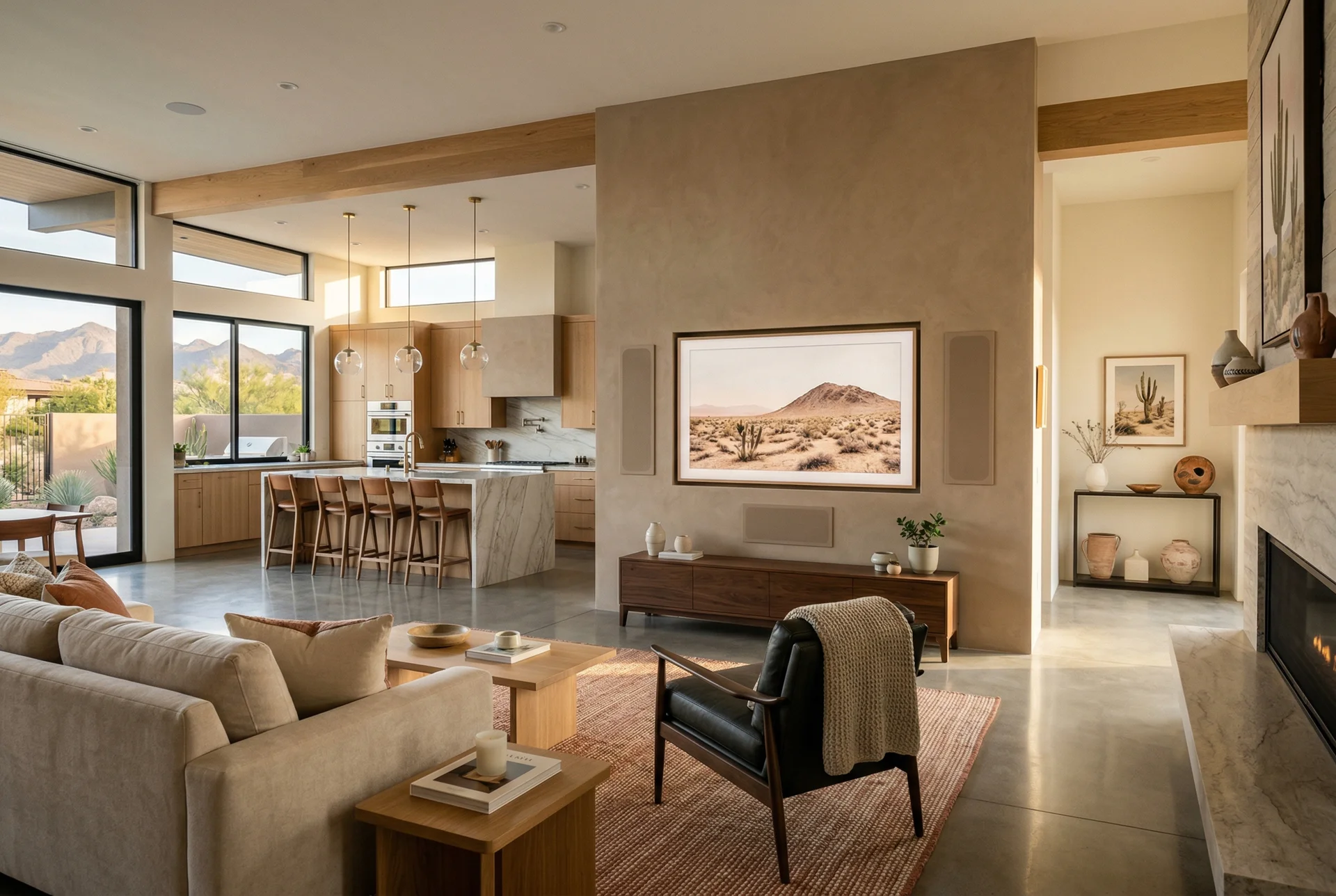
DC Ranch's architectural identity leans contemporary desert. Think open great rooms with 12 to 14-foot ceilings, polished concrete or large-format tile floors, steel accents, and minimal walls between living spaces. According to Parks Associates, 53% of U.S. broadband households earning $150,000 or more own three or more connected entertainment devices (Parks Associates, 2025). In DC Ranch, those devices are scattered across wide-open rooms that were never designed with acoustics in mind.
The core challenge? Sound has nowhere to stop. In a traditional room with four walls and a standard ceiling, sound waves bounce predictably. In a DC Ranch great room that opens into the kitchen, dining area, and hallway, bass bleeds everywhere. Dialogue from the center channel scatters across hard surfaces. You get volume without clarity.
Speaker Placement Strategy for DC Ranch Homes
I approach DC Ranch rooms with custom on-wall speakers positioned on the room's solid surfaces, typically the media wall and adjacent side walls. Tower speakers work well here too, anchoring the front soundstage with authority that smaller speakers can't deliver in a room this size. The center channel goes under the display, matched to its width for even dialogue dispersion.
In one DC Ranch project, the great room was 22 feet wide with an open staircase on one side. Standard placement rules went out the window. I ended up using asymmetric speaker positioning with DSP correction to compensate for the uneven wall surfaces. The calibration took three sessions. But the result was a system that sounds balanced from every seat, even the kitchen island 30 feet away.
Acoustic panels along the first reflection points make a dramatic difference in these open rooms. I spec panels that match the room's design, not generic studio foam. In DC Ranch's contemporary aesthetic, that usually means fabric-wrapped panels in neutral tones mounted at strategic heights.
What Makes Silverleaf Homes the Most Demanding for Audio Design?
Silverleaf is the pinnacle of Scottsdale residential architecture. Homes here regularly sell between $5 million and $30 million, and many are designed by nationally recognized architects (Russ Lyon Sotheby's, 2025). That means every surface, every material, and every sightline has been specified by someone with strong opinions. Walking in with a rack of generic speakers and a standard install template won't cut it.
The defining challenge in Silverleaf is design integration. These aren't homes where you can mount a speaker wherever the acoustics want it and call the job done. The architect specified that stone wall. The designer chose that lighting scheme. The homeowner approved a furniture plan that took six months to finalize. The audio system has to perform at the highest level while respecting all of those decisions.
Working Within an Architect's Vision
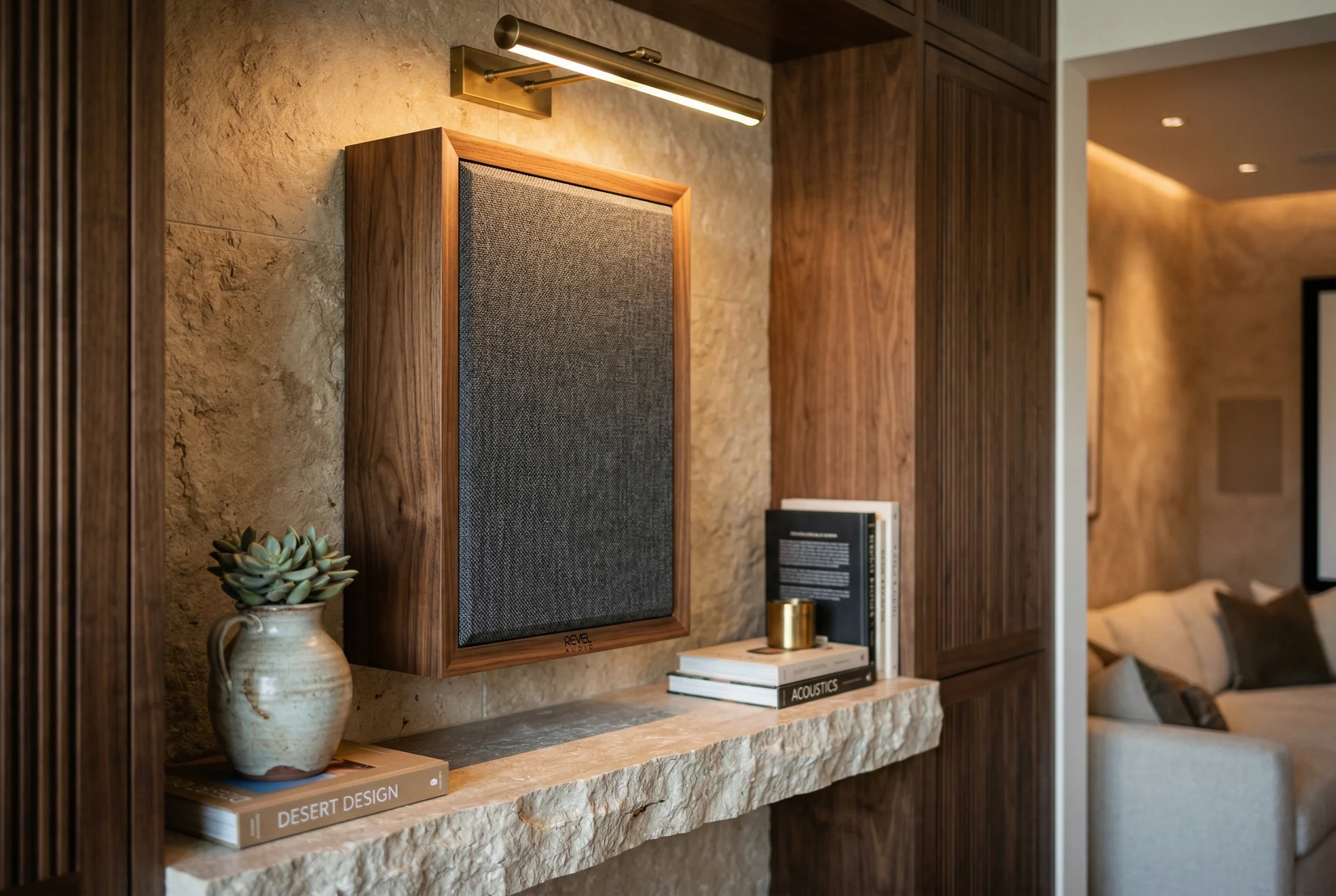
Most AV installers treat the architect's plans as an obstacle. I treat them as a design brief. If the architect specified a clean media wall with no visible hardware, that tells me we need slim-profile on-wall speakers with custom color-matched finishes. If the great room features a floor-to-ceiling fireplace as the focal point, the center channel and display positioning have to honor that hierarchy. The audio system should feel like it belongs, not like it was added after the fact.
Custom speaker finishes are non-negotiable in Silverleaf. I build WubWub Audio speakers with cabinet finishes tailored to match specific stone, wood, or paint palettes. A walnut-veneered tower speaker next to a walnut built-in looks intentional. A black box speaker in the same spot looks like a mistake.
How Do You Handle Troon's Glass-Heavy Hilltop Architecture?
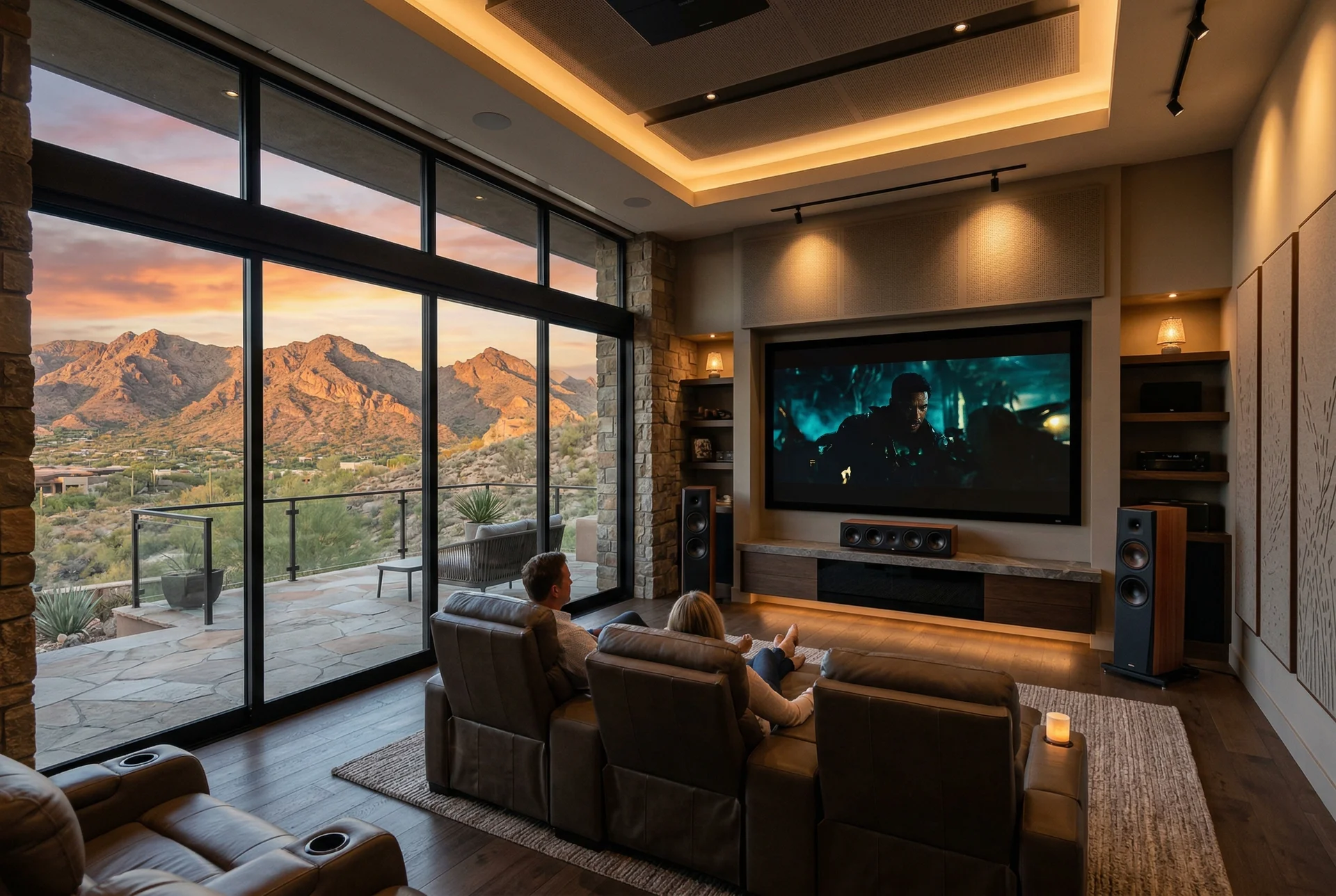
Troon and Troon North sit on some of Scottsdale's most dramatic terrain. Hilltop lots with panoramic views of the McDowell Mountains and the city below. The Cromford Report noted that north Scottsdale luxury inventory above $3 million remained under four months of supply throughout 2025 (Cromford Report, 2025). These homes sell fast precisely because of their views. And those views mean glass. Lots of glass.
Glass is one of the most challenging surfaces in residential acoustics. It reflects high and mid-frequency sound almost perfectly, creating harsh echoes, flutter effects, and an overall bright, fatiguing sound signature. A room with two walls of floor-to-ceiling glass behaves more like a racquetball court than a listening room.
Acoustic Solutions for Glass-Walled Rooms
I don't ask Troon homeowners to cover their views. That defeats the purpose of buying the lot. Instead, I work with what the room gives me. On-wall speakers go on the solid walls, positioned to project sound across the room rather than directly into the glass. Strategic acoustic treatment on the ceiling and any available solid surfaces absorbs enough reflected energy to tame the room without blocking sightlines.
Calibration matters more in glass-heavy rooms than anywhere else. I run multiple measurement passes from every primary listening position and use DSP correction to flatten the response across the full frequency range. The glass will always influence the sound. The goal is to account for it precisely rather than pretend it isn't there.
Has a Troon hilltop home ever made me rethink my entire approach? Once. The room had glass on three sides. I ended up treating the ceiling as the primary acoustic surface and using tower speakers angled slightly inward to minimize direct reflections off the side glass. It worked. But it took planning that a standard installation template would never account for.
What Role Does Acoustic Treatment Play in Desert Luxury Homes?
The American Society of Interior Designers reports that hard surface flooring now appears in 78% of new luxury homes nationally (ASID, 2024). In Scottsdale, I'd put that number closer to 95%. Tile, polished concrete, natural stone. Carpet is rare. Add glass walls, minimal window treatments, and open floor plans, and you have rooms that are acoustically brutal without intervention.
Acoustic treatment in a luxury home doesn't mean studio foam on the walls. It means purpose-designed panels that handle first reflections, bass traps integrated into architectural details, and sometimes acoustic plaster on ceilings that looks identical to standard finishes but absorbs sound. The treatment should be invisible to anyone who doesn't know it's there.
In my experience, about 80% of the sonic improvement in a Scottsdale estate home comes from getting three things right: speaker placement, the first reflection points on walls, and bass management in the corners. Everything else is refinement. Those three elements transform the room.
Should You Plan Home Theater During Construction or Retrofit Later?
The answer is both, depending on your situation. But the math strongly favors planning during construction. Wire routing, equipment closet placement, structural backing for displays, and acoustic treatment integration all cost a fraction during the build phase compared to a retrofit. For new construction in DC Ranch, Silverleaf, or Troon, I coordinate directly with your builder and design team from schematic design through final walkthrough.
Retrofit is absolutely possible. I've installed complete theater systems in existing Scottsdale homes without tearing open walls. On-wall speakers don't require in-wall cavities. Equipment can be centralized in a closet with HDMI distribution to every room. The result is a clean, professional installation that looks like it was always part of the home.
Either way, plan for a timeline of 6 to 12 weeks or more. Custom speaker fabrication alone takes time. I build every WubWub Audio speaker by hand in my Arizona workshop, and I won't rush a build to meet an arbitrary deadline. The warranty and service commitment I put behind every system depends on getting the build right the first time.
Frequently Asked Questions
What makes home theater installation different in DC Ranch versus Silverleaf?
DC Ranch homes tend toward contemporary desert architecture with open floor plans, exposed steel, and polished concrete. These spaces need careful speaker placement to handle reflective surfaces and large volumes. Silverleaf homes are architect-driven custom estates where the audio system must integrate with a design vision curated down to the doorknobs. Both need acoustic treatment, but the approach differs significantly.
Can you install a home theater in a Troon hilltop home with floor-to-ceiling glass?
Yes, though glass walls are one of the toughest acoustic challenges in residential work. Glass reflects sound almost as aggressively as concrete. I use strategic on-wall speaker placement on solid walls, acoustic panels where the design allows, and careful calibration to compensate. The views are worth keeping. The audio system works around them.
Do you work with Scottsdale luxury home builders during construction?
That's the ideal scenario. Getting involved during schematic design means speaker placement, wire routing, and equipment locations are planned around the architecture from the start. I coordinate regularly with builders and design firms across north Scottsdale. For existing homes, retrofit is possible, it just requires more creative solutions.
Why do you use on-wall speakers instead of in-wall in luxury homes?
In-wall speakers compromise sound quality for concealment. They're sealed inside wall cavities that weren't engineered as speaker enclosures, which degrades bass and midrange clarity. My custom on-wall and tower speakers deliver audiophile-grade performance while mounting flush and clean. In a home where every other detail is premium, the speakers shouldn't be the weak link.
How long does a luxury home theater project take in Scottsdale?
Plan for 6 to 12 weeks or more depending on scope. Custom speaker fabrication, acoustic treatment, and calibration all take time. For new construction, I align with your builder's schedule. Retrofits in existing homes sometimes move faster since the room is already accessible. Reach out early so we can plan the timeline together.
The Right System for Your Community
DC Ranch, Silverleaf, and Troon are three of the best places to live in Scottsdale. Each one demands something different from a home theater system. The common thread? Every one of these homes deserves audio that matches the thought and investment that went into the architecture, the finishes, and the views.
I take on about 15 projects a year across the Valley. That's intentional. Each system gets my full attention from the first site visit through final calibration. If you're building or renovating in one of these communities and want to get the audio right, I'd enjoy hearing about your project.
Schedule a free consultation or call (928) 440-1950 to start the conversation.
Comments
Leave a Comment