
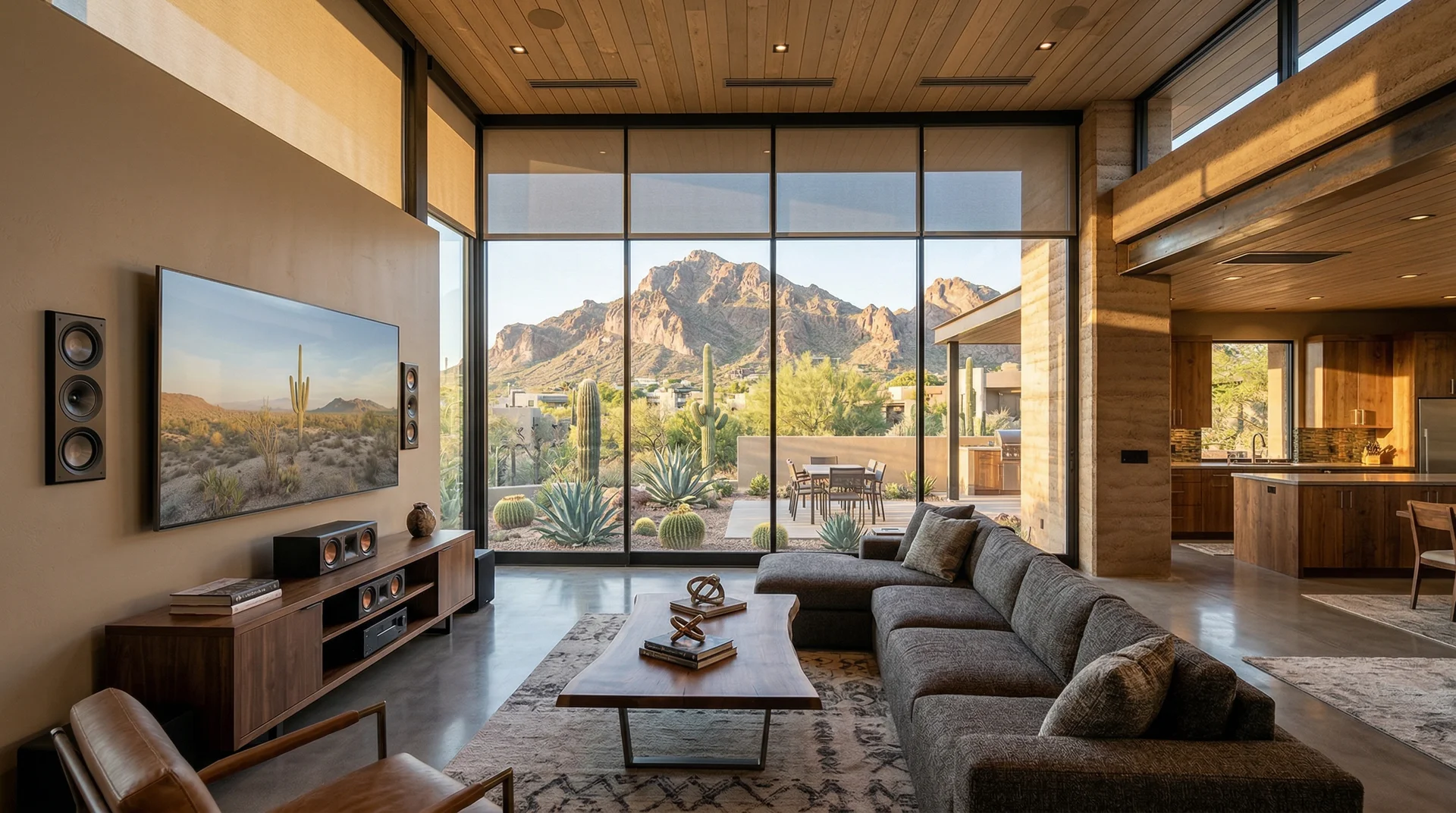
Most Paradise Valley homes are open-concept, which makes dedicated theater rooms rare unless purpose-built. Here's how to get real theater sound in a great room, when a dedicated space makes more sense, and why on-wall speakers outperform in-ceiling in open floor plans.
Most Paradise Valley homes are built around open floor plans, floor-to-ceiling glass, and sight lines that stretch from the kitchen island to the backyard. That's great for entertaining. It's terrible for sound. Here's how to decide between a media room and a dedicated theater, and how to make either one deliver real performance.
About 84% of new single-family homes in the US are built with open or partially open floor plans (NAHB, 2023). In Paradise Valley, that number feels closer to 100%. The architectural DNA here runs toward expansive great rooms, vanishing-edge glass walls, and indoor-outdoor flow. Stunning to look at, genuinely difficult to fill with controlled, accurate sound.
I'm Mike, owner of Mike Knows Audio Video. I build custom speakers and design home theater systems across Arizona. In Paradise Valley specifically, I've worked in enough open-concept estates to know that "media room vs. dedicated theater" isn't just a preference question. It's an architecture question. And the answer shapes everything that comes after it.
What's the Real Difference Between a Media Room and a Dedicated Theater?
The global home theater market reached $9.4 billion in 2024 and is projected to hit $15.5 billion by 2032, growing at 6.4% annually (Fortune Business Insights, 2024). That growth is split across two very different approaches: media rooms and dedicated theaters. Understanding the distinction matters because each demands a completely different design strategy.
A media room is a shared-use space. It's your great room, living room, or family room that also happens to have a serious audio and video system. Lights come in from windows. People walk through. The kitchen is twenty feet away. You're designing around the room as it exists.
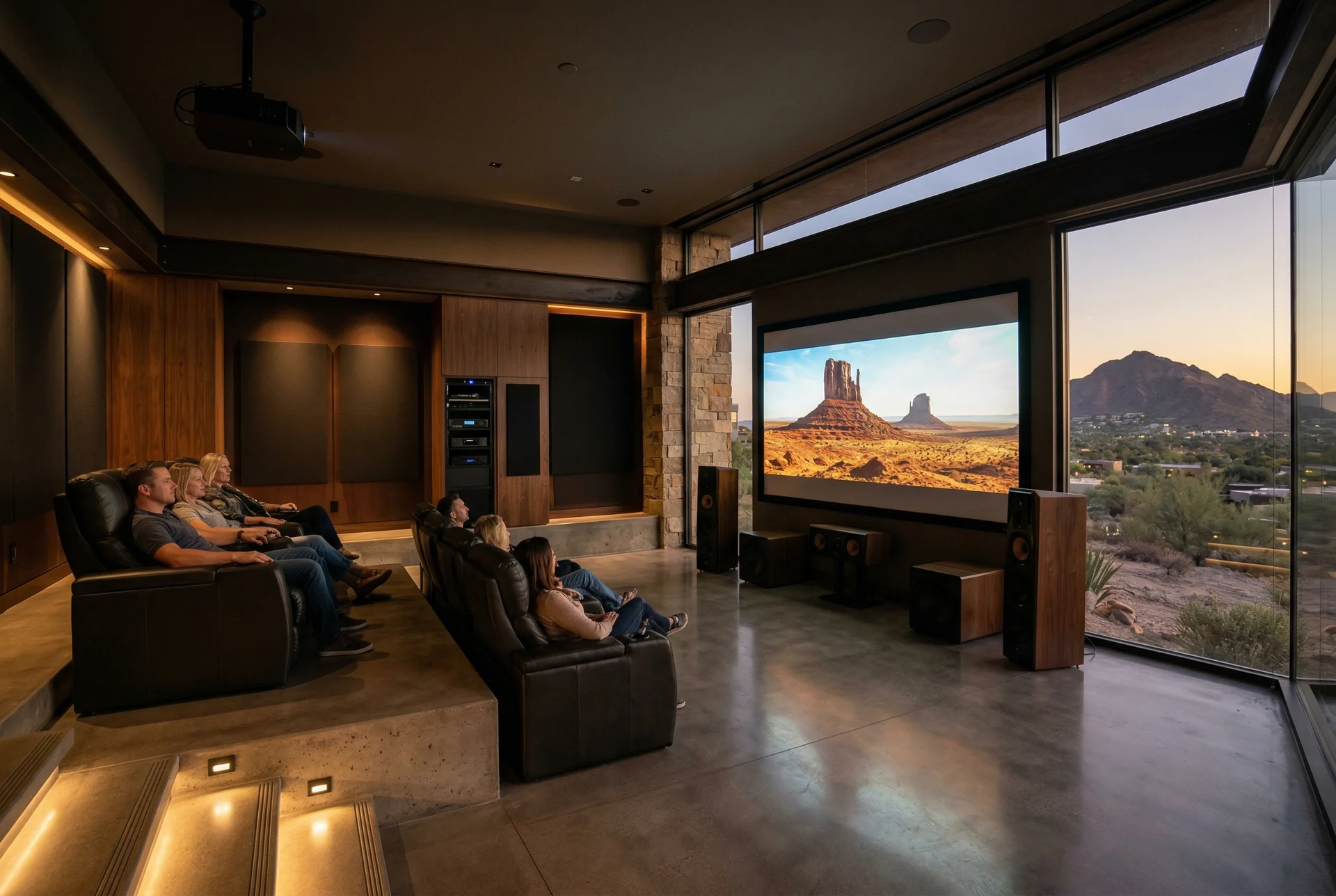
A dedicated theater is a purpose-built, light-controlled, acoustically isolated room. No windows. Dedicated seating. The room exists for one purpose: watching and listening. In Paradise Valley, this almost always means either converting an existing bonus room or including one in new construction.
Neither is inherently better. But in PV's open-concept landscape, the media room approach is far more common, and it requires a different set of solutions than a sealed box.
Why Do Paradise Valley Homes Lean Toward Media Rooms?
Paradise Valley is one of the wealthiest municipalities in the country, with a median household income above $235,000 (US Census Bureau ACS, 2023). That buys a lot of house. But the architecture here favors openness over compartmentalization. Desert contemporary, mid-century modern, and Santa Fe styles all prioritize sight lines, natural light, and connection to the landscape.
That design philosophy is the reason most PV clients don't have a spare windowless room to convert into a theater. What they have is a 30-foot-wide great room with 14-foot ceilings, a fireplace, a wall of glass facing Camelback Mountain, and a 85-inch TV that sounds like it's playing through a tin can because the builder ran some cheap in-ceiling speakers and called it a day.
I've walked into dozens of these homes. The story is almost always the same: the builder's electrician ran speaker wire to the ceiling during rough-in, dropped in some generic 6.5-inch in-ceiling cans, and the homeowner has been underwhelmed ever since. The system technically works. It just doesn't sound like anything worth sitting down for.
So the real question for most PV homeowners isn't "should I build a theater?" It's "how do I get theater-quality sound in the room I already use every night?"
How Do You Get Theater Sound in an Open-Concept Living Room?
The ambient light rejecting (ALR) screen market is projected to reach $3.2 billion by 2030, growing at 8.1% CAGR (Grand View Research, 2024). That growth tells you something: more people are putting projectors and high-performance displays in rooms that aren't pitch-dark. The technology to do it well actually exists now. The audio side takes more thought.
Here's what a serious media room design looks like in a Paradise Valley great room:
Video: Managing Light Instead of Eliminating It
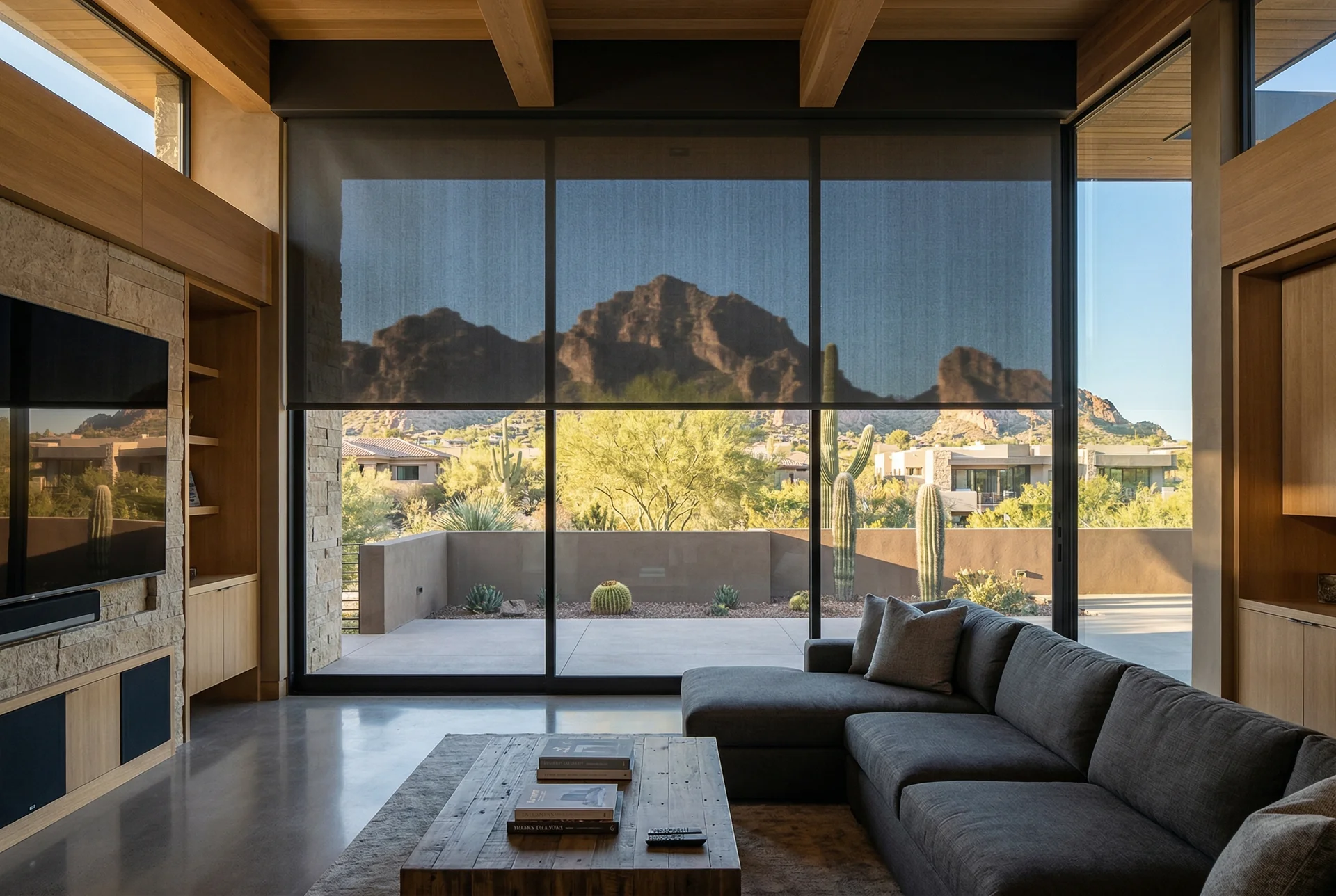
You don't need a dark room. You need a room where you can control the light when you want to. Motorized shades on the glass walls give you that option. For projector setups, ALR screens reject ambient light from the sides while preserving the image from the projector's throw angle. For TV-based systems (which are more common in PV open-concept rooms), proper placement away from direct window glare handles most of it.
The motorized shade piece matters more than most people realize. One button dims the room. Another opens it back up for morning coffee. The room stays a living room 90% of the time.
Audio: Why On-Wall Speakers Outperform In-Ceiling in Open Rooms
This is where most open-concept systems fail, and it's the hill I'll die on. In-ceiling speakers push sound down. In a room with 14-foot ceilings, that sound has to travel a long way before it reaches your ears, and by the time it does, it's scattered across the entire open space. You lose imaging. You lose dialogue clarity. You lose the sense that sound is coming from the screen.
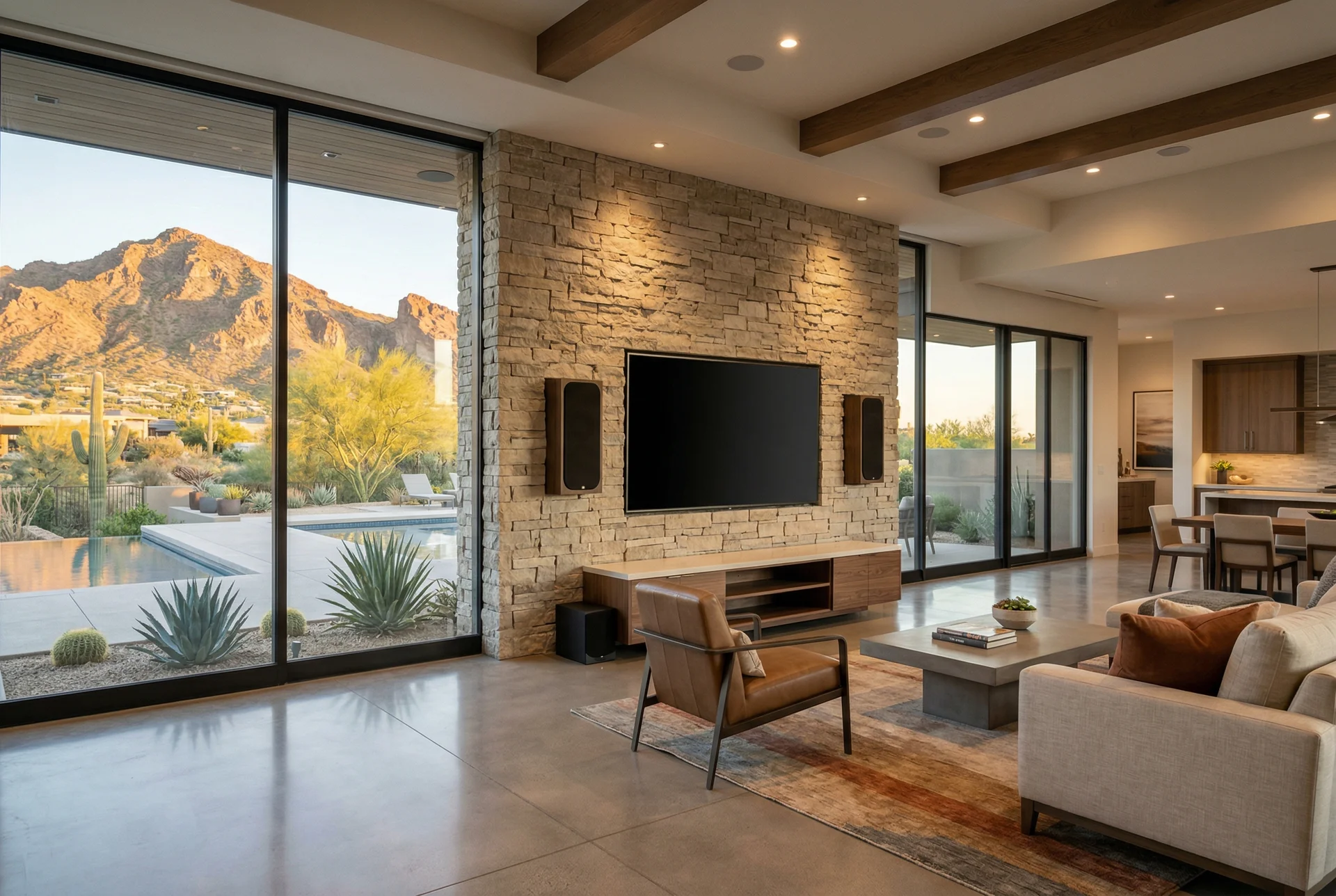
On-wall speakers, mounted at ear level flanking the display, project sound directly at the listening position. The center channel sits under or on top of the TV. Left and right speakers frame it. The result is a focused soundstage that puts voices at the screen and effects in the correct spatial position, even in a room that's open on three sides.
I build custom on-wall speakers at my Arizona workshop specifically for rooms like this. The cabinets are CNC-fabricated, the finishes match the interior design, and the DSP inside each speaker lets me calibrate for the room's exact acoustic signature. That last part, calibration, is what separates a system that sounds good from one that sounds correct.
Acoustic Treatment: Subtle, Not Obvious
You're not going to hang studio foam panels in a designer-curated Paradise Valley living room. That's fine. Acoustic treatment in a media room context means strategic use of soft furnishings, area rugs on hard floors, fabric-wrapped panels that look like art, and careful speaker placement that works with the room's surfaces instead of fighting them.
In my experience, getting the speaker placement and calibration right eliminates about 70% of the acoustic problems people blame on "the room." The remaining 30% can usually be solved with treatments that nobody would recognize as acoustic products.
When Does a Dedicated Theater Make Sense in Paradise Valley?
US spending on home entertainment rooms, including both media rooms and dedicated theaters, is expected to grow 12% annually through 2028 as more homeowners prioritize private entertainment spaces (CEDIA, 2025). A dedicated theater makes sense when you have the space and the commitment to use it. In Paradise Valley, that usually means one of three scenarios.
New construction. If you're building from scratch and your architect is still in the design phase, adding a dedicated theater room is the cleanest path. It can be designed with proper isolation, HVAC that doesn't introduce noise, a flat ceiling at the right height, and no windows. This is the only time I'd recommend going fully dedicated in PV.
Basement or lower level. Some hillside lots in PV have walk-out lower levels that are partially or fully below grade. These make natural theater spaces because they're already dark, cool, and somewhat isolated from the main living areas.
Detached casita conversion. A few clients have converted guest casitas into dedicated theaters. The separation from the main house provides natural sound isolation, and the smaller footprint is easier to control acoustically.
If none of those apply to your home, a well-designed media room will outperform a poorly executed dedicated theater every time. The room matters less than what you put in it and how it's tuned.
How Do Custom Speakers Fit a Designer-Driven Interior?
This is the objection I hear most often from Paradise Valley clients, and from their interior designers. "We love the idea of better sound, but we don't want big black boxes on the walls." Fair enough. That's exactly why I build custom.
Every set of WubWub Audio speakers I build at my Arizona workshop is finished to match the room. White oak to match your cabinetry. Matte black to disappear against a dark accent wall. Custom RAL color to match your designer's spec sheet. The speakers become part of the room instead of an intrusion on it.
On-wall speakers also solve a practical problem that in-wall models can't: they're not permanent. If the homeowner remodels in ten years, the speakers come off the wall and go with them. In-wall speakers are part of the construction, and in a town where homes turn over and get redesigned regularly, that permanence can become a liability.
I've also found that designers warm up quickly once they see the finished product. A pair of tower speakers flanking a fireplace media wall, finished in the same material as the mantel, don't read as "audio equipment." They read as furniture.
What About the "I Just Want It to Work" Client?
Not every Paradise Valley homeowner wants to geek out about speaker placement and ALR screen gain values. Some just want to sit down, press one button, and hear their movie or music at a level that matches what they paid for the house. That's completely valid, and honestly, it's most of my clients.
The design complexity happens on my side, not yours. A properly integrated media room system works from a single remote or a wall-mounted touchscreen. One scene for movies (shades down, lights dim, system on). One scene for music (shades up, full volume across the patio zone). One scene for game day. The technology should disappear behind the experience.
My build process takes 6 to 12 weeks depending on the scope, and that includes the custom speaker fabrication, system design, installation, and professional calibration. By the time I hand you the remote, everything just works.
How Should You Decide Between the Two?
Here's the honest framework I use with clients. If you're building new and you have room in the floor plan for a dedicated space, build both: a casual media room in the great room and a dedicated theater somewhere else. You'll use the media room 95% of the time and love the theater for movie nights and football Sundays.
If you're working with an existing home (which is most PV projects), invest in making the media room excellent rather than trying to retrofit a dedicated theater into a space that wasn't designed for it. A great room with custom on-wall speakers, proper calibration, motorized shades, and a quality display will outperform 90% of the "dedicated theaters" I've seen people cobble together in converted bedrooms.
The room you actually use every day deserves the best system in the house. Don't put your best audio in a room you visit twice a month.
Frequently Asked Questions
How much does a media room design cost in Paradise Valley?
Media room systems for Paradise Valley great rooms typically range from $20,000 to $50,000 depending on display size, speaker configuration, motorized shade integration, and the level of custom finish work on the speakers. Dedicated theaters with acoustic isolation, tiered seating, and full light control start around $50,000 and can exceed $100,000 for premium builds.
Can I get surround sound in an open floor plan?
Yes. On-wall speakers placed at ear level around the listening area deliver focused surround imaging even in open rooms. I use a combination of front left/right/center on-wall speakers and up to four ceiling speakers for overhead effects. The key is calibration: every speaker's output is tuned for the room's specific dimensions and surfaces.
Are in-ceiling speakers good enough for a Paradise Valley living room?
In-ceiling speakers work for background music across a large open space, but they're poor for theater-quality sound. They push audio downward from height, which scatters the soundstage and kills dialogue clarity. On-wall speakers at ear level deliver direct, focused sound that in-ceiling models can't match for critical listening.
Do I need a projector, or is a large TV enough?
For most Paradise Valley media rooms with significant natural light, a 75-to-98-inch TV is the better choice. Projectors require more light control and work best in dedicated theaters or rooms with motorized blackout shades. ALR screens help in ambient light, but a high-quality TV still wins for daytime viewing in a glass-heavy room.
How long does a media room installation take?
My typical media room build takes 6 to 12 weeks from initial consultation through final calibration. Custom speaker fabrication at my Arizona workshop accounts for much of that timeline. Installation itself is usually 2 to 4 days depending on complexity. For dedicated theaters, add time for any construction, acoustic treatment, and seating installation.
If you're weighing a media room against a dedicated theater for your Paradise Valley home, I'd like to help you figure out which approach makes sense for your space. Reach out here or call (928) 440-1950 to start the conversation.
Comments
Leave a Comment