
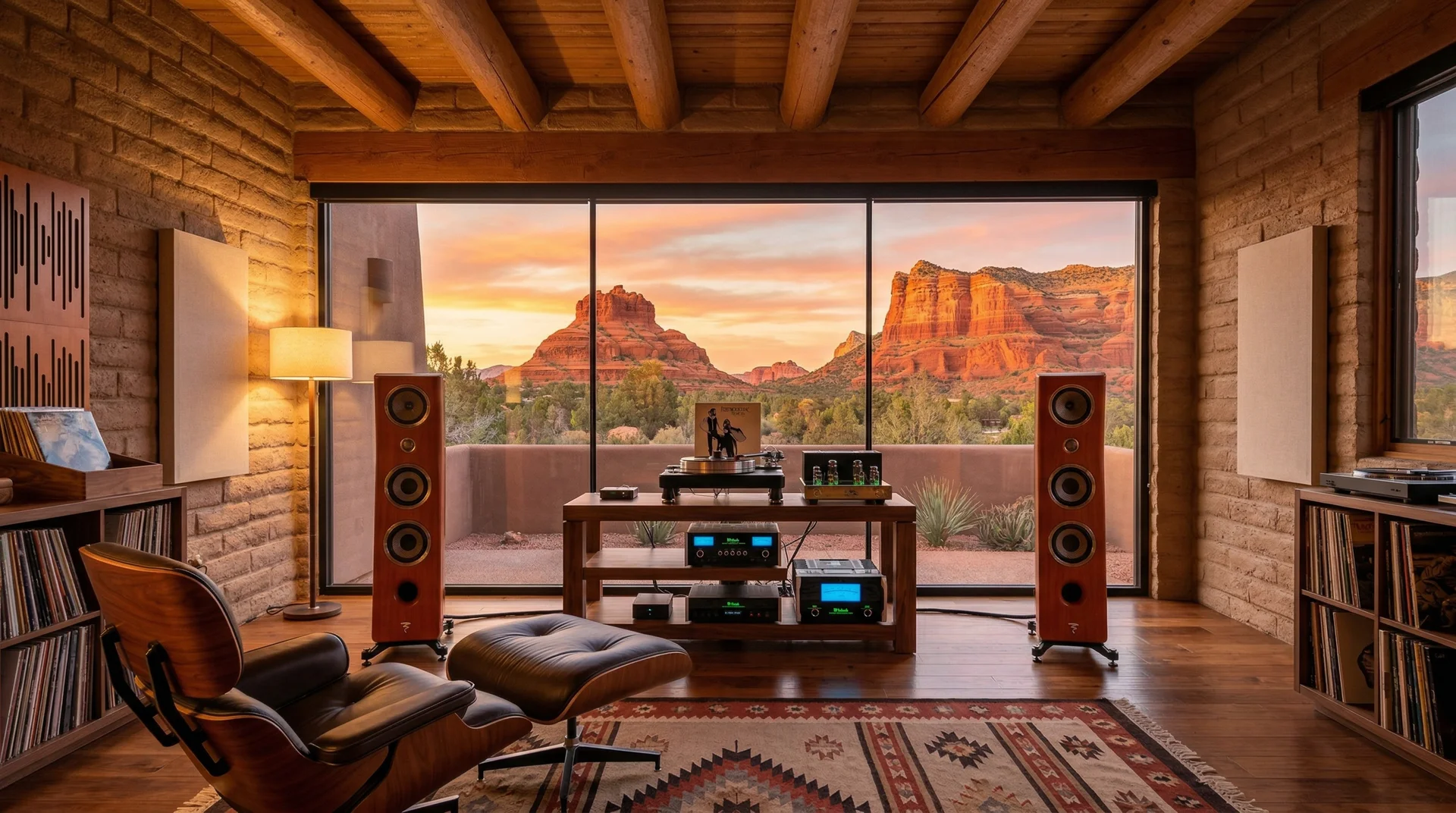
Sedona's arts community includes serious music listeners who deserve more than a Bluetooth speaker. Here's how to design a dedicated listening room in your Sedona home, from acoustic treatment for adobe walls to speaker placement around exposed beam ceilings, with WubWub Audio two-channel speakers as the foundation.
Sedona has over 80 art galleries, a symphony orchestra, and a chamber music series that draws performers from around the world. The town attracts people who care deeply about art and culture. But when those same people go home and press play, most are listening through a soundbar or a wireless speaker sitting on a shelf. Here's how to build a room that does the music justice.
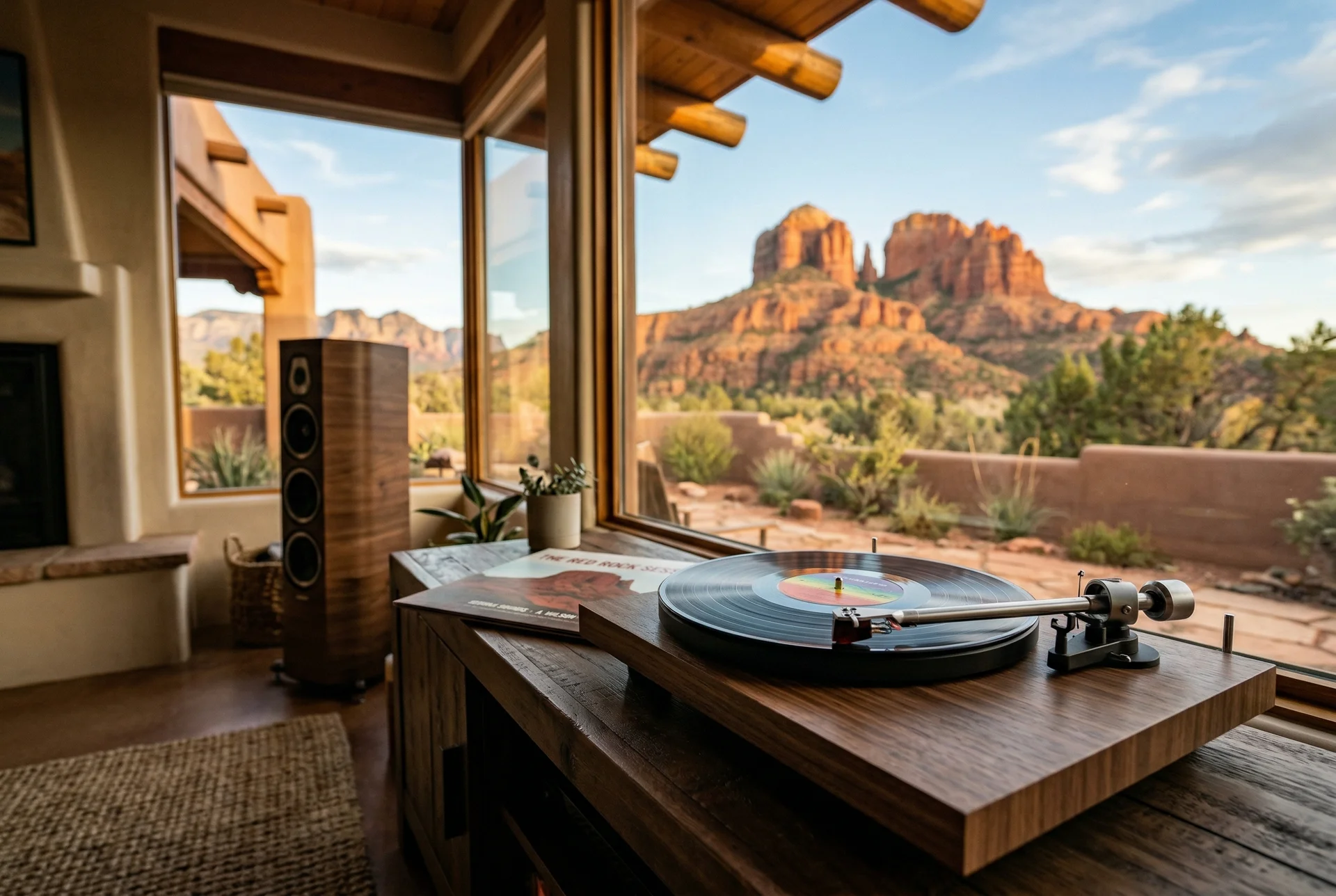
Americans now listen to music an average of four hours and two minutes every day (Edison Research, Infinite Dial, 2024). That's a significant part of your waking life. If you've relocated to Sedona from a major metro area, chances are good you brought a vinyl collection, strong opinions about recorded sound, and expectations your current audio setup isn't meeting. A dedicated listening room changes that. It gives music the space, the acoustics, and the equipment it actually needs.
I'm Mike, owner of Mike Knows Audio Video. I build WubWub Audio speakers by hand in my Arizona workshop and design audio systems for homes across Northern and Central Arizona. This post is about creating a dedicated music room in a Sedona home, one built around two-channel stereo and designed to work with the architecture, not against it.
Why Does Sedona Attract Serious Music Listeners?
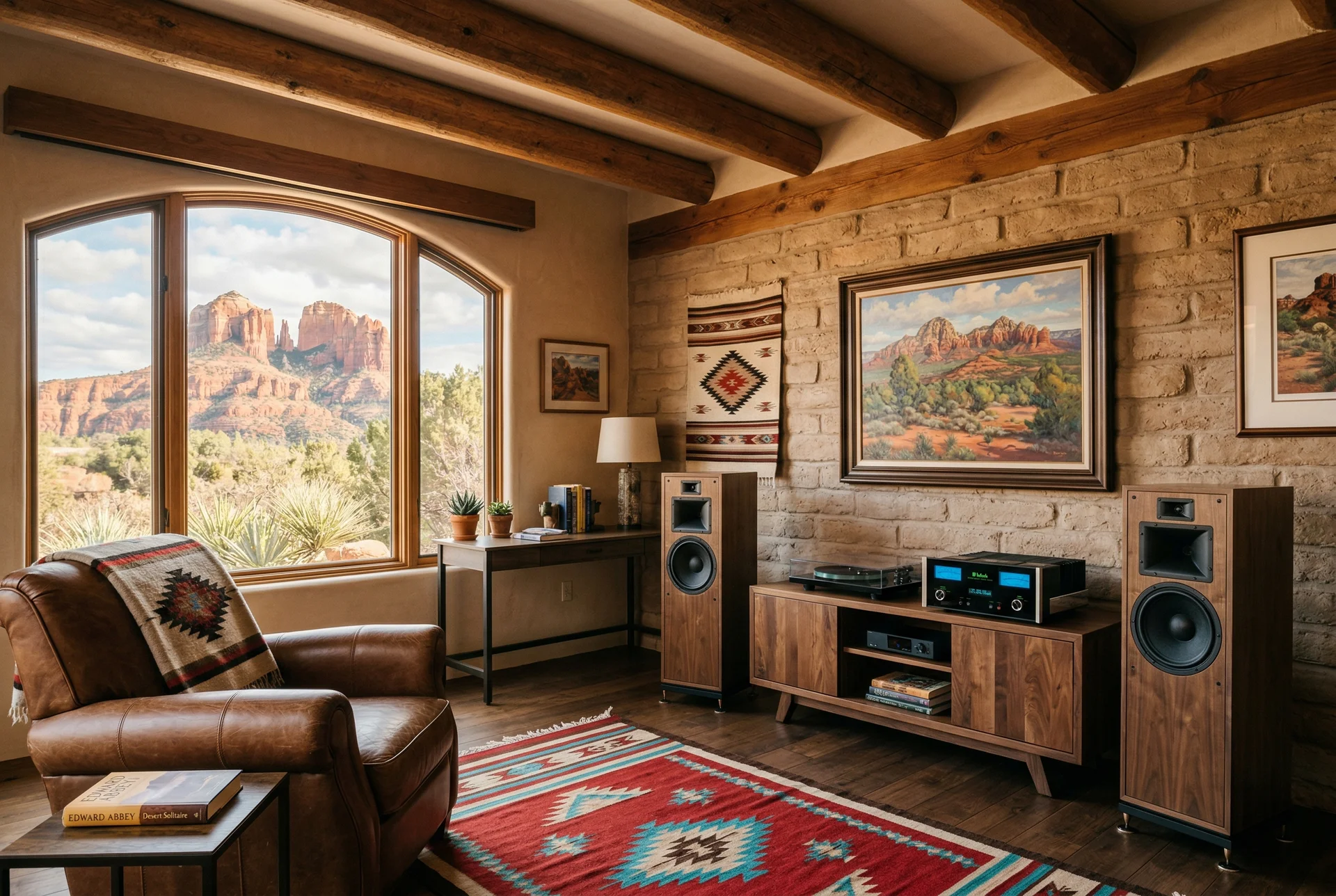
The Sedona Chamber of Commerce counts more than 80 galleries within four square miles, making it one of the densest arts communities in the American West (Sedona Chamber of Commerce). That cultural density isn't just about visual art. Chamber Music Sedona, the Sedona Symphony, and regular jazz performances at local venues create a community where people think carefully about how music sounds, not just what's playing.
Many of my Sedona clients moved from cities like Chicago, San Francisco, or New York. They built serious audio systems in previous homes. Some collected vinyl for decades. Turntable sales alone reached $531 million in 2024, up 10% year over year (Consumer Technology Association, 2025). These aren't casual hobbyists. They know what a well-recorded album should sound like and they can hear when a room is working against the recording.
In my experience, Sedona clients tend to ask better questions about audio than clients anywhere else. They want to understand why a speaker sounds the way it does, not just how loud it gets. That's the arts community influence. When you spend your days surrounded by people who care about craft, it changes how you evaluate everything, including the sound in your own home.
What Makes Sedona Architecture Challenging for Audio?
US music industry revenues reached $17.1 billion in 2024, yet most of that music gets played in rooms never designed for listening (RIAA, 2025). Sedona homes present specific acoustic challenges that off-the-shelf solutions can't solve. The materials that make these homes beautiful, stone, adobe, stucco, and timber, behave very differently from standard drywall.
Stone and adobe walls are highly reflective. Sound bounces off them with more energy than it would off a typical plaster wall, creating harsh reflections and muddy bass. Exposed beam ceilings, common in Sedona's territorial and southwestern architectural styles, scatter sound unevenly. The beams act as partial diffusers, but the gaps between them can create flutter echoes that smear detail.
Then there's the glass. Sedona homeowners want red rock views, and rightly so. But large picture windows facing Cathedral Rock or Courthouse Butte add another broad reflective surface. A listening room with a view requires careful balance: enough acoustic treatment to control reflections without turning a stunning room into a padded cell.
The solution isn't covering every wall with foam. It's strategic placement of absorption panels at first reflection points, diffusion on the back wall, and bass traps in the corners. Earth-toned fabric wraps on acoustic panels can match the southwestern palette so the treatment looks intentional, like a design choice rather than an afterthought.
How Should You Place Speakers in a Sedona Listening Room?
Roughly 73% of Americans age 12 and older now listen to online audio monthly (Edison Research, Infinite Dial, 2024). Whether you're streaming lossless files or dropping a needle on a first pressing, speaker placement determines at least half of what you hear. In a Sedona home with irregular ceiling heights and thick walls, getting this right matters more than usual.
Two-channel stereo is deceptively simple: two speakers and a listening position forming an equilateral triangle. But Sedona rooms throw curveballs. Exposed beam ceilings at varying heights change how sound reflects overhead. Thick adobe or stone walls mean you can't always place speakers at the textbook distance from the back wall. And if your listening room has a flagstone or tile floor, as many do, early reflections off the hard floor surface can smear the stereo image.
I recommend WubWub Audio tower speakers or on-wall models for dedicated listening rooms. Each speaker has built-in DSP that measures and corrects for the room's acoustic problems. That means even with a challenging stone wall behind the speakers, the DSP compensates for boundary reflections and bass loading issues. You're hearing the recording, not the room's problems.
Position the speakers 6 to 10 feet apart, slightly toed in toward the listening position. Keep them at least 2 feet from the back wall if possible. If the room has a window centered on the back wall, placing speakers on either side of it creates a natural soundstage that seems to extend through the glass and into the red rocks beyond. It's a listening experience you simply won't get anywhere else.
Can a Listening Room Double as a Home Office?
Remote work has become a permanent fixture, with approximately 28% of all US work days now happening at home (WFH Research/Stanford, 2026). In Sedona, the percentage skews higher. Many residents relocated specifically because remote work freed them from a metro commute. They need a home office that performs, and great audio makes it perform better.
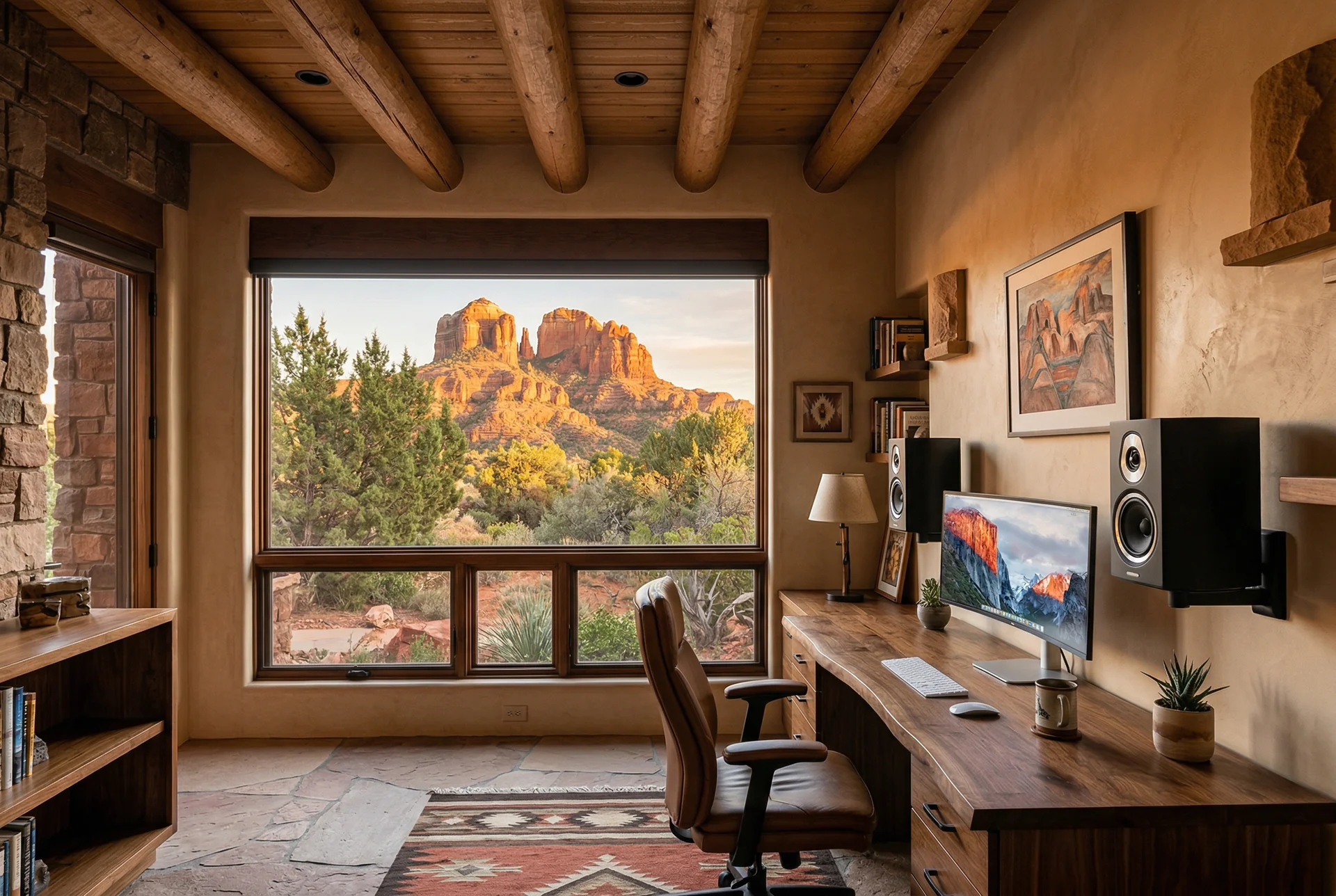
Several of my Sedona clients have combined their listening room and home office into a single space. The key is positioning the desk chair at the stereo sweet spot, right at the apex of that equilateral triangle between the speakers. You get immersive music for focused work and conference-quality audio for calls without switching rooms or fumbling with headphones.
WubWub Audio speakers work particularly well for this dual-purpose setup. The built-in DSP handles room correction automatically, so whether you're listening to a Coltrane record or joining a video call, the sound stays clean and natural. No separate amplifier rack. No tangle of cables. Just a pair of speakers, your source, and a room that sounds right.
What Does the Setup Look Like Start to Finish?
Designing a dedicated music room in Sedona isn't a weekend project, but it's not a year-long renovation either. Most listening room builds take 6 to 12 weeks from the initial consultation through final calibration. Here's what that process typically involves.
First, I visit the home and evaluate the room. I'm looking at dimensions, wall materials, ceiling type, floor surface, window placement, and any existing furniture. Every room has a personality acoustically, and understanding it comes before buying a single piece of equipment. Then I measure the room's frequency response to identify problem areas: bass peaks, null points, and reflection patterns.
Next comes speaker selection and placement planning. For most Sedona listening rooms, I recommend a pair of WubWub Audio tower speakers as the foundation. If the room is smaller or the client prefers a more minimal look, on-wall models deliver the same DSP-corrected sound in a slimmer profile. Source components, whether a turntable, streaming endpoint, or both, get specified at this stage too.
Acoustic treatment goes in before the speakers arrive. Panels at first reflection points on side walls, bass traps in the corners, and a diffuser panel on the rear wall. Everything gets finished in fabrics and colors that complement the room's design. Once the speakers are installed and connected, I run the DSP calibration, measure the final response, and fine-tune until the room sounds right at the listening position.
Why Build a Listening Room in Sedona Instead of Just Anywhere?
There's something about listening to music in a room with a view of Cathedral Rock at sunset that I can't fully explain in technical terms. The light turns the red sandstone formations orange, then pink, then deep violet. You're sitting in your chair, a record is playing, and the room just disappears. The music and the landscape merge into something bigger than either one alone.
Sedona's arts community understands this. The town exists because people chose beauty and craft over convenience. A dedicated listening room is the same kind of choice. It says that music matters enough to give it a proper space, good speakers, treated acoustics, and time to actually sit and listen. Not as background noise. As the main event.
If you're in Sedona, the Village of Oak Creek, Cottonwood, or anywhere in the Verde Valley, and you've been thinking about building a space like this, I'd enjoy the conversation. Every room is different, and that's what makes this work interesting.
Ready to design your listening room? Get in touch here or call (928) 440-1950 to start the conversation.
Comments
Leave a Comment