
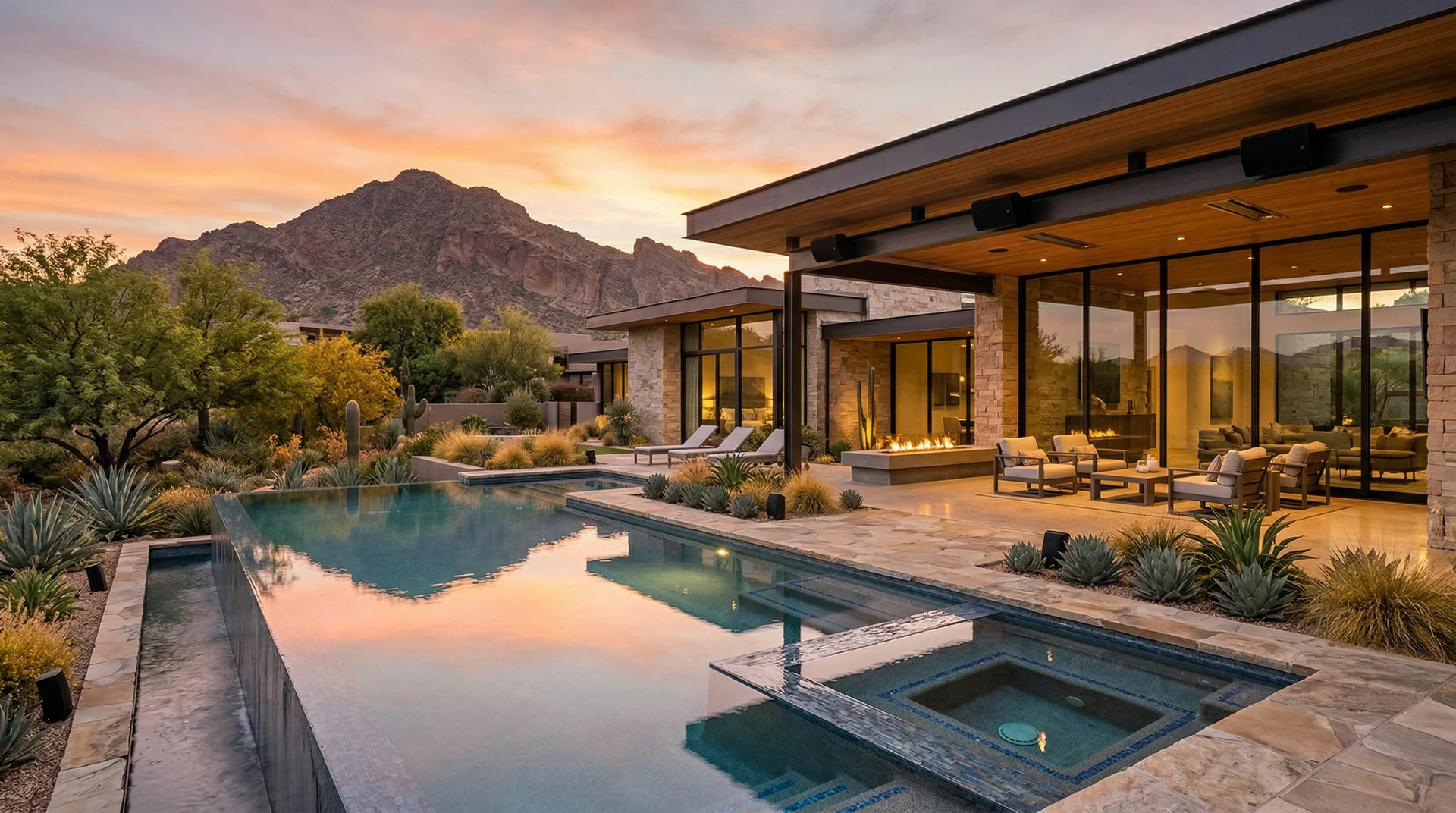
Paradise Valley estates treat the backyard as half the home. Pool decks, covered patios, outdoor kitchens, fire pits, casitas. The audio should cover all of it, independently, with speakers built for Arizona's extreme climate.
Paradise Valley isn't a suburb with a backyard. It's a town where the outdoor living space rivals the indoor square footage. Pool decks, covered patios with full kitchens, fire pit lounges, casitas, putting greens. All of it used year-round. Here's how to build an outdoor audio system that actually covers the whole property.
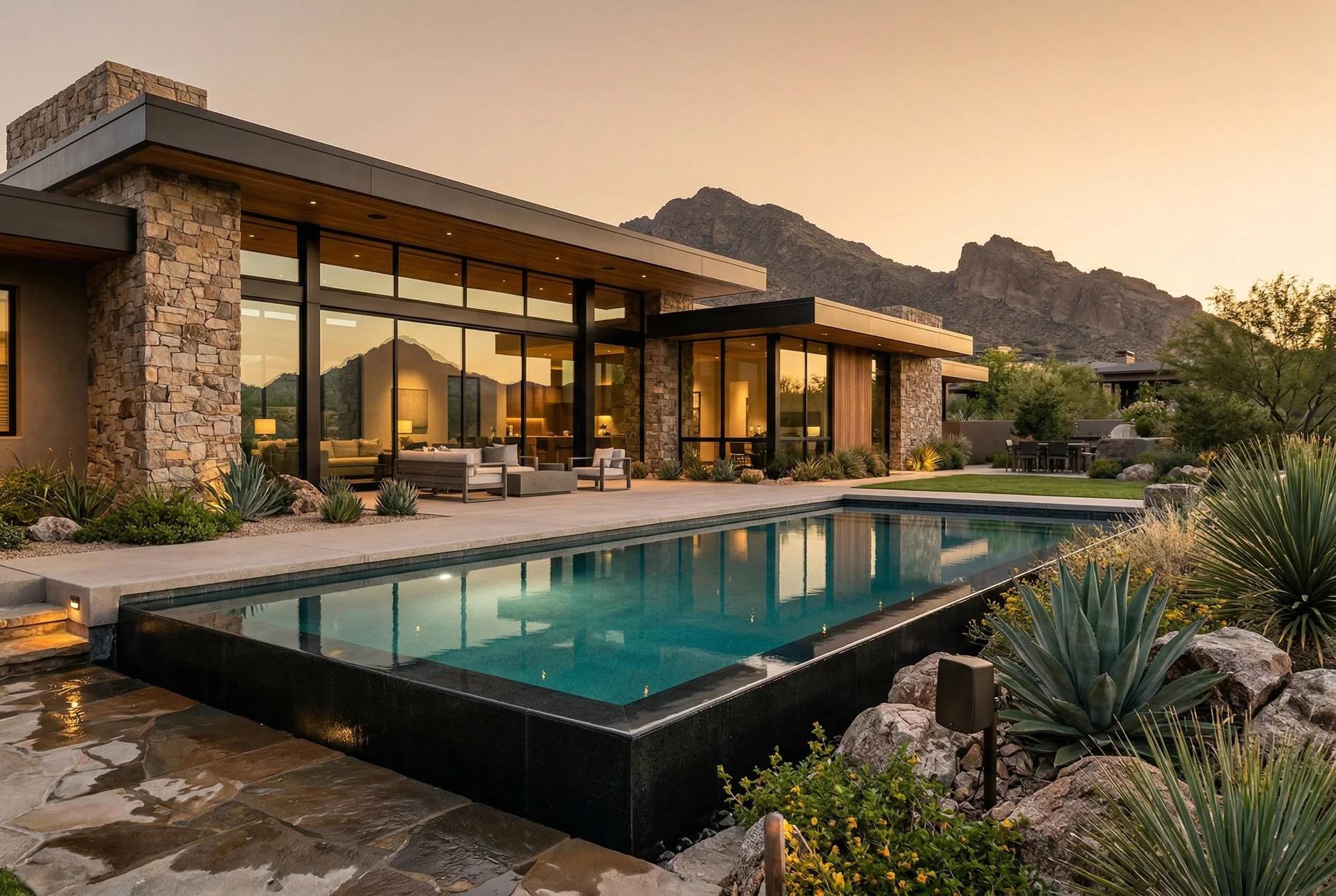
An estimated 93% of homes in Paradise Valley have a swimming pool, one of the highest rates for any municipality in the country (Town of Paradise Valley, 2025). Add covered patios, outdoor kitchens, fire pits, and separate guest houses, and the outdoor living area on a typical estate is 2,000 to 5,000 square feet of usable space. That's not a patio. That's a second home.
I'm Mike, owner of Mike Knows Audio Video. I design and build outdoor audio systems in Paradise Valley that treat every part of that outdoor space as its own listening environment. Not one pair of speakers trying to cover everything. Independent zones, weather-rated hardware, and a system that connects to your indoor audio when you want it to.
Why Does Paradise Valley Need Zone-Based Outdoor Audio?
American homeowners spent $127 billion on outdoor living improvements in 2024, a 12% increase over 2023 (LawnStarter / Home Improvement Research Institute, 2025). In Paradise Valley, that investment shows. The typical estate along Mockingbird Lane or in Clearwater Hills has four to six distinct outdoor areas, each used differently throughout the day.
A single pair of speakers under the patio roof can't cover a pool deck 60 feet away. Turning them up to reach the yard blasts the neighbors and rattles the windows. Turning them down means silence by the fire pit. That's not an audio system. That's a compromise.
Zone-based design solves this. Each outdoor area gets its own speakers, its own volume control, and its own source selection. The pool deck plays one thing. The outdoor kitchen plays another. The casita plays nothing. You control it all from your phone. Want to know how this compares to indoor systems? Here's a look at how I approach whole-home audio.
What Zones Does a Paradise Valley Estate Typically Need?
The global outdoor speaker market reached $2.7 billion in 2025 and is projected to grow at 7.8% annually through 2033 (Fact.MR, 2025). That growth tracks with what I see locally: homeowners are done accepting poor sound outside. Here's how I typically break down the zones for a Paradise Valley property.
Zone 1: Covered Patio
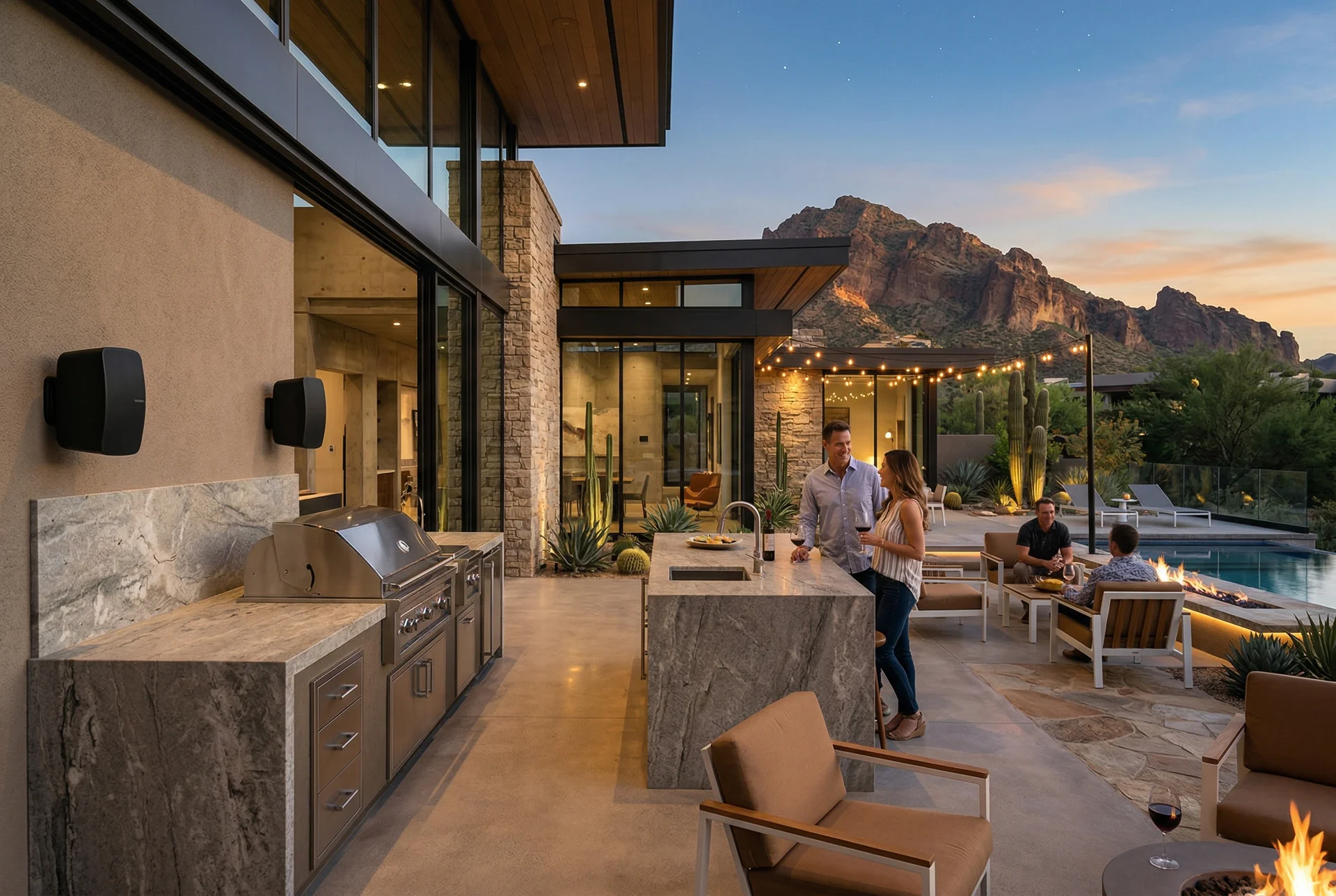
This is the primary outdoor living room. Dinner parties, morning coffee, evening cocktails. I mount weather-rated on-wall speakers to columns or the patio structure, angled to create even coverage across the seating area. Two to four speakers depending on the footprint. The covered roof helps contain sound and keeps the speakers shaded from direct sun.
Zone 2: Pool Deck and Yard
Open-air spaces need landscape speakers. These are ground-mounted units that sit among the rock, gravel, and plantings. They disperse sound in a wide pattern at ground level, which means even coverage across the pool area without hot spots or dead zones. I place them to overlap so the music follows you from the lounge chairs to the shallow end.
Zone 3: Outdoor Kitchen
The cook wants music. The guests at the dining table might want something quieter, or different entirely. A dedicated zone at the outdoor kitchen gives you that independence. Compact on-wall speakers aimed at the prep and cooking area, separate from the patio zone.
Zone 4: Fire Pit
Fire pit areas are typically set back from the main patio, often at a lower elevation. They need their own coverage. I use compact speakers positioned to fill the seating circle without bleeding into adjacent zones. This is where low-volume ambient music works best, so the zone needs to sound clean at whisper levels.
Zone 5: Casita or Pool House
Many Paradise Valley estates have a separate guest house or casita. That's its own world. An independent zone with its own volume and source means a guest can listen to their own music, or nothing at all, without affecting the main property.
Optional: Putting Green, Bocce Court, Sport Court
Larger estates along Lincoln Drive or near Camelback Mountain sometimes have recreational zones that benefit from a speaker pair. These are simple additions to the system once the infrastructure is in place.
How Do Landscape Speakers Disappear into Desert Landscaping?
The U.S. landscape lighting and audio market for residential properties exceeded $3.1 billion in 2025, with integrated landscape speaker systems growing fastest among luxury homeowners (Mordor Intelligence, 2025). Paradise Valley's desert aesthetic makes landscape speakers especially effective.
Landscape speakers come in earth tones, sandstone textures, and rock-shaped enclosures designed to blend with gravel, boulders, and native plants. In a yard full of desert landscaping, granite boulders, and saguaros, a well-placed landscape speaker genuinely vanishes. I've walked properties after installation with the homeowner and had them struggle to point out where the speakers are. That's the goal.
The sound quality from modern landscape speakers is excellent, too. These aren't novelty products. They use the same driver technology as indoor speakers, housed in enclosures engineered for outdoor acoustic dispersion. Combined with a properly sized subwoofer buried in a planting bed, they deliver full-range sound across the yard.
Can Outdoor Speakers Really Handle Arizona Monsoons and 115-Degree Heat?
Phoenix recorded its hottest summer on record in 2024, with 113 consecutive days above 100 degrees Fahrenheit (National Weather Service Phoenix, 2024). Paradise Valley sits right in that heat zone. If your outdoor speakers weren't specified for this climate, they won't last.
I only install speakers with IP65 or higher ingress protection ratings for full outdoor exposure. That means sealed against dust infiltration and protected from water jets in any direction. UV-stabilized enclosures resist the cracking and fading that destroys cheaper speakers after two Arizona summers. Marine-grade wiring and weatherproof connections handle monsoon rain, blowing dust, and temperature swings from 35 degrees on a January morning to 118 degrees on a July afternoon.
I've seen outdoor speakers on Paradise Valley properties that were installed during construction by the electrician, using indoor-rated speakers with a basic weather coating. After 18 months of Arizona sun, the rubber surrounds are cracked, the housings are chalky, and the sound is distorted. That's not a failure of the speaker brand. It's a failure of specification. The wrong product was used for the environment.
A properly specified outdoor system should last 10 years or more without degradation. That's the standard I hold every project to.
How Does Indoor-Outdoor Audio Handoff Work Through Glass Walls?
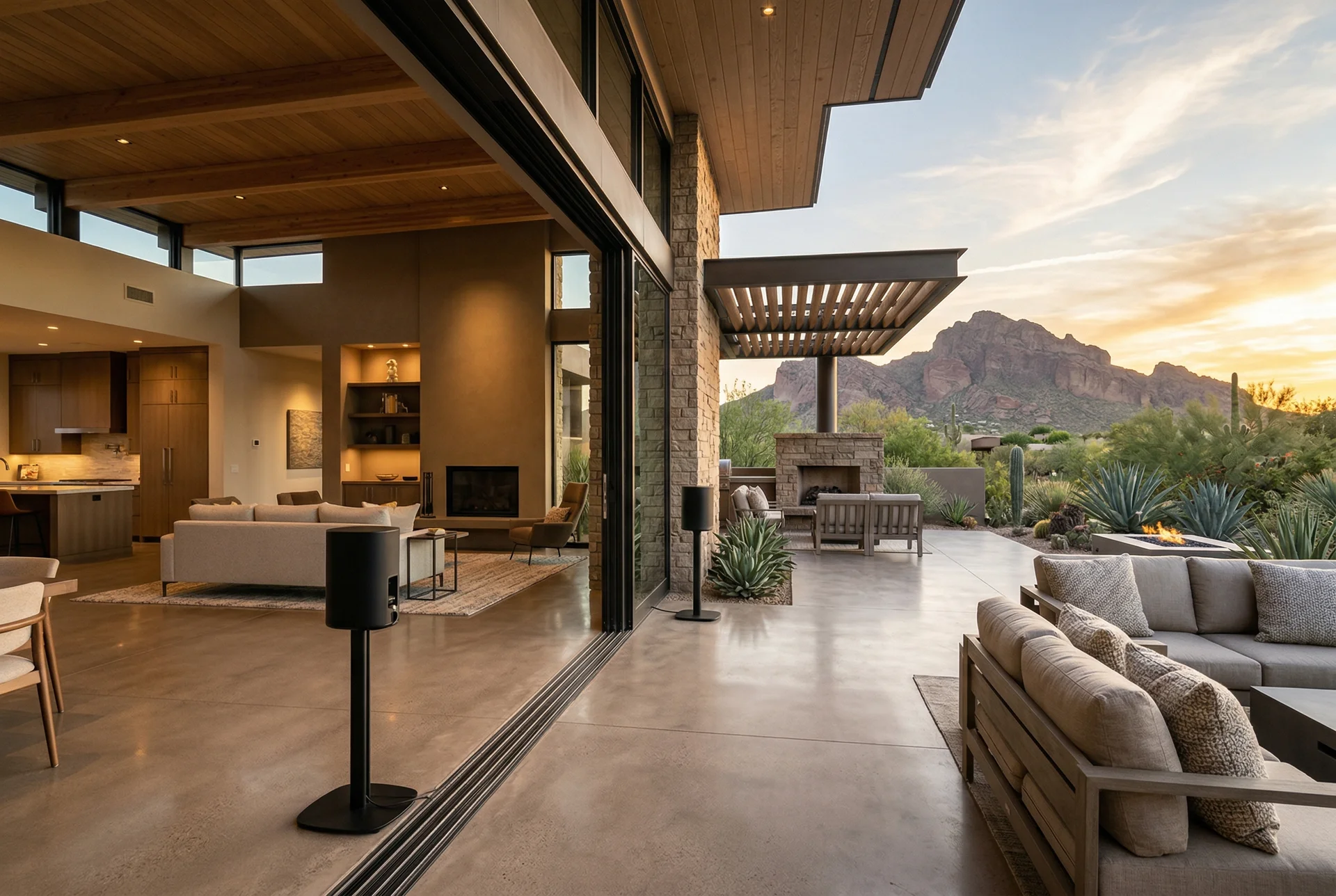
Paradise Valley homes are famous for their indoor-outdoor flow. Retractable glass walls, pocket sliders, and floor-to-ceiling windows blur the line between the great room and the patio. The audio needs to match that architecture.
I design outdoor zones as part of the same whole-home audio network that serves the interior. Your indoor zones and outdoor zones live in one system, controlled from one app. Open the sliders for a party and group the living room with the patio. Close them for a quiet evening and separate the zones instantly.
The technical challenge is the transition point. When those glass walls are open, the patio and great room become one acoustic space, and the system needs to respond without you touching anything. When they close, the spaces isolate and each zone resumes independent operation. I configure crossover behavior so the handoff feels natural. Music follows you through the doors without a volume drop or an awkward gap.
If you're building a new home or renovating, this is something I coordinate with your architect early in the process. The wiring paths through glass wall systems need to be planned before the framing goes up. For existing homes, retrofit solutions work well with exterior wire routing and buried conduit. Learn more about how I build speakers for specific rooms and environments.
What About Neighbor Noise in Estate Neighborhoods?
Paradise Valley's minimum lot size is one acre. Neighborhoods like Clearwater Hills, the Camelback Mountain corridor, and the estates along Tatum Boulevard have generous setbacks. But sound carries in the desert, especially at night when ambient noise drops to near zero. Responsible audio design accounts for this.
Most outdoor audio complaints aren't caused by volume. They're caused by speaker placement. Speakers mounted high on a wall and aimed outward project sound like a megaphone across property lines. That's a design error. Ground-level landscape speakers disperse sound horizontally across a short radius. On-wall speakers aimed downward into seating areas contain their coverage pattern. Independent zones mean you're never cranking one area to compensate for another.
I also factor in hardscape reflections. A large pool deck or stone patio can bounce sound upward and outward in ways that carry further than expected. Speaker placement angles and zone boundaries account for these reflections so the sound stays where you want it.
How Long Does Outdoor Audio Installation Take?
For a typical multi-zone Paradise Valley project, the design phase takes one to two weeks after the initial site survey. If the system includes custom-built WubWub Audio speakers for covered areas, fabrication runs 6 to 12 weeks or more depending on complexity. The on-site installation itself usually takes two to four days, including wiring, speaker placement, and full system calibration.
I calibrate every outdoor zone independently, using a measurement microphone and analyzer at the actual listening positions in each zone. That means I'm sitting in your patio chair, standing at your grill, and lying on your pool lounge while I dial in the EQ and level for each zone. Auto-calibration software doesn't work outdoors. The open-air environment, ambient noise, and lack of room boundaries require manual tuning by ear and by measurement.
For new construction, I get involved during the design phase so conduit, junction boxes, and wire paths are in the plans before the first trench is dug. That saves time and money compared to retrofitting later. For existing homes, I route wiring through exterior walls, landscape trenching, and existing conduit where available.
Frequently Asked Questions
How many outdoor audio zones does a typical Paradise Valley estate need?
Most properties need four to six independent zones: covered patio, pool deck, outdoor kitchen, fire pit area, and casita or pool house. Larger estates with putting greens, bocce courts, or detached guest houses may need additional zones. I design the layout after walking your full outdoor living space.
Will outdoor speakers survive Arizona monsoons and 115-degree summers?
Yes, if they're properly specified. I use speakers with IP65 or higher ratings designed for full outdoor exposure, not indoor speakers mounted outside. UV-stabilized enclosures, marine-grade wiring, and sealed connections handle monsoon rain, desert dust, and extreme heat without degradation.
Can outdoor audio zones connect to my indoor system?
Yes. I design outdoor zones as part of the whole-home audio network. Group the patio with the living room for a party. Separate them for a quiet evening. One app controls everything. The indoor-outdoor handoff through sliding glass walls is something I design for on every Paradise Valley project.
How do you prevent outdoor music from reaching the neighbors?
Speaker placement, angling, and zone design. I aim speakers into your living areas, not across property lines. Landscape speakers disperse sound at ground level, which carries far less than elevated speakers. Independent zones mean you never overdrive one area to compensate for another.
What does outdoor audio installation cost in Paradise Valley?
A multi-zone outdoor audio system for a Paradise Valley estate typically runs $8,000 to $35,000+ depending on zone count, speaker selection, and integration with existing indoor systems. I provide a detailed quote after the site survey. Reach out here or call (928) 440-1950.
Your Backyard Is Half the House. The Audio Should Reflect That.
You've invested in an outdoor space designed for year-round living. The pool, the kitchen, the fire pit, the casita. Every detail is considered. The audio should be, too.
A properly designed outdoor audio system in Paradise Valley gives you independent control over every zone, speakers that disappear into the landscape, and sound quality that matches the rest of your home. No Bluetooth speaker on the counter. No single pair of patio speakers trying to cover 4,000 square feet.
If you're thinking about outdoor audio for your Paradise Valley property, I'd enjoy talking through what's possible. Call me at (928) 440-1950 or use the contact form. You can also visit the Scottsdale service area page to learn about nearby projects I've completed.
Comments
Leave a Comment