
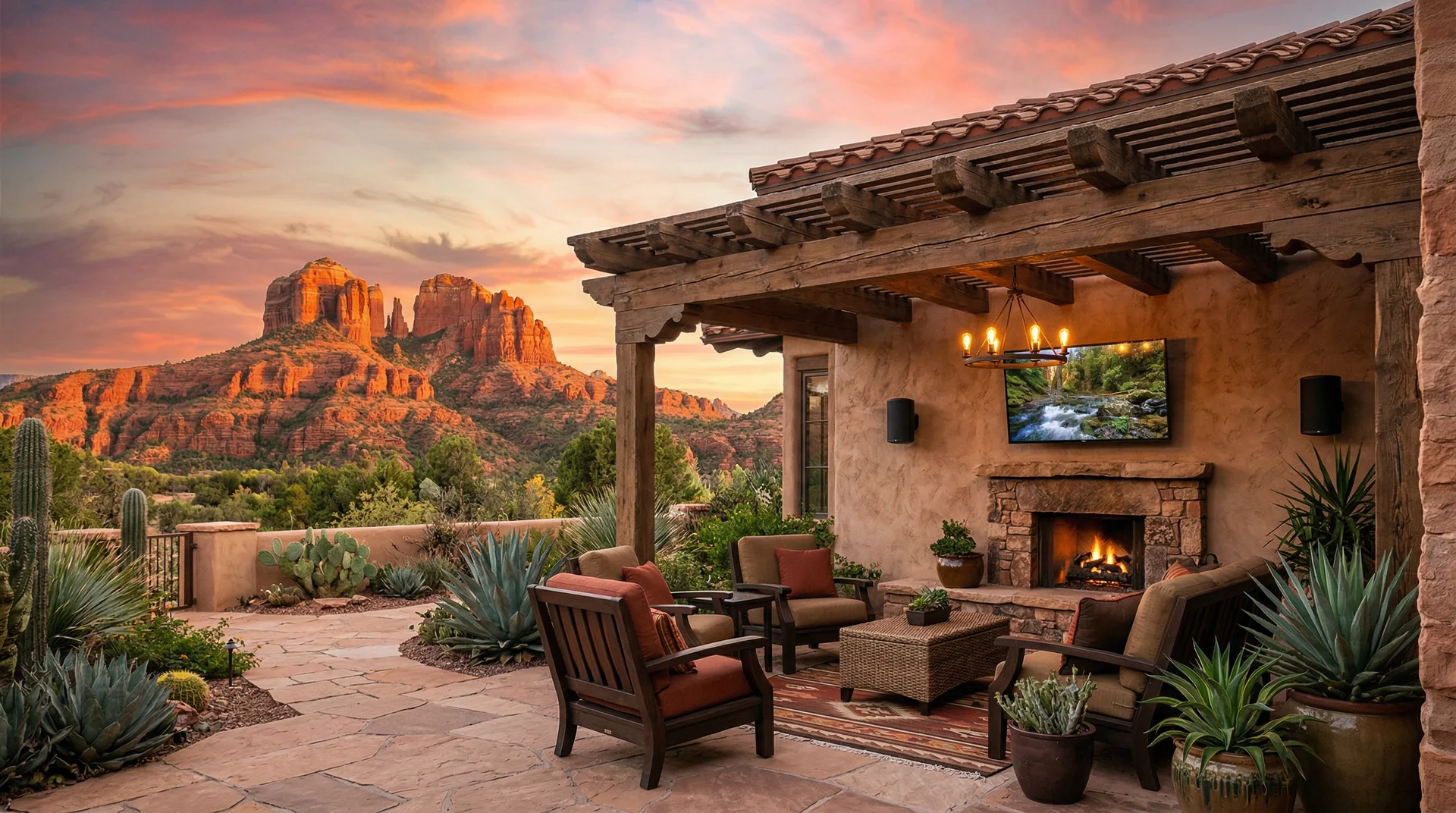
Sedona homeowners spend more time on their patios than almost anywhere else in the house. A portable Bluetooth speaker can't keep up. Here's what a complete outdoor entertainment system looks like for canyon-view decks, fire pit terraces, and Verde Valley wine nights.
The global outdoor TV market is projected to reach $3.3 billion by 2030, growing at nearly 12% annually (Grand View Research, 2023). That growth isn't surprising when you consider how many homeowners, especially in places like Sedona, treat their outdoor space as their primary living area for eight or nine months of the year. But most of what passes for "outdoor entertainment" around here is still a Bluetooth speaker balanced on a railing and a phone propped against a wine glass.
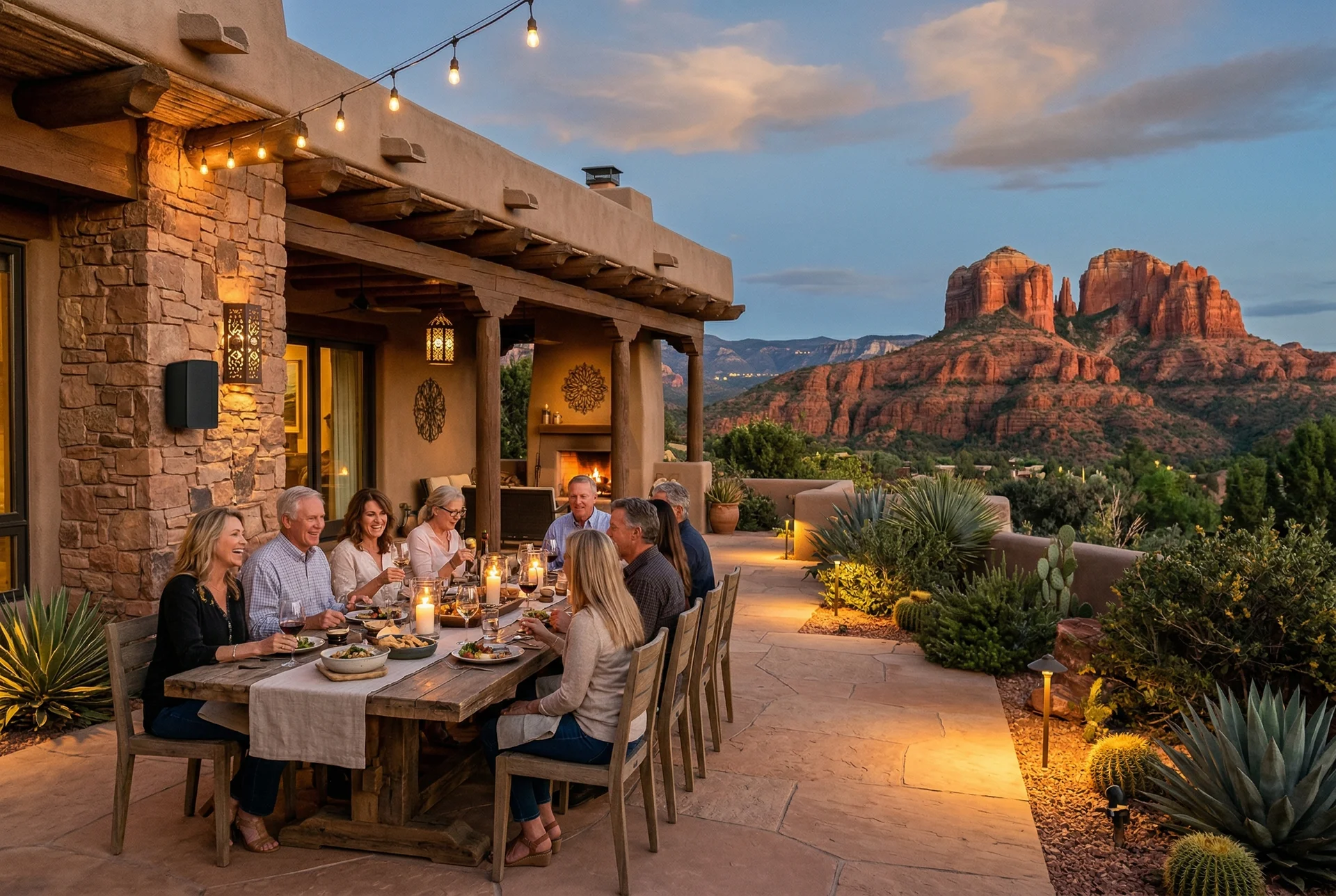
I'm Mike, owner of Mike Knows Audio Video. I design and install complete outdoor entertainment systems in Sedona, AZ, covering audio zones, weather-rated displays, and landscape lighting that works together as one system, not a pile of disconnected gadgets.
Why Does Sedona Demand a Different Approach to Outdoor Entertainment?
Sedona welcomed roughly 3 million visitors in 2023, and real estate sales above $1 million hit 254 transactions that same year (Sedona Chamber of Commerce, 2024). The people buying and building here aren't looking for ordinary. They're designing homes around the landscape, with decks that cantilever over canyons and patios that frame Cathedral Rock at sunset.
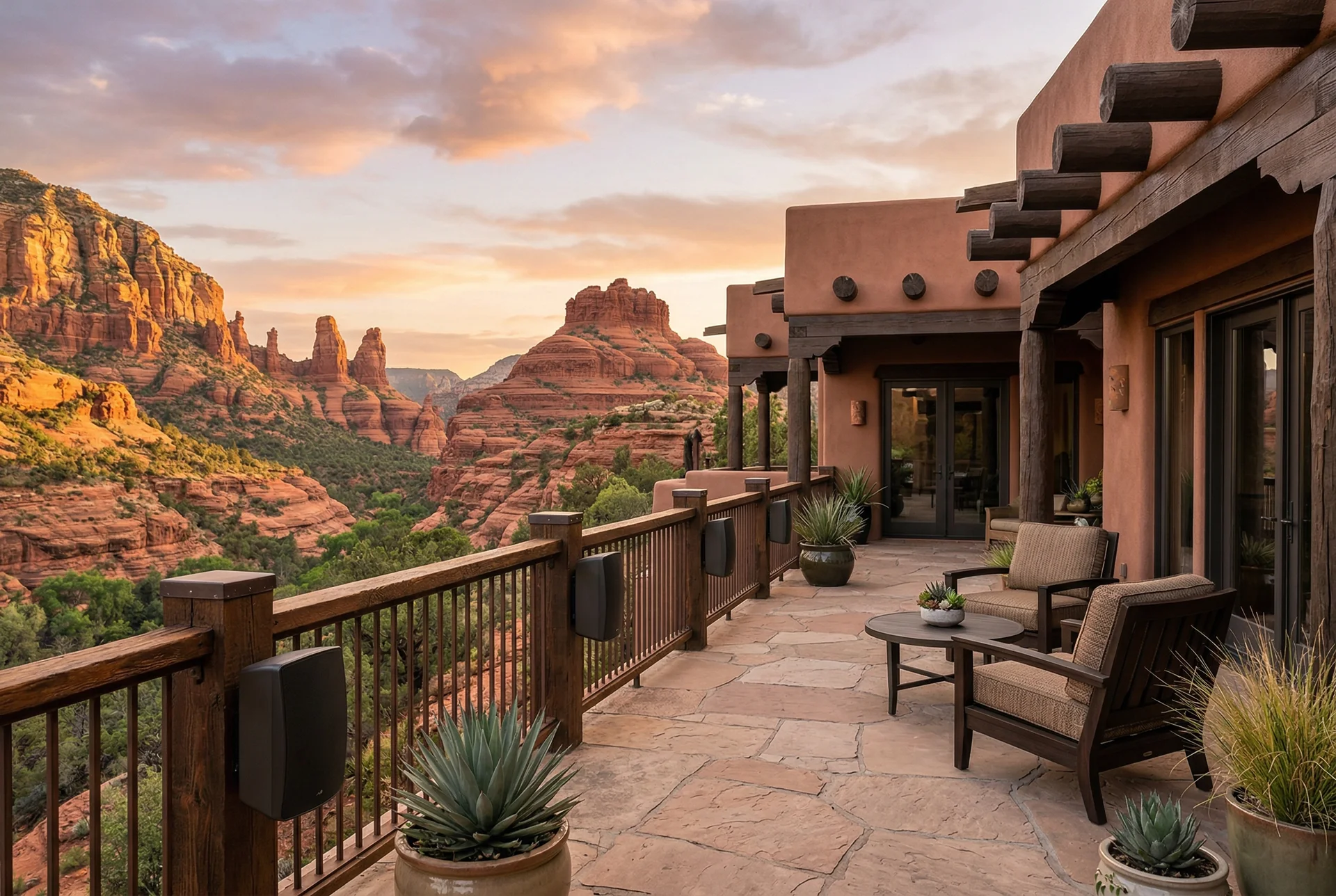
That context changes everything about how outdoor entertainment should work. A flat suburban backyard with a privacy fence is forgiving. Sound bounces off the fence and stays contained. But a Sedona deck overlooking a canyon? Sound carries straight out into open air and vanishes. You need more coverage, smarter speaker placement, and equipment that can handle the altitude, UV exposure, and monsoon seasons that come with living at 4,500 feet.
I've installed systems on properties where the patio literally hangs over a 200-foot drop. The acoustic challenges are real, but so is the payoff. When the sound, the screen, and the lighting all work together against that backdrop, there's nothing else like it.
What Goes Into a Complete Patio Entertainment System in Sedona?
Americans spent an average of $7,750 on outdoor living improvements in 2024 (Angi, 2024). But most of that went toward furniture, grills, and landscaping. The entertainment layer, audio, video, and lighting, is still an afterthought for many homeowners. Here's what a properly designed system includes.
Audio Zones for Different Outdoor Areas
A single pair of speakers can't cover a Sedona property's outdoor spaces. Most homes I work with have at least three distinct areas: a covered patio or deck, a fire pit terrace, and a garden or path area. Each needs its own audio zone with independent volume and source control.
For covered patios, I use weather-rated on-wall speakers mounted under the roof structure and angled toward the seating area. For open areas like fire pits and garden paths, landscape speakers work best. These are ground-mounted units that disperse sound in a wide pattern and blend into the rocks, gravel, or plantings around them. They handle direct sun, monsoon rain, and temperature swings from 20-degree winter mornings to 100-degree summer afternoons.
The key is independent zones. Want jazz at the fire pit and silence on the dining terrace? One tap in the app. Hosting a party and want everything playing the same thing? Group the zones together. That flexibility is what separates a system from a speaker.
Should You Put a TV on Your Sedona Patio?
The outdoor display market is booming, and for good reason. Outdoor-rated TVs now offer 2,500 to 3,000 nits of brightness, compared to 300 to 500 nits on a standard indoor TV (Consumer Technology Association, 2024). That means you can actually see the picture in direct Arizona sunlight, not just a washed-out reflection of yourself squinting.
For Sedona homes with a covered patio, a weather-rated display in the 55 to 75-inch range makes sense. These units are sealed against moisture, dust, and insects. They handle temperature extremes without cracking or dimming. And they're designed for the UV exposure that destroys a regular indoor TV in one Arizona summer.
I mount them where they make sense for the seating layout, not just where there's a convenient wall. The goal is comfortable viewing from the primary seating area without the screen dominating the view. In Sedona, the view is the whole point. The TV should complement it, not compete with it.
Not every patio needs a TV. If you're on a west-facing deck watching the sunset, a screen might be the wrong call for that space. I'll tell you that honestly during a consultation. But for covered north or east-facing patios, a game-day setup with proper audio is hard to beat.
How Does Sound Behave Differently in Open Desert Space?
Most outdoor audio advice assumes a flat yard with fences or walls on three sides. Sedona's topography breaks every one of those assumptions. Canyon-facing decks, sloped lots, and open ridgelines mean sound has nothing to reflect off of. It dissipates fast. You lose bass first, then mids, and eventually all you hear is a tinny suggestion of the music you're playing.
The fix isn't turning up the volume. It's strategic placement. Landscape speakers positioned closer together in open areas create overlapping coverage zones, so you're never more than 10 to 15 feet from a source. On-wall speakers under a patio cover reflect off the ceiling and floor surfaces, keeping sound contained where you actually sit. I also pay attention to where the property opens up to the canyon and where natural walls, retaining walls, or the house itself provide some reflection.
Enclosed patios with stone or stucco walls behave more like indoor rooms. Sound stays put. Open decks with nothing but sky and canyon need twice the thought. I design for both, often on the same property.
What About Lighting Integration?
The global smart outdoor lighting market is expected to reach $15.6 billion by 2030, growing at 16.3% annually (MarketsandMarkets, 2024). Lighting is the piece most people forget when planning outdoor entertainment, but it's what ties the whole experience together.
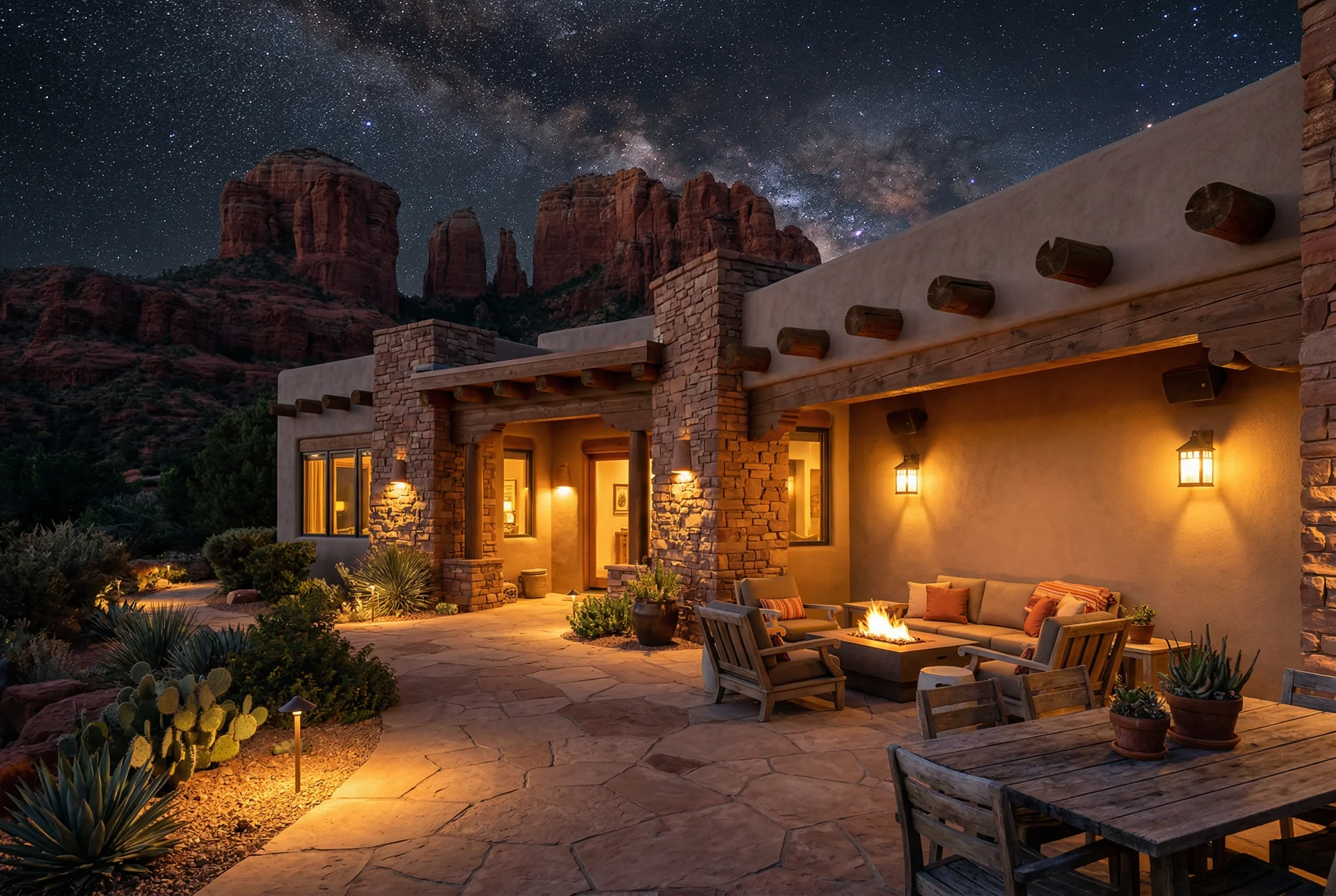
In Sedona, you've got a unique advantage: dark skies. The city has an outdoor lighting ordinance specifically to protect stargazing. That means your landscape lighting needs to be thoughtful, not just functional. Low-voltage path lights along walkways, warm accent lighting on architectural features, and dimmable zones that can drop to near-zero when you want to see the Milky Way.
I integrate the lighting control into the same system that runs your audio and video. One button on your phone sets the scene: "dinner party" brings up the path lights, dims the patio overheads, turns on music at the dining terrace, and fires up the TV if you want it. "Stargazing" kills everything except the path lights at ankle level and plays ambient music at the fire pit. That's not novelty. That's how outdoor spaces should work.
Sedona Entertaining: Canyon Sunsets, Wine Nights, and Stargazing
The Verde Valley wine trail now includes over 30 tasting rooms and vineyards within a short drive of Sedona (Verde Valley Wine Trail, 2025). That wine culture has turned Sedona into an entertaining destination, and homeowners here host more often than they expected to when they bought the place.
I've designed systems specifically around the sunset-to-stargazing transition that's practically a nightly ritual on Sedona decks. The system starts with upbeat music and full patio lighting as guests arrive. As the sun drops behind the buttes, the lighting automatically shifts warmer and dimmer. After dark, the landscape lights accent the red rock walls while the audio moves to something quieter. Guests barely notice the transition, but they feel it.
For dedicated stargazing nights, the system pulls back almost entirely. Path lighting stays on for safety at about 10% brightness. A single zone plays low ambient music at the fire pit. Everything else goes dark and quiet. Sedona's dark sky designation means you can see things from your backyard that most people drive hours to find. The entertainment system should respect that, not fight it.
How Long Does an Outdoor Entertainment Installation Take?
Most complete outdoor entertainment systems in Sedona take 6 to 12 weeks from design to completion, depending on scope and complexity. A straightforward patio audio and TV setup is on the shorter end. A multi-zone system with landscape speakers, lighting integration, and whole-home control sits at the longer end.
If you're building a new home or doing a major remodel, the best time to plan the outdoor system is during the design phase, before the patio is poured and the landscaping is installed. Running conduit and low-voltage wiring during construction is dramatically easier and less expensive than retrofitting later.
That said, I retrofit outdoor systems on existing Sedona homes regularly. Landscape speaker wire can be buried in planting beds. On-wall speakers mount to existing patio structures. TV power and signal can often route through exterior walls or existing conduit. It's rarely as disruptive as people expect.
Frequently Asked Questions
How much does an outdoor entertainment system cost in Sedona?
A basic patio audio zone with 2 to 4 weather-rated speakers starts around $2,500 to $4,000 installed. A complete system with multiple audio zones, an outdoor TV, and lighting integration typically runs $8,000 to $20,000 depending on the property's size and the number of zones. I'll give you a specific quote after seeing the space. Reach out for a free consultation.
Can outdoor speakers handle Sedona's monsoon season?
Yes, if they're properly rated. I only install speakers with IP ratings designed for full outdoor exposure, meaning direct rain, dust infiltration, and temperature extremes. Cheap "weather resistant" indoor speakers won't last. Properly specified outdoor equipment handles monsoons, UV, and freezing winter mornings without degradation for a decade or more.
Do I need a special TV for my outdoor patio?
Yes. Standard indoor TVs aren't sealed against moisture, insects, or dust, and their screens aren't bright enough to compete with daylight. Outdoor-rated displays deliver 2,500+ nits of brightness and are built for temperature extremes. They cost more upfront, but an indoor TV used outside typically fails within one season in Arizona.
Will outdoor speakers disturb my neighbors?
Not with proper design. Angled speaker placement focuses sound on your living areas, not across property lines. Landscape speakers disperse at ground level, which carries less than elevated speakers pointed outward. Independent zones mean you're never overdriving one area to reach another. In Sedona's spread-out lot layouts, neighbor noise is rarely an issue when the system is designed correctly.
Can you integrate outdoor audio with my indoor home theater?
Absolutely. The outdoor zones connect to the same whole-home control system as your indoor home theater and custom speakers. Group indoor and outdoor zones for a party, or keep them completely independent. It's all controlled from one app on your phone.
Your Patio Already Has the Best View in Arizona
Sedona patios don't need much help looking good. The red rocks handle that. But the sound, the screen, and the lighting? Those are the details that turn a beautiful patio into a place where people actually want to spend the evening. Not just for 20 minutes before the Bluetooth speaker dies, but for the whole sunset, the whole dinner, the whole night under the stars.
If you're ready to talk about what a complete outdoor entertainment system in Sedona could look like for your property, schedule a free consultation. You can also visit the Sedona service area page or explore our home theater systems and custom speaker builds to see how we approach the indoor side.
Comments
Leave a Comment