
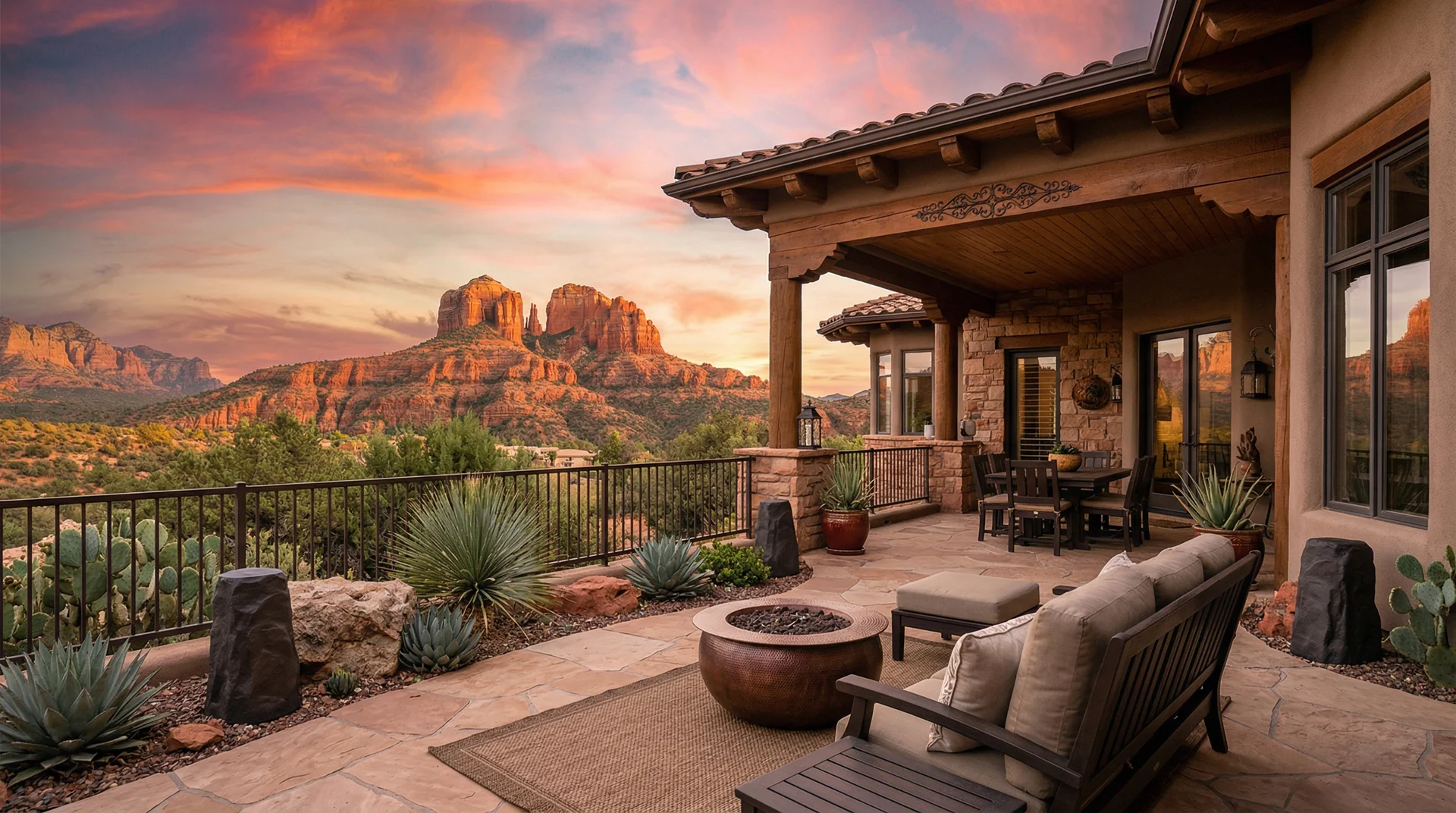
Sedona's 4,500-foot elevation, monsoon storms, and triple-digit summer heat destroy outdoor speakers that weren't designed for it. Here's how to build a landscape audio system that sounds great against the red rocks and actually lasts.
Sedona sits at 4,500 feet. The UV index regularly hits extreme levels in summer. Monsoon storms drop inches of rain in minutes. And the temperature can swing 40 degrees between noon and midnight. If you're putting speakers outside in this environment, you're not shopping for patio accessories. You're engineering around one of the most punishing climates in the Southwest.
I'm Mike, owner of Mike Knows Audio Video. I build and install outdoor audio systems across northern and central Arizona, including Sedona, the Village of Oak Creek, and the Verde Valley. The red rock landscape here is stunning. It's also brutal on electronics. Here's what I've learned about making outdoor speakers in Sedona, AZ actually last, and actually sound good.
Why Does Sedona Destroy Outdoor Speakers?
The global outdoor speaker market reached $3.5 billion in 2024 and is projected to grow at 9.2% annually through 2032 (Fortune Business Insights, 2024). That growth means more product options, but most of those products were not designed for Sedona's specific combination of threats. Elevation, UV, monsoons, dust, and thermal cycling all hit at the same time here.
At 4,500 feet, Sedona receives roughly 25% more UV radiation than sea-level cities. The EPA's UV Index scale tops out at 11+, and Sedona regularly reaches that extreme category from May through September (EPA, 2024). UV degrades polymer enclosures, fades finishes, and breaks down the rubber surrounds on speaker cones. A speaker rated for "outdoor use" in Portland won't survive three summers here.
Then there's the monsoon season. The National Weather Service reports that Arizona's monsoon season (June 15 through September 30) brings an average of 2.5 to 3.5 inches of rain to the Sedona area, often falling in violent bursts of half an inch or more in under an hour (NWS Flagstaff, 2024). Wind-driven rain doesn't just fall on speakers. It hits them sideways.
I've pulled apart failed outdoor speakers from Sedona patios. The story is always the same: corrosion on the terminal connections, cracked enclosures from thermal cycling, and driver surrounds that crumbled from UV exposure. These weren't cheap speakers, either. They just weren't rated for this environment.
What IP Rating Do Outdoor Speakers Need in Sedona?
IP (Ingress Protection) ratings tell you exactly how much dust and water a speaker can handle. For Sedona's conditions, an IP55 rating is the bare minimum for covered patio speakers, and IP66 or IP67 is what I recommend for any speaker exposed to open sky. The first digit rates dust protection (5 = dust-protected, 6 = dust-tight). The second rates water (5 = low-pressure jets, 6 = high-pressure jets, 7 = temporary immersion).
Why does this matter so much here? Sedona's fine red dust gets into everything. It's not just cosmetic. Dust infiltration into speaker drivers causes distortion over time and accelerates wear on moving parts. A dust-tight enclosure (IP6X) isn't optional for landscape speakers sitting at ground level in desert soil.
For water, the distinction between IP55 and IP66 is the difference between surviving a gentle rain and surviving a monsoon microburst with 60 mph wind gusts. If your landscape speakers are in an open position, not under a ramada or covered patio, they need IP66 at minimum.
How Do Canyon Acoustics Affect Outdoor Sound in Sedona?
Sedona's canyon walls and red rock formations create acoustic environments you won't find in flat desert cities like Scottsdale or Phoenix. Sound bounces off hard sandstone surfaces, and depending on your property's orientation, those reflections can either help you or fight you. Understanding this is the difference between a system that sounds great and one that sounds muddy.
Properties that face an open canyon or valley tend to lose low-frequency energy quickly. Bass just dissipates into the open space. But properties backed by a rock wall or cliff face get natural reinforcement, almost like a built-in reflector that adds warmth and presence without extra hardware. I've measured 4 to 6 dB of natural bass reinforcement on properties with a rock face within 30 to 50 feet of the listening area. That's significant. It changes subwoofer placement strategy entirely.
Wind patterns matter too. Sedona's canyon breezes are predictable: cool air drops down the canyons in the evening, and thermals rise in the afternoon. Sound travels farther downwind and gets pushed back upwind. If your patio faces into the prevailing evening breeze, you'll need more speaker coverage than a sheltered position. This isn't something you solve by turning up the volume. You solve it with speaker placement and aim.
Covered Patio Speakers vs. Open-Air Landscape Speakers
These are two fundamentally different design problems, and most outdoor audio installations in Sedona need both. A covered patio, whether it's a ramada, pergola, or extended roofline, offers some protection from direct sun and rain. Open-air landscape positions, like around a fire pit, along a walkway, or near a pool, offer none.
Covered Patio Speakers
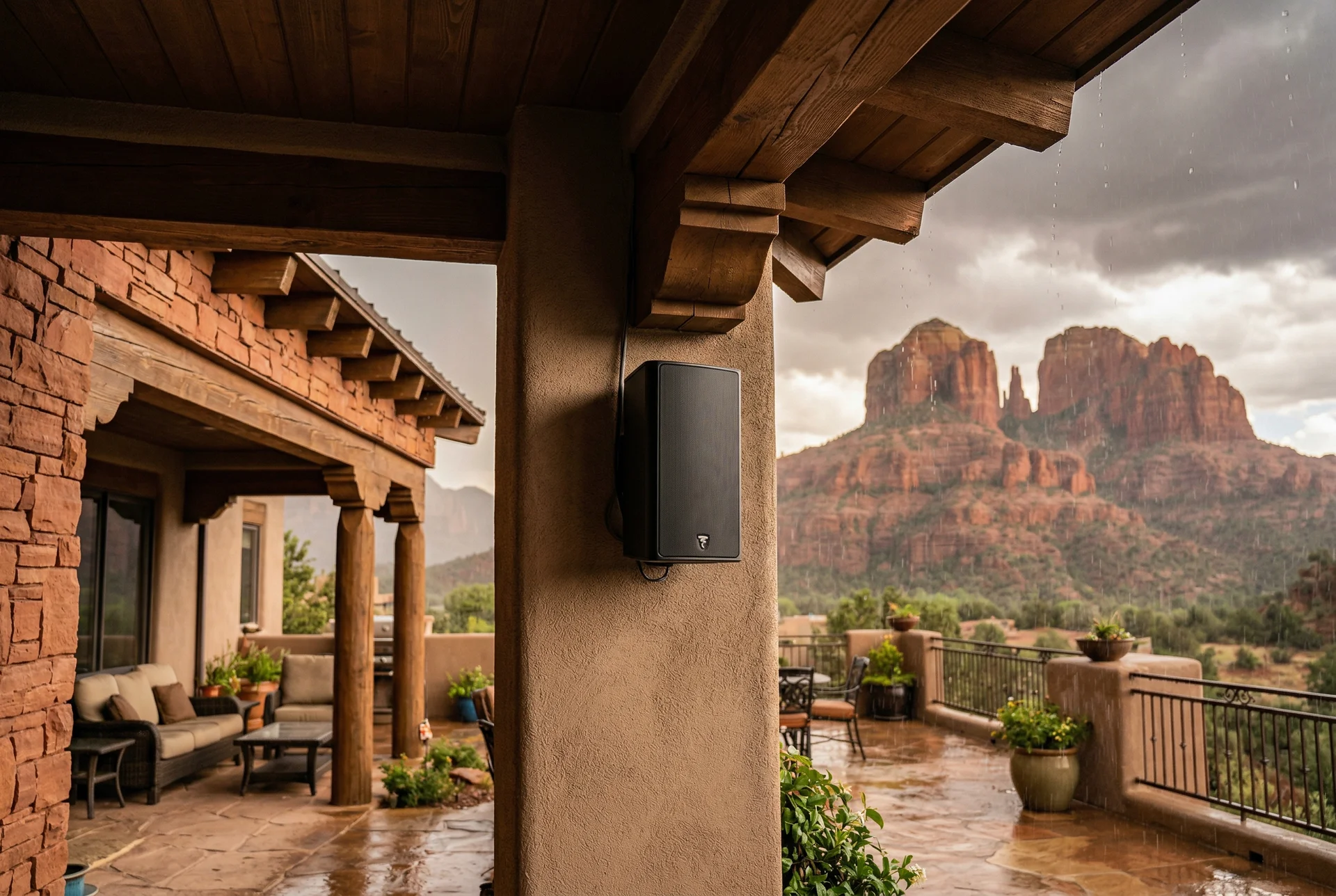
Under a roof, on-wall speakers are the best option. They mount under the eave, aim down toward the seating area, and stay protected from direct monsoon rain. IP55 is usually sufficient. The covered position also reduces UV exposure by 60 to 80%, which dramatically extends the life of enclosure materials and driver surrounds. Placement should create even coverage across the seating area without hot spots near the mounting wall.
Open-Air Landscape Speakers
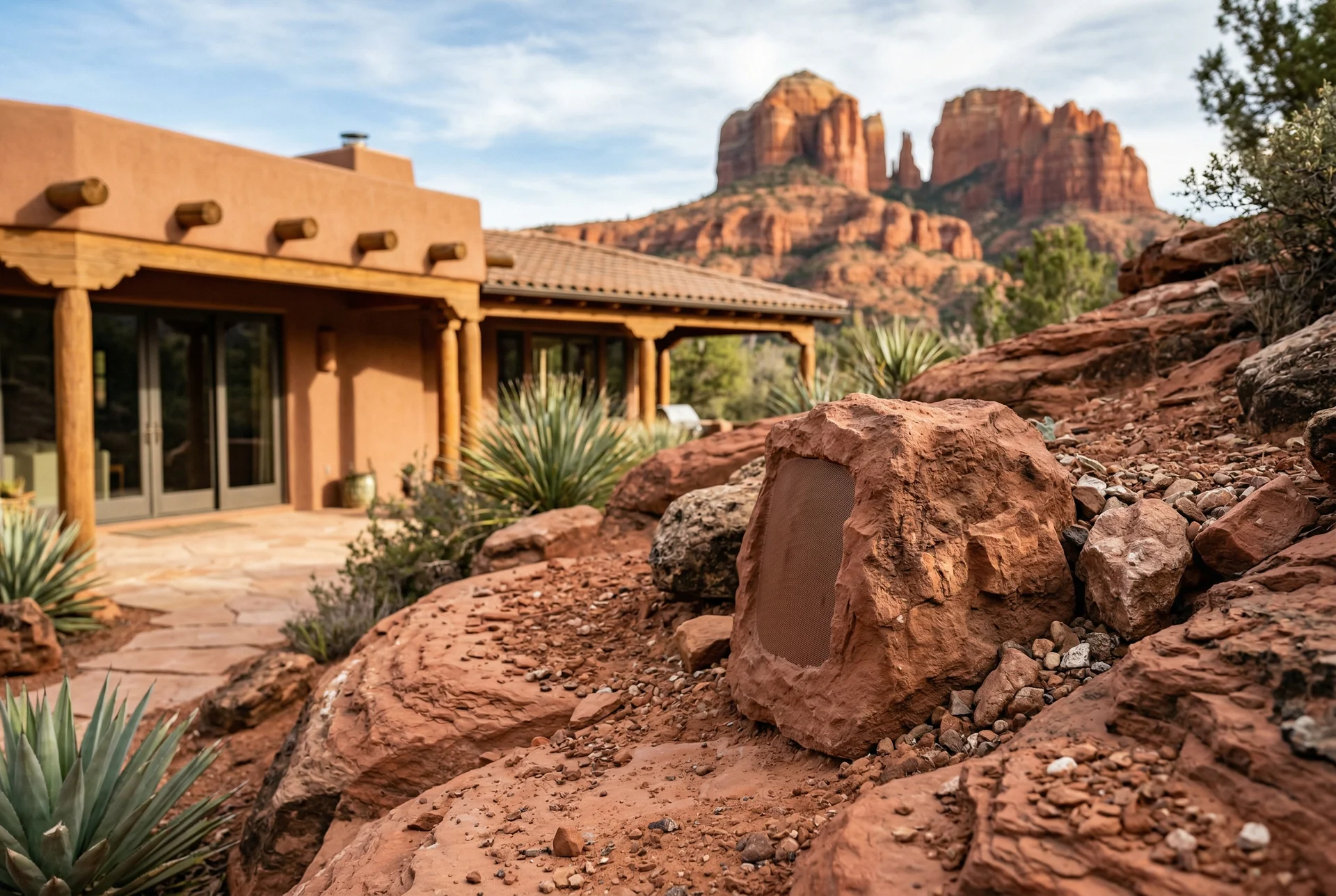
In open positions, landscape speakers and rock speakers are the right tool. They sit at ground level, disperse sound in a 360-degree pattern (or 180 degrees for half-burial models), and they're designed to take full weather exposure. For landscape speakers in Sedona, color matching matters. Generic gray granite rock speakers look completely wrong against Sedona's red and orange sandstone. Look for brands offering sandstone or terracotta color options, or plan to have them professionally color-matched after installation.
Burial-grade direct-bury cable is non-negotiable for landscape runs. Standard outdoor-rated cable won't survive long term in Arizona soil. I run all landscape speaker wire in conduit with pull strings for future serviceability.
How Do You Design a Fire Pit Audio Zone?
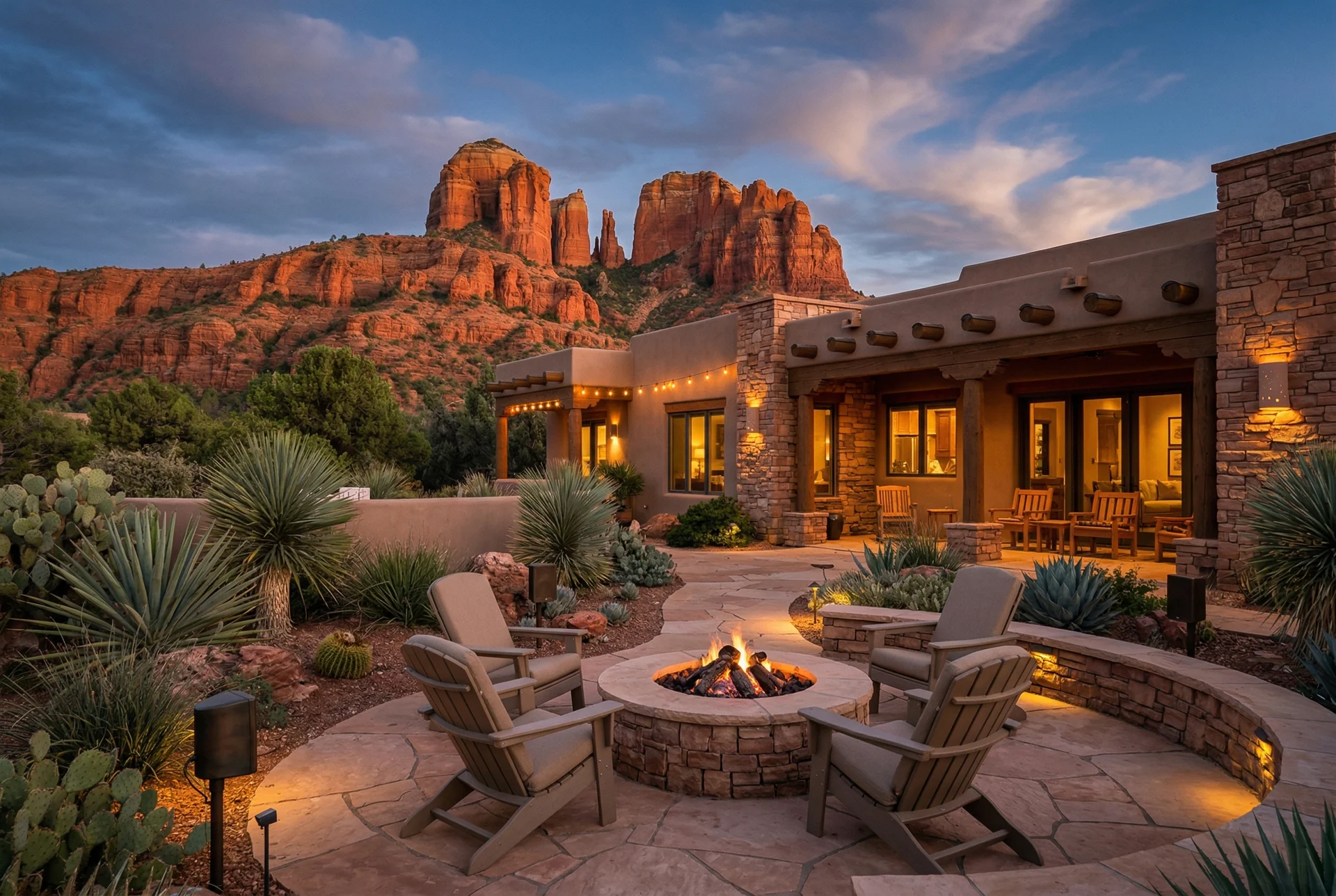
The fire pit is the social anchor of most Sedona patios. It's where people gather after sunset with the red rocks silhouetted against the sky. Getting the audio right in this zone means background music that fills the space without overwhelming conversation. That requires different thinking than a patio zone where you might want louder, more direct sound.
I typically ring a fire pit area with three to four landscape speakers placed 8 to 12 feet from the seating circle, angled slightly inward. This creates an even wash of sound from every direction, so no single seat is louder than another. An in-ground subwoofer placed outside the seating ring adds low-frequency warmth without the localized thump you'd get from a surface-mounted sub.
In my experience, fire pit zones perform best at 65 to 72 dB, which is roughly the volume of a normal conversation. Louder than that and people start shouting over each other. Quieter and the music disappears behind the crackle of the fire and ambient canyon noise. Getting that calibration right, and giving the homeowner a simple way to adjust it, is what separates a designed system from speakers tossed in the yard.
What About Temperature Swings and Thermal Cycling?
Sedona's average daily temperature range is among the widest in Arizona. Winter nights can drop below 20\u00b0F while summer afternoons regularly exceed 100\u00b0F. According to NOAA climate data, Sedona's record high is 114\u00b0F and record low is -5\u00b0F (NOAA/NWS Flagstaff, 2024). That's a 119-degree total range, and the daily swings of 30 to 40 degrees are what really matter for electronics.
Thermal cycling, the repeated expansion and contraction from hot days and cold nights, is what kills speaker connections and enclosures over time. Solder joints crack. Plastic housings develop hairline fractures. Gaskets lose their seal. This is why marine-grade construction matters even though Sedona is nowhere near the ocean. Marine-grade speakers use stainless steel hardware, sealed terminal connections, and enclosure materials rated for extreme thermal cycling.
Don't overlook the amplifier. If your outdoor amp lives in an uninsulated equipment closet or patio cabinet, it's experiencing those same temperature swings. I install outdoor amplifiers in ventilated, insulated enclosures with thermal protection. A good outdoor amp should have an operating range of -4\u00b0F to 130\u00b0F at minimum.
How Do You Plan Zones for a Sedona Outdoor Audio System?
A 2024 report from the Consumer Technology Association found that 33% of US smart home device owners use outdoor audio zones, up from 21% in 2021 (CTA, 2024). That growth reflects what I'm seeing on the ground: homeowners don't want a single outdoor audio switch anymore. They want zones they can control independently.
For most Sedona properties, I design two to three outdoor zones:
Zone 1: Covered patio. This is the primary entertaining zone, closest to the house, usually with a dining table or lounge seating. On-wall speakers under the eave, wired back to the main equipment rack. This zone often ties into the indoor whole-home audio system so you can group it with the kitchen or great room.
Zone 2: Landscape or fire pit. Farther from the house, with rock or landscape speakers at ground level. Independent volume control so it can run quietly during a fire pit conversation or louder for a party. Buried cable runs with conduit.
Zone 3: Pool, spa, or courtyard. If the property has a secondary outdoor area, it gets its own zone. This could be a pool deck, a side courtyard, or even a garden path. The key is independence: you shouldn't have to blast the fire pit to get music at the pool.
Each zone gets its own amplifier channel (or a dedicated zone on a multi-channel outdoor amp) and its own volume control, either a wall-mounted dial or app-based control through the home automation system.
Choosing Outdoor Speakers That Match Red Rock Landscape
Sedona homeowners care about aesthetics. That's not a stereotype. It's a fact backed by one of the strictest architectural review processes in Arizona, where even exterior paint colors require approval from the city's design review board. An outdoor speaker system that looks like it was bolted on as an afterthought won't fly here.
Rock speakers designed for desert landscapes come in several color families. The ones that work best in Sedona are sandstone, canyon red, and weathered copper tones. Avoid standard granite gray. It reads as completely foreign against the native red rock. Placement is equally important. Tuck landscape speakers into existing boulder groupings, behind native plantings like agave or prickly pear, or along the edges of dry creek beds. A well-placed speaker disappears. A badly placed one is an eyesore no matter what color it is.
For on-wall speakers on covered patios, match the enclosure color to the wall or beam color. Most outdoor on-wall speakers come in white, black, or brown. For Sedona's earth-toned architecture, brown or custom-painted enclosures blend best.
Ready to Build an Outdoor System That Lasts?
If you're building or renovating in Sedona and want outdoor audio that survives the environment and sounds worth listening to, I'd like to help. I design outdoor speaker systems in Sedona, AZ around the specific challenges of your property: its orientation, its exposure, its layout, and the way you actually use your outdoor spaces.
Every system I install uses weather-rated, landscape-grade equipment with proper IP ratings for Sedona's conditions. I handle the design, the speaker selection, the cable routing, and the calibration. Build timelines for outdoor audio projects typically run 6 to 12 weeks depending on complexity and whether we're coordinating with a landscaper or builder.
Get in touch here or call (928) 440-1950 to talk through what you're working with. No pressure, no pitch. Just a conversation about what makes sense for your property.
Comments
Leave a Comment