
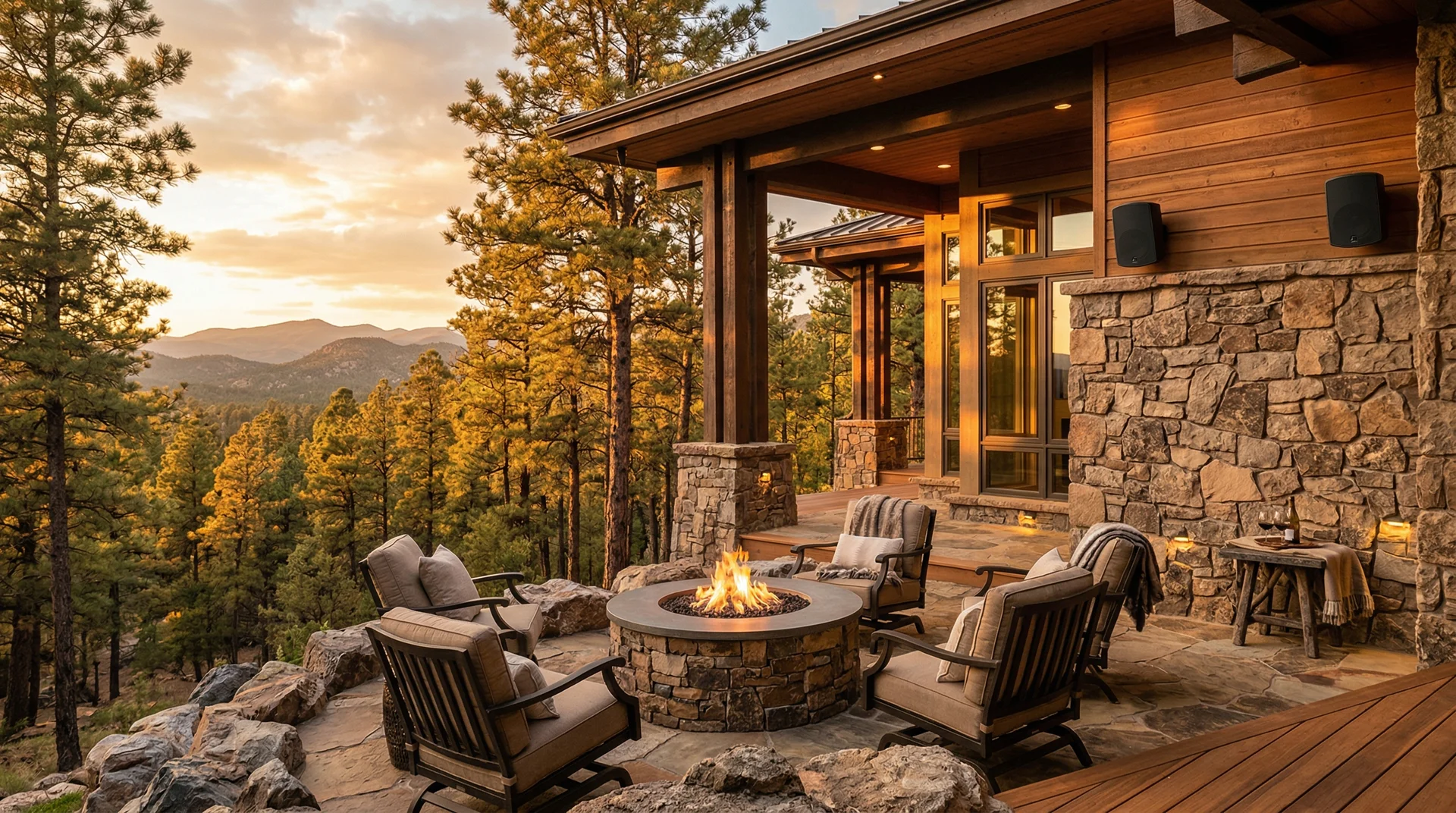
Prescott gets real winter, real monsoons, and real UV. Here's how to design an outdoor speaker system that handles all four seasons without replacing hardware every two years.
Prescott isn't Phoenix. You get real snow, genuine monsoons, and summer afternoons that crack cheap plastic. Here's how to build an outdoor audio system that handles all four seasons without replacing hardware every two years.
Prescott averages 80-plus degrees of temperature swing across the year, from below-freezing winter mornings to summer highs near 100 (NWS Flagstaff). That range destroys outdoor speakers that weren't built for it. Freeze-thaw cycles crack enclosures. Monsoon rain and dust get inside housings. UV exposure degrades rubber surrounds and plastic grilles in a single summer.
I'm Mike, owner of Mike Knows Audio Video. I design outdoor audio systems across northern Arizona, and Prescott's climate is one of the most demanding environments I work in. Not because of any single extreme, but because everything changes. Four real seasons means four different kinds of stress on your equipment.
Why Does Prescott's Climate Destroy Cheap Outdoor Speakers?
Prescott receives approximately 18.7 inches of precipitation annually, split between winter snow and dramatic summer monsoons from July through September (NWS Flagstaff). That combination, paired with 260 days of sunshine and hard UV at 5,400 feet, creates a punishing cycle for any outdoor hardware.
Most outdoor speakers sold at big-box stores are designed for mild climates. They'll handle some rain. They won't handle a January morning at 15 degrees followed by a July afternoon at 98. That 80-degree swing is the real killer. Water gets into housings, freezes, expands, and cracks the enclosure from inside. UV breaks down the materials that are supposed to keep water out in the first place.
What does that look like after two years? Faded grilles, cracked driver surrounds, corroded terminals, and sound quality that's noticeably worse than the day they were installed. I've pulled plenty of these off Prescott patios.
In my experience, outdoor speakers rated below IP55 rarely survive more than two Prescott winters without visible degradation. I spec IP65 or higher for every outdoor installation here.Covered Patio vs. Open Deck: How Does Design Change?
A 2023 American Institute of Architects survey found that outdoor living spaces were the most popular special function room, requested in 70% of residential projects (AIA Home Design Trends Survey, 2023). In Prescott, that outdoor space usually comes with a covered patio, which changes everything about speaker design.
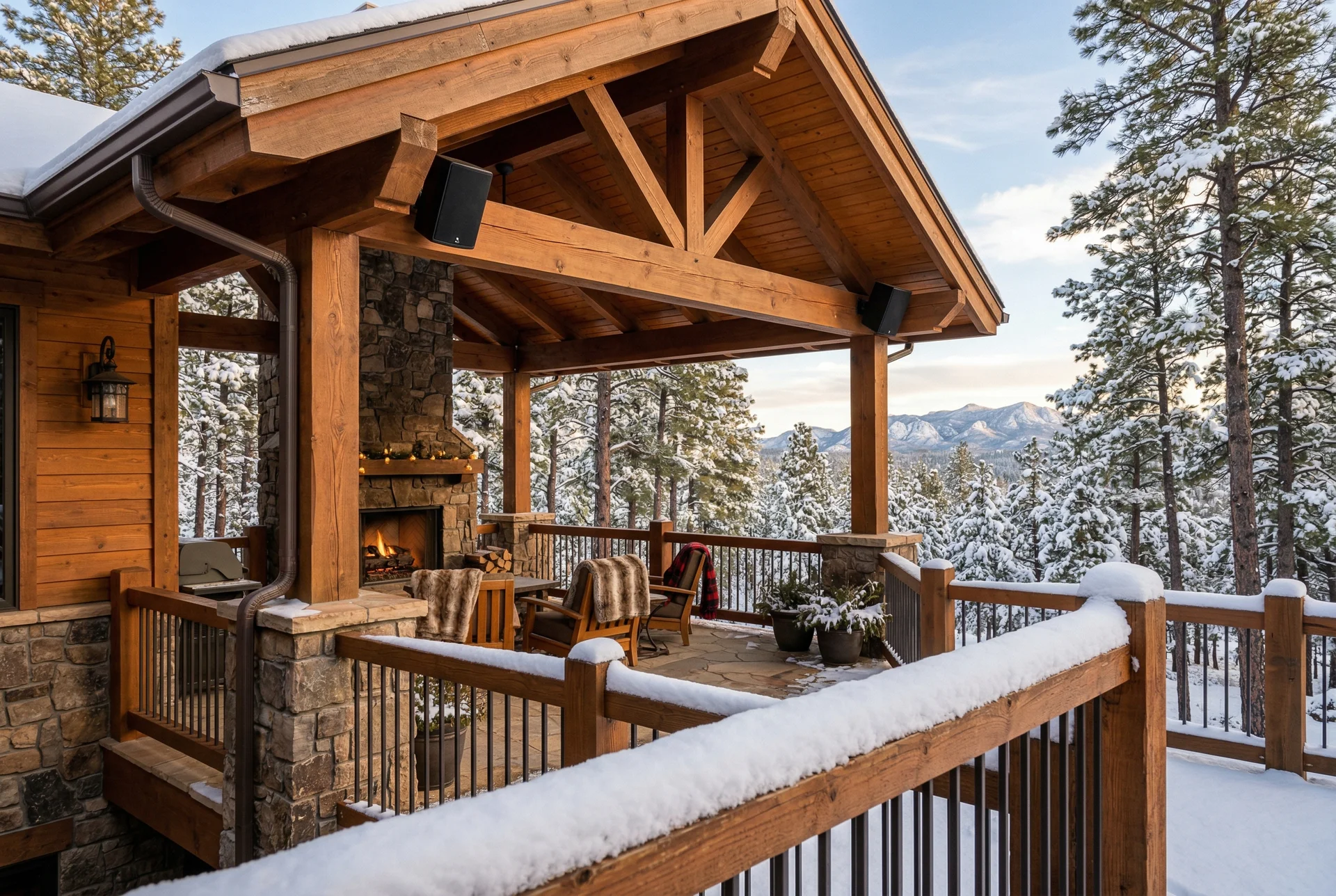
A covered patio gives you protection from direct rain and UV, which means on-wall speakers mounted under the ceiling work beautifully here. I angle them downward toward the seating area for focused coverage. Two to four speakers handle most covered patios, depending on depth and width. The cover also helps contain sound, so you get better volume control and less bleed toward neighbors.
Open decks are a different story. No overhead protection means full exposure to monsoon downpours, winter snow, direct sun, and wind. These areas need landscape speakers or weather-rated on-wall units mounted to posts or exterior walls with IP66 or higher ratings. The speaker placement has to account for wind carrying sound away, which means closer spacing than you'd use under a cover.
What About Partially Covered Areas?
Many Prescott homes have a covered section that extends into an open deck or yard. I treat these as two separate zones. The covered portion gets on-wall speakers aimed at the dining or seating area. The open section gets landscape speakers in the surrounding yard. Each zone runs independently so you can adjust volume based on where people are, not based on what the weather is doing.
What Makes Prescott's Outdoor Entertaining Culture Unique?
The Prescott metro area grew by over 15% between 2010 and 2020, making Yavapai County one of Arizona's fastest-growing regions (U.S. Census Bureau, 2020). Many of those new residents came from Phoenix and California specifically for the four-season lifestyle, and they want outdoor spaces that work year-round.
Prescott isn't a "pool and patio" city like Scottsdale. The outdoor culture here revolves around fire pits, pine-shaded decks, and cooler evening entertaining. People gather around the fire on a September night, host Thanksgiving outdoors because the weather allows it, and sit on the patio with coffee on crisp spring mornings. That's three-season heavy use with occasional winter sessions, and the audio system has to match that rhythm.
I've noticed that Prescott clients use their outdoor systems differently than my Scottsdale clients. In Scottsdale, outdoor audio runs daily from March through November. In Prescott, usage peaks in spring and fall, drops in summer heat, and surprises you with random January afternoons that hit 60 degrees. The system has to be ready on short notice.Watson Lake, the Granite Dells, and the surrounding national forest define the area's character. Homes with views of these landscapes often have expansive outdoor living areas designed to take advantage of the setting. The audio should complement that, not compete with it. Background music for a fire pit gathering is fundamentally different from pool-party volume at a Scottsdale estate.
How Do You Design Audio for a Fire Pit Zone?
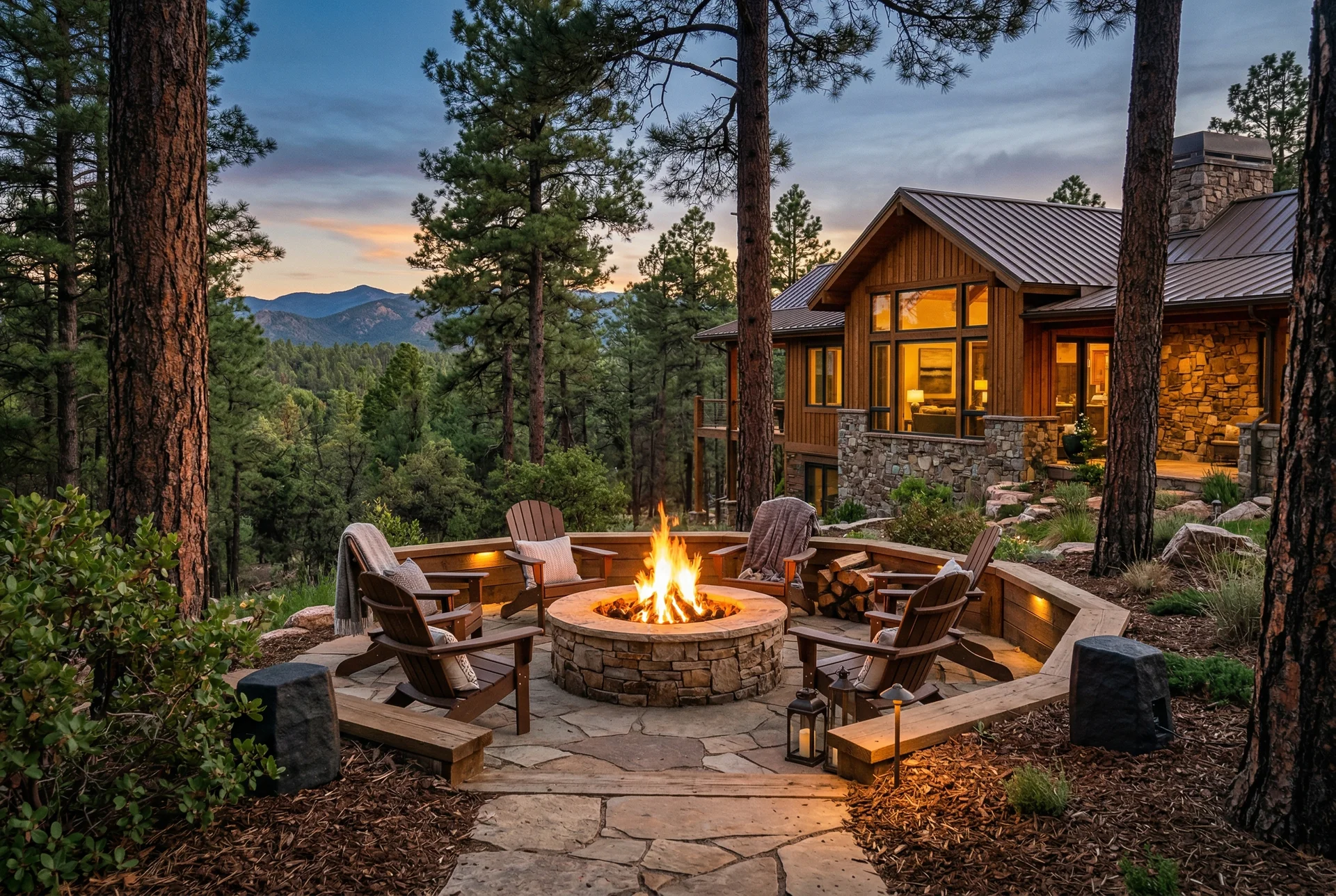
A 2024 survey by the American Society of Landscape Architects found that fireplaces and fire pits were the most popular outdoor design element, requested by 91% of residential clients (ASLA Residential Landscape Architecture Trends Survey, 2024). In Prescott, a fire pit isn't a luxury feature. It's the center of outdoor life for eight months a year.
Fire pit zones need landscape speakers positioned around the perimeter of the seating area. I typically place four to six units in a rough circle at ground level, spaced to create even coverage from every seat. The sound should feel like it's coming from everywhere and nowhere, soft enough for conversation but present enough to fill silence when the talking stops.
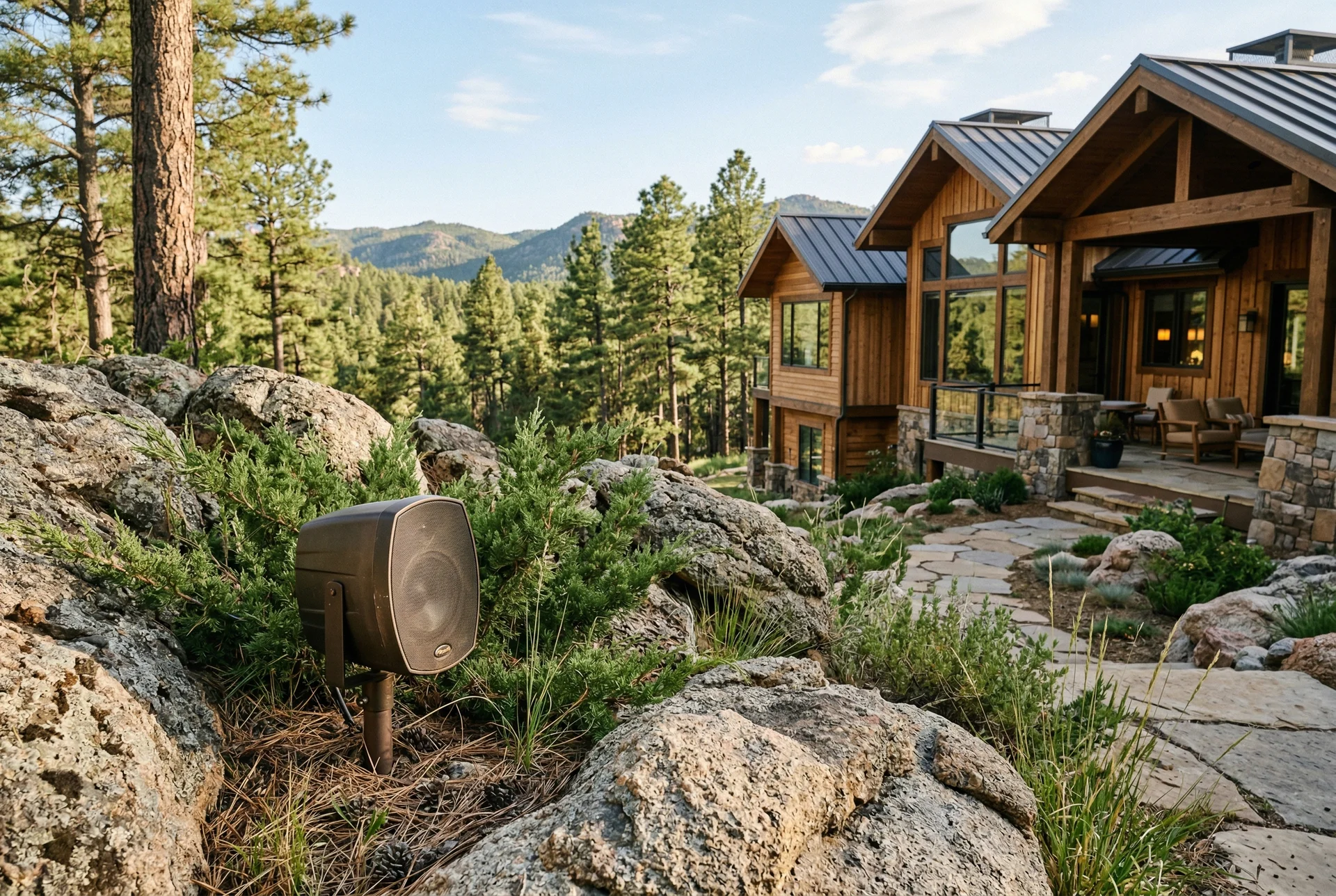
Why landscape speakers and not on-wall? Because fire pit areas are usually away from the house, out in the yard where there's no wall to mount anything on. Landscape speakers sit among the granite boulders and pine duff that define most Prescott lots. They blend in. Guests don't notice them. They just notice the music.
Volume and Conversation Balance
The biggest mistake with fire pit audio is making it too loud. People gather around fire pits to talk. The music is a backdrop. I calibrate fire pit zones to a lower default volume than patio zones, with easy adjustment from your phone if you want to turn it up later in the evening. Independent zone control means the fire pit doesn't have to match whatever's happening on the patio or inside the house.
Do Prescott's Seasons Affect How You Plan the System?
Prescott receives an average of 12.3 inches of snowfall per year, concentrated between December and March, with overnight lows that regularly dip below 20 degrees Fahrenheit (NWS Flagstaff). Unlike Phoenix, where outdoor systems run nearly every day, Prescott's seasonal patterns directly shape how I design and specify equipment.
Some clients ask about winterizing their speakers, covering them, or even bringing them inside. With the right hardware, none of that is necessary. Speakers rated IP65 or higher with marine-grade crossover components and UV-stabilized enclosures handle everything Prescott throws at them. I've had systems running through multiple Prescott winters with zero degradation.
Here's what most installers miss about seasonal use patterns: a system that sits idle for weeks at a time is actually harder on connections than one that runs daily. Corrosion builds faster on dormant terminals. That's why I use sealed, weather-protected connections at every junction, not just at the speaker.The design itself also changes based on seasonal use. Prescott clients tend to use their outdoor audio most heavily from April through October, with peak usage during those cool fall evenings. I position primary speakers to optimize for where people actually sit during the comfortable months, not for even coverage of the entire yard year-round.
What About Monsoon Season?
Monsoon storms in Prescott are intense but brief. Heavy rain, wind, blowing dust, and occasional hail between July and September. The speakers handle the water. The bigger concern is dust, which works its way into poorly sealed housings and grinds against moving parts. Every speaker I install in Prescott has sealed enclosures and weather-resistant driver materials specifically because of monsoon dust.
How Do Landscape Speakers Work in Pine and Juniper Settings?
Landscape speakers are designed to sit at ground level and blend with natural surroundings. In Scottsdale, that means desert rock and gravel. In Prescott, it means something completely different: pine needle duff, juniper beds, granite boulders, and manzanita. The aesthetic is mountain, not desert.
I select landscape speaker finishes and housings that match Prescott's specific terrain. Dark granite tones work among the boulders. Earth-toned units disappear into pine needle beds. The goal is invisible audio: you hear the music, you don't see where it's coming from.
Placement matters more in wooded lots than open desert yards. Pine trees and dense juniper absorb and scatter sound differently than an open lawn. I space landscape speakers closer together in heavily landscaped areas to compensate for absorption, and I angle them to work with the natural terrain rather than fight it.
Granite Dells and Rocky Lots
If your property borders the Granite Dells or sits on a rocky lot, the terrain actually works in your favor. Hard granite surfaces reflect sound naturally, which means fewer speakers can cover more area. I take advantage of that by placing landscape units where the rock formations will help carry the audio. It's one of the few cases where the landscape does some of the work for you.
Frequently Asked Questions
Do I need to winterize my outdoor speakers in Prescott?
Not if they're properly specified. Speakers rated IP65 or higher with marine-grade components handle Prescott's freeze-thaw cycles without damage. I use speakers designed for full outdoor exposure year-round, so there's nothing to cover, disconnect, or bring inside. The key is getting the right hardware from the start.
How many outdoor speakers do I need for a Prescott patio?
A covered patio typically takes 2-4 on-wall speakers depending on size. Add 4-6 landscape speakers for yard and fire pit areas. An outdoor kitchen adds 2 more. I design the count and placement after walking your property, because every lot in Prescott is different. Schedule a free consultation to get a real plan.
Can landscape speakers work in rocky Prescott yards?
Absolutely. Landscape speakers were designed for exactly this kind of terrain. In Prescott, I place them among granite boulders, pine duff, and juniper beds where they blend naturally. The rocky soil actually helps with drainage, which extends speaker life. These aren't delicate indoor units. They're built for the ground.
Will outdoor speakers disturb my neighbors?
Proper placement and angling keeps sound focused on your living areas, not across property lines. Landscape speakers disperse audio at ground level, which carries far less than elevated speakers pointed outward. Independent zones also mean you're never overdriving one area to make up for another.
How long does outdoor speaker installation take?
Most outdoor audio projects take 6 to 12 weeks from initial consultation to final calibration, depending on complexity. A simple covered patio system is on the shorter end. Multi-zone designs with landscape speakers, buried conduit, and whole-home integration take longer. I'll give you a realistic timeline after we talk through the project.
Your Prescott Backyard Deserves Better Than a Bluetooth Speaker
You moved to Prescott for the pines, the seasons, and the outdoor lifestyle. The audio should be part of that, not an afterthought you carry outside in one hand. A properly designed patio speaker system in Prescott handles snow, monsoons, UV, and everything in between. It's ready when you are, whether that's a crisp October fire pit evening or an unexpected warm afternoon in February.
Every system I build for outdoor entertainment in Prescott AZ starts with a conversation about how you actually use your outdoor space. Not a catalog. Not a template. Your property, your seasons, your lifestyle.
Schedule a free consultation or visit the Prescott service area page to learn more about what's possible for your property.
Comments
Leave a Comment