
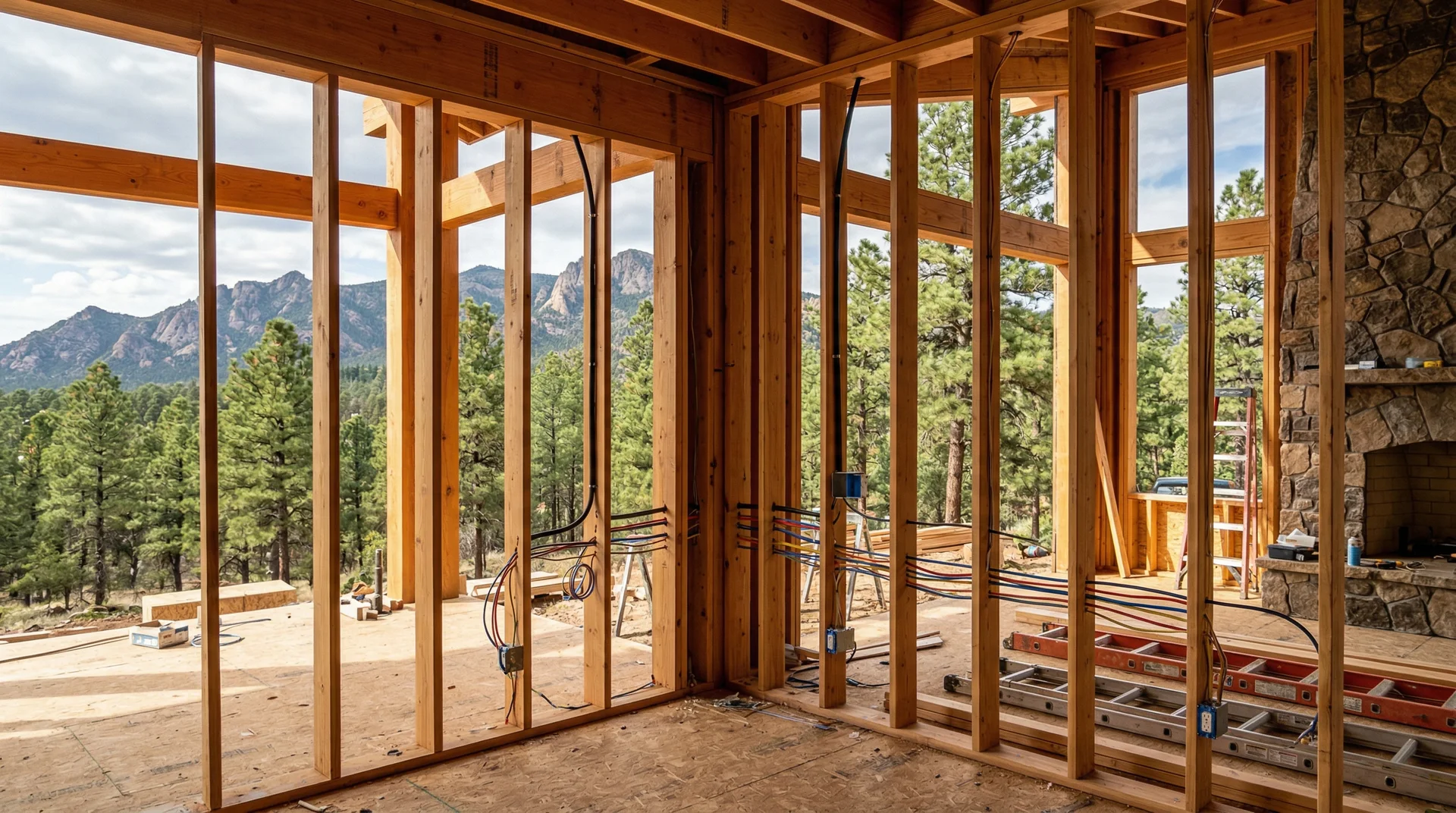
Building a new home in Prescott? The framing stage is your one shot to get audio wiring right. Here's how to work with your builder on speaker placement, cable routing, and system planning before the drywall goes up.
Building a new home in Prescott? The framing stage is your one shot to get audio wiring right. Here's how to work with your builder on speaker placement, cable routing, and system planning before the drywall goes up.
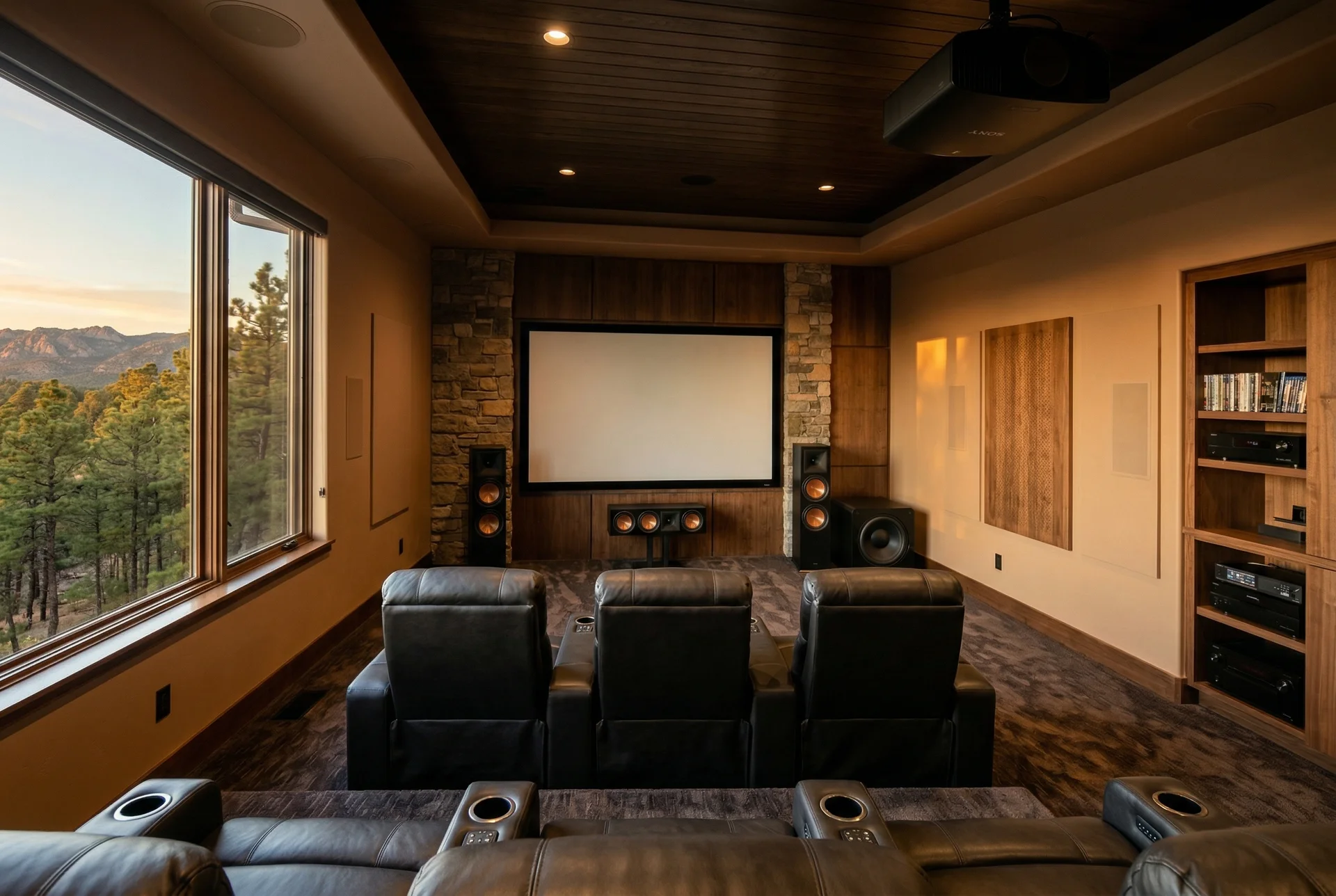
Every year, hundreds of new homes go up across Prescott, Prescott Valley, and the surrounding Quad Cities. Yavapai County issued over 1,800 single-family residential building permits in 2024 (U.S. Census Bureau Building Permits Survey, 2025). Most of those homes get wired for cable TV and internet. Almost none get wired properly for a real sound system.
That's a missed opportunity. I'm Mike Vincent, and I build custom speakers and design home theater systems from my workshop in the Arizona high desert. I've worked with builders across the Prescott area on new construction audio, and I can tell you this: the difference between pre-wiring during framing and retrofitting after move-in is thousands of dollars and a much cleaner result.
Why Does Pre-Wiring During Construction Save So Much Money?
The National Association of Home Builders reports that the average cost of a new single-family home in the West reached $453,000 in 2024 (NAHB, 2024). Within that budget, pre-wiring for audio adds roughly 0.1% to 0.4% to the total build cost. Retrofitting the same wiring after drywall, paint, and trim are finished? That number jumps dramatically.
Here's the math in plain terms. Running speaker wire and network cable through open wall studs takes a few hours. Running that same cable through a finished wall means cutting drywall, patching, repainting, and hoping you don't hit a fire block or plumbing line. The wire itself costs the same either way. It's the labor and repair work that multiplies the price.
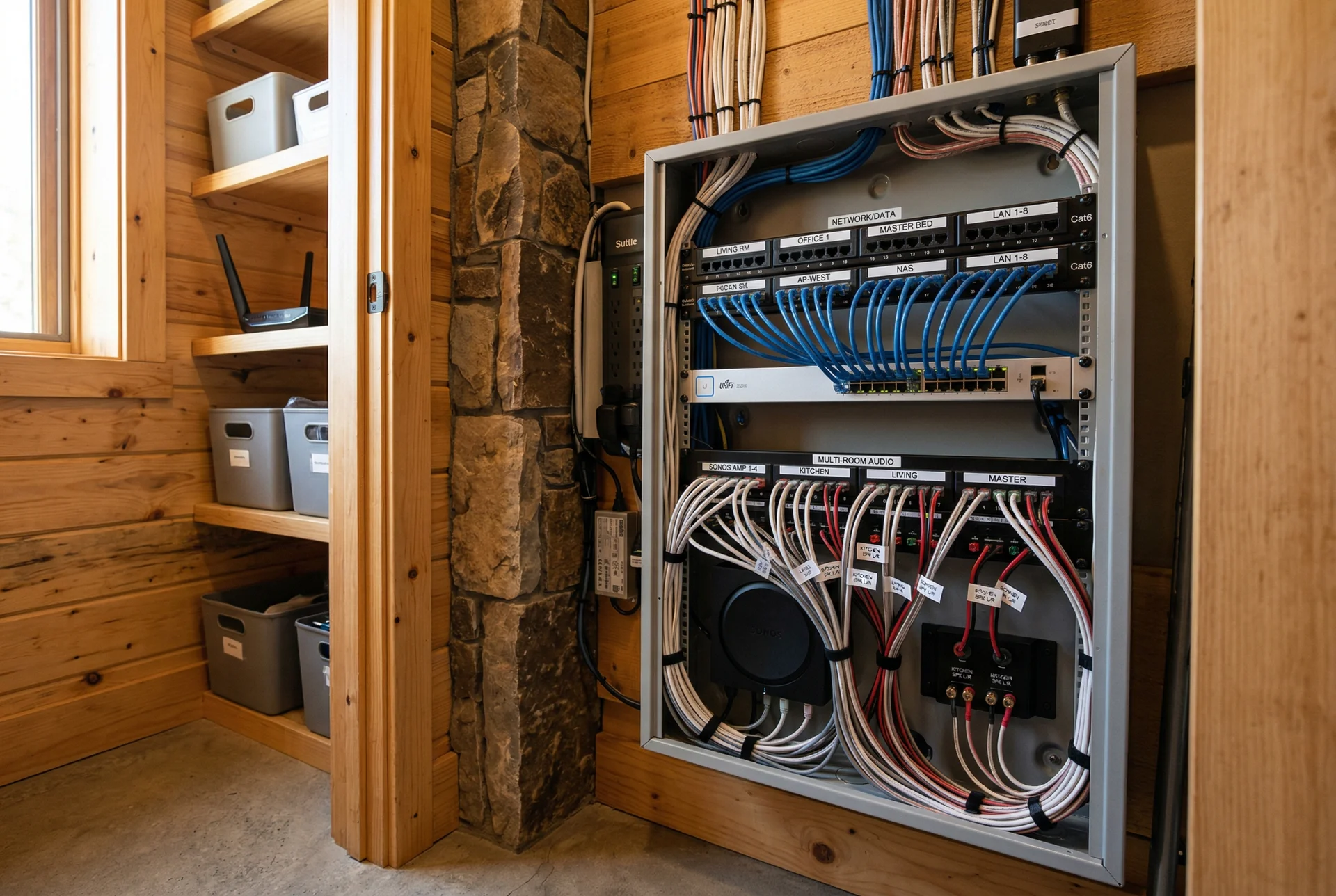
In my experience working on Prescott-area new builds, pre-wiring a whole-home audio system during framing typically costs 60-70% less than a post-construction retrofit. On a four-zone system, that can mean saving $2,000 to $4,000 in labor alone.
What Prescott Developments Are Building Right Now?
The Prescott area has seen sustained residential growth, with the City of Prescott alone approving over 400 new residential units in its 2024 fiscal year (City of Prescott, 2024). Active developments like Deep Well Ranch, Pronghorn Ranch, and Prescott Lakes are putting up homes ranging from production builds to fully custom estates. Each one represents a window for pre-wire planning.
Custom builders including Capstone Homes, Evermore Homes, Dorn Homes, Davidson Homes, and Crystal Creek Builders are active across Yavapai County. These aren't tract home operations. Most of them build semi-custom or fully custom homes and are accustomed to coordinating with specialty subcontractors during the framing phase.
If you're working with any of these builders, or another custom builder in the area, I can step in during framing to handle audio wire routing, speaker location marking, and conduit placement. The builder's electrician handles their scope, and I handle mine. No conflicts, no delays.
Have you already broken ground? Even if framing is underway, there's usually still time. But once insulation goes in, the window closes fast.
How Does Spray Foam and Energy-Efficient Construction Affect Your Audio?
The U.S. Department of Energy notes that air sealing and insulation can reduce heating and cooling costs by up to 15% in a typical home (U.S. DOE, 2024). Prescott builders have leaned hard into energy efficiency, and for good reason. At 5,400 feet, winters get cold. Spray foam insulation, SIPs (Structural Insulated Panels), and advanced framing techniques are common in new Prescott construction.
This matters for audio in two important ways.
First, the good news. Closed-cell spray foam creates an airtight, dense wall cavity. That's excellent for sound isolation. A dedicated theater room insulated with spray foam will keep bass and movie explosions from bleeding into the bedroom next door. SIP construction offers similar benefits, with the rigid foam core acting as both structure and insulation.
Here's the catch that most people miss: once spray foam is applied, you cannot fish wire through that wall. Period. The foam bonds to the studs and fills every gap. If you didn't run your speaker cable before the insulation crew showed up, you're looking at surface-mounted cable, wireless solutions, or tearing into the wall. None of those are ideal. With SIPs, it's even more restrictive, since the panels arrive as solid units with no accessible cavity at all.
This is exactly why the timing of your AV pre-wire matters more in energy-efficient Prescott homes than in conventional builds. I coordinate with your builder to make sure my wiring is done before the insulation contractor arrives.
What Are Prescott's Building Code Differences from Maricopa County?
Yavapai County and the City of Prescott follow the International Residential Code (IRC) as adopted by Arizona, but local amendments and enforcement differ from Maricopa County in ways that affect AV installation. Prescott requires separate low-voltage permits for structured wiring in new construction, and inspections are handled by Yavapai County Development Services for unincorporated areas.
A few practical differences stand out. Prescott's fire-rated assembly requirements in multi-story homes mean that penetrations through floor and ceiling assemblies, including speaker wire, need fire stopping. Cable pathways between floors must be sealed. This isn't optional, and it's something I account for in every pre-wire plan.
I've also found that Prescott-area inspectors tend to be more hands-on with low-voltage work than their Maricopa County counterparts. That's not a bad thing. It keeps the work clean. But it means your AV pre-wire needs to be done correctly the first time, with proper brackets, labeled cables, and code-compliant routing. I handle all of that as part of my scope.
If you're building in an unincorporated part of Yavapai County versus within Prescott city limits, the permitting process is different. I'm familiar with both and can advise on what's required for your specific lot.
What Exactly Gets Pre-Wired in a Home Theater?
According to Parks Associates, 43% of U.S. broadband households now own a smart TV and at least one connected audio device (Parks Associates, 2025). But owning a smart TV and having a properly wired home theater are two very different things. Here's what I run during a new construction pre-wire.
Speaker Wire Runs
Every speaker position gets a dedicated run of 14-gauge or 12-gauge speaker wire back to the equipment location. For a 5.1 surround system, that's six runs minimum (five speakers plus a subwoofer). I also pull extra runs to future expansion positions. Wire is cheap during framing. Cutting into drywall later is not.
Network and Signal Cable
Cat6 Ethernet goes to the display location, the equipment rack or closet, and any room where you might want a streaming device or game console. I also run conduit for HDMI or fiber optic cable between the equipment location and the screen. Conduit is critical because HDMI standards change every few years, and you'll want to pull new cable without opening walls.
Low-Voltage Brackets and Boxes
Every speaker location gets an orange low-voltage bracket mounted in the framing. These mark exactly where the cable exits the wall. I also install recessed power outlets behind the TV and at the equipment location so you never see a power cord.
Equipment Closet Planning
Your receiver, streaming devices, and network gear need a home. I work with the builder to designate a closet or cabinet location with adequate ventilation, power, and cable access. This keeps equipment out of sight and protects it from the Arizona dust that gets into everything.
How Do I Coordinate with Your Builder?
This is where a lot of homeowners worry they'll create friction on their build. They won't. I've worked with builders across the Prescott area and the process is straightforward.
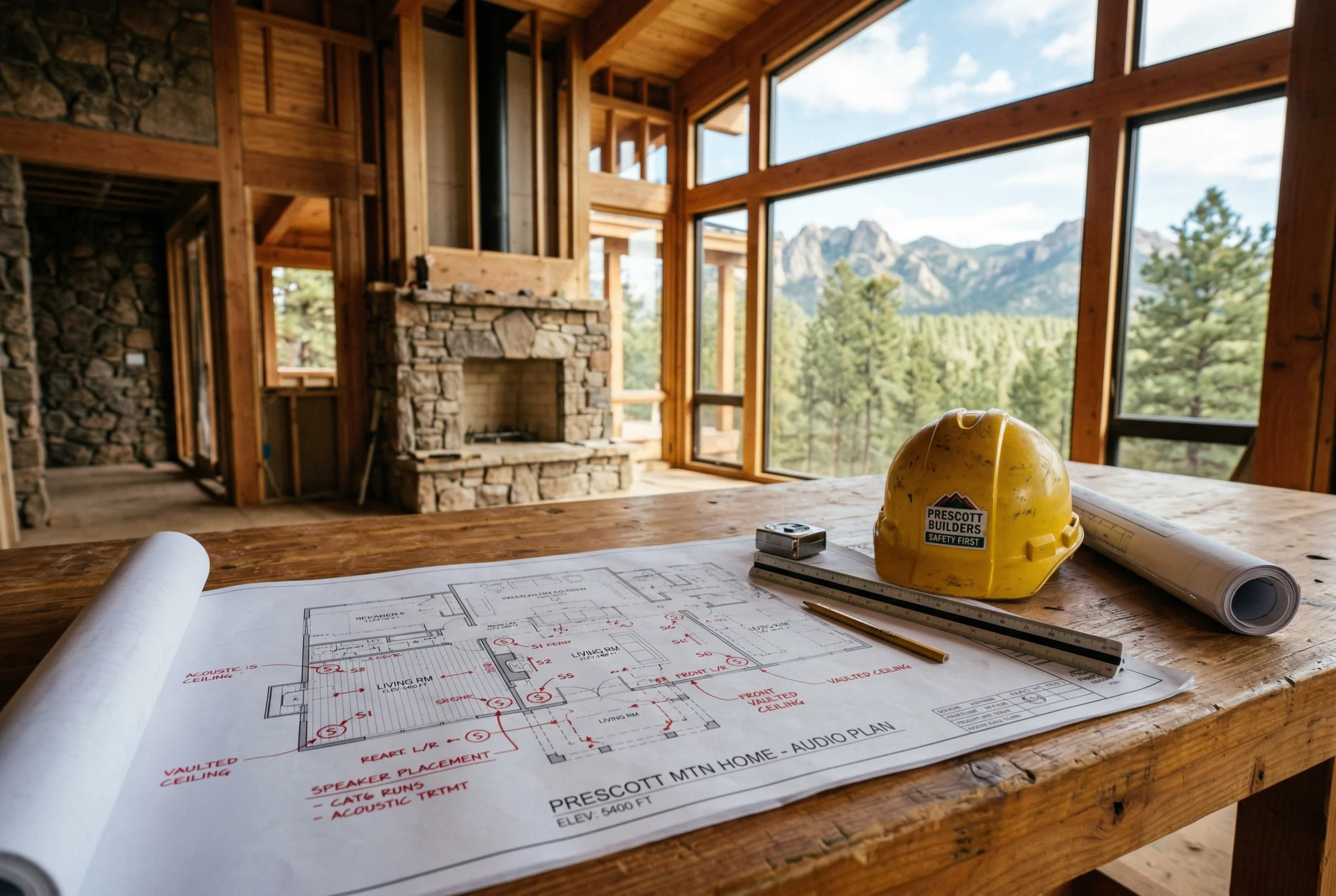
First, I review your floor plans and identify speaker locations, equipment placement, and cable routing. I put together a wiring diagram that I share with both you and your builder. This document shows every cable run, every bracket location, and every penetration point.
Next, I schedule my pre-wire for a specific window in the construction timeline, after framing and rough electrical but before insulation and drywall. Your builder's project manager and I coordinate on timing. I typically need one to two days on-site depending on the scope.
After my pre-wire is complete, I document everything with photos and measurements. This becomes your reference for the rest of the build and for final speaker installation after the home is finished. If inspectors have questions about the low-voltage work, I'm available to address them directly.
The builder keeps building. I show up at the right time, do my work, and get out of the way. Clean and simple.
When Should You Start Planning?
The ideal time to contact me is during the design phase, before your builder even breaks ground. If I can review floor plans before they're finalized, I can sometimes suggest minor layout adjustments, like moving an outlet or widening a closet, that make the audio system dramatically better.
If you're already past design and into framing, there's still time. But once insulation starts, the opportunity for clean, concealed wiring in an energy-efficient Prescott home is essentially gone.
Custom speakers from my shop take 6 to 12 weeks or more to build depending on size and complexity. If you start the conversation during the design or early framing phase, your speakers can be ready right around the time your builder finishes the interior. That means I install the day you're ready, not months after you've moved in.
Building in Deep Well Ranch, Pronghorn Ranch, Prescott Lakes, or anywhere else in the Prescott area? Reach out through my contact page or call (928) 440-1950. Let's look at your plans together and get the wiring right the first time.
Frequently Asked Questions
How much does pre-wiring for a home theater cost during new construction in Prescott?
Pre-wiring during construction typically costs $500 to $2,000 depending on the number of rooms and cable runs. That's a fraction of a retrofit, which can run $3,000 to $7,000 or more once you're cutting into finished walls and ceilings. The earlier you plan, the more you save.
Which Prescott builders will work with an AV installer during framing?
Most custom and semi-custom builders in the Prescott area are open to AV coordination during framing. Builders working in developments like Deep Well Ranch, Pronghorn Ranch, and Prescott Lakes regularly accommodate low-voltage subcontractors. I coordinate directly with your builder's project manager to stay on schedule.
Does spray foam insulation affect home theater sound quality?
Yes. Closed-cell spray foam, common in Prescott energy-efficient builds, creates an airtight wall cavity. This reduces sound transmission between rooms, which is great for a theater. But it also means you can't fish wires after the fact. Pre-wiring before insulation is critical.
What cables should be run during new construction for a home theater?
At minimum, run 14-gauge or 12-gauge speaker wire to each speaker location, Cat6 Ethernet to equipment and display locations, and conduit for HDMI or fiber runs. I also recommend pulling extra runs to future speaker positions. Cable is cheap during framing. Labor to retrofit is not.
How far in advance should I contact you before my Prescott home build starts?
Ideally, during the design phase or at least before framing begins. I need to review floor plans, identify speaker locations, and coordinate with your builder on wire routing. For custom speakers, build time is 6 to 12 weeks or more, so planning early keeps everything aligned with your construction timeline. Get in touch here.
Comments
Leave a Comment