
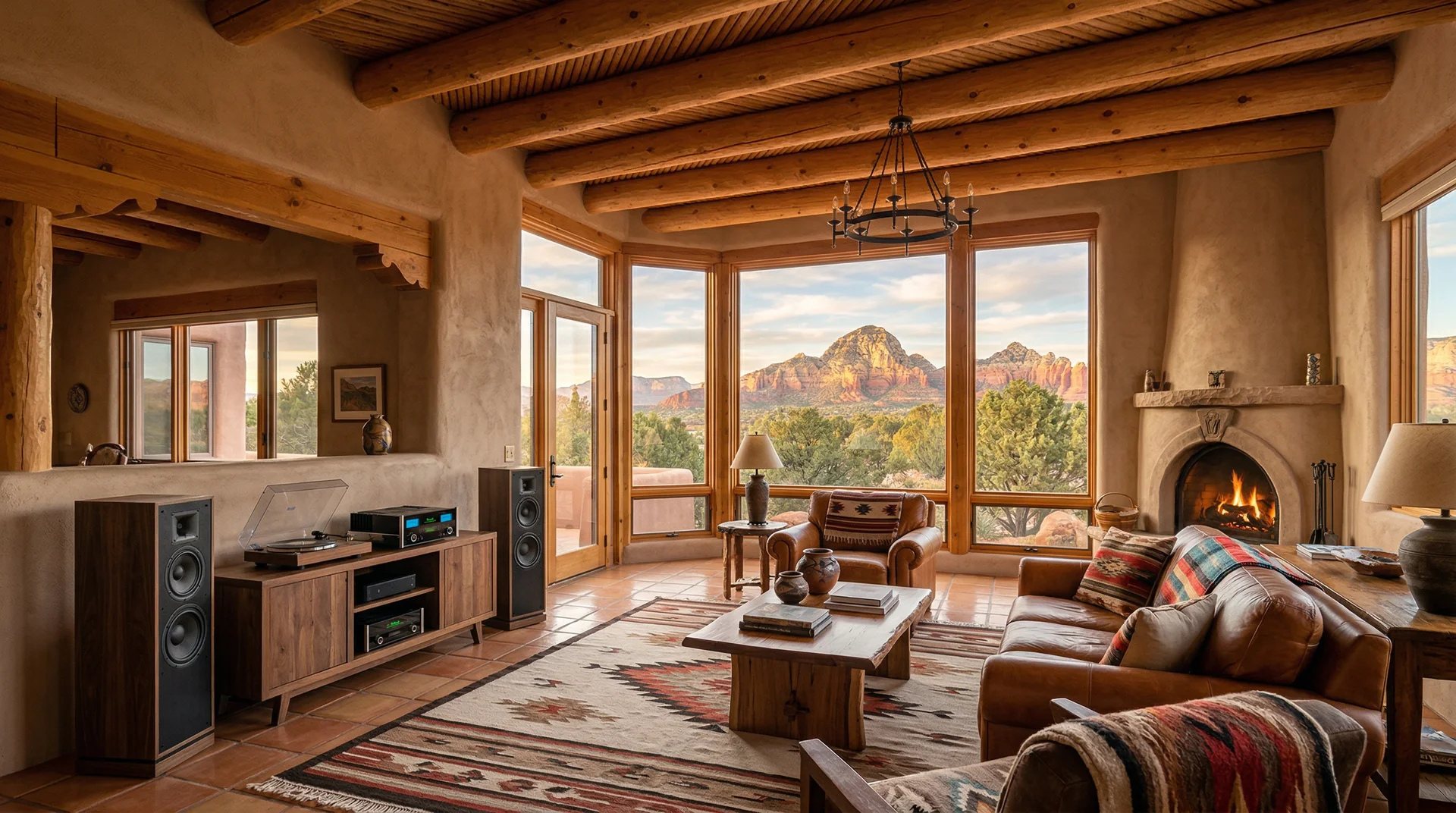
Adobe absorbs bass. Sandstone reflects everything. Viga beams scatter mids. Every building material in your Sedona home changes how music and movies sound. Here's what actually happens, material by material, and how to design around it.
Every wall in your Sedona home is making a decision about how your music and movies sound. Most homeowners don't realize it until they've spent thousands on equipment that underperforms. According to the Acoustical Society of America, room surfaces account for up to 60% of what you actually hear from any speaker system. In Sedona, those surfaces aren't drywall and carpet. They're adobe, sandstone, hand-hewn timber, and polished concrete, each with acoustic properties that standard installation methods simply don't address.
I've designed audio systems for Pueblo Revival estates, Contemporary Southwest builds, and Desert Modern homes across Sedona and the Verde Valley. The building materials in this region are genuinely different from what you'll find in Phoenix or Scottsdale. That's not a problem. It's an opportunity, if you understand what each material does to sound and plan accordingly.
Why Does Sedona Architecture Create Unique Acoustic Challenges?
Sedona's architectural character comes from materials that interact with sound in ways standard home theater design doesn't anticipate. The National Association of Home Builders (2024) reports that 78% of custom homes in the Western U.S. now incorporate natural stone or masonry, compared to 31% nationally. In Sedona, that number approaches 100%.
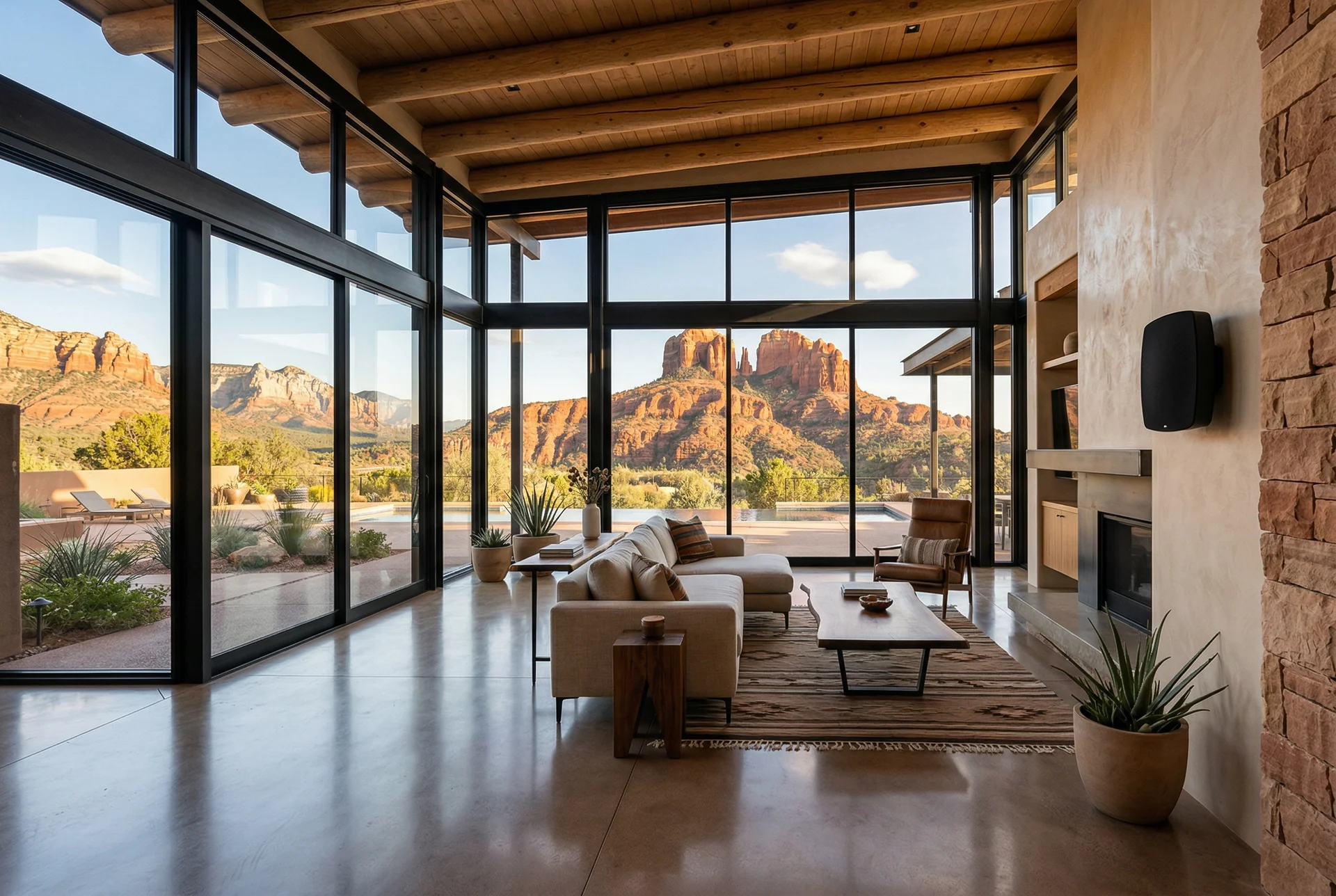
Three architectural styles dominate Sedona residential construction. Pueblo Revival features thick adobe walls, rounded edges, vigas, and latilla ceilings. Contemporary Southwest blends natural stone accents with modern glass. Desert Modern pushes toward floor-to-ceiling glass, polished concrete, and minimal ornamentation. Each style presents a distinct acoustic fingerprint. What works in one fails in another.
The common thread? Hard, irregular, massive surfaces. Standard acoustic treatment guides assume flat drywall, drop ceilings, and carpeted floors. Sedona homes have almost none of that. So we start from the materials themselves.
How Does Adobe and Stucco Affect Home Theater Sound?
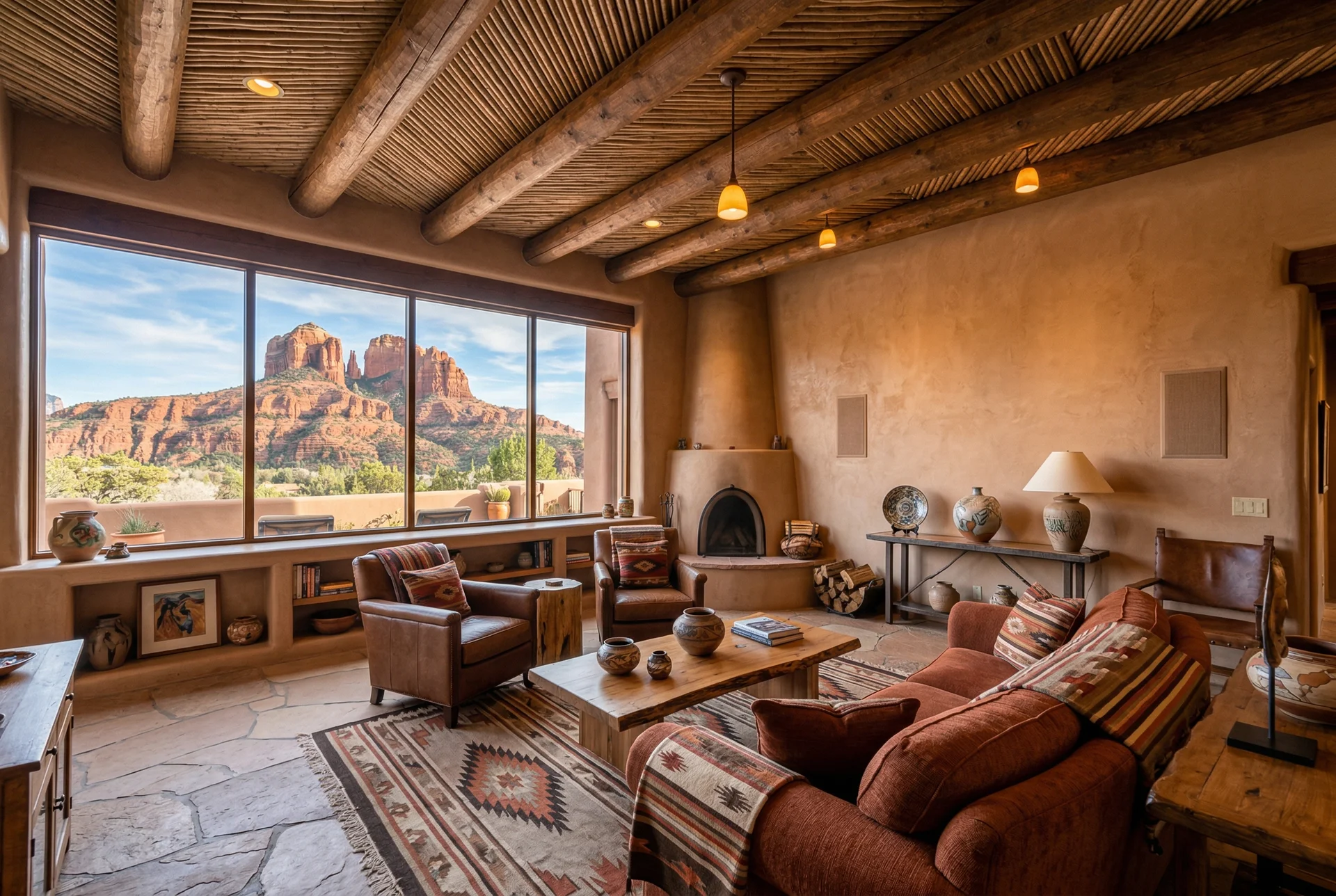
Adobe is one of the more forgiving materials for audio. Research published by the journal Applied Acoustics shows that traditional adobe walls (10-14 inches thick) achieve a Noise Reduction Coefficient (NRC) of 0.25 to 0.40, absorbing significantly more low-frequency energy than standard 1/2-inch drywall at 0.05 NRC. That mass and porosity work in your favor.
In my experience, Sedona adobe rooms have less of the boomy, muddy bass that plagues typical home theaters. The walls themselves act as low-frequency absorbers. I've measured rooms in adobe homes where the bass decay was noticeably tighter than in new drywall construction, before any treatment was added.
The catch is irregularity. Adobe and hand-applied stucco create uneven surfaces that absorb and scatter sound unpredictably across frequencies. One corner might ring at 200 Hz while the opposite corner is dead. DSP calibration in the speaker system corrects this, adjusting output frequency by frequency based on actual room measurements.
Mounting on adobe requires masonry-rated hardware. The walls handle weight well, so on-wall speakers anchor solidly. But you can't run wires through adobe the way you would through stud walls. I plan cable routing before anything gets mounted, usually along beam lines or through existing conduit paths.
What Happens When Sandstone and Flagstone Meet Sound Waves?
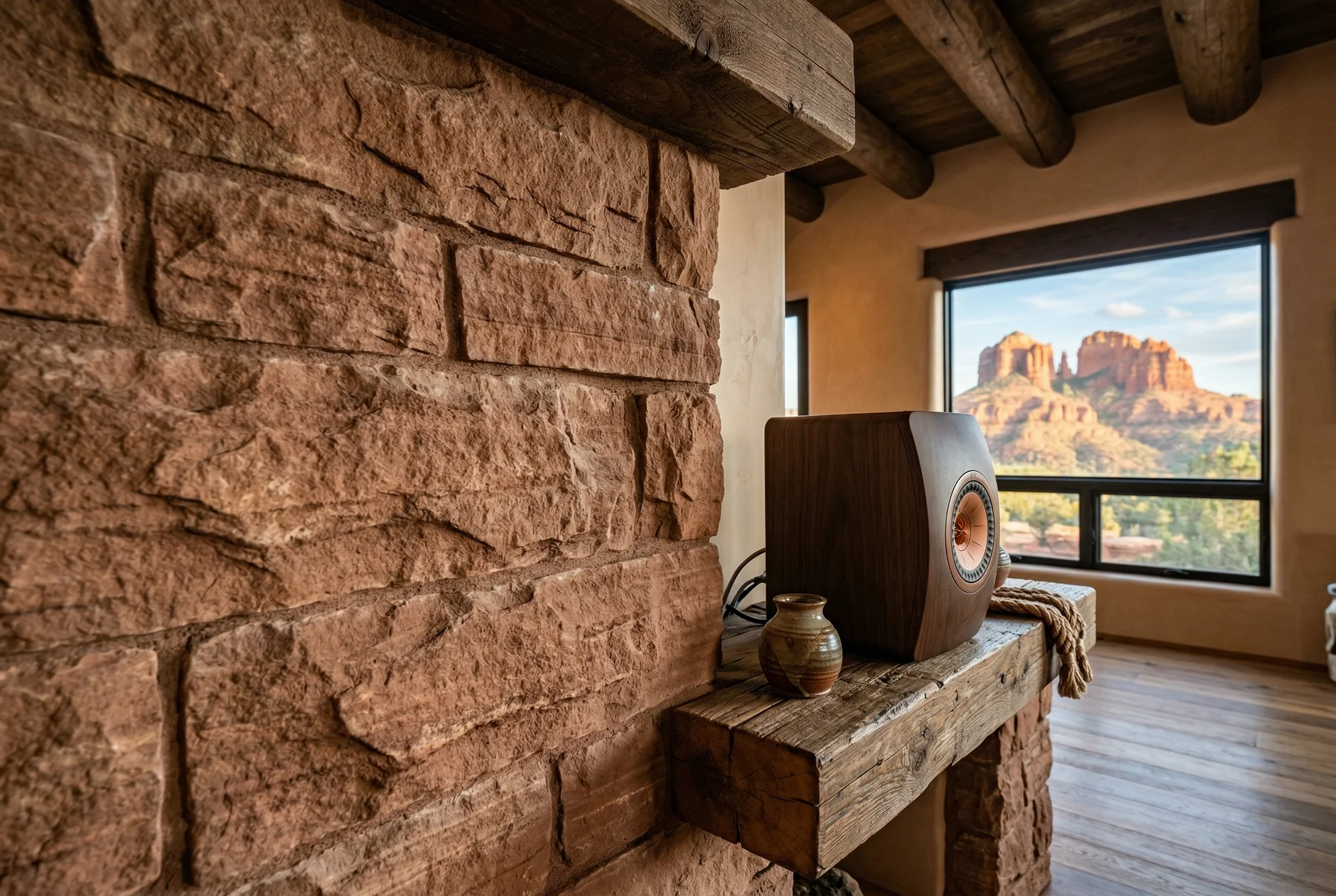
Sandstone and flagstone are the opposite of adobe acoustically. Dense natural stone reflects almost all sound energy. According to engineering reference data from the Engineering ToolBox, natural stone surfaces have absorption coefficients as low as 0.01 to 0.05, meaning 95% to 99% of sound bounces right back into the room. That creates bright, echoey spaces.
Many Sedona homes use sandstone or flagstone as accent walls, sometimes floor to ceiling behind the main viewing area. That's exactly where you don't want a giant reflective surface. Sound from the front speakers hits the back wall, bounces forward, and arrives at your ears a few milliseconds after the direct sound. The result is smeared dialogue and muddied detail.
Here's what most installers miss: the solution isn't covering the stone with acoustic panels. Homeowners chose that stone for a reason. Instead, I position speakers to minimize direct energy hitting the stone wall, use tower speakers with controlled dispersion patterns, and let DSP handle the remaining reflections. The stone stays visible. The sound stays clean.
For rooms with stone on multiple walls, strategic textile placement makes a measurable difference. A heavy area rug, upholstered furniture, even a mix on the opposing wall, each absorbs reflections the stone creates. Combined with proper speaker placement, these practical steps solve most problems without dedicated acoustic panels.
How Do Viga Beams and Latilla Ceilings Change the Sound?
Exposed vigas, the large round ceiling beams in Pueblo Revival homes, are actually acoustic assets. The Audio Engineering Society has documented that cylindrical diffusers scatter sound waves across a wide frequency range, reducing flutter echoes between parallel surfaces. Vigas do this naturally. Their round profile and irregular spacing break up ceiling reflections that would otherwise cause comb filtering.
Latilla ceilings, the smaller sticks laid between vigas, add another layer of diffusion. The irregular gaps and angles create a surface that's acoustically complex in a good way. Compared to a flat plaster ceiling, a viga-and-latilla ceiling produces a more even sound field with less harshness.
The real challenge is mounting. You can't cut into vigas for recessed speakers, and you shouldn't want to. I keep ceiling speaker count to a maximum of four, mounted between beams using custom brackets that attach to the latilla framework or the structural members behind it. This preserves the ceiling's character while adding overhead channels for surround sound.
For most Sedona rooms with viga ceilings, I recommend prioritizing on-wall and tower speakers for the main channels. Towers don't touch the ceiling at all. On-wall speakers mount to the adobe or stone below the beam line. The ceiling speakers handle ambient surround only, where precise imaging matters less.
Can You Build a Great Home Theater with Polished Concrete Floors?
Polished concrete is the toughest acoustic surface in Sedona homes. The Buildings.com materials database lists sealed concrete at an NRC of 0.00 to 0.02, making it the most reflective common flooring material. Every sound that hits that floor bounces upward at full strength. Pair concrete floors with glass walls, common in Desert Modern homes, and you've created a reverb chamber.
But concrete floors are also a design choice homeowners feel strongly about. So how do you work with them?
First, area rugs. A thick wool or layered rug between the listening position and the speakers absorbs first-reflection energy from the floor. This single addition can cut reverb time by 20-30% in a concrete-floor room. Second, upholstered seating absorbs mid and high frequencies right at ear level. Third, tower speakers with controlled vertical dispersion put less energy into the floor in the first place.
I've found that concrete floor rooms actually benefit from tower speakers more than any other room type. Towers elevate the main drivers above floor-bounce height, and their controlled dispersion patterns direct sound toward the listening area rather than scattering it across every reflective surface. On-wall speakers mounted at ear height achieve a similar effect.
How Should You Handle Glass Walls in Sedona Homes?
Large glass walls are standard in Sedona's Contemporary Southwest and Desert Modern homes. Homeowners want those red rock views, and rightfully so. But glass is acoustically similar to stone: highly reflective, with absorption coefficients around 0.04 to 0.06 across most frequencies. A 12-foot glass wall is essentially a 12-foot mirror for sound.
The strategy depends on how much glass you're working with. A single picture window is manageable with speaker positioning alone. A full glass wall requires more deliberate treatment. Heavy drapes that can be drawn during movie viewing absorb a significant amount of reflection energy. Motorized shades with acoustic fabric are another option that preserves the view when you want it.
Speaker placement relative to glass matters enormously. Speakers firing directly at a glass wall produce the harshest reflections. Angling speakers slightly inward, toward the listening position and away from glass, reduces the energy hitting that surface. Combined with DSP correction, this approach tames glass-heavy rooms without compromising the architecture.
What's the Best Speaker Setup for Sedona's Mixed-Material Rooms?
Most Sedona homes combine several of these materials in a single room. You might have an adobe wall on one side, a sandstone accent wall on another, viga ceilings above, and concrete underfoot. According to the CEDIA (2024) Integrator Best Practices survey, 67% of residential technology professionals report that mixed-material rooms require custom acoustic modeling, compared to 22% for standard drywall construction.
I approach mixed-material rooms by mapping the acoustic character of each surface before choosing speaker positions. The absorptive walls (adobe) go behind or beside the speakers. The reflective walls (stone, glass) get treated with furnishings or positioned where they cause the least interference. Tower speakers handle the front stage because they're independent of wall material entirely. On-wall speakers go on adobe where anchoring is solid and absorption is favorable.
Every speaker I build includes DSP that measures and corrects for the room's actual behavior. This isn't a generic room correction mode. It's a full-spectrum calibration done in person, accounting for every surface, every angle, every material in your specific room. In Sedona's mixed-material spaces, this step isn't optional. It's what separates a system that sounds right from one that fights the room.
Build timelines for Sedona projects run 6 to 12 weeks or more. Custom speaker finishes matched to your adobe, stone, or wood tones add time but make the system belong in the room visually, not just acoustically.
Ready to Work With Your Sedona Home's Materials, Not Against Them?
Your Sedona home's architecture isn't an obstacle to great sound. It's the starting point. Adobe, sandstone, vigas, concrete, glass: each material has acoustic properties that shape system design from the ground up. The key is understanding those properties before choosing equipment, not after.
I design and build custom speaker systems in my Arizona workshop specifically for rooms like yours. Every cabinet, every driver, every DSP profile is tailored to the space it will live in. If you're planning a home theater renovation in Sedona or anywhere in the Verde Valley, I'd enjoy talking through what your room's materials mean for your system.
Get in touch here or call (928) 440-1950 to start the conversation.
Comments
Leave a Comment