
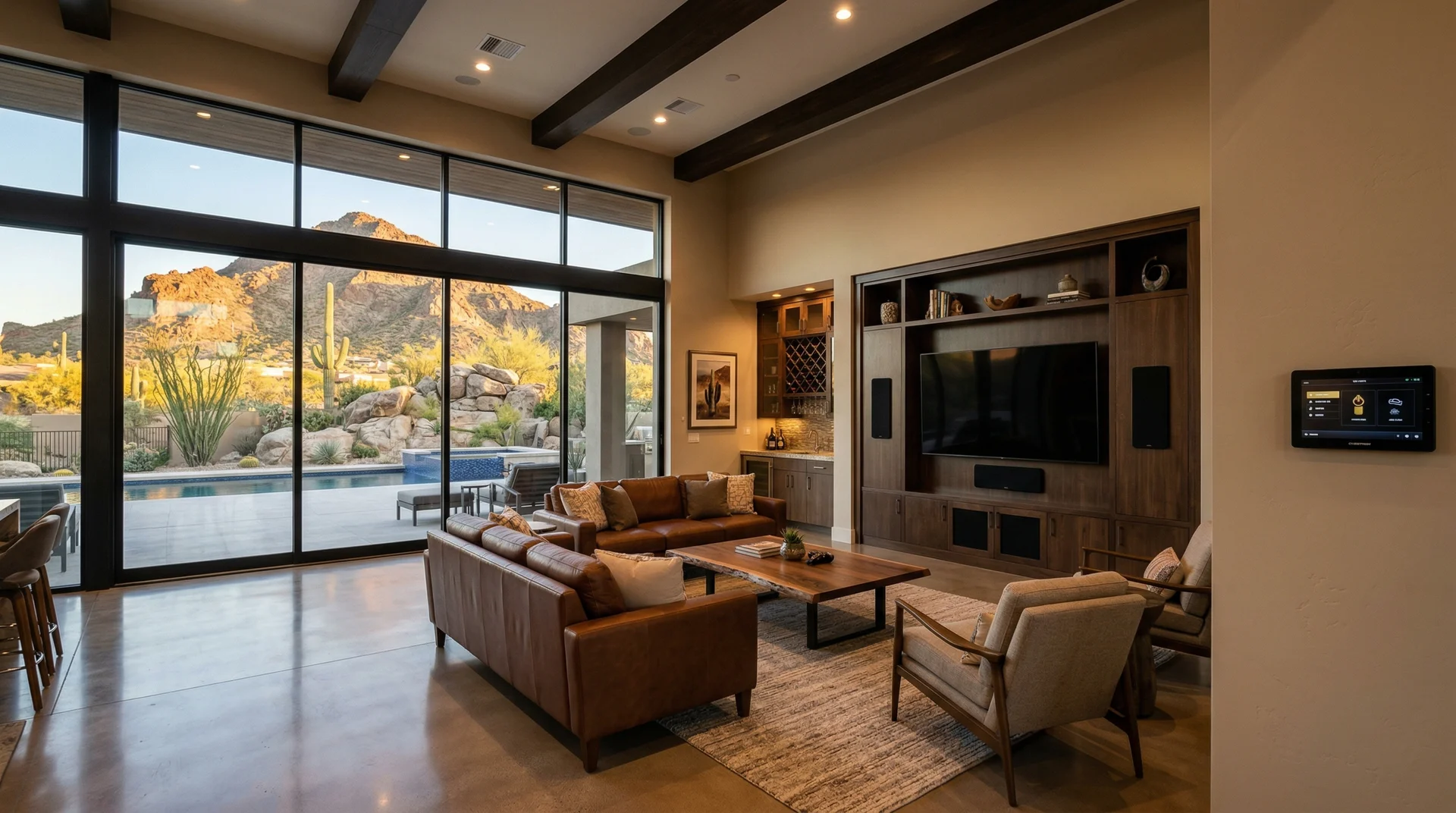
Paradise Valley homes spend six figures on Crestron and Savant automation, then play music through commodity speakers. Here's how to fix the weakest link in your smart home.
I walk into Paradise Valley homes worth $5 million or more and find the same problem. The automation is incredible. Lights respond to a single tap. Shades glide into position at sunset. The climate system knows which room you're in. Then someone hits play on the music, and it sounds like a hotel lobby.
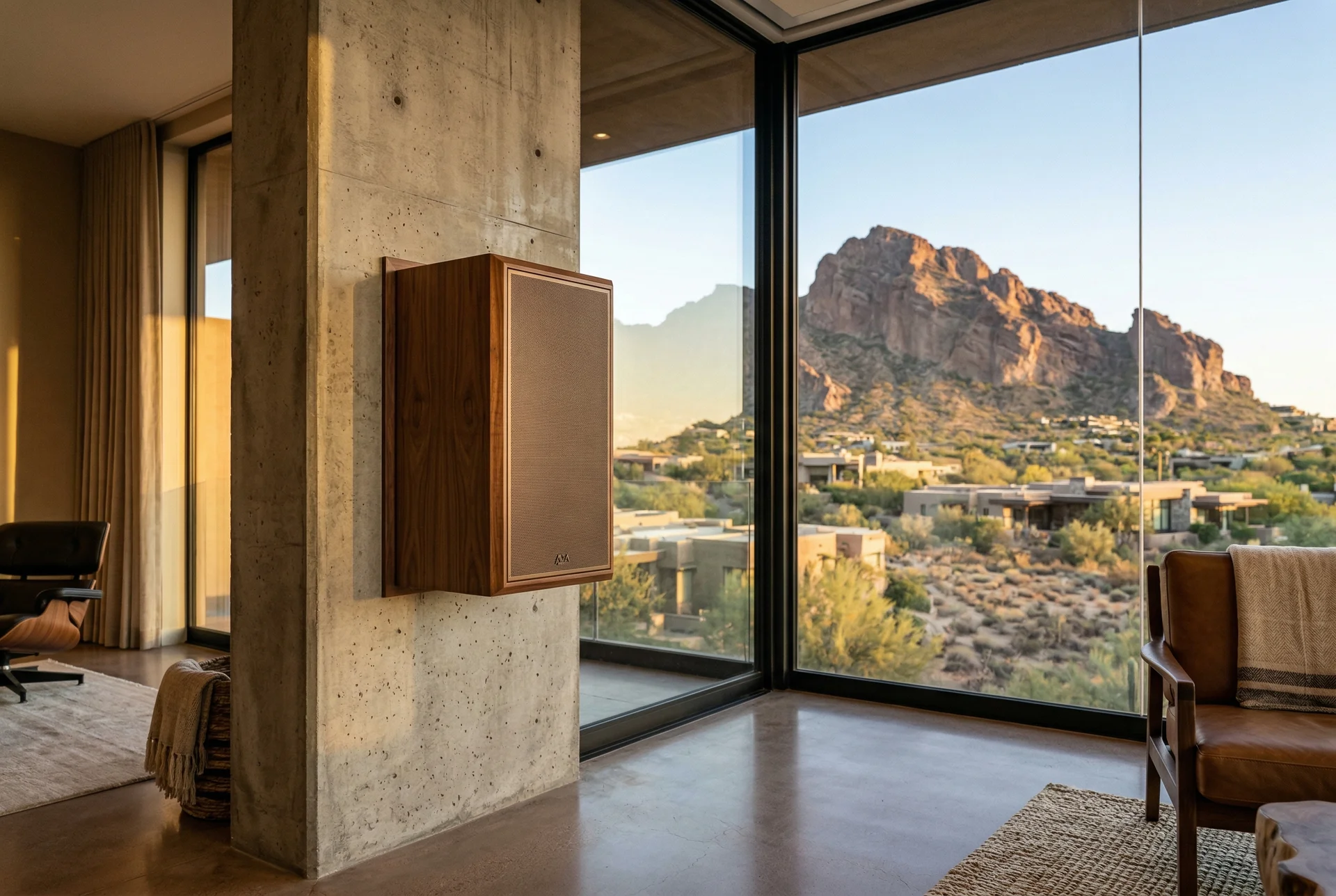
The control system isn't the issue. The speakers are.
According to CEDIA's 2024 Integrated Technology Trends Report, 85% of homes in the $3M+ price range now include a whole-home automation system at the time of sale. Paradise Valley, where the median home price exceeded $3.5 million in 2025 (Redfin, 2025), sits right in that bracket. These homes don't lack technology. They lack audio quality worth controlling.
Why Do So Many Luxury Smart Homes Sound Average?
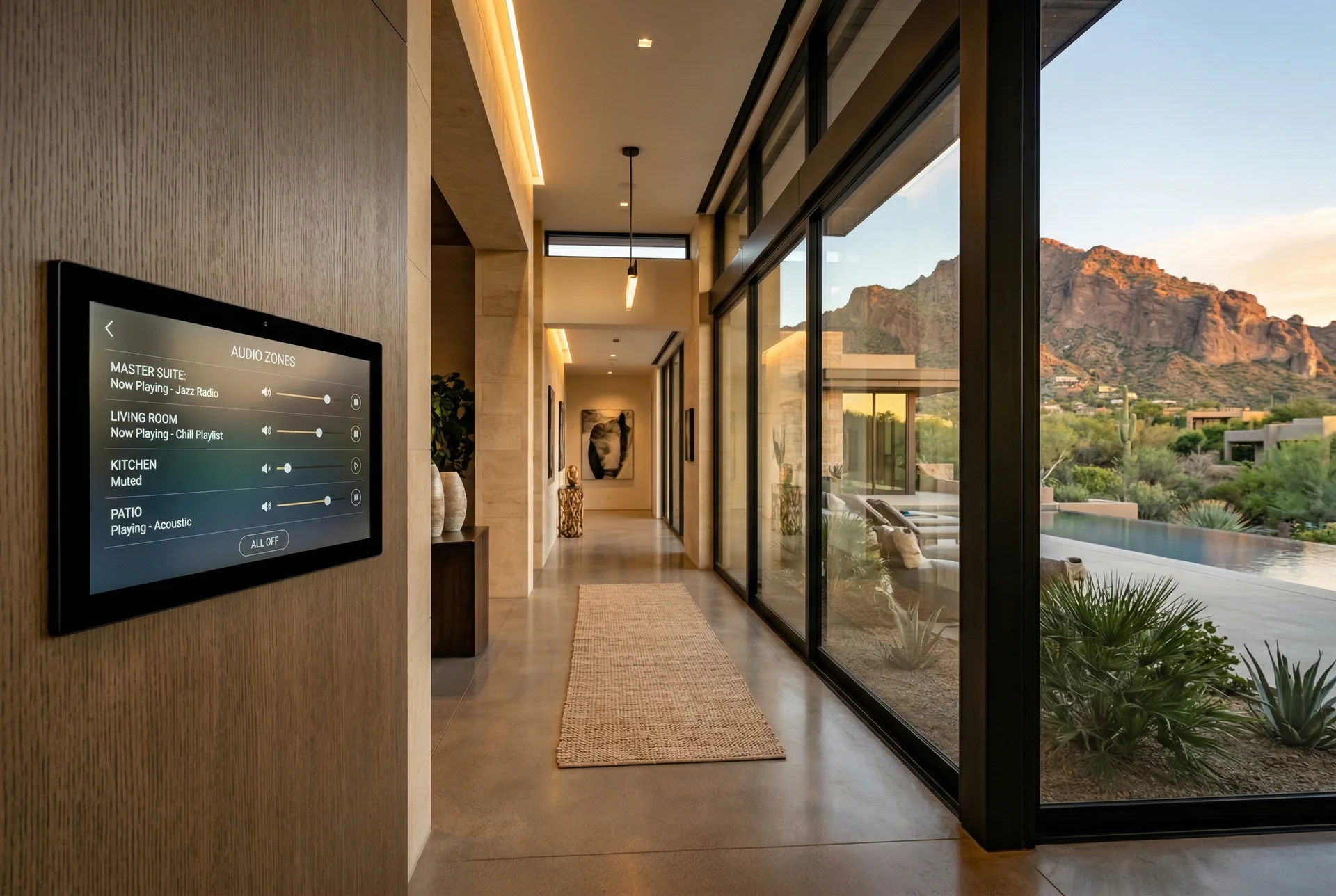
Builders prioritize the control system because it photographs well in listing brochures. Crestron and Savant keypads look expensive. They are expensive. But Parks Associates reports that audio equipment accounts for just 12% of the typical whole-home automation budget (Parks Associates, 2024), even though speakers are what homeowners actually interact with every day. The math doesn't add up.
Here's what typically happens during construction. The builder allocates $80,000 to $150,000 for automation, control panels, networking, and lighting. The integrator specifies commodity in-wall or in-ceiling speakers because they're fast to install and easy to hide. The homeowner moves in, taps the touchscreen, and wonders why their $120,000 system sounds thin.
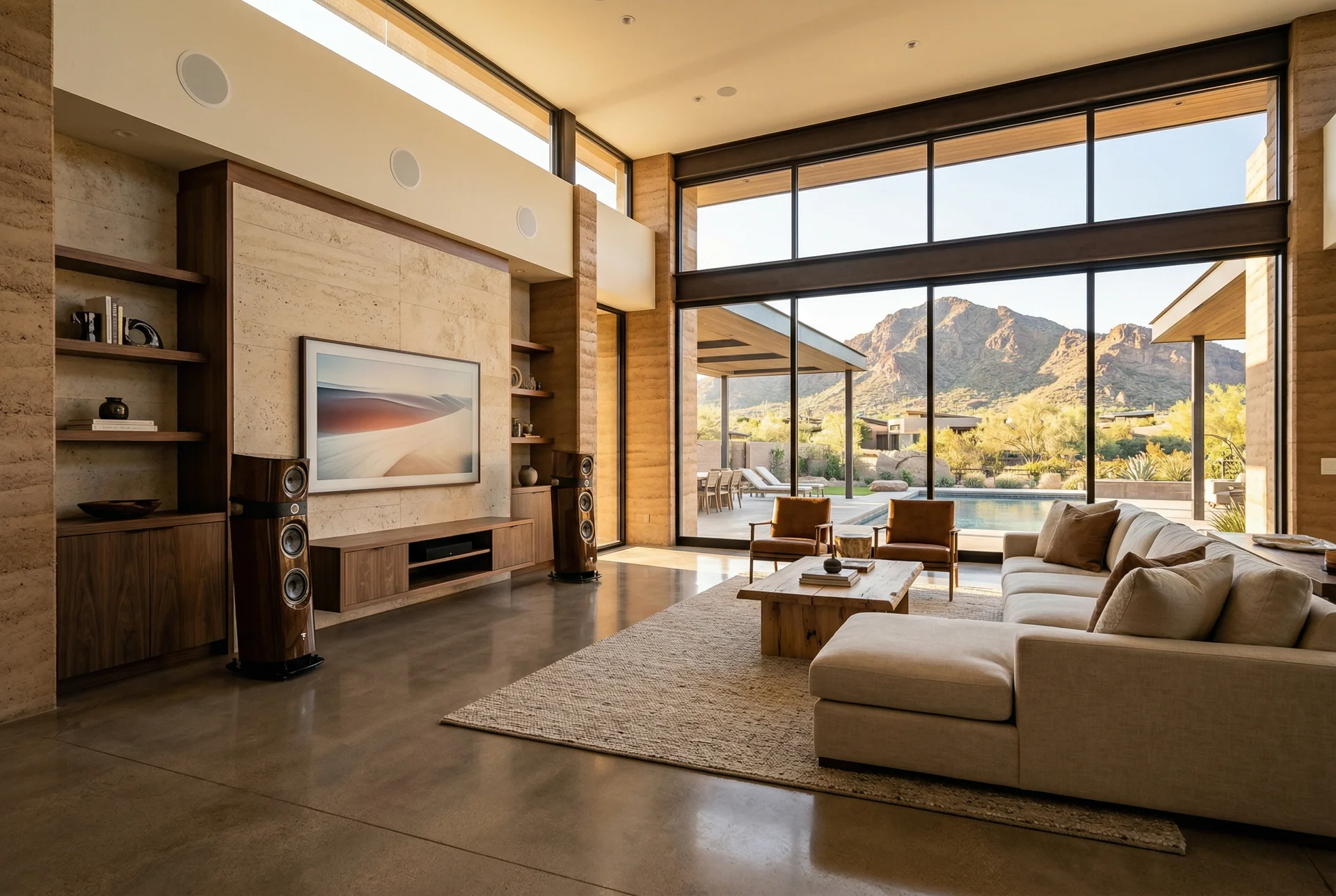
The control system is only as good as what it's controlling. A Crestron processor running commodity speakers is like a sports car on economy tires. All that power with no grip.
What Makes Paradise Valley Different From Other Markets?
Paradise Valley is one of the most concentrated luxury markets in the country. According to the Town of Paradise Valley, the community has roughly 13,000 residents across fewer than 5,000 homes, and single-family residence is the only permitted use. No apartments. No commercial storefronts. Every property is a house, and most of them are substantial.
That exclusivity means the town has an unusually high density of installed automation systems. Crestron, Savant, Control4, Lutron, sometimes layered together. I've worked in Paradise Valley homes with three separate control platforms managing different parts of the house, all feeding audio to the same forgettable speakers that were spec'd during framing.
The good news is that upgrading speakers in an existing automation environment is one of the most impactful changes you can make. You don't need to rewire. You don't need to replace your processor. You just need better endpoints.
How Do Custom Speakers Integrate With Crestron and Savant?
Compatibility concerns stop a lot of homeowners from exploring speaker upgrades. They shouldn't. The Consumer Technology Association found that 93% of residential control systems use standard analog or digital audio connections (CTA, 2024), which means virtually any quality speaker connects without modification to the existing infrastructure.
WubWub Audio speakers, which I build at my Arizona workshop, are self-powered with built-in DSP. That's an advantage for retrofit projects. Each speaker has its own amplification and digital signal processing, so they don't depend on the builder's original amp rack. Your Crestron or Savant system sends the audio signal, and the speaker handles everything from there.
For Paradise Valley homeowners, this means three things. First, your touchscreens and keypads keep working exactly as they do now. Second, you don't need to tear into walls. On-wall and tower speakers mount where they perform best acoustically, not wherever the builder ran wire. Third, each speaker can be calibrated independently for the room it lives in.
I've done automation-compatible speaker upgrades in Paradise Valley where the homeowner's reaction was immediate. Same playlist, same volume, completely different experience. The control system finally had something worth controlling.What Does the Upgrade Path Look Like?
A speaker upgrade in an automated home follows a different process than a ground-up build. CE Pro's 2024 State of the Industry report notes that retrofit and upgrade projects now represent 38% of all residential AV work nationally (CE Pro, 2024). The demand is real, and the process is simpler than most people expect.
It starts with a listening session in your home. I bring reference speakers so you can hear the difference in your actual rooms, with your actual automation system, playing your actual music. No showroom tricks. No imagining what it might sound like.
From there, I map each zone. Most Paradise Valley homes have six to twelve audio zones. The kitchen, great room, primary suite, outdoor patio, pool area, maybe a gym or office. Each zone gets a speaker recommendation based on the room's size, acoustics, and how you actually use it.
Timeline and Installation
Custom speakers are built to order at my workshop in the Arizona high desert. Build time runs 6 to 12 weeks depending on the number of zones and any custom finish requests. Installation in a retrofit scenario typically takes one to two days per zone. No drywall work. No repainting. The old speakers come down and the new ones go up.
Your integrator or I can handle the control system configuration so your Crestron or Savant interface recognizes the new speakers. In most cases, the programming update takes an hour or less.
Can You Upgrade Just a Few Rooms at a Time?
Absolutely. In fact, I recommend it. Start with the room where you spend the most time, usually the kitchen or great room. Live with the upgrade for a few weeks. Once you hear the difference, you'll know exactly which zone to do next.
This phased approach also makes budgeting easier. A single-zone upgrade with a pair of custom on-wall speakers is a fraction of the cost of a whole-home project, and every zone you add integrates with your existing automation. No rework required.
Most automation companies push whole-home packages because that's how they structure their margins. But the smartest upgrade path for Paradise Valley homeowners with existing systems is one zone at a time. You get to hear the improvement immediately and make informed decisions about the rest.Why On-Wall Speakers Instead of In-Wall?
This is the question I get most often from homeowners whose builders installed in-wall speakers. In-wall speakers make acoustic compromises that no amount of processing can fix. They fire into wall cavities that weren't designed as speaker enclosures. They couple to drywall that vibrates and distorts. They can't be repositioned if the furniture layout changes.
On-wall and tower speakers sit in properly engineered cabinets with controlled internal volumes. They project into the room from an optimal position. And they look intentional, like furniture, not like holes in the wall covered by grilles.
For Paradise Valley homes with custom interiors, I match speaker finishes to existing millwork, stone, or paint colors. The speakers become part of the design rather than something to hide.
Frequently Asked Questions
Will upgrading speakers void my Crestron or Savant warranty?
No. Speakers are peripheral devices, not part of the control system hardware. Swapping speakers is no different from changing a light fixture on a Lutron system. Your automation warranty and programming remain intact.
How much does a speaker upgrade cost for one zone?
Pricing varies based on room size, speaker configuration, and finish options. I provide a custom quote after an in-home listening session so you know exactly what you're getting. There are no surprise charges and no pressure to commit to more zones than you want.
Do I need to hire my automation integrator separately?
Not necessarily. I work with most major control platforms and can handle the configuration update in many cases. If your system requires proprietary dealer access, I'll coordinate directly with your integrator to keep the process smooth.
Can custom speakers handle whole-home audio and home theater?
Yes. WubWub Audio speakers work in both distributed audio zones and dedicated theater rooms. The same build quality and DSP calibration that makes music sound natural also delivers clean dialogue and dynamic movie sound. Many Paradise Valley clients start with whole-home audio and add a theater later.
Your Automation System Is Ready for Better Sound
If you're living in Paradise Valley with a Crestron, Savant, or Control4 system, you've already made the hard investment. The infrastructure is in place. The control is dialed in. The only thing standing between you and genuinely great sound is the speakers at the end of the chain.
I'd enjoy talking through what's possible in your home. Reach out here to schedule an in-home listening session, and hear what your automation system is actually capable of.
Comments
Leave a Comment