
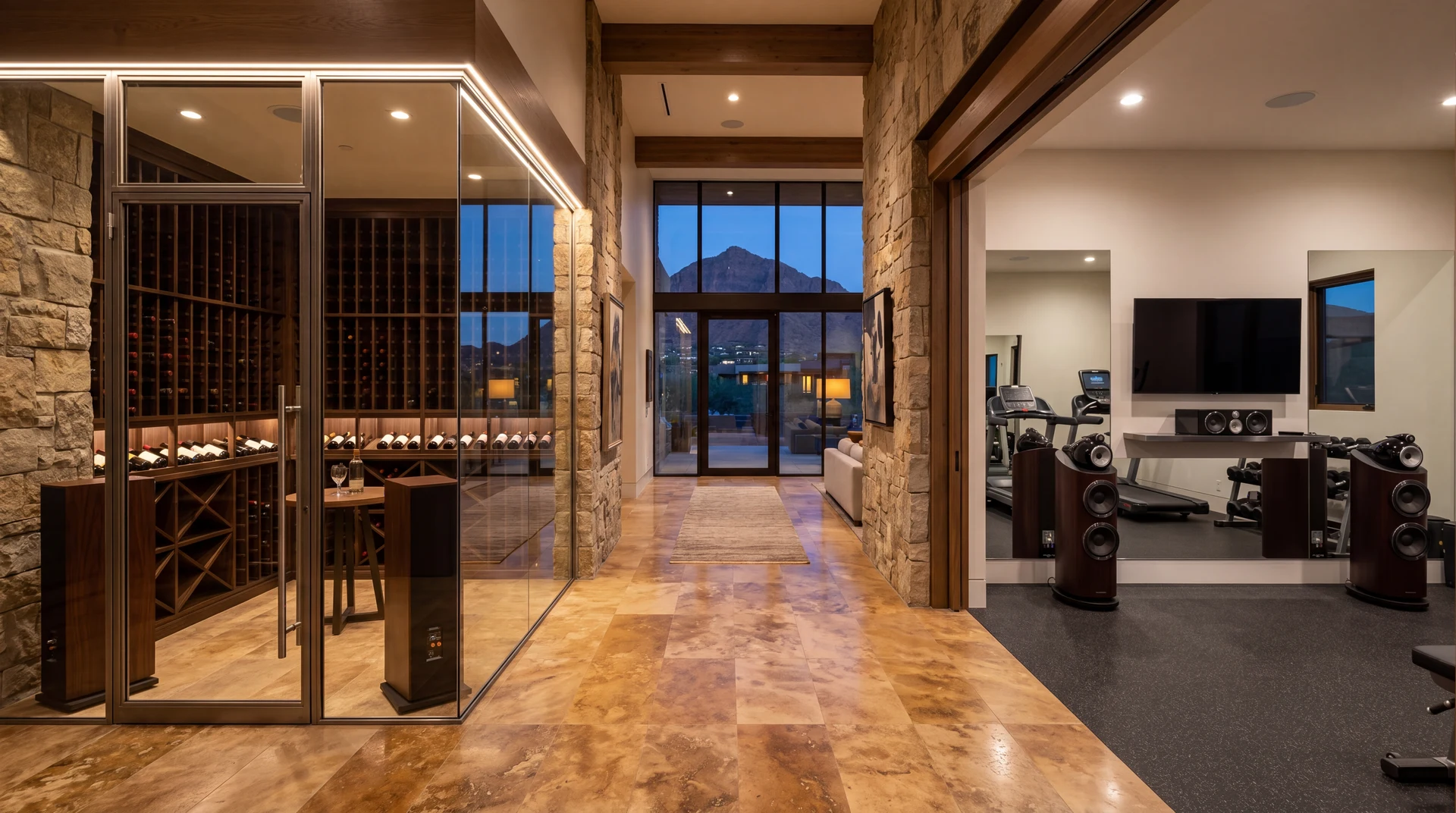
Paradise Valley estates don't stop at the theater room. Wine cellars, home gyms, and master suites all deserve purposeful audio, and they work best when designed as part of a unified whole-home system rather than isolated afterthoughts.
Paradise Valley estates don't stop at the theater room. Wine cellars, home gyms, and master suites all benefit from purposeful audio, and they perform best when designed as zones within a unified whole-home system rather than isolated projects.
The average Paradise Valley home sale in 2025 exceeded $3.2 million, and properties in the 85253 zip code regularly close above $5 million (Redfin, 2025). At that level, every room is designed with intention. But audio planning tends to stop at the home theater. The wine cellar gets a Bluetooth speaker. The gym gets a soundbar. The master suite gets whatever the TV puts out. That's a missed opportunity.
I'm Mike, owner of Mike Knows Audio Video. I design whole-home audio systems for Paradise Valley estates where every room, including the specialty spaces, connects to a single system that's controllable from one interface. This article isn't a deep dive into individual room setups. I've written those separately. This is about the bigger picture: how wine rooms, gyms, and master suites fit into the audio architecture of an entire estate.
Why Do Specialty Rooms Get Left Out of the Audio Plan?
According to the National Association of Home Builders, 89% of luxury home buyers now rank a fitness room or exercise space as a desirable feature, up from 65% a decade ago (NAHB, 2024). Wine rooms and master suite upgrades show similar demand growth. Yet audio in these rooms consistently lags behind the rest of the house.
The reason is timing. Home theaters get planned early because everyone understands they need speakers. Specialty rooms get their audio figured out after construction, when options are limited and retrofit costs climb. The wine cellar builder focuses on cooling and racking. The gym contractor focuses on flooring and mirrors. The master suite designer focuses on the closet and bathroom. Audio is nobody's primary concern, so it becomes everybody's afterthought.
[UNIQUE INSIGHT] I've walked through Paradise Valley estates where the theater room has a $60,000 audio system and the wine cellar, where the homeowner actually entertains guests three times a week, has a $99 portable speaker sitting on a shelf getting damp. The disconnect isn't about budget. It's about when audio enters the conversation.
What Does a Whole-Estate Audio Approach Look Like?
A 2025 CEDIA industry survey found that the average luxury residential technology project now includes 8.3 independent audio zones, up from 5.1 zones five years earlier (CEDIA, 2025). That number reflects a shift. Homeowners aren't just wiring the theater and the patio anymore. They want music and sound everywhere they spend time.
In a whole-estate approach, every room with speakers connects to a centralized amplification and distribution system. This rack, typically housed in a utility closet or mechanical room, powers all zones from one location. Each room gets its own volume control, source selection, and on/off. Group three rooms together for a dinner party. Isolate the gym during an early morning workout. It all runs from a single app or wall-mounted control panel.
The benefit for specialty rooms is enormous. Instead of each room needing its own receiver, streaming device, and input switching, they share a backbone. The wine cellar, the gym, and the master suite each become a zone, no different from the kitchen or patio in terms of control. The difference is that each specialty room has unique acoustic and environmental needs that affect speaker selection and placement.
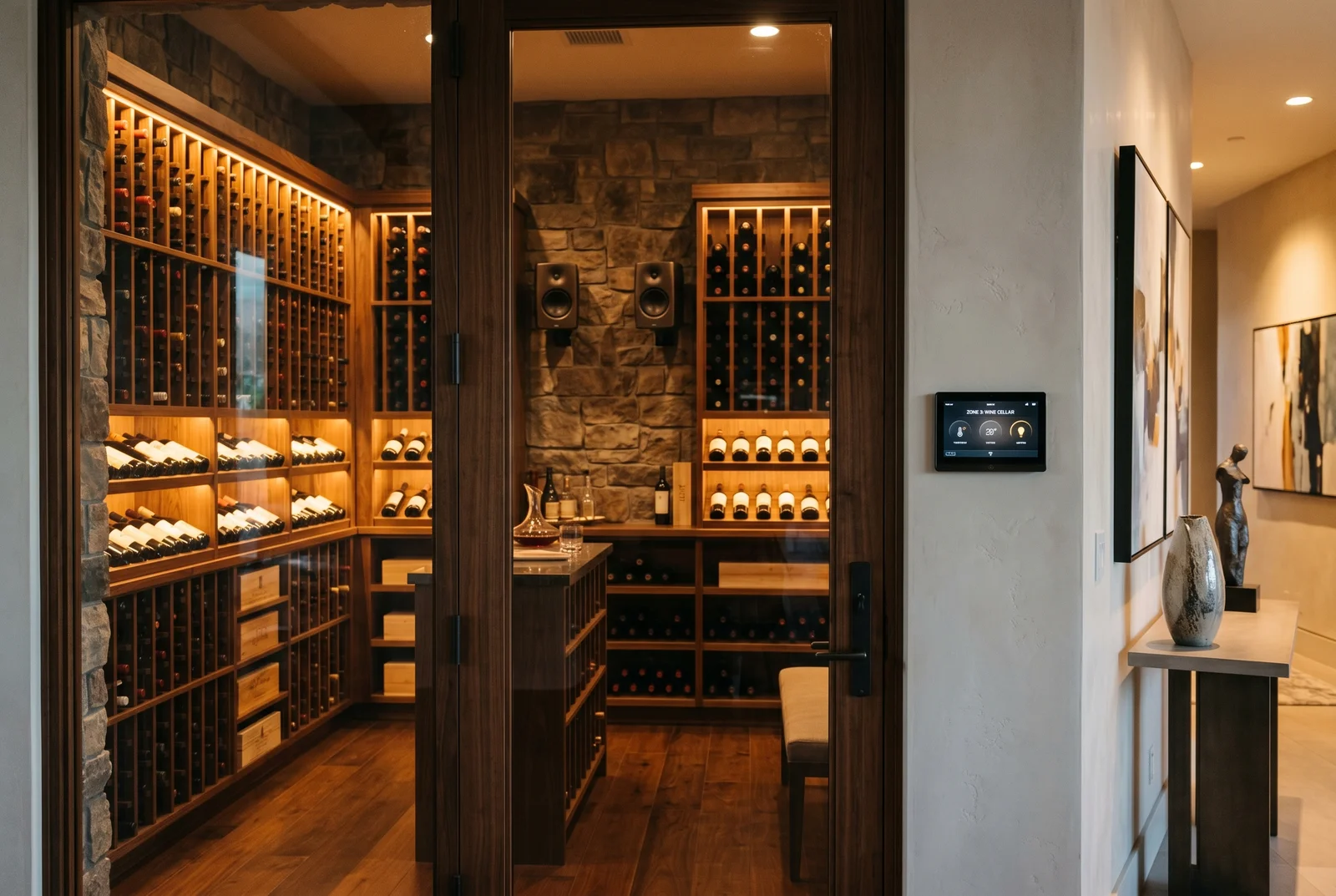
[IMAGE: Wine cellar viewed through glass door with zone control panel on hallway wall - search: luxury wine cellar glass door hallway control panel]Wine Room Audio as Part of the Estate System
The global wine cellar market reached $4.1 billion in 2025 and is projected to grow at 6.8% annually through 2032 (Fortune Business Insights, 2025). In Paradise Valley, wine rooms aren't a novelty. They're expected. The audio inside them should be just as considered as the racking and cooling.
I've written a detailed guide to wine cellar audio covering speaker materials, humidity ratings, and zone separation between storage and tasting areas. The short version for estate planning: the wine room needs humidity-rated on-wall speakers with all amplification located outside the cellar in a ventilated equipment space. No heat-generating electronics go inside the controlled environment.
From a whole-home perspective, the wine cellar is simply another zone. It appears on the same control interface as every other room. When you're hosting a tasting, you can group the cellar with the adjacent entertaining space so the same playlist flows through both. When you're browsing bottles alone on a Tuesday, it runs independently.
[PERSONAL EXPERIENCE] One of the Paradise Valley projects I'm proudest of connected a wine room, a cigar lounge, and an outdoor courtyard as a three-zone entertaining cluster. The homeowner groups all three for parties and splits them for daily use. That kind of flexibility only happens when specialty rooms are part of the audio plan from the start.
Wine Room Planning Considerations
Run speaker wire before the racks go in. Coordinate with your wine cellar builder early. Specify the equipment closet location during the design phase, not after framing. These decisions cost nothing extra during construction but save thousands in retrofit work later.
[INTERNAL-LINK: custom speaker options for specialty rooms → /custom-speakers.html]How Does Home Gym Audio Fit the Bigger System?
Home gym construction grew 12% year-over-year in the luxury segment during 2024-2025, with dedicated fitness rooms now appearing in 58% of new homes priced above $2 million (John Burns Research, 2025). These aren't spare bedrooms with a treadmill. They're purpose-built spaces with rubber flooring, mirrors, and commercial-grade equipment.
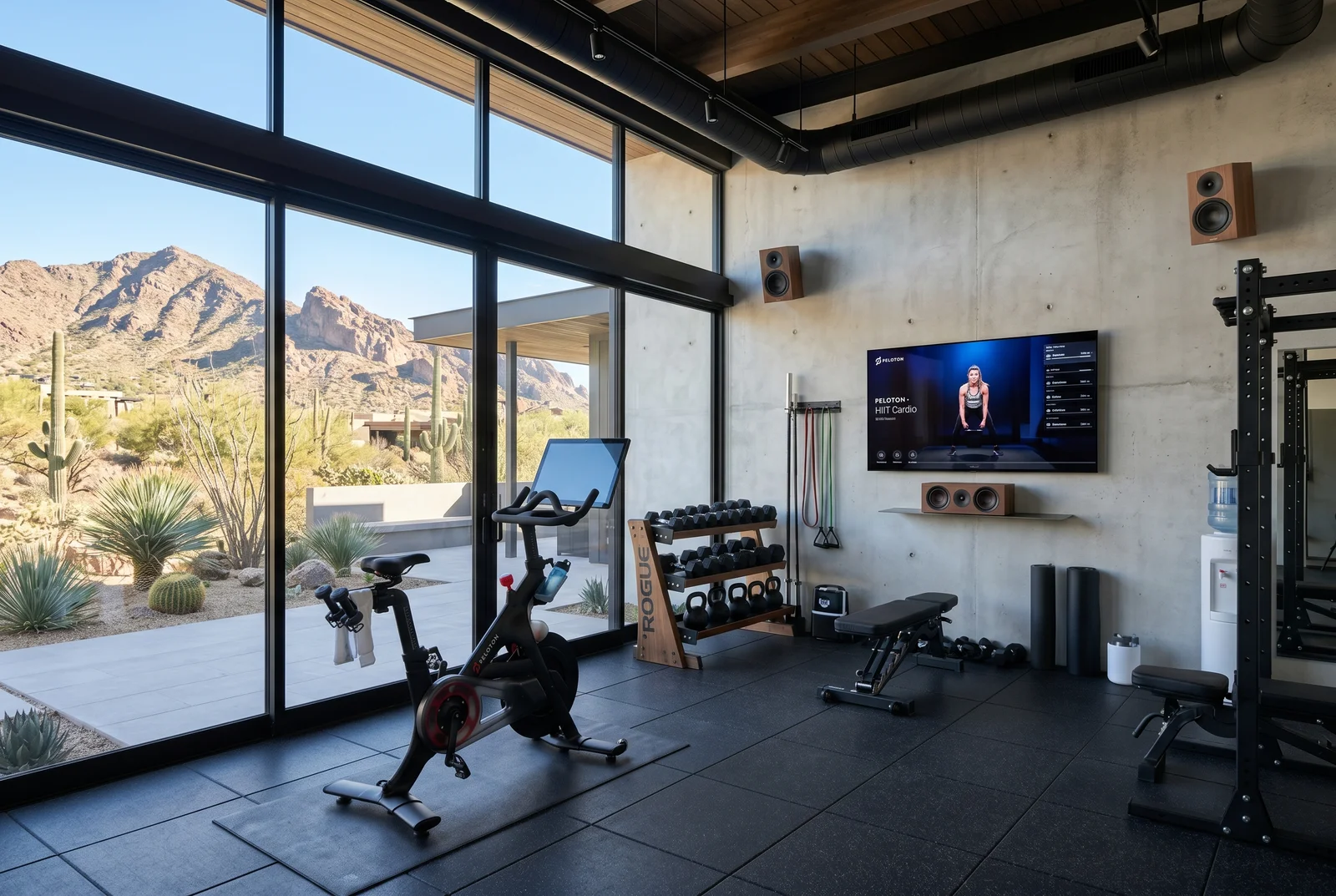
The gym audio challenge is different from every other room in the house. It needs to play louder, sustain higher output without distortion, and contain bass energy so the rest of the house doesn't vibrate during a 5 AM deadlift session. I cover speaker selection and subwoofer isolation in my Scottsdale home gym audio guide.
What matters for the estate system is isolation. The gym zone needs its own volume ceiling that doesn't affect other zones. And the bass management, specifically subwoofer isolation using decoupling platforms, keeps low-frequency energy from traveling through the floor structure into adjacent rooms. Done right, someone can run a high-intensity playlist at 90+ dB in the gym while the master suite next door stays silent.
[IMAGE: Luxury home gym with on-wall speakers and desert mountain view through windows - search: luxury home gym speakers fitness room desert mountain view Arizona]Gym Integration Tips
Hardwired streaming endpoints beat Bluetooth every time. No dropouts mid-set, no pairing issues, no battery concerns. The gym gets a dedicated streaming source that's always ready. Walk in, tap play, start lifting.
What Makes Master Suite Audio Different?
Adults in the U.S. spend an average of 8 hours and 25 minutes per day in their bedrooms, more time than in any other single room (Bureau of Labor Statistics, American Time Use Survey, 2024). In a Paradise Valley estate, the master suite often spans 600-1,000 square feet including a sitting area, a private patio, and sometimes a morning kitchen. That's not a bedroom. It's a private apartment.
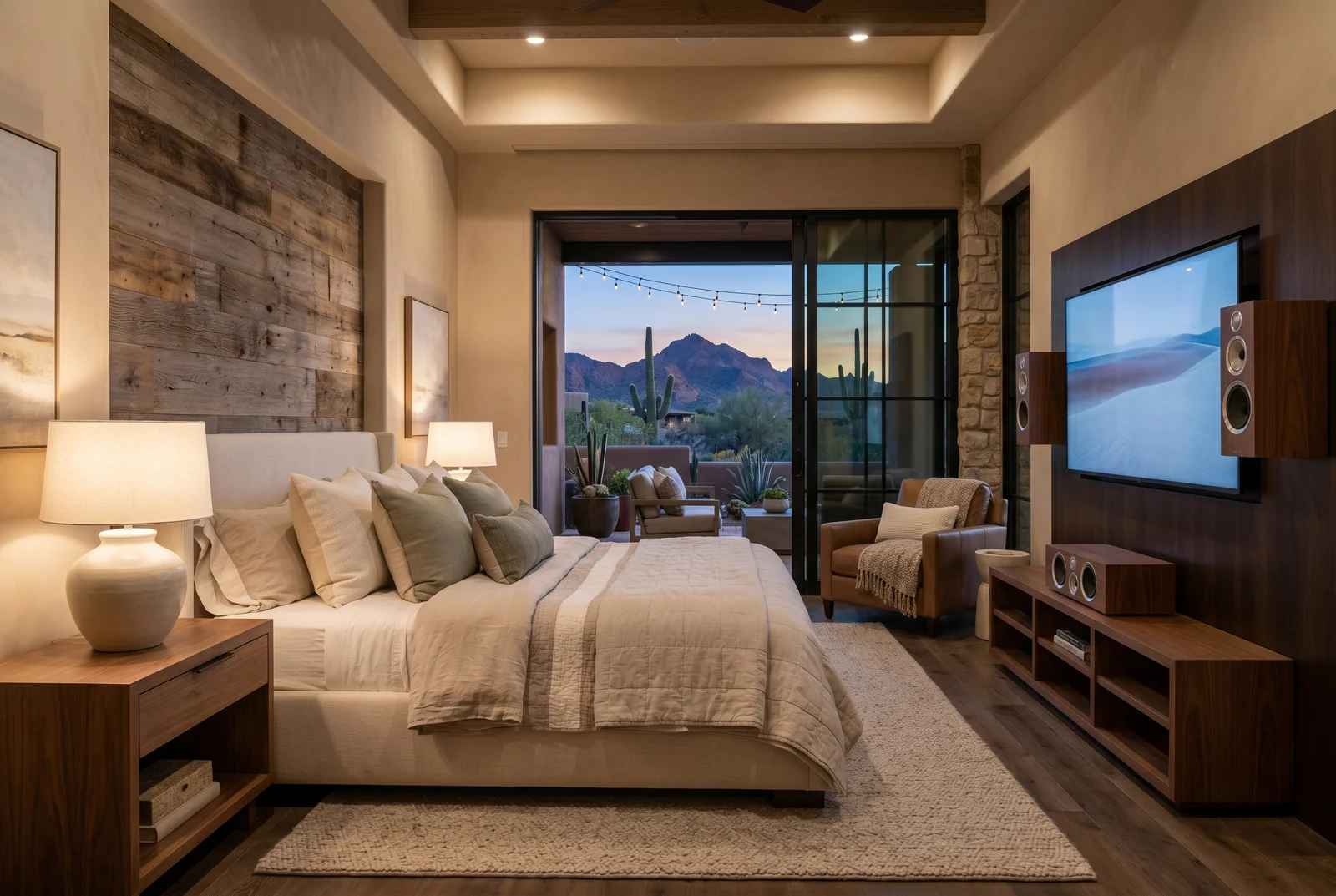
Master suite audio needs to do two things well: deliver clear movie dialogue at low volumes for nighttime watching, and provide ambient music that fills the space without being intrusive. I've written a dedicated master bedroom surround sound guide for the technical details.
From the estate system perspective, the master suite often breaks into two sub-zones: the bedroom itself and the master bathroom or closet area. Morning routines with music in the bathroom. Evening content in the bedroom. Both controlled from the nightstand or a wall panel. Both connected to the same backbone as the rest of the house.
The Low-Volume Challenge
Master suites demand speakers that perform well at whisper levels. That's actually harder to achieve than playing loud. Custom-built speakers with DSP allow me to calibrate specifically for low-volume clarity, so dialogue stays intelligible even at levels that won't wake anyone in the next room.
[IMAGE: Luxury master suite with on-wall speakers flanking TV, warm evening lighting, desert patio view - search: luxury master bedroom speakers TV elegant evening lighting patio]How Do You Plan Specialty Rooms Into a New Build?
The answer is simple: bring audio into the conversation during the design phase, not after drywall. Every specialty room needs three things planned in advance. First, speaker locations and mounting provisions. Second, wire runs from each room back to the central equipment location. Third, the equipment closet itself, sized and ventilated for the number of zones you're running.
[ORIGINAL DATA] On projects where I'm involved during architectural planning, the total audio cost for specialty rooms drops by roughly 25-30% compared to retrofit projects. Pre-wire is cheap. Tearing into finished walls is not. And the aesthetic result is always cleaner when speaker locations are designed, not compromised.
For Paradise Valley estates under construction, I coordinate with architects, builders, and interior designers to map every zone before framing begins. Wine cellar builders, gym contractors, and closet designers all get a one-page spec sheet showing exactly what's needed on their end. It takes one meeting to prevent six months of retrofit headaches.
Retrofit Is Still Possible
If your Paradise Valley estate is already built, specialty rooms can still join the whole-home system. Wire routing gets more creative, sometimes running through attic spaces, adjacent closets, or above dropped ceilings. The result is the same: every room on one system, one control interface, one experience.
Frequently Asked Questions
How many audio zones does a typical Paradise Valley estate need?
Most estates I work with end up between 6 and 12 zones. That includes the theater, great room, kitchen, master suite, patio, pool deck, wine room, gym, and sometimes a casita or guest wing. Each zone runs independently but groups together when you want the same music flowing through the house during a party.
Can specialty rooms share equipment with the main home theater?
They share the distribution backbone, not the theater's processor. A centralized amplification rack in a utility closet powers every zone from one location. The theater keeps its own dedicated processor and amplifiers because it has different performance demands, but all zones appear on the same control interface.
Do wine cellar speakers need special treatment in Paradise Valley?
Yes. Wine cellars maintain 55-58 degrees and 60-70% relative humidity, which destroys standard electronics. Humidity-rated on-wall speakers with sealed enclosures go inside the cellar. All amplification stays outside in a ventilated closet. I cover this in detail in my Scottsdale wine cellar audio guide.
What does a whole-home audio system with specialty rooms cost?
A multi-zone system covering 8-12 rooms in a Paradise Valley estate typically ranges from $25,000 to $75,000 depending on speaker selection, zone count, and whether custom-built speakers are involved. Individual specialty rooms can be added to an existing system for $3,000-$12,000 each.
Every Room Deserves Intentional Audio
Paradise Valley estates are built with purpose. Every material, every finish, every system in the house is chosen deliberately. The audio should follow the same principle. When wine cellars, gyms, and master suites are designed as part of the whole-home system from day one, you get better sound, cleaner aesthetics, simpler control, and lower total cost.
If you're building or renovating a Paradise Valley estate and want every room, including the specialty spaces, to sound as intentional as it looks, I'd enjoy talking through what's possible.
Get in touch here or call (928) 440-1950.
[INTERNAL-LINK: start your project conversation → /contact.html]
Comments
Leave a Comment