
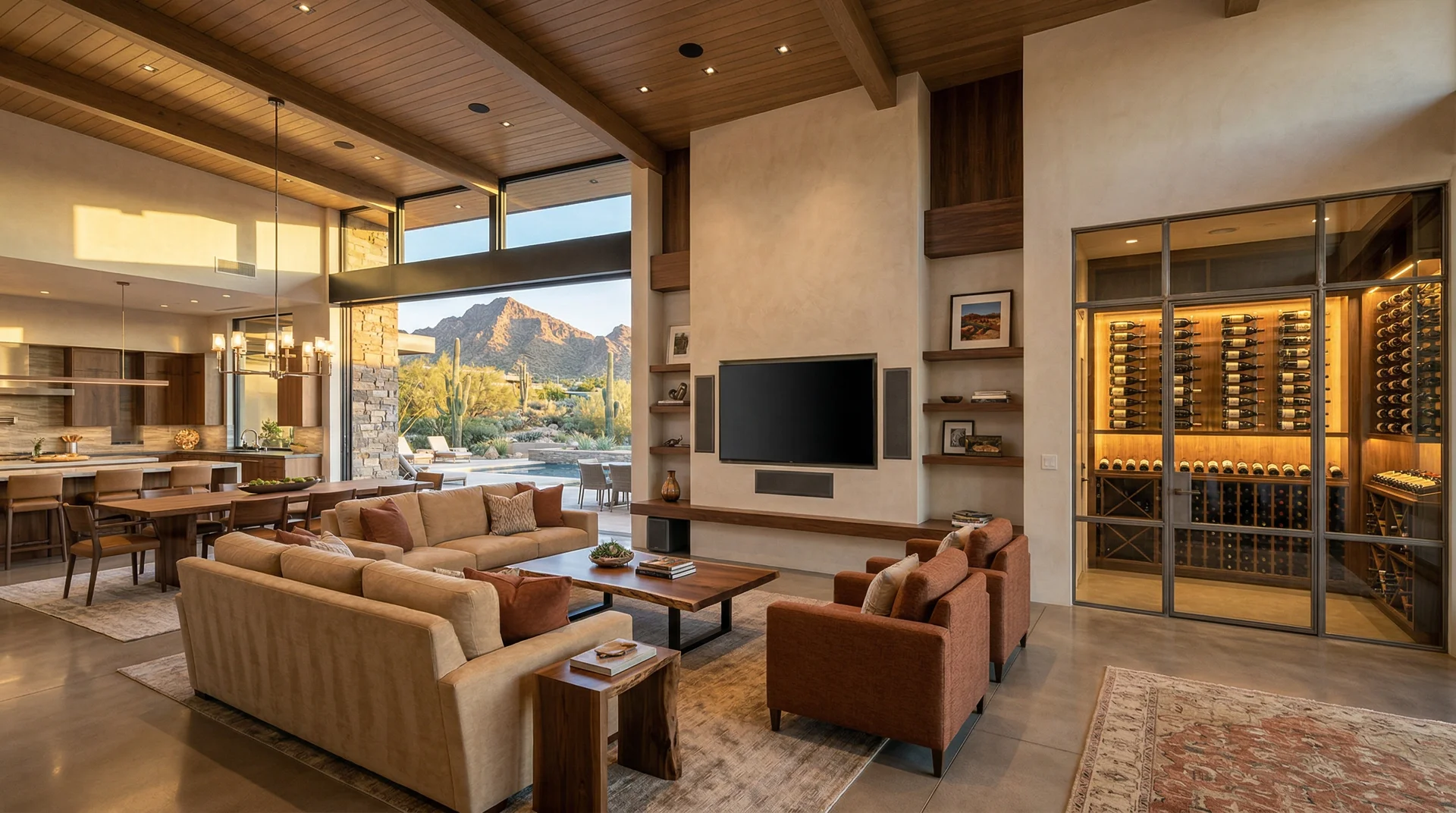
Paradise Valley estates with 15+ rooms need more than a wireless speaker on the kitchen counter. Here's how architectural-grade whole-home audio works in 5,000 to 10,000+ square foot homes, from the wine cellar to the pool deck.
Paradise Valley estates with 15+ rooms need more than a wireless speaker on the kitchen counter. Here's how architectural-grade whole-home audio works in 5,000 to 10,000+ square foot homes, from the wine cellar to the pool deck.
Whole-home audio in Paradise Valley isn't a luxury add-on. It's infrastructure. The global whole-home audio market reached $11.2 billion in 2024 and is projected to grow at 17.4% annually through 2032 (Fortune Business Insights, 2024). That growth is driven largely by owners of 5,000 to 10,000+ square foot estates who want real music in every room, not just the room with the Bluetooth speaker.
I'm Mike, owner of Mike Knows Audio Video. I design and install multi-zone audio systems for Paradise Valley properties where 15 to 20 independent zones isn't unusual. The wine cellar, gym, master suite, home office, pool deck, outdoor kitchen, each one gets its own source and its own volume. That's what whole-home audio actually means.
What Makes Whole-Home Audio Different From Multi-Room Wireless?
Over 68 million US households used a smart speaker in 2025 (eMarketer / Insider Intelligence, 2025). That's a lot of wireless audio, and most of it sounds mediocre. The difference between commodity multi-room wireless and architectural-grade distributed audio comes down to three things: speaker quality, system reliability, and zone independence.
Wireless multi-room products connect to your Wi-Fi and play from a phone app. They work fine in a one-bedroom apartment. In a 7,000-square-foot estate with stone walls, a detached casita, and a pool deck 80 feet from the router, they drop signal, distort at volume, and can't deliver actual bass response. I've walked into plenty of Paradise Valley homes where the owner spent $3,000 on wireless speakers scattered through the house and hated every one of them.
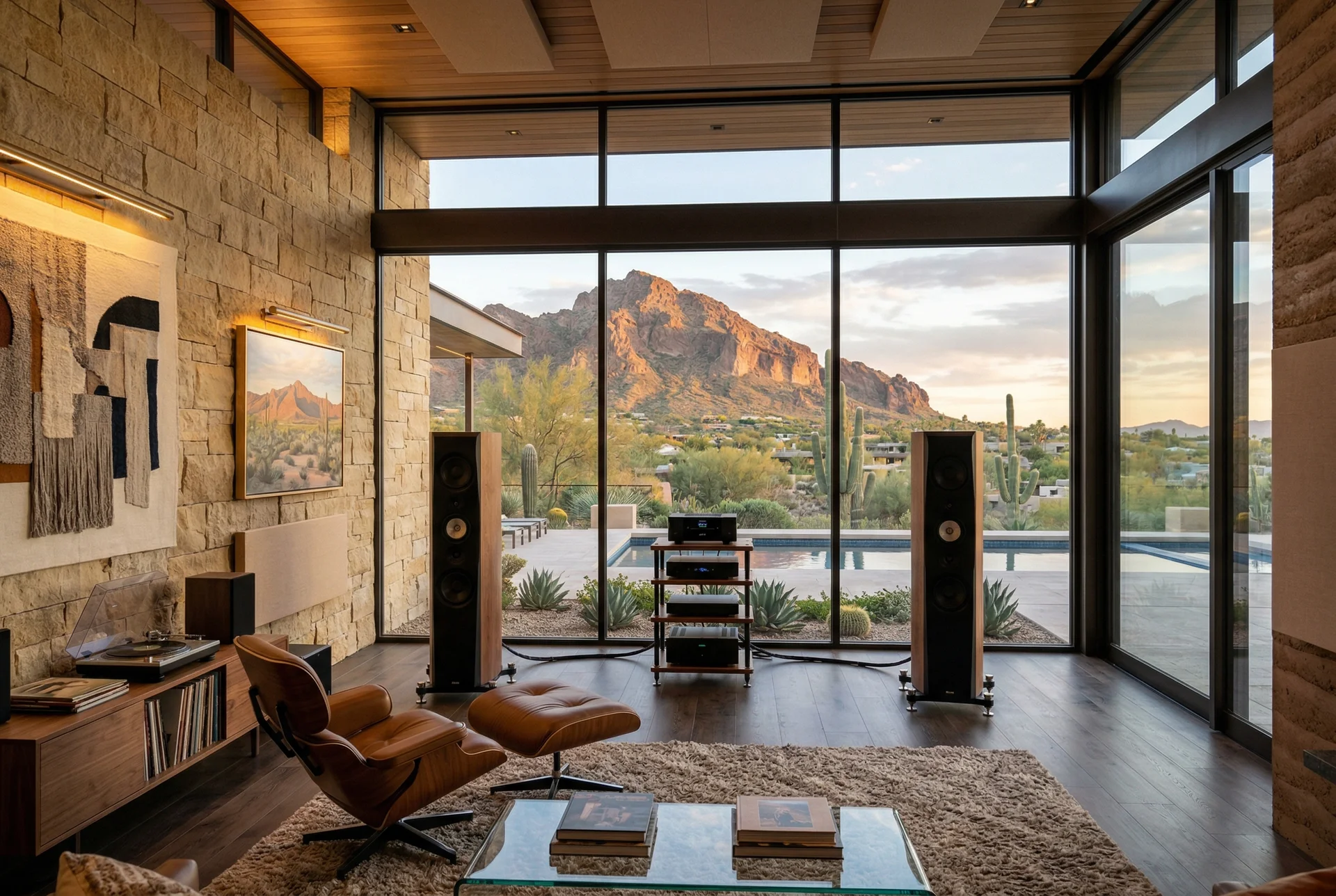
An architectural-grade system uses dedicated amplification, hardwired speaker runs, and custom speakers built to match each room's acoustics and design. Every zone is independent. The wine cellar plays jazz. The gym plays something with a pulse. The pool deck plays nothing because nobody's out there right now. No lag, no dropouts, no fighting over the queue.
How Many Zones Does a Paradise Valley Estate Need?
The average US home has about 6.5 rooms (US Census American Housing Survey, 2023). A Paradise Valley estate typically has 12 to 25 distinct living spaces, depending on whether you count the outdoor areas. Each space that might play audio independently should be its own zone. In my experience, most PV projects land between 12 and 18 zones.
Here's how zones break down for a typical 8,000-square-foot estate on Mockingbird Lane or along the Camelback corridor:
Indoor Zones
- Great room / living room - on-wall speakers flanking the main seating area
- Kitchen - compact on-wall pair, positioned for coverage over the island and prep area
- Master suite - on-wall speakers plus optional ceiling pair (max 2) for ambient overnight listening
- Home office - compact on-wall or desktop pair, tuned for near-field listening
- Wine cellar - compact on-wall pair, rated for cool and humid conditions
- Gym / fitness room - on-wall speakers with a dedicated subwoofer for impact
- Guest bedrooms (2-3 zones) - independent pairs so guests control their own music
- Hallways / common areas - up to 4 ceiling speakers total for ambient background
Outdoor Zones
- Covered patio - on-wall speakers under the roofline
- Pool deck - weather-rated landscape or on-wall speakers for open-air coverage
- Outdoor kitchen / bar - compact on-wall pair
- Casita or guest house - fully independent system
That's 14 to 18 zones before we even discuss the dedicated home theater, which runs on its own system entirely.
Why Do On-Wall Speakers Outperform Ceiling Speakers for Music?
Ceiling speakers account for a huge portion of installed distributed audio, and most of it sounds flat. Here's the physics: music was mixed and mastered to be heard from speakers at ear level, facing you. Ceiling speakers fire straight down. The stereo image collapses. The frequency response shifts. You hear sound, but you don't hear music the way the artist intended.
On-wall speakers, mounted at or near ear height, preserve the stereo image. Left and right separation stays intact. Vocals land in front of you instead of above you. The difference is immediately obvious to anyone who listens to both setups side by side. In open-concept Paradise Valley great rooms with 14-foot ceilings, ceiling speakers are even worse because the distance to the listener adds delay and further degrades clarity.
I limit ceiling speakers to hallways and transitional spaces where background ambiance is the goal, not critical listening. Four ceiling speakers total is my cap for a whole-home system. Every primary living space gets on-wall or tower speakers. That's not a preference. It's acoustics.
After years of installing both configurations, I can tell you that the single biggest upgrade most estate owners experience isn't better amplification or higher-end drivers. It's moving music playback from the ceiling to the wall. The reaction is always the same: "That's what it's supposed to sound like."
How Does Whole-Home Audio Work With Interior Designers?
Residential interior design spending topped $26 billion in 2024 (IBISWorld, 2024), and in Paradise Valley, every major renovation involves a design team. Speaker placement has to be part of that conversation early, not an afterthought during trim-out.
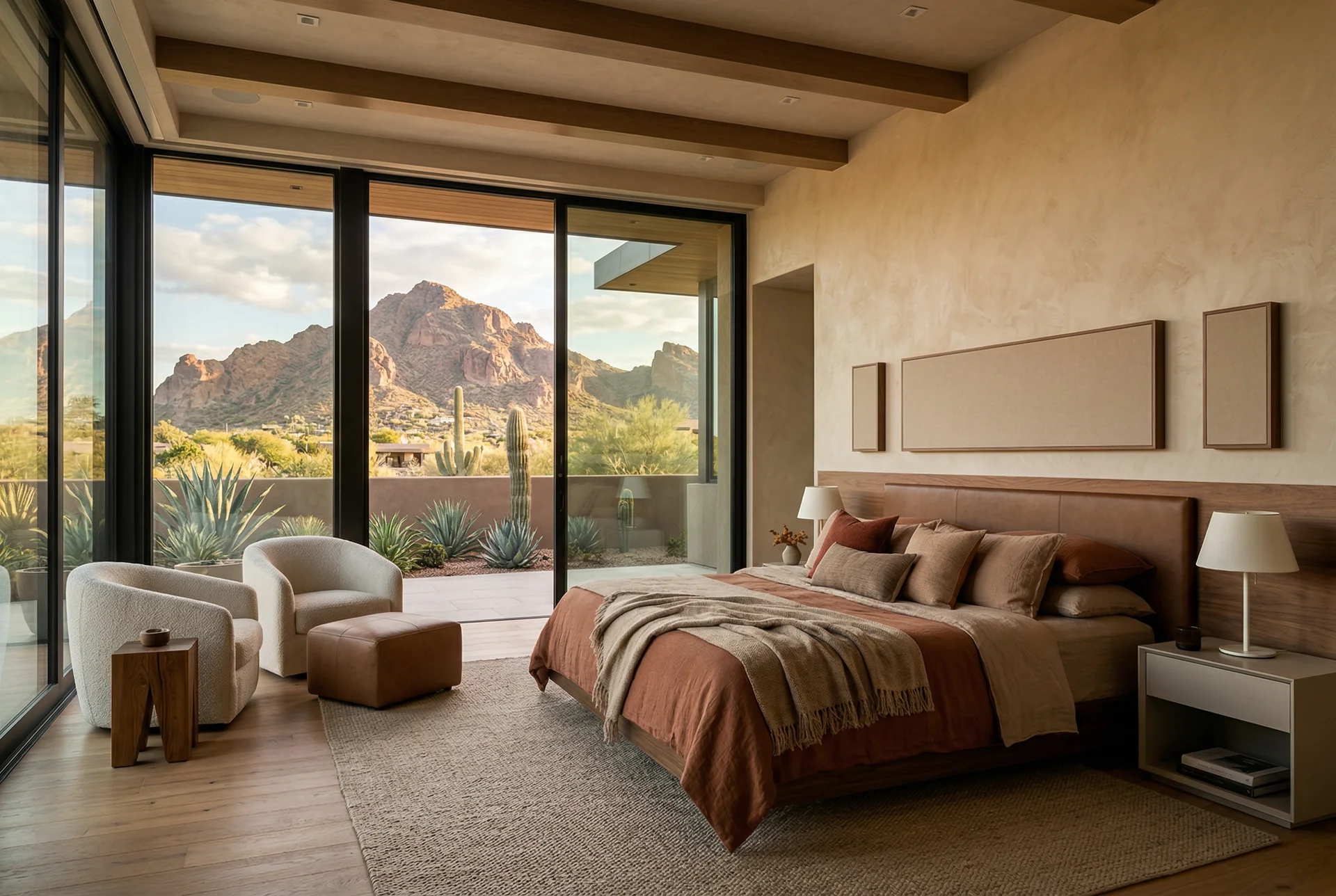
I work directly with interior designers and architects during the planning phase. We coordinate speaker finishes, placement heights, and wire routing before drywall goes up. Custom on-wall speakers can be finished to match cabinetry, wall color, or wood tones. This isn't about hiding the speakers. It's about integrating them so they look intentional, like they belong in the room.
The worst outcome is a beautifully designed wine room or master suite where somebody stuck a white ceiling disc in a dark wood ceiling because the audio was planned last. I've seen it more times than I can count. When I'm involved early, the speakers become part of the design, not an apology for it.
What About Specialty Rooms Like Wine Cellars and Home Gyms?
Specialty rooms make or break a whole-home audio system. A wine cellar kept at 55 degrees and 60% humidity isn't a standard environment for electronics. A gym with concrete walls and rubber flooring has completely different acoustics than a carpeted living room. Each space needs speakers and amplification rated for its conditions.
Most distributed audio installers treat every room the same, running identical speaker pairs everywhere. That's the fast, cheap approach. In a Paradise Valley estate, the wine cellar might be 200 square feet with barrel-vault ceilings, stone walls, and bottle racks that create an incredibly diffuse acoustic environment. It actually sounds fantastic for music with almost zero treatment needed, because all that irregular surface area scatters reflections naturally. The gym is the opposite: hard, flat surfaces that need controlled directivity from the speakers to avoid a harsh, echoey mess.
Home offices present their own challenge. They need to sound great for music, but they also need to disappear when a video call starts. Zone control solves this. One tap mutes the office zone. The rest of the house keeps playing.
How Do You Control 15+ Audio Zones?
Music streaming hit 89% of total US recorded music revenue in the first half of 2025 (RIAA, 2025). People aren't spinning CDs in the wine cellar. They're streaming from Apple Music, Spotify, Tidal, or their own lossless libraries. A proper whole-home audio system integrates all of those sources and makes them available to every zone.
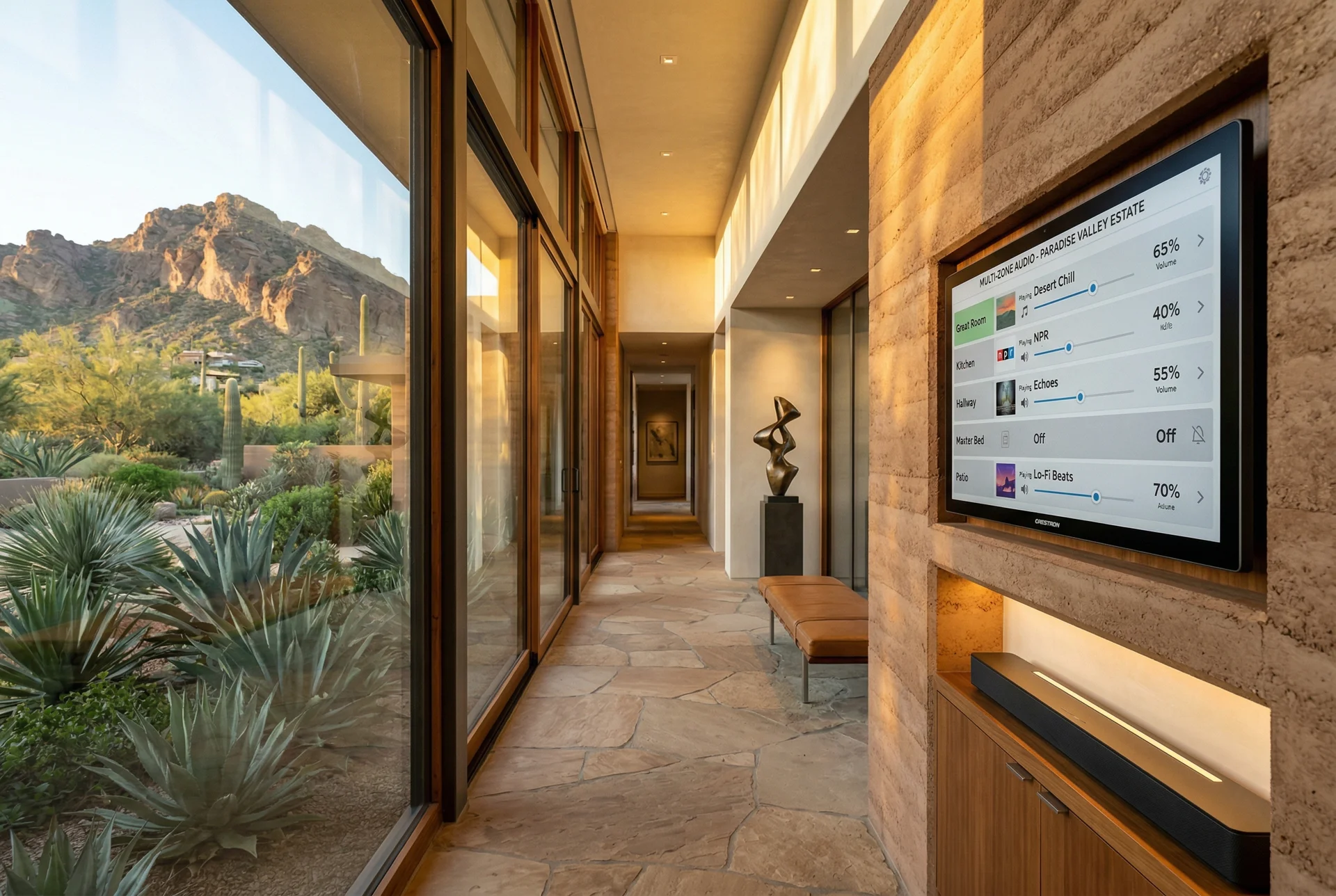
Zone control happens through wall-mounted keypads, a dedicated app on your phone or tablet, or voice commands through whatever assistant you already use. Each zone has independent source selection, volume, and on/off. You can group zones together for a party, so the patio, pool deck, and outdoor kitchen all play the same thing. Or you can keep every zone independent for daily life.
The key is reliability. The system should work every time, without rebooting anything, without waiting for firmware updates, and without needing your phone to be on the same Wi-Fi network. I design systems with dedicated audio processors and hardwired control, so the whole thing operates even if your internet goes down. The streaming stops, sure, but local sources and zone control keep working.
What Does Whole-Home Audio Cost in Paradise Valley?
A 12-to-18-zone architectural-grade audio system for a Paradise Valley estate typically starts around $25,000 and can exceed $80,000 depending on speaker count, amplification quality, and whether outdoor zones require trenching and weather-rated infrastructure. Pricing varies by room count, speaker selection, and how much custom finish work is involved.
That range is consistent with national data. The typical high-end residential AV project runs $12,500 at the median, but whole-home audio for estates in the 5,000-to-10,000-square-foot range pushes well above that because of the zone count and the quality expectations (CE Pro, 2025). I provide detailed proposals with room-by-room pricing after the initial consultation, so nothing is a surprise.
Build timeline for a full whole-home audio system runs 6 to 12 weeks or more, depending on the scope and whether we're coordinating with a builder or designer on a new construction or renovation project. Retrofit installations in existing homes typically move faster because we're working around what's already there.
Is Whole-Home Audio Worth It for Resale Value?
Smart home technology, including distributed audio, adds measurable resale value. Homes with integrated smart technology sold for 5% more on average according to a 2024 analysis (National Association of Realtors, 2024). In a market where Paradise Valley homes regularly trade above $3 million, that 5% translates to real money.
But I don't sell audio systems as investments. I install them because music in every room changes how you live in your home. It makes the wine cellar an experience. It makes the gym tolerable. It makes the pool deck feel alive on a Saturday afternoon. That's the real return.
Across the whole-home audio projects I've completed in the Paradise Valley and Scottsdale corridor, the most-used zones are consistently the kitchen, master suite, and covered patio, in that order. The wine cellar gets the most compliments from guests. The gym gets the most volume. The home office gets muted the most.
Ready to Bring Music Into Every Room?
If you're building, renovating, or just tired of carrying a Bluetooth speaker from room to room in a home that deserves better, I'd love to talk through what's possible. Whole-home audio for a Paradise Valley estate is a project I genuinely enjoy designing, because every home is different and every owner listens differently.
Get in touch for a free consultation, or call me directly at (928) 440-1950. I'll walk your property, map the zones, and put together a proposal that fits your home and how you actually use it.
Comments
Leave a Comment