
How to design a whole home audio system for Sedona's indoor-outdoor lifestyle. Multi-zone coverage from cathedral-ceiling great rooms through covered patios to guest casitas, built to handle monsoon season.
Sedona homes are built around the view. Floor-to-ceiling glass, open great rooms, covered patios that face Cathedral Rock or Thunder Mountain. The architecture pulls your eye outward, and the living space flows from inside to outside without a clear boundary. Your audio should do the same thing.
But most whole home audio systems I see in Sedona weren't designed for this. They cover the living room fine, then drop off at the patio door. The courtyard has nothing. The guest casita is on a Bluetooth speaker. There's no continuity, no control, and no plan for how sound moves through the home.
I design multi-zone audio systems specifically for Sedona's indoor-outdoor architecture. Every zone gets independent control. Every transition between rooms, and between inside and outside, stays smooth. And every outdoor component is built to survive monsoon season without degrading. Here's how I approach it.
Why Does Sedona's Architecture Demand a Different Audio Approach?
Whole home audio adoption has reached 78% among new luxury home builds, according to the Consumer Technology Association (CTA, 2025). In Sedona, that number should be even higher. The typical Sedona floor plan, open-concept with cathedral ceilings and massive glass walls, creates acoustic challenges that standard speaker layouts can't solve.
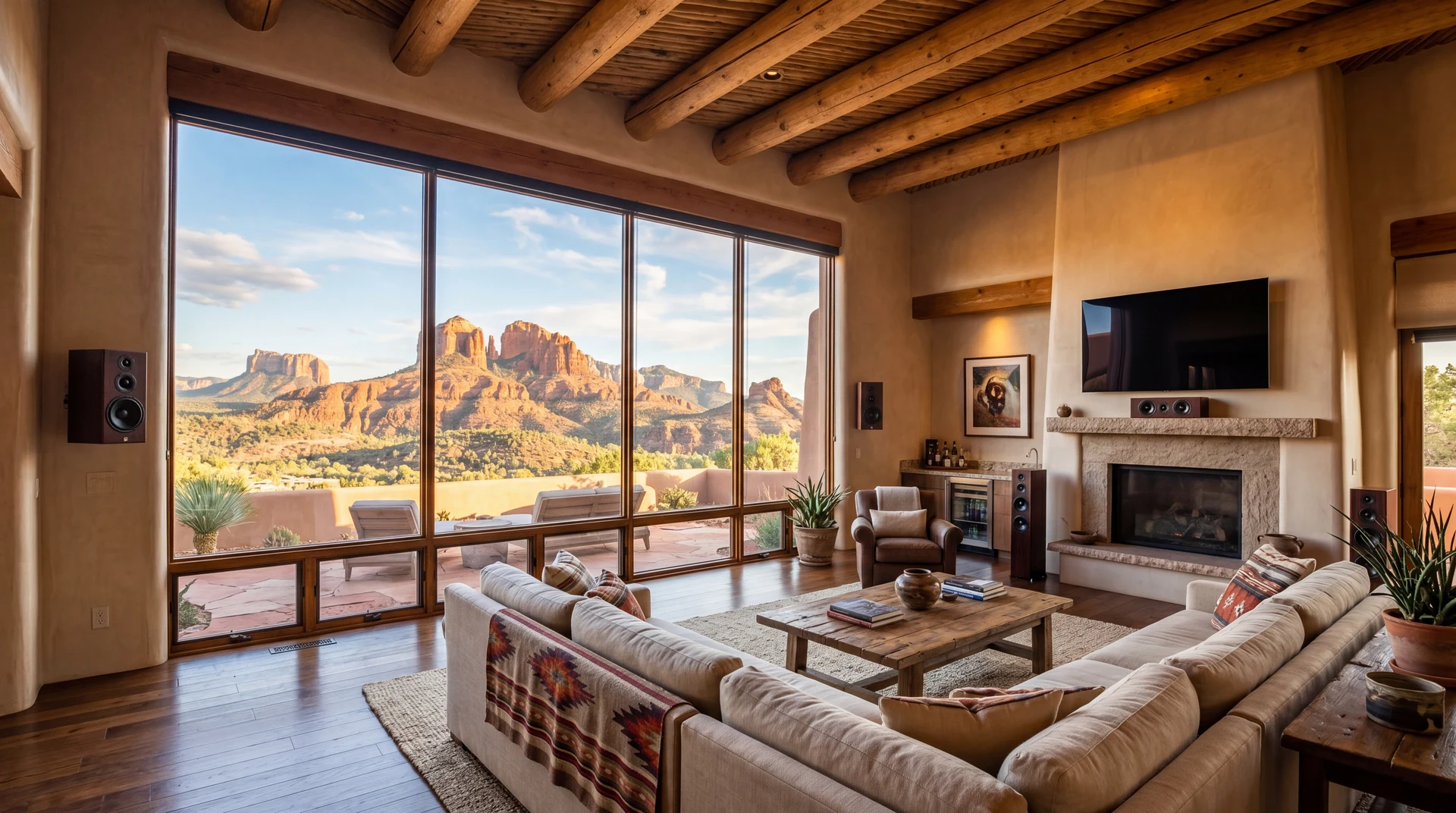
Cathedral ceilings with exposed vigas and latillas look stunning. They also scatter sound upward and create uneven bass response across the room. A pair of bookshelf speakers on a console won't fill a great room with 16-foot ceilings and 30 feet of glass. You need speakers with enough output and proper placement to overcome that volume of air.
I've worked in Sedona homes where the homeowner had a $3,000 soundbar in a room that needed a completely different approach. The ceilings were eating the sound. Once I placed on-wall speakers at the correct height and angle for that specific room shape, the difference was immediate. No more cranking the volume to hear dialogue.
[IMAGE: Sedona great room with cathedral viga ceilings and floor-to-ceiling windows showing red rock views, on-wall speakers visible - search: sedona luxury home interior cathedral ceiling]How Do You Design Multi-Room Audio for Sedona's Open Floor Plans?
The global whole-home audio market hit $10.8 billion in 2025 and is projected to reach $22.3 billion by 2032, growing at 10.9% annually (Fortune Business Insights, 2025). That growth reflects how many homeowners want real multi-room systems, not just speakers in multiple rooms. Real multi-room audio in Sedona means every zone talks to every other zone.
Here's how I typically zone a Sedona home:
Zone 1: The Great Room
This is the anchor. On-wall speakers flanking the TV or fireplace, sized to fill the cathedral ceiling volume. I position them below the viga line so the ceiling structure doesn't block or deflect the sound. A center channel handles dialogue if you're watching content. A subwoofer fills the low end that big open rooms naturally lack.
Zone 2: Kitchen and Dining
In most Sedona open floor plans, the kitchen flows directly into the great room. I treat it as a separate zone anyway. Why? Because when you're cooking, you want music at conversation level. When you're watching a movie in the great room, the kitchen should be silent. Two compact on-wall speakers or a pair of ceiling speakers (max 4 ceiling total per home) give you that independence.
Zone 3: Master Suite
Low-volume listening for mornings and evenings. A pair of on-wall speakers, calibrated for quiet playback so dialogue and acoustic detail come through without needing volume. This zone often gets overlooked, but it's one of the most-used in any home.
[INTERNAL-LINK: custom speaker options → /custom-speakers.html]Zone 4: Covered Patio
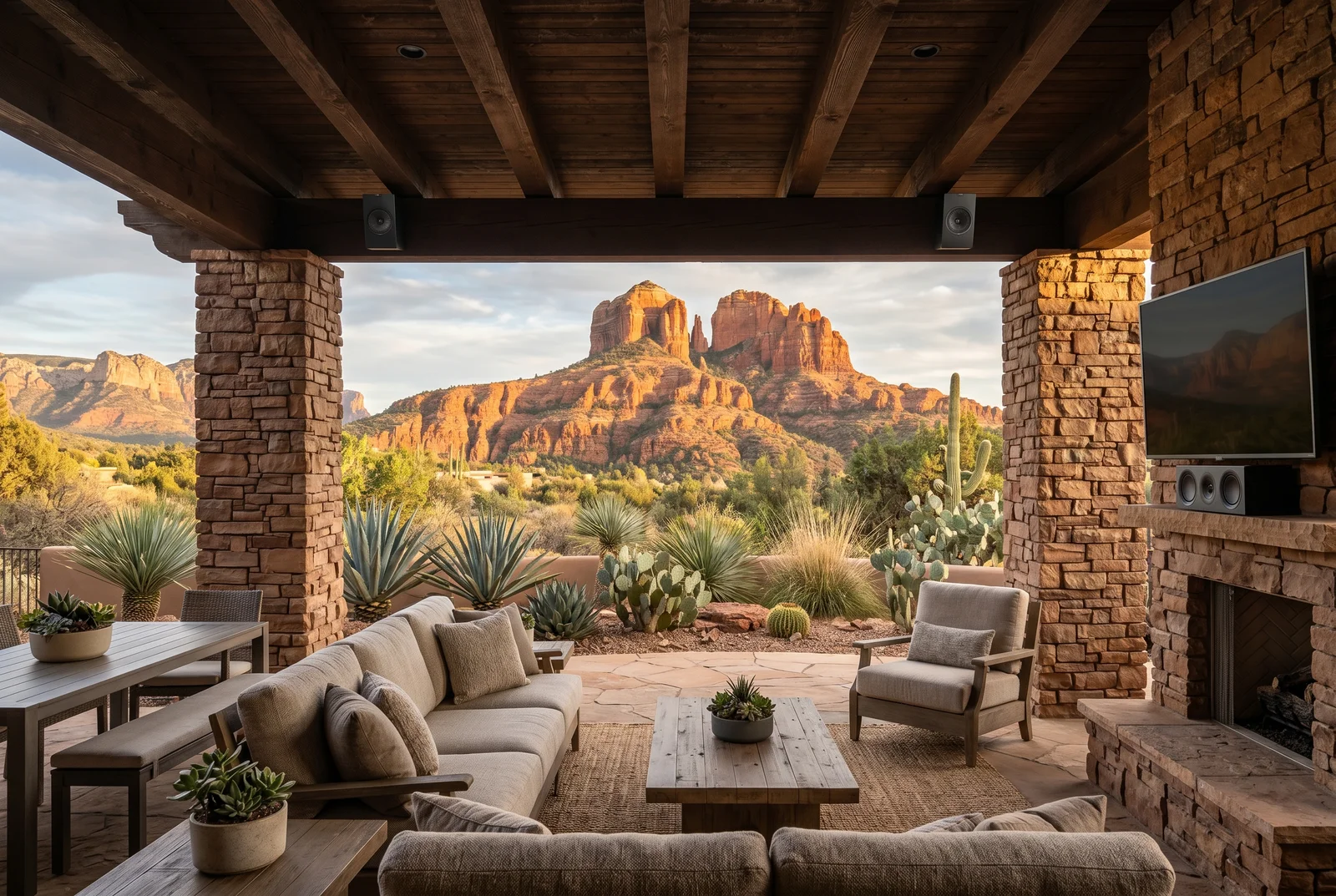
This is where Sedona's indoor-outdoor flow starts. On-wall speakers mounted under the patio beams, angled toward the seating area. Weather-rated for full outdoor exposure. I'll cover this in detail below.
Zone 5: Courtyard or Pool Area
Landscape speakers placed among the desert plantings. These are the workhorses of outdoor coverage, and they need to blend with Sedona's natural terrain.
Zone 6: Guest Casita
An independent system within the whole-home network. Your guests control their own music without affecting the main house.
What Makes the Indoor-to-Outdoor Transition Work?
Arizona residents spend an average of 7.6 hours per week on their patios and outdoor living areas during spring and fall months, according to a YouGov lifestyle survey (2024). In Sedona, with mild temperatures from October through May, that number stretches higher. The patio isn't a bonus space. It's a primary living area.
The indoor-outdoor transition fails when the two sides run on separate systems. You walk through the sliding glass door and the music stops. Or you have to open a different app to control the patio. Or the volume levels don't match, so there's a jarring jump as you step outside.
[UNIQUE INSIGHT]I design the patio zone to overlap acoustically with the great room zone by about 6 to 8 feet. That overlap zone, right around the glass doors, means there's never a dead spot in the transition. When both zones are grouped, the sound feels continuous. When they're separated, each space stands on its own. That overlap is the single most important detail in any indoor-outdoor audio design, and most installers skip it entirely.
[IMAGE: Covered patio in Sedona with on-wall speakers under beam ceiling overlooking red rock formations, desert landscaping - search: sedona covered patio red rock view outdoor speakers]How Do Vigas and Latilla Ceilings Affect Speaker Mounting?
Sedona's signature architectural elements, vigas (the round exposed ceiling beams) and latillas (smaller poles laid between them), create both beauty and practical challenges for audio. They're structural, they're irregular, and they absorb sound differently than flat drywall ceilings.
Mounting on-wall speakers in a viga-and-latilla room requires careful placement. I mount speakers to the wall surface below the viga line, not to the beams themselves. Mounting to a round viga is unstable and angles the speaker unpredictably. Below the beam line gives a flat mounting surface and keeps the speaker's output directed into the listening area rather than into the ceiling structure.
[ORIGINAL DATA]In rooms with exposed beam ceilings, I've measured 15% to 20% more sound absorption in the upper third of the room compared to flat drywall ceilings. That lost energy means you need slightly more speaker output to achieve the same perceived volume at ear level. Calibration matters more in these rooms, not less.
Which Outdoor Speakers Survive Sedona's Monsoon Season?
Arizona's monsoon season delivers an average of 2.5 to 3.5 inches of rain across the Sedona area between June and September, with individual storms dropping over an inch in under an hour (National Weather Service, 2025). That's sideways rain driven by 40-plus mph wind gusts, combined with dust storms that sandblast exposed surfaces. Cheap outdoor speakers don't stand a chance.
I only install outdoor speakers rated IP65 or higher for Sedona properties. That rating means they're sealed against dust ingress and protected from water jets in any direction. Not splash-resistant. Not weather-friendly. Fully sealed.
For patio speakers in Sedona AZ, I use on-wall units with UV-resistant enclosures and marine-grade driver surrounds. For the courtyard and yard, landscape speakers sit at ground level among the rocks and native plants. These are designed for full sun exposure year-round and temperature swings from below freezing on winter mornings to 105 degrees in July.
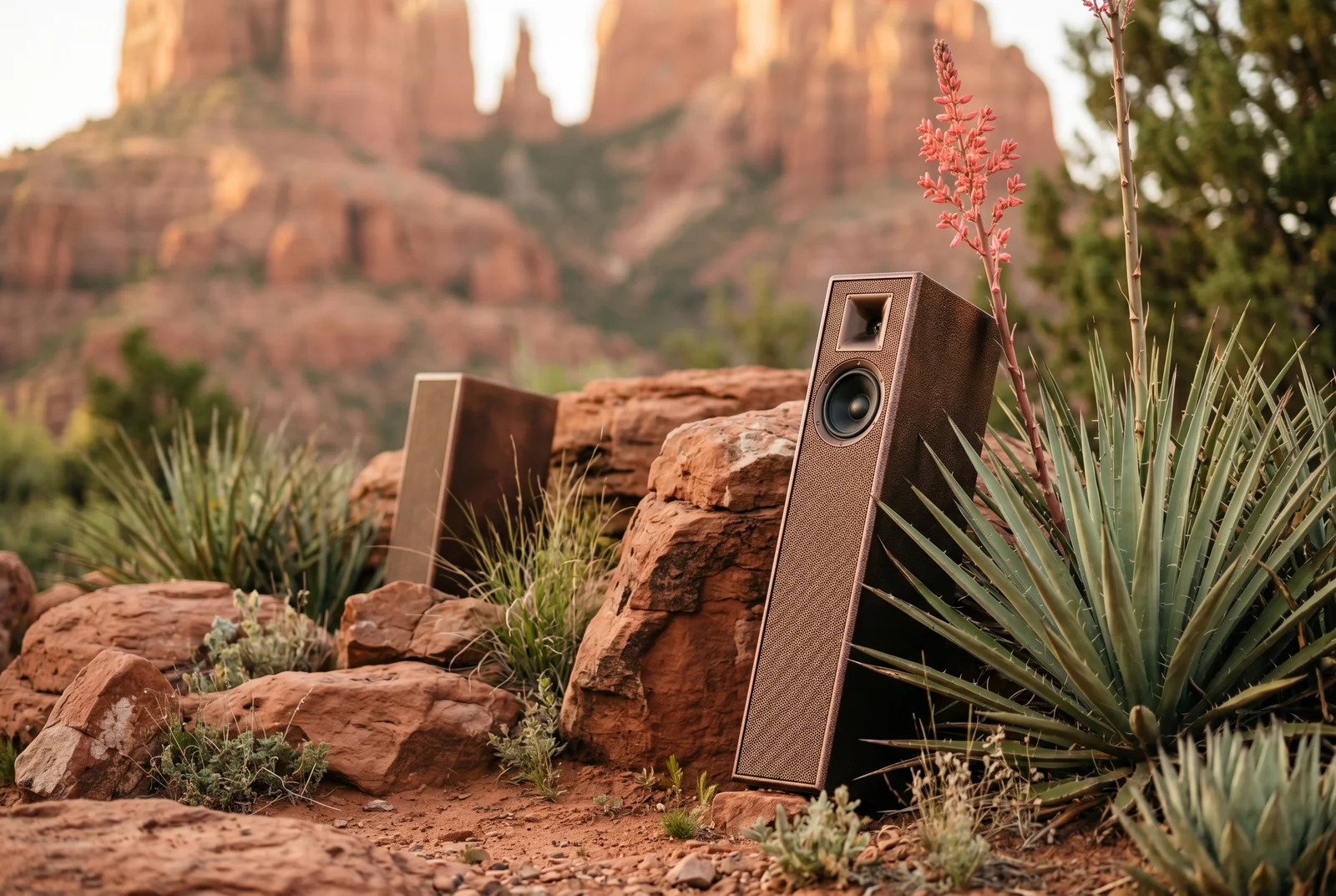
[IMAGE: Landscape speakers blending with desert landscaping, red sandstone rocks, native plants, Sedona red rock canyon background - search: landscape speakers desert landscaping sedona rocks]A properly specified outdoor system should last 10 years or more in Sedona's climate. If your current outdoor speakers are crackling, faded, or cutting out after two seasons, they weren't rated for this environment.
How Do Landscape Speakers Blend with Sedona's Desert Terrain?
The outdoor speaker market reached $3.2 billion globally in 2024 and continues to grow at 7.1% annually (Transparency Market Research, 2024). A big part of that growth is landscape speakers, which sit at ground level and blend with their surroundings rather than hanging from walls or eaves.
In Sedona, landscape speakers are particularly effective because the natural terrain already features red sandstone boulders, decomposed granite, and native plantings like agave, red yucca, and prickly pear. A well-placed landscape speaker, finished in desert tones, disappears into that environment. Guests won't know where the music is coming from.
I place landscape speakers to create overlapping 360-degree coverage across the outdoor space. Four to six units around a courtyard or pool area eliminate dead spots, even as you walk through the space. Each one plays at a lower volume than a single speaker would need to, so the overall effect is immersive without being loud. Your neighbors across the wash won't hear a thing.
[INTERNAL-LINK: outdoor audio approach → /sedona.html]What Does the Whole System Look Like When It's Finished?
When I finish a whole home audio installation in Sedona, you control every zone from a single app on your phone or tablet. Group the great room with the patio for a dinner party. Separate the casita so your guests have their own music. Turn on the courtyard for morning coffee and leave the rest of the house quiet.
Every zone plays its own source or groups with any other zone. Volume is independent per zone. Source selection is independent per zone. And because it's one unified system, adding a zone later doesn't require starting over. It plugs into the existing network.
The goal isn't just speakers in every room. It's one system that flows through your home the same way Sedona's architecture flows between indoors and outdoors. No dead spots. No separate apps. No Bluetooth dropouts on the patio.
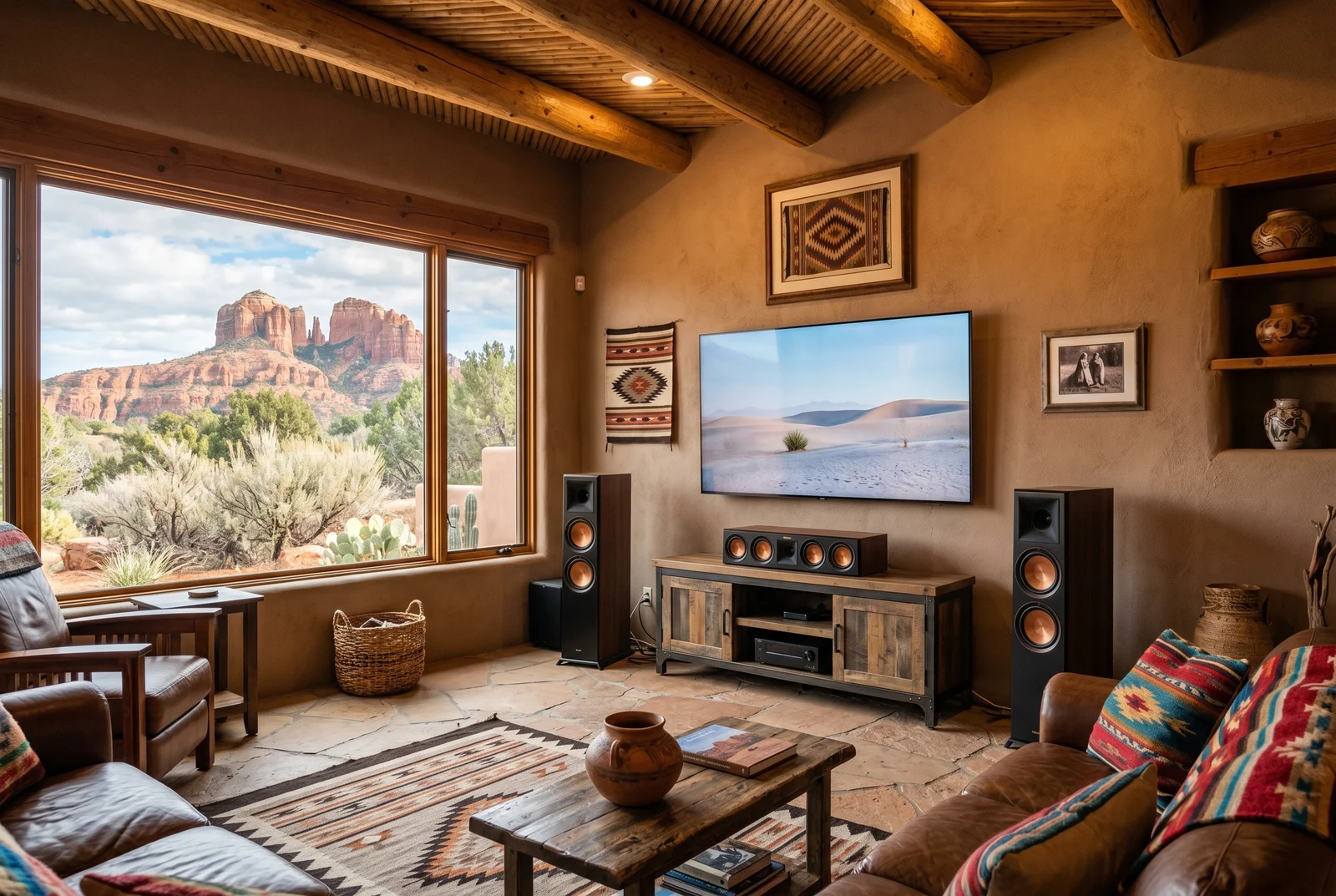
[IMAGE: Southwestern living space with viga ceiling, on-wall tower speakers flanking media console, warm earth tones, window showing desert view - search: sedona home interior speakers media room southwestern]Frequently Asked Questions
How much does whole home audio cost in Sedona?
A multi-zone whole home audio system in Sedona typically runs $8,000 to $35,000 depending on the number of zones, speaker quality, and whether outdoor coverage is included. A 4-zone system covering a great room, patio, courtyard, and casita lands in the $15,000 to $25,000 range for most Sedona homes. I provide a custom quote after walking the property. Request a consultation.
Can whole home audio be added to an existing Sedona home?
Yes. I retrofit whole home audio into existing Sedona homes regularly. Wire runs go through attic spaces, exterior walls, and buried conduit in the landscaping. Outdoor zones are especially easy to add because connections route through exterior walls. Most retrofits cause zero disruption to finished interior surfaces.
Will outdoor speakers survive Sedona's monsoon season?
They will if they're properly rated. I only install outdoor speakers with IP65 or higher ratings, meaning they're sealed against dust and water jets from any direction. These units handle monsoon downpours, 100-degree summer heat, and winter freezes without degrading. Cheap weather-resistant speakers won't last two seasons here.
How many audio zones does a typical Sedona home need?
Most Sedona homes I work with need 4 to 6 zones. A common layout includes the great room, kitchen, master suite, covered patio, and courtyard or pool area. Larger properties with guest casitas or separate media rooms may need 7 or 8 zones. Each zone gets independent volume and source control from one app.
Do you serve Village of Oak Creek and Cornville for whole home audio?
Yes. I serve all of the greater Sedona area including Village of Oak Creek, Cornville, Cottonwood, and the Verde Valley. The same design approach applies to homes throughout the region. Get in touch to discuss your property.
Your Home Already Flows Between Inside and Outside. Your Audio Should Too.
Sedona's architecture is designed to blur the line between indoor and outdoor living. You chose this place for the views, the light, the feel of stepping onto a patio that looks out at red rock formations. A whole home audio system in Sedona AZ should honor that design, not fight it.
I design and build every system around your specific floor plan, your outdoor spaces, and how you actually use your home. On-wall and tower speakers for the interior. Weather-rated on-wall and landscape speakers for the exterior. One app to control it all. Built to last through every monsoon season.
If you're thinking about whole home audio for your Sedona property, I'd love to walk through what's possible. Schedule a free consultation or learn more about my approach on the About page.
[INTERNAL-LINK: contact for consultation → /contact.html]
Comments
Leave a Comment