

How a sheet of charged film thinner than a sandwich bag became the sound audiophiles chase for a lifetime.
Ask a room full of audiophiles to name the best-sounding speaker ever made, and someone will always say it quietly, like they're letting you in on a secret: an electrostatic. Not the biggest. Not the loudest. Just the one that seems to step out of the way and let the music through.
The electrostatic loudspeaker, the ESL, is the purist's holy grail. It swaps the heavy paper cone for a sheet of charged film thinner than a sandwich bag, and the result is a kind of clarity that has haunted engineers for a hundred years. I've listened through enough of these panels to understand the obsession. Let's get into how they work, why people worship them, and who ended up owning the legends.
Key Takeaways
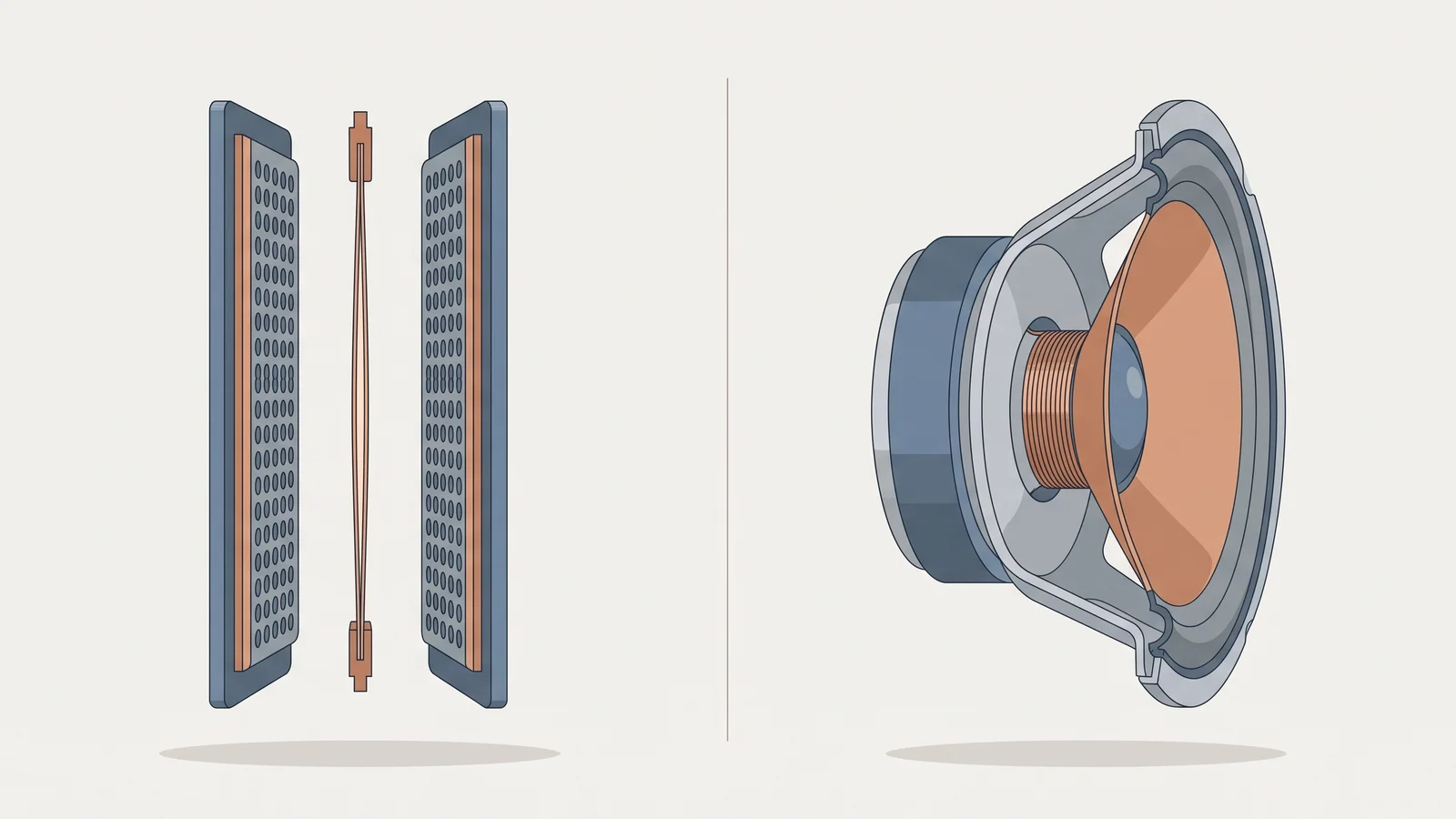
- An electrostatic speaker moves sound with a near-massless charged film held between two perforated metal grids, not a cone on a magnet.
- The Quad ESL, later called the ESL-57, was the first commercially successful full-range electrostatic, launched in 1957 by Peter J. Walker.
- Quad built the ESL-57 until 1985, selling roughly 54,000 units, per Wikipedia's Quad entry.
- Purists chase electrostatics for midrange clarity and speed; the trade-offs are limited bass, low efficiency, fussy amps, and a mains-powered bias supply.
- Quad is now owned by China's International Audio Group (1997) and Stax by China's Edifier (2011), yet both records show continuity, not a fire sale.
How does an electrostatic loudspeaker work?
An electrostatic loudspeaker makes sound with a wafer-thin charged film instead of a cone. A separate power supply holds that diaphragm at a fixed bias of roughly 5,000 to 6,000 volts, and the audio signal on the two grids around it does the pushing, as MartinLogan's ESL theory pages explain. No magnet, no voice coil, no cone. Just charge and air.
Picture a thin plastic film, coated to hold an electrical charge, stretched tight like a drumhead. On each side sits a perforated metal plate called a stator. The film gets its steady high-voltage charge from a bias supply, which is why an ESL needs to be plugged into the wall, as PS Audio walks through in plain terms. The music signal goes onto the stators. One grid pulls, the other pushes.
Here's the beautiful part. That film weighs almost nothing, so the whole surface moves as one, driven evenly from edge to edge. A cone gets shoved from a single point at its center and has to stay rigid on the way out. The electrostatic diaphragm doesn't. The payoff is very low distortion, lightning-fast transients, and, in a pure panel, no crossover chopping up the signal, per MartinLogan's theory notes.

How is that different from a normal speaker?
A conventional dynamic driver, the moving-coil design in almost every speaker you own, works the opposite way: a stiff cone gets driven from one point by a coil sitting in a magnet gap. It has real mass to move, and mass fights speed. The electrostatic answer is to make the moving part so light it barely exists, then drive every square inch of it at once.
That single design choice is the whole story. Force spread across a big, light membrane behaves differently from force punched into a small, heavy cone. One trades output for purity. The other trades a little purity for muscle. Neither is wrong. They're just different religions.
What are the trade-offs of electrostatic speakers?
Electrostatics buy their purity at a real price. A flat dipole panel struggles to move enough air for deep bass and big volume, which is exactly why MartinLogan bolted a powered dynamic woofer onto its 1987 hybrid design, as the company's own history recounts. Finesse up top, brute force down low. That compromise tells you everything about the format's weak spots.
Start with bass and loudness. A big flat panel radiates from both faces, front and back, so a lot of low-frequency energy cancels itself in the room. Getting real slam out of a pure ESL means going huge, and even then it has limits. Sound & Vision, praising the Quad, still flags that these speakers are "difficult to run and maintain," in its look back at the ESL-57.
Then there's the amplifier. An electrostatic panel looks like a capacitor to your amp, a reactive load that gets harder to drive as the music climbs in frequency. Pair one with the wrong amp and it wheezes or shuts down. They're also low in efficiency, they need mains power for that bias supply, and their sweet spot is narrow, so you sit in one chair or you don't get the magic. Add the old horror stories: dust, humidity, and the occasional arc snapping across the panel. Purists forgive all of it. Most people don't.
Who invented the electrostatic loudspeaker?
No single person invented the electrostatic loudspeaker; it arrived as a lineage. The first commercially successful full-range version, the Quad ESL, launched in 1957 and stayed in production until 1985, selling roughly 54,000 units, according to Wikipedia's Quad Electrostatic Loudspeaker entry. But the idea is decades older, and the road to it ran through some famous names.
Bell Labs and the road not taken (1923-25)
The dynamic speaker and the electrostatic were rivals from the start. Around 1923 to 1925, Chester Rice and Edward Kellogg at Bell Labs and General Electric tested a large electrostatic design, one experimental version using a gold-beaten leaf and animal-membrane diaphragm, before they went with the moving-coil driver instead, as MartinLogan's history recounts. The same engineers who could have crowned the electrostatic chose the cone. That fork in the road shaped the next century of home audio.
Arthur Janszen and the practical tweeter (1952)
American engineer Arthur Janszen built the first genuinely practical electrostatic element around 1952 and founded JansZen Laboratories in 1954, as The Absolute Sound documents. Worth a careful footnote here: Janszen's marketing later billed his work as a "world's first," but that claim is promotional, and the breakthrough element was a tweeter, not a full-range speaker. He solved the high frequencies brilliantly. Someone else solved the whole spectrum.
The Quad ESL: the first full-range electrostatic (1957)
That someone was Peter J. Walker of Quad in England, whose 1957 ESL, later nicknamed the ESL-57, was the first commercially successful full-range electrostatic loudspeaker, per Wikipedia's Quad entry. Some accounts also credit the engineer David Theodore Williamson in the design's development, so it wasn't purely a one-man show. Either way, the ESL-57 is the landmark. Sound & Vision calls it "one of the most important speakers of the 20th century," in its retrospective.
The KLH Model Nine: America's answer (1959)
Two years later, America got its own landmark full-range electrostatic: the KLH Model Nine of 1959. Here's the fact the internet keeps garbling. The Model Nine was designed by Arthur Janszen, not by Henry Kloss, as Sound & Vision makes clear. Kloss co-founded KLH in 1957 and championed the speaker commercially, per his biography. And no, it wasn't the first full-range electrostatic; the Quad beat it by two years. Call the Model Nine the first major American full-range ESL and you've got it right.
The Quad ESL-63 and the point-source trick (1981)
Peter Walker wasn't done. In 1981 Quad released the ESL-63, a cleverer panel that used a series of concentric rings fed through an electronic delay line, so the sound radiated as if from a single point roughly 30 centimeters behind the panel, as Stereophile describes. Fans love to say it holds "12 miles of wire," which is an approximate, oft-repeated figure rather than a spec sheet number, as the Vintage Technology Archive notes. The point-source idea made imaging almost spooky.
MartinLogan and the hybrid (1983-1987)
The American revival came from MartinLogan, founded in 1983, though the company's own site says 1982, by Gayle Martin Sanders and Ron Logan Sutherland, per Wikipedia. Its CLS arrived in 1986 as a full-range electrostatic, and the 1987 Sequel paired an electrostatic panel with a powered dynamic woofer, as MartinLogan's history records. The Absolute Sound credits the company with having "reinvented the electrostatic speaker" through that hybrid, in its audio-history series. The hybrid solved the bass problem without killing the magic.
Stax and the electrostatic earspeaker (1938 / 1960)
The last branch of the family tree went straight to your head. Japan's Stax, founded in 1938, released the SR-1 in 1960, the first electrostatic "earspeaker," which is Stax-speak for headphone, as Wikipedia records. The same physics that makes a big panel sound so clean works beautifully an inch from your ears. Ask any headphone obsessive about the "Stax sound" and watch their eyes go soft.
Why do purists call the electrostatic speaker the holy grail?
Because when it clicks, nothing else sounds like it. More than 65 years after its 1957 debut, the Quad ESL-57 is still described by Sound & Vision as "one of the most important speakers of the 20th century," praised for "clarity and precision" and a sound that's "transparent," "lifelike," "neutral," "open," and "spacious," in the magazine's retrospective. That's not hype. That's the format's whole reason to exist.
The specific praise gives you the flavor. Sound & Vision points to the ESL-57's "extraordinarily lucid midrange, speed, and transparency," the qualities that come straight from that near-weightless diaphragm. It also notes the speaker was used by BBC engineers, which tells you how seriously the pros took it. Voices and acoustic instruments through a good electrostatic can stop a conversation cold.
The obsession with getting out of the way, with adding nothing and subtracting nothing, is the same instinct that guides how we voice our own hand-built loudspeakers. We don't build electrostatics, and I'll be honest about that. But the target is identical: a speaker that disappears and leaves you with the music. That's the grail every serious designer is chasing, cone or panel.
Who owns Quad and Stax now?
The two great electrostatic names both sit under Chinese ownership today. Quad passed through the Verity Group in 1995 and then to International Audio Group in September 1997, per Wikipedia, while Stax was acquired by the audio firm Edifier in December 2011, as Robb Report reported. Two British and Japanese legends, two big conglomerate parents.
Now, in this series I've documented one grim pattern often enough to give it a name: enshittification, where a passionate small maker gets bought and slowly hollowed out into an offshored nameplate. I'm not going to pin that label on these two, because the record doesn't support it. IAG kept Quad's research and development nominally in Huntingdon, England, and Edifier funded a new Stax factory in Saitama and kept the team on. What the documents show is continuity, not a fire sale.
Still, something quieter did shift. The storied independents no longer stand alone; stewardship of these purist icons passed to volume conglomerates, and the era of the lone obsessive tinkering in a small English shop is mostly gone from the electrostatic world. That's the part worth sitting with.
Which is exactly the model I've built my own shop around. One owner-craftsman, custom loudspeakers built by hand in Arizona, for about fifteen clients a year, made in the USA. I'm not claiming my towers do what a great electrostatic does. I'm saying the small-shop purist ethos that produced the ESL-57 is still a living thing, and keeping it alive is the whole point of doing it the old way.
Frequently Asked Questions
What is an electrostatic speaker?
An electrostatic speaker, or ESL, reproduces sound using a thin, electrically charged film suspended between two perforated metal grids called stators, as PS Audio explains. Instead of a cone driven by a magnet, the whole near-weightless membrane moves at once. That gives famously low distortion and speed, at the cost of bass, efficiency, and easy amplifier matching.
How do electrostatic speakers work?
A bias supply holds the diaphragm at a fixed charge of roughly 5,000 to 6,000 volts, so the speaker must be plugged into mains power, per MartinLogan's ESL theory. The music signal goes to the two stators; one pulls the charged film while the other pushes. Because the diaphragm is so light, it moves uniformly across its surface, producing very low distortion.

Who invented the electrostatic loudspeaker?
There's no single inventor; it's a lineage. Bell Labs engineers tested an electrostatic in the 1920s but chose the moving-coil driver, per MartinLogan. Peter J. Walker of Quad built the first commercially successful full-range ESL in 1957, the ESL-57, per Wikipedia. Arthur Janszen made the first practical electrostatic tweeter element around 1952.
Are electrostatic speakers better than regular speakers?
Better in some ways, worse in others. Electrostatics offer exceptional midrange clarity, speed, and low distortion, which is why Sound & Vision calls the Quad ESL-57 one of the most important speakers of the 20th century, in its retrospective. But they give up bass, loudness, efficiency, and easy amp matching, and Sound & Vision notes they're "difficult to run and maintain."
Who owns Quad now?
Quad has been owned by the Chinese-based International Audio Group since September 1997, after passing through the Verity Group in 1995, per Wikipedia. Under IAG, Quad's research and development has nominally stayed in Huntingdon, England. The brand still produces electrostatic loudspeakers, keeping Peter Walker's 1957 design lineage alive under corporate ownership.
Who owns Stax now?
The audio company Edifier acquired Stax in December 2011, as Robb Report reported. Stax, founded in Japan in 1938, released the first electrostatic earspeaker, the SR-1, in 1960, per Wikipedia. Under Edifier, the company funded a new factory in Saitama, Japan, and retained its team, so the records show continuity rather than decline.
Sources
- Wikipedia, "Quad Electrostatic Loudspeaker": https://en.wikipedia.org/wiki/Quad_Electrostatic_Loudspeaker
- Sound & Vision, "Quad ESL-57: The Original Electrostatic Speaker": https://www.soundandvision.com/content/quad-esl-57-original-electrostatic-speaker
- QUAD, "Our Story": https://quad-hifi.co.uk/pages/our-story
- PS Audio, "How Electrostatic Loudspeakers Work": https://www.psaudio.com/blogs/pauls-posts/how-electrostatic-loudspeakers-work
- MartinLogan, "Electrostatic (ESL) Theory": https://www.martinlogan.com/en/electrostatic-esl-theory
- MartinLogan, "Electrostatic Loudspeaker History": https://www.martinlogan.com/en/electrostatic-loudspeaker-history
- The Absolute Sound, "TAS Legacy: Arthur Janszen and the KLH Model Nine": https://www.theabsolutesound.com/articles/tas-legacy-arthur-janszen-and-the-klh-model-nine/
- Sound & Vision, "KLH Model Nine Rides Again": https://www.soundandvision.com/content/klh-model-nine-rides-again
- Wikipedia, "Henry Kloss": https://en.wikipedia.org/wiki/Henry_Kloss
- Stereophile, "Quad ESL": https://www.stereophile.com/floorloudspeakers/720/index.html
- Vintage Technology Archive, "Quad ESL-63": https://vintagetechnologyarchive.com/audio/quad/esl-63/
- The Absolute Sound, "Audio History Series: MartinLogan Reinvents the Electrostatic Speaker": https://www.theabsolutesound.com/articles/audio-history-series-martin-logan-reinvents-the-electrostatic-speaker/
- Wikipedia, "MartinLogan": https://en.wikipedia.org/wiki/MartinLogan
- Wikipedia, "Stax Ltd": https://en.wikipedia.org/wiki/Stax_Ltd
- Robb Report, "Stax Celebrates an 80-Year Journey as an Audiophile Brand": https://robbreport.com/gear/audio/stax-celebrates-80-year-journey-audiophile-brand-2790089/
- Wikipedia, "International Audio Group": https://en.wikipedia.org/wiki/International_Audio_Group
Mike Vincent is the founder of Mike Knows Audio Video and WubWub Audio, where he designs and hand-builds custom loudspeakers and home theaters in Arizona, the old way, for about fifteen clients a year. He doesn't build electrostatics, but he shares their one obsession: a speaker that disappears and leaves you with the music. If that's the sound you're after, start with our hand-built custom loudspeakers.
Comments
Leave a Comment