
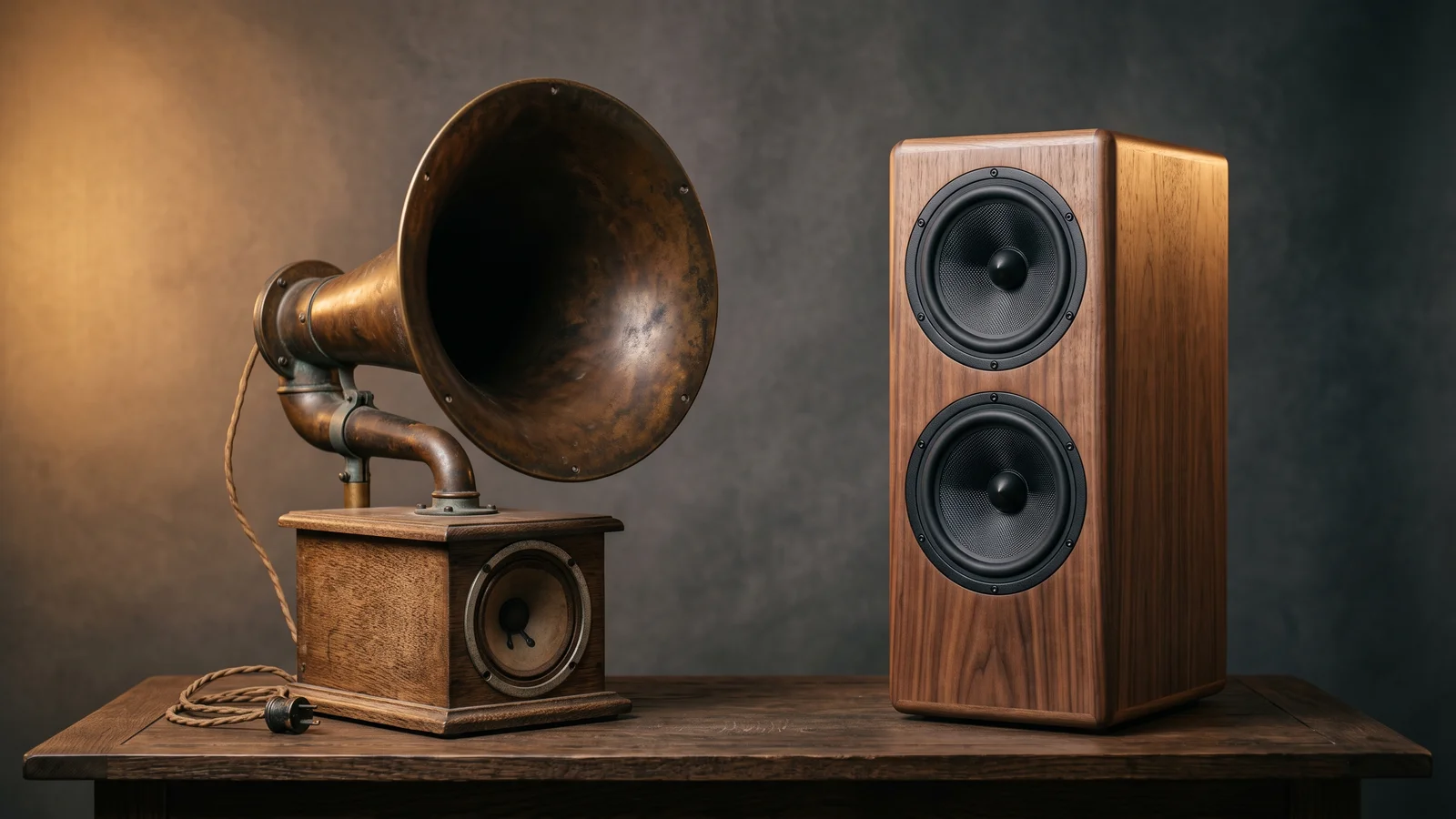
There's no single inventor of the loudspeaker. There's a hundred-year relay race, and the design everyone finally grabbed got drawn up in 1925.
Ask a room full of audio nerds who invented the loudspeaker and watch the argument start. It's a trick question. There's no single genius, no lightning-bolt moment, no lone tinkerer yelling "Eureka" over a cone. What you get instead is a hundred-year relay race, and the baton everyone eventually grabbed got drawn up in 1925.
That baton is the moving-coil driver. It's the little motor buried in your earbuds, your car doors, your laptop, your soundbar, and the towers I build by hand out here in Arizona. Same basic idea in every one of them. I've built and rebuilt enough of these to tell you the design has barely budged in a century, and once you see why, you'll never look at a speaker the same way again. Let's get into it.
Key Takeaways
- There's no single inventor of the loudspeaker. It's a lineage running from Ernst Siemens (1877) to Oliver Lodge (1898) to Jensen and Pridham's Magnavox (around 1915) to Rice and Kellogg (1925).
- Chester Rice and Edward Kellogg at General Electric published the theory for the modern moving-coil driver in a 1925 paper, then paired it with a real power amplifier.
- The first loudspeaker you could actually buy was the RCA Radiola Model 104 in 1926, priced around $250 with a roughly one-watt amp built in.
- The dynamic driver won because it's cheap, rugged, efficient, and broadband, beating electrostatic, planar, and horn designs for mass-market use.
- Magnets went field-coil, then Alnico, then ferrite, then neodymium (around 1983), but the architecture Rice and Kellogg drew in 1925 is still what's in your speakers.
How does a moving-coil driver actually work?
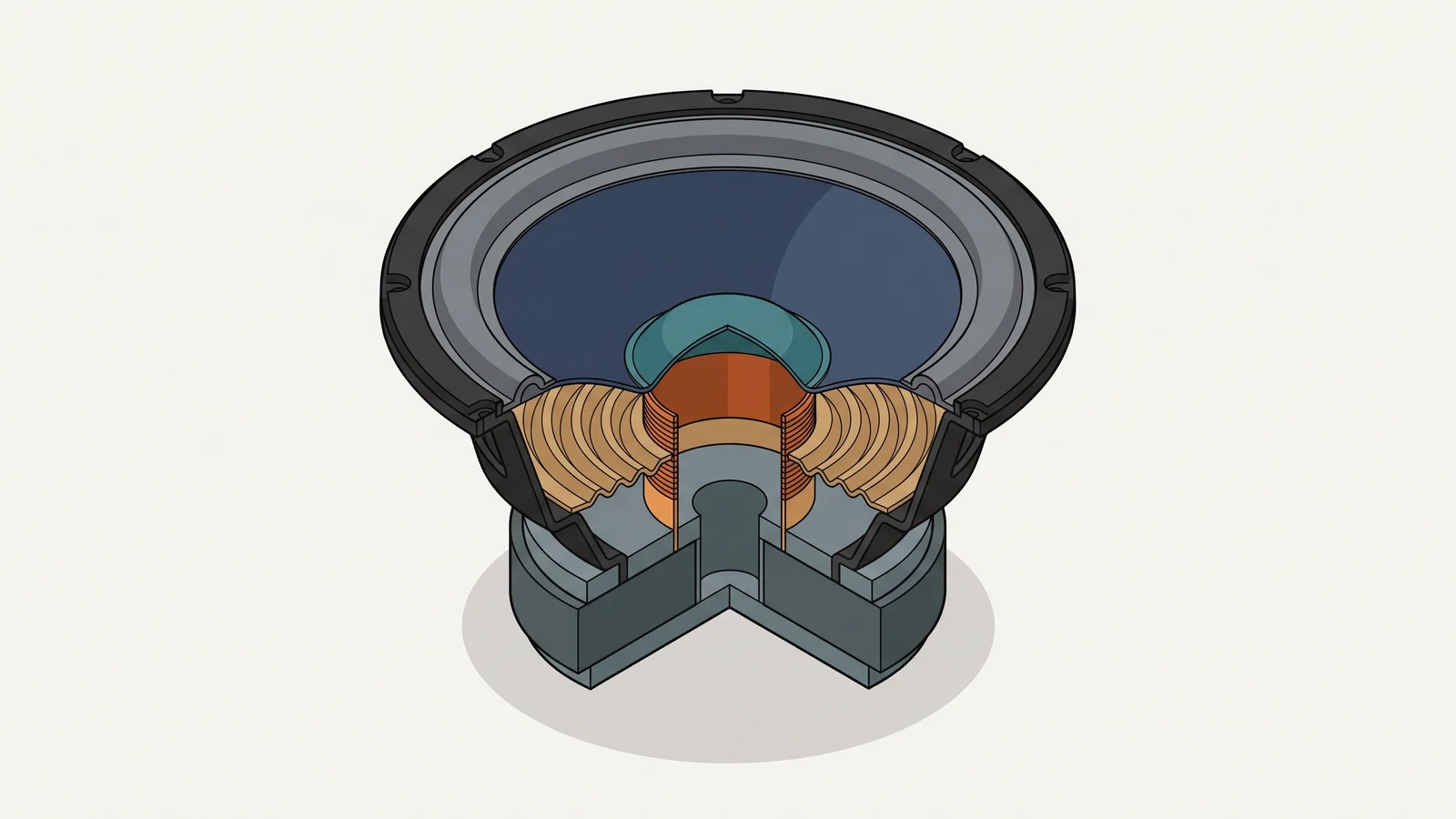
A moving-coil driver turns electricity into motion using a coil of wire hung in a magnet's gap. Feed audio current through that coil and it becomes an electromagnet, shoved back and forth by the permanent magnet around it. The coil drags a cone, the cone pistons, and air moves. The dynamic driver is by far the most common speaker on earth, per the IEEE's history of loudspeakers.
Here's the physics without the headache. Run current through a wire inside a magnetic field and the wire gets pushed sideways. That's the Lorentz force, the same trick that spins every electric motor. In a speaker, the "wire" is a coil wound on a tube called the former, and it sits in a narrow circular gap in a permanent magnet. Music is just a wiggling electrical signal, so the coil wiggles right along with it, in and out, thousands of times a second.
The motor: a coil in a magnet's gap
The coil is glued to the cone, so wherever the coil goes, the cone follows. Push the coil out, the cone pushes air toward you. Pull it back, the cone pulls air away. Do that fast enough and you've made sound. The magnet, the gap, and the coil together are what speaker people call the motor, and it's the whole ballgame. A stronger, tighter motor means better control over that cone.
The cone, the surround, and the spider
The cone can't just flop around loose, so two flexible parts hold it centered. The surround is the soft ring around the outer edge, the part that visibly flexes when a woofer pumps. The spider is a corrugated fabric ring hidden down near the coil. Together they act like a spring: they let the cone move freely in and out, but they yank it back to dead center the instant the music stops. I've replaced hundreds of dry-rotted surrounds, and I'll tell you, the surround always fails first.
The basket and the baffle
The basket is the metal or plastic frame that holds everything in alignment, magnet at the back, cone at the front, coil floating perfectly in the gap. Then there's the baffle, which is just the front panel or box the driver mounts to. It matters more than it looks. Without a baffle, the sound off the back of the cone wraps around and cancels the sound off the front, especially the bass. Engineers call that an acoustic short circuit, and killing it is half of why speaker cabinets exist.
The 1925 breakthrough: Rice, Kellogg, and General Electric
In 1925, two General Electric engineers in Schenectady, New York, Chester Rice and Edward Kellogg, published the design theory for the modern moving-coil loudspeaker. Their paper ran in the AIEE journal, Volume 44, pages 461 to 475, and carried the wonderfully blunt title "Notes on the Development of a New Type of Hornless Loud Speaker," as Mix magazine documents.
Now, here's the thing people get wrong. Rice and Kellogg didn't invent the coil, the cone, or the magnet. Those parts already existed in one form or another. What they invented was the recipe: the actual quantitative theory of how to size the cone's mass, the suspension, the magnet, and the baffle so the whole thing produced a broad, flat response across the midrange, as PS Audio recounts. That math is the difference between a noisemaker and a loudspeaker.
They nailed two things nobody had properly worked out before. First, they figured out that a light, coil-driven cone in a proper baffle, working in its mass-controlled range, gives you even output across a wide band. Second, they documented why the baffle matters, spelling out how it stops that front-to-back acoustic short circuit. Their 1925 unit even used a rubber surround, the same idea sitting on your woofers today. The US patent was filed on April 20, 1925, according to secondary accounts, and the paper was presented that September.
There's one more piece, and it's the practical genius. Rice and Kellogg understood their speaker was useless without enough clean power behind it, so they insisted the amplifier "should have sufficient capacity" to drive it properly, as COMSOL notes in its centennial history. Pairing a well-designed direct-radiator with a matched power amp is what made the design manufacturable at scale. That's not a lab curiosity. That's a product.
So who really invented the loudspeaker?
Nobody, and everybody. The honest answer is that the loudspeaker has no single inventor, only a lineage of people who each added a piece, as the IEEE's loudspeaker history lays out. Anyone who tells you one name did it all is selling something. Rice and Kellogg get credit for the modern design, but they were standing on roughly fifty years of other people's failures and half-wins.
Ernst Siemens and the idea on paper (1877)
The German inventor Ernst Werner Siemens sketched the moving-coil transducer concept first. His US patent 149,797 was granted in 1874, and a German patent filed on December 14, 1877, added a cone or horn diaphragm to the moving coil, per Wikipedia's loudspeaker history. He had the core idea. He just never used it to play music, because in the 1870s there was no way to amplify a signal enough to make it worth the trouble.
Oliver Lodge and the first experimental coil (1898)
The British physicist Oliver Lodge built the first recognizable experimental moving-coil driver. His British patent 9712, dated April 27, 1898, described a "bellowing telephone," and the surviving unit is held at the Science Museum in London, according to Lodge's record. Lodge basically described the modern driver, coil in a gap and all. He just didn't have the amplification or the market to turn it into anything you could own.
Jensen, Pridham, and Magnavox (the first practical one)
Then came the first practical moving-coil speaker. Peter Jensen and Edwin Pridham, working in Napa, California, between 1911 and 1919, built a driver that actually worked in public and branded it Magnavox, Latin for "great voice," as Magnavox's history records. Their first public demo was December 10, 1915, and in 1919 their system carried a speech to a San Diego crowd estimated at 50,000. But they leaned on horns and lacked Rice and Kellogg's flat-response direct-radiator theory. First practical, yes. Modern, not quite.
What was the first loudspeaker you could buy?
The first commercial loudspeaker built on the Rice-Kellogg design was the RCA Radiola Model 104, introduced in 1926. It sold for about $250, serious money then, and had a roughly one-watt amplifier built right into its base, as PS Audio and the Smithsonian both note. That "104" specificity traces back through Wikipedia, PS Audio, and the Smithsonian, so it's well anchored.
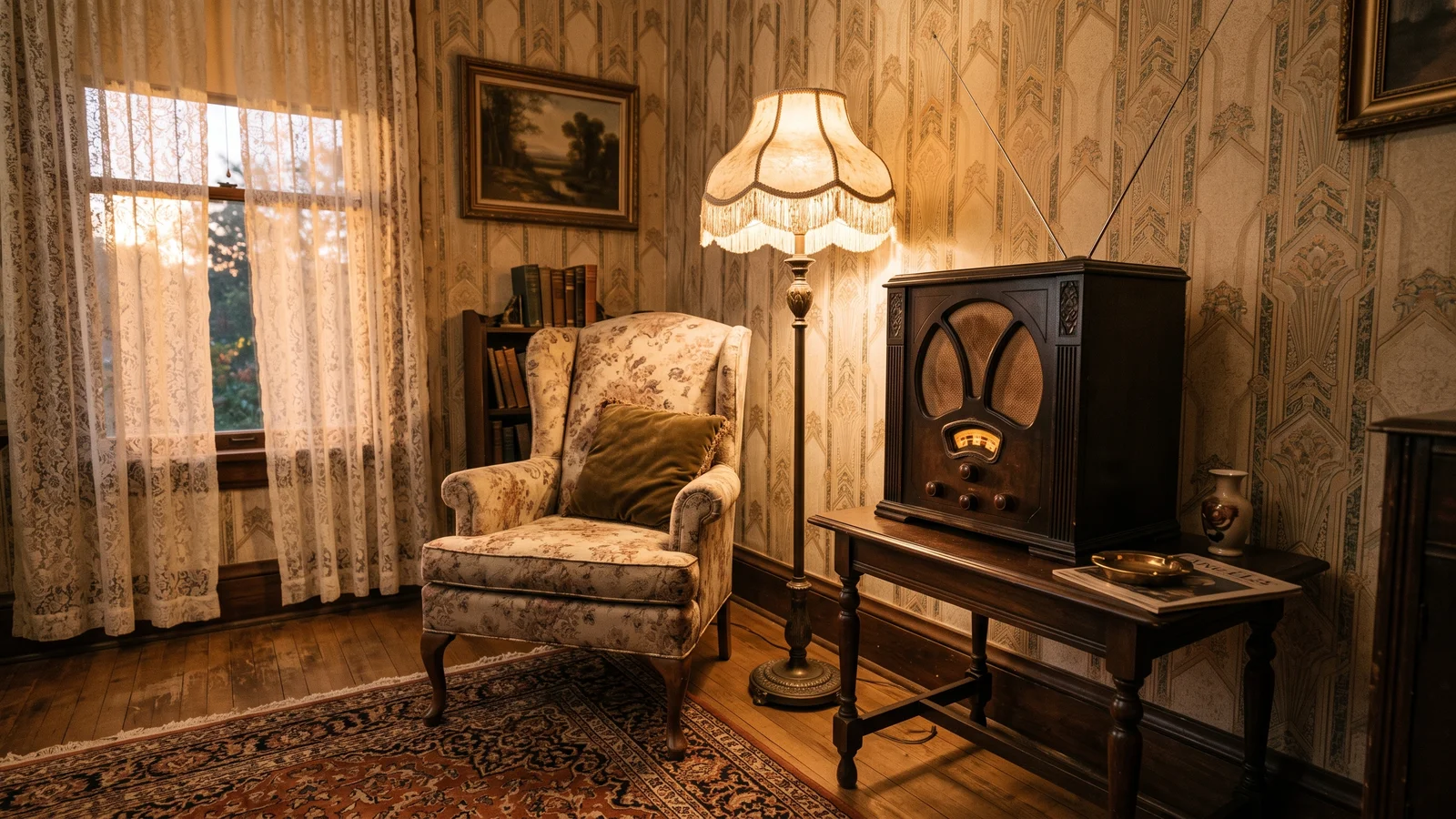
Keep the two dates straight, because the internet mashes them together constantly. The paper landed in 1925. The product landed in 1926. The Radiola 104 was designed to pair with the Radiola 28 receiver, and together they made one of the first radios you could plug straight into the wall instead of feeding with batteries. It went on to be the number-one loudspeaker on the market from 1926 into the early 1930s, per the IEEE's account. A hundred years later, its great-grandkids are still doing the same job.
Why is the moving-coil driver still everywhere?
Because it wins on the math that actually matters for real products: cost, efficiency, ruggedness, and bandwidth. A light moving mass gives you wide, flat response; the parts are cheap and tough; and it stays efficient at modest power. That combination is why the dynamic driver has outlasted every fancier rival for a full century, as COMSOL's centennial piece explains.
I love exotic speakers. I really do. But let's be honest about the tradeoffs. Electrostatic panels sound gorgeous and need a high-voltage bias supply, take up half a wall, and sip current for a living. Planar magnetics are heavy and inefficient. Horns go loud and clean but eat your room. Each one is brilliant at one thing and awkward everywhere else. The moving-coil driver is the honest generalist that's merely very good at all of it, which is exactly what a mass-produced product needs to be.
That's the quiet lesson of this whole story. The design that took over wasn't the most glamorous one. It was the one that balanced every constraint at once and could be built, by the millions, for a price people would pay. Rice and Kellogg didn't just invent a better speaker. They invented a speaker you could actually make and sell, and then they published the math so everyone else could too.
A century of upgrades to the same 1925 idea
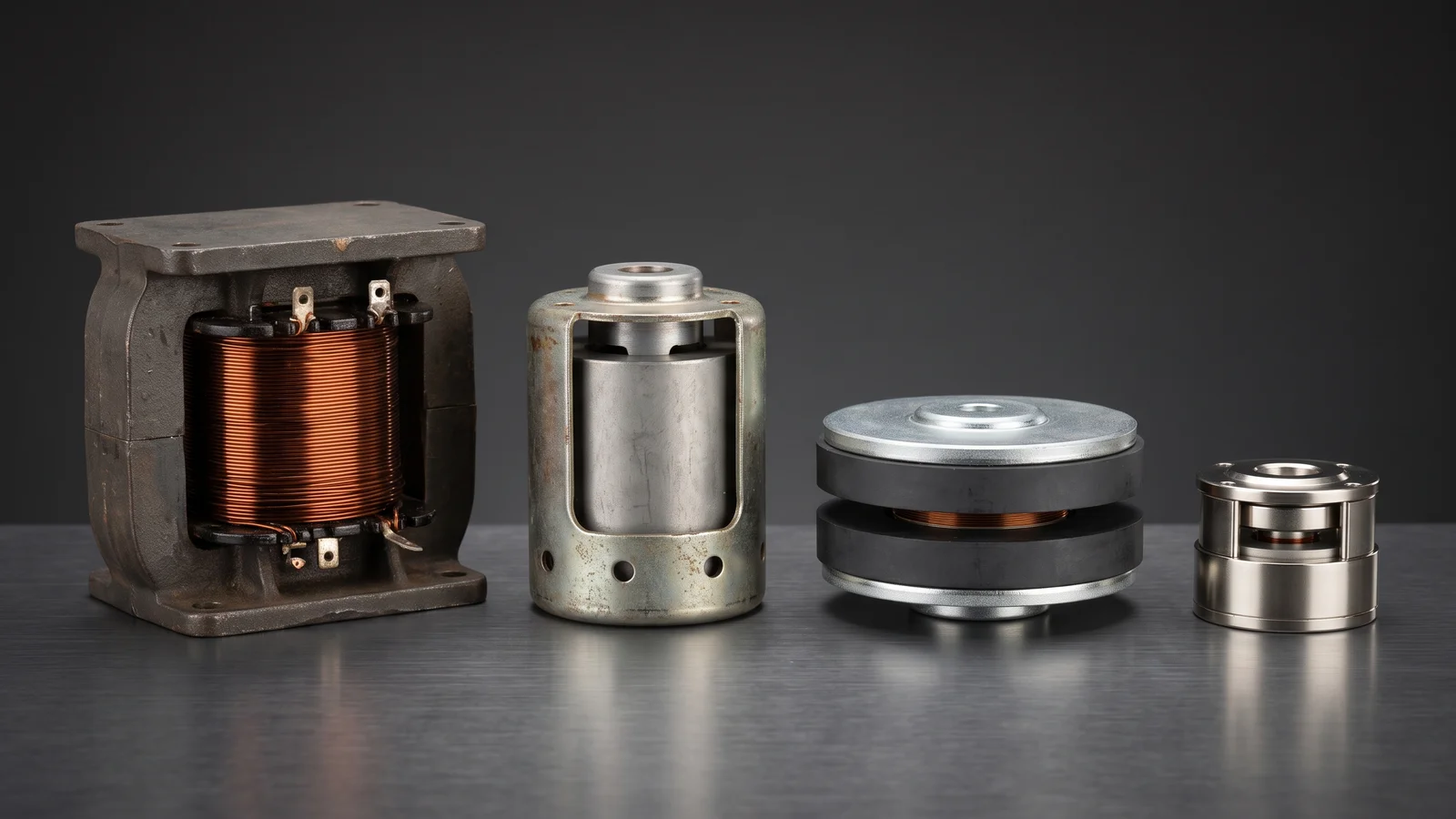
Plenty has been improved since 1925, and the biggest changes are in the magnet. Early drivers used a field-coil, an electromagnet you had to power. That gave way to Alnico alloy magnets in the 1930s and '40s, then to cheaper ferrite (ceramic) magnets in the late '60s and '70s when cobalt got expensive, and finally to neodymium around 1983, as audioXpress traces.
Neodymium was a genuine leap, and it has a fun origin. The neodymium-iron-boron magnet was developed independently and almost simultaneously by Sumitomo in Japan and General Motors in the United States, and one of its first audio uses was in an Electro-Voice compression driver, per audioXpress. Neodymium packs a huge magnetic punch into a tiny, light package, which is why the drivers in featherweight earbuds and pro line arrays can hit so hard.
Cones changed too. Treated paper ruled for decades and still sounds wonderful, but builders now also use polypropylene, aluminum and other metals, Kevlar, and carbon fiber, each tuned for a different balance of stiffness, weight, and damping. And in the 1970s, the Thiele/Small parameters gave us the equations to model a driver in a box before cutting a single panel, as the AES loudspeaker history describes. Today, tools like finite-element analysis and Klippel measurement let us see exactly how a cone flexes.
Now here's what hasn't changed one bit. A voice coil, hung in a magnet's gap, driving a cone, suspended by a surround and a spider, mounted in a baffle. That's the exact architecture Rice and Kellogg drew in 1925, and it's still the architecture in the driver on my bench right now, as Wikipedia's entry on Chester Rice confirms. Better magnets, better cones, better math. Same skeleton.
Which is a big part of why I still build the way I do. The drivers in our hand-built tower speakers are direct descendants of that 1925 Rice-Kellogg design, just with a century of better materials poured into them. The principle is settled; the craft is in the execution, in choosing the right motor, cone, and cabinet and matching them like Rice and Kellogg said to a hundred years ago.
Frequently Asked Questions
Who invented the loudspeaker?
No one person did. It's a lineage: Ernst Siemens sketched the moving-coil concept (patent 1874, cone diaphragm added 1877), Oliver Lodge built the first experimental coil (1898), Jensen and Pridham made the first practical one as Magnavox (around 1915), and Rice and Kellogg drew up the modern direct-radiator design in 1925, per the IEEE.
How does a speaker driver work?
Audio current runs through a coil of wire suspended in a permanent magnet's gap, turning the coil into an electromagnet that gets pushed and pulled by the Lorentz force. The coil is glued to a cone, so the cone moves back and forth and pushes air, making sound. A surround and spider keep it centered, as COMSOL explains.
What is a moving-coil (dynamic) driver?
A moving-coil driver, also called a dynamic driver, is the most common type of speaker. It uses a voice coil in a magnetic gap to drive a cone or dome. It's the design in earbuds, soundbars, car audio, and floor-standing towers, and it dates to Rice and Kellogg's 1925 work at General Electric, per Mix magazine.
What was the first commercial loudspeaker?
The RCA Radiola Model 104, introduced in 1926, was the first commercial loudspeaker built on the Rice-Kellogg design. It cost about $250 and included a roughly one-watt amplifier in its base, according to PS Audio and the Smithsonian. It was the top-selling loudspeaker from 1926 into the early 1930s.
Why are most speakers still dynamic?
Because the moving-coil driver beats every rival on the combination that matters for real products: cost, efficiency, ruggedness, and broad frequency range. Electrostatic, planar, and horn designs each excel at one thing but stumble elsewhere, as COMSOL notes. The dynamic driver is the well-rounded generalist that can be mass-produced affordably.
What has changed since 1925?
Mostly the materials. Magnets went from field-coil to Alnico to ferrite to neodymium (around 1983), cones went from paper to polypropylene, metal, Kevlar, and carbon, and Thiele/Small parameters plus modeling software made design far more precise, per audioXpress. The basic architecture, though, is unchanged.
Sources
- IEEE Engineering & Technology History Wiki — "Loudspeakers": https://ethw.org/Loudspeakers
- Wikipedia — "Loudspeaker": https://en.wikipedia.org/wiki/Loudspeaker
- Wikipedia — "Chester Williams Rice": https://en.wikipedia.org/wiki/Chester_Williams_Rice
- Wikipedia — "Edward W. Kellogg": https://en.wikipedia.org/wiki/Edward_W._Kellogg
- Mix — "1925: Chester Rice, Edward Kellogg (General Electric Co.) - Modern Dynamic Loudspeaker": https://www.mixonline.com/technology/1925-chester-rice-edward-kellogg-general-electric-co-modern-dynamic-loudspeaker-377962
- AES — "The History of Loudspeakers": https://web.archive.org/web/20260415201347/https://www.aes-media.org/historical/html/recording.technology.history/loudspeaker.html
- PS Audio — "Sound Waves and the Roaring Twenties: The Legacies of Edward W. Kellogg and Chester Williams Rice": https://www.psaudio.com/blogs/copper/sound-waves-and-the-roaring-twenties-the-legacies-of-edward-w-kellogg-and-chester-williams-rice
- COMSOL — "The Loudspeaker Celebrates 100 Years of Use and Influence": https://www.comsol.com/blogs/the-loudspeaker-celebrates-100-years-of-use-and-influence/
- Wikipedia — "Oliver Lodge": https://en.wikipedia.org/wiki/Oliver_Lodge
- Smithsonian National Museum of American History — RCA Radiola loudspeaker: https://americanhistory.si.edu/collections/object/nmah_711666
- audioXpress — "Neodymium: The Perfect Storm, Part 1 - The Neodymium Supply Chain": https://audioxpress.com/article/neodymium-the-perfect-storm-part-1-the-neodymium-supply-chain
- Wikipedia — "Magnavox": https://en.wikipedia.org/wiki/Magnavox
Mike Vincent is the founder of Mike Knows Audio Video and WubWub Audio, where he designs and hand-builds custom loudspeakers and home theaters in Arizona, the old way, for about fifteen clients a year. He's rebuilt enough vintage drivers to have a real soft spot for Rice and Kellogg; if you want speakers built on that century-old principle with modern materials, take a look at our custom tower speakers.
Comments
Leave a Comment