The Horn and the Compression Driver: How Movie Sound Got Loud
By Mike Vincent • September 21, 2026
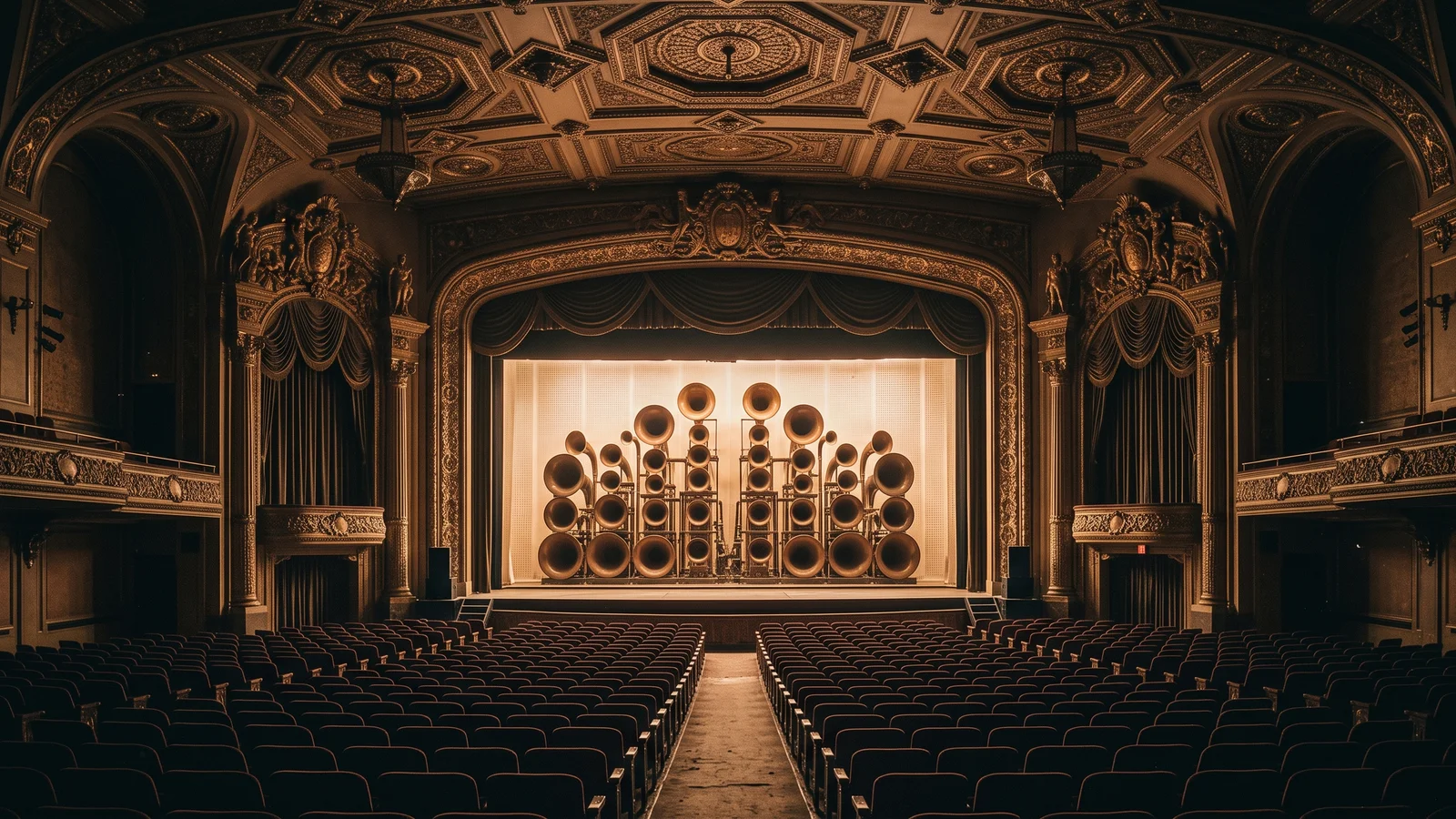
Before big amplifiers existed, the horn made movie sound loud. The story of the compression driver, the Voice of the Theatre, and the Klipschorn.
Here's a problem the movies had to solve in about 1926. You've got a theater with a thousand seats, a talking picture on the screen, and an amplifier that puts out maybe a handful of watts. That's it. A few watts, total, to fill a room the size of a church. Modern gear laughs at that number. Back then it was everything they had.
So the speaker couldn't afford to waste a single one. Efficiency wasn't a nice-to-have. It was the whole ballgame. The answer they landed on, the horn and the compression driver, is a piece of engineering so good that eighty-plus years later it's still bolted behind cinema screens and stacked on concert stages. I've had a few of these old drivers on the bench, and they're beautiful. Let me show you why they mattered.
Key Takeaways
A bare speaker cone turns under 1% of the power fed to it into actual sound; a horn-loaded driver can hit roughly 10 to 50%, about ten times the output, or +10 dB, for the same watts (Wikipedia: Horn loudspeaker).
The compression driver was developed at Bell Labs in the mid-1920s and defined by the 1928 Wente-Thuras paper, with the phase plug as its key innovation.
The Western Electric No. 555 (patent filed August 4, 1926) was the first commercial compression driver, and it carried the sound of early Vitaphone films.
MGM's Shearer Horn won the Academy's Scientific and Technical Award in 1936; it led straight to Altec Lansing's Voice of the Theatre line (1945, with the iconic A7 in 1947).
Paul Klipsch's corner-folded Klipschorn (1946) brought horn efficiency home, rated at 105 dB sensitivity by Klipsch, and THX (1983) capped the era by standardizing how it all should sound.
Once the gold standard of cinema horns, Altec Lansing slid from 1969 mergers to a 1974 bankruptcy, and by the 1990s the name lived on mostly as a badge on budget computer speakers (Wikipedia: Altec Lansing).
Why did early movie speakers have to be so efficient?
Efficiency was survival. A typical direct-radiator cone converts less than 1% of the electrical power it's fed into sound, because air is a lousy load for a stiff cone to push (Wikipedia: Horn loudspeaker). With cinema amplifiers rated in single-digit watts, that loss was fatal. You simply could not fill a room that way.
Think about the math for a second. A modern receiver might hand a speaker a hundred clean watts without breaking a sweat. The engineers of 1926 had maybe three or four. So the pressure fell entirely on the speaker: it had to squeeze a usable roar out of almost nothing. That single constraint, watts are precious, shaped the next twenty years of loudspeaker design. It's the reason the horn won.
Citation capsule: A direct-radiating cone converts less than 1% of its input power into sound because air presents such low acoustic impedance, per the Wikipedia entry on horn loudspeakers. With 1920s cinema amplifiers rated at only a few watts, that inefficiency made high-efficiency horn loading a practical necessity, not a luxury.
How horn loading works: diaphragm, phase plug, and flaring horn
How does horn loading actually work?
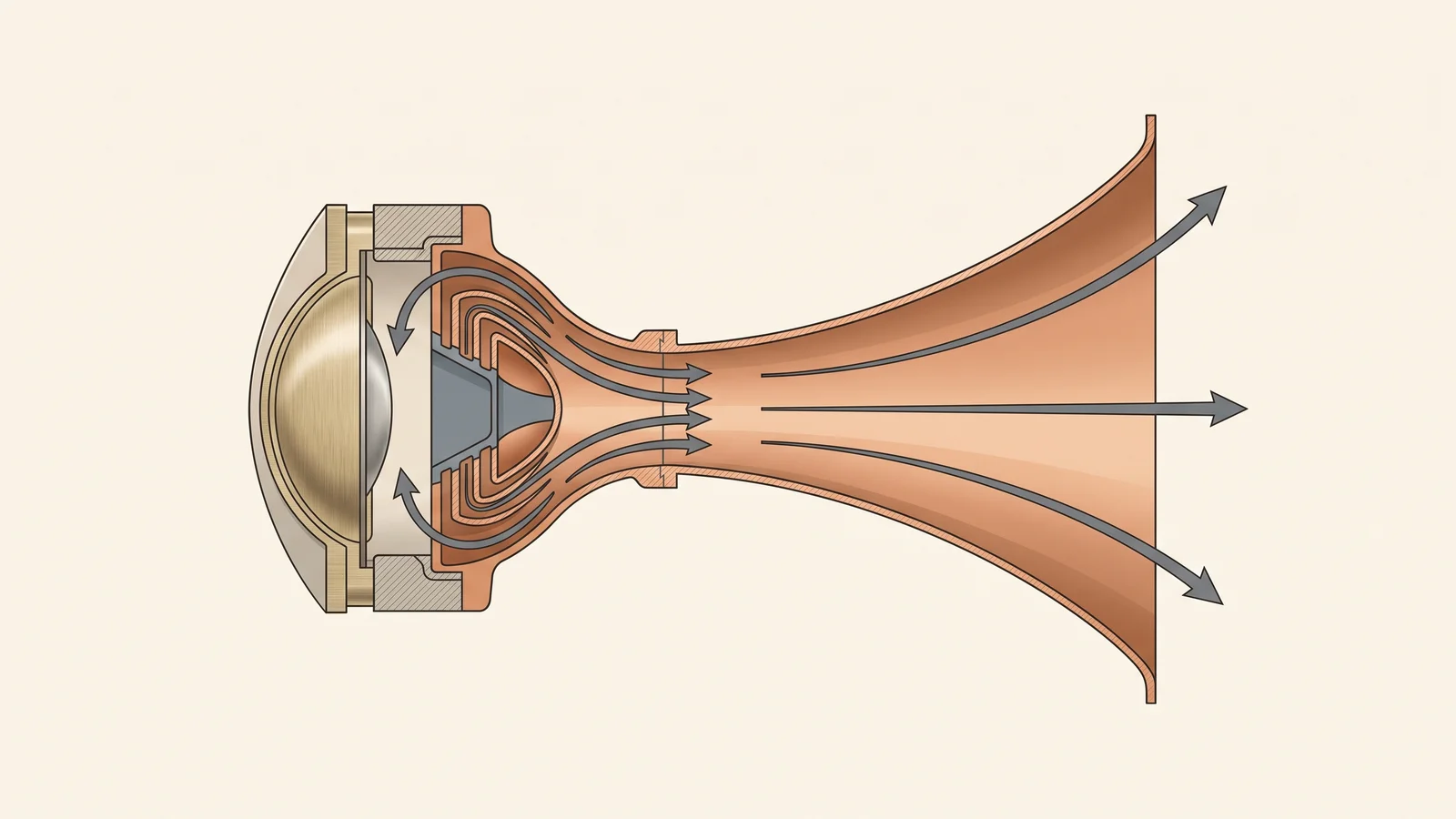
A horn is an acoustic impedance transformer, which is a fancy way of saying it's a very clever megaphone. It matches the driver to the air, and that match is what lifts efficiency from under 1% for a bare cone up toward 10 to 50% for a horn-loaded moving-coil driver, roughly ten times the output for the same watts (HandWiki: Compression driver).
Here's the plain-English version. Air is thin. A cone waving at open air is like trying to push a car by slapping it, lots of motion, almost no work done. A horn fixes the mismatch. The narrow end, the throat, lets the diaphragm build real pressure while barely moving. The flaring mouth then steps that pressure down gradually to meet open air, the way gears match an engine to the road.
Match the driver to the air well, and you get roughly +10 dB more output for free. That matters more than it sounds. Every +3 dB is like doubling your amplifier power (Benchmark Media). So a +10 dB jump is like turning three watts into thirty, without touching the amp. That's the trick that made talking pictures possible.
Who invented the compression driver?
The compression driver was developed at Bell Labs in the mid-1920s and defined by the landmark 1928 paper "A High-Efficiency Receiver for a Horn-Type Loud Speaker," published by Edward C. Wente and Albert L. Thuras in the Bell System Technical Journal (Wente & Thuras, BSTJ, Jan 1928). Their key innovation was the phase plug, and it changed everything about how horns sounded.
A compression driver flips the usual layout. Instead of a diaphragm smaller than what it feeds, it uses a diaphragm larger than the horn throat in front of it. That size mismatch literally compresses the air into a small chamber, which is where the pressure comes from. The catch: sound from different parts of a big diaphragm arrives at the tiny throat slightly out of step, and cancels. Wente and Thuras solved that with the phase plug, a plug carved with channels that route every part of the wave to the throat in phase (SVC Online: E.C. Wente).
Citation capsule: The compression driver was developed at Bell Labs in the mid-1920s and defined by the 1928 Bell System Technical Journal paper of Edward C. Wente and Albert L. Thuras. Its defining feature is the phase plug, a channeled component that keeps sound from a large diaphragm in phase as it funnels into a small horn throat.
The idea was in the air first. William Hanna and Joseph Slepian floated the compression-driver concept in 1924; Bell Labs is the team that actually executed it (Wikipedia: Compression driver). The first commercial unit was the Western Electric No. 555, its patent filed August 4, 1926, built around a diaphragm of about two-thousandths of an inch of aluminum (Mix: Western Electric 555). If you saw Don Juan in 1926 or The Jazz Singer in 1927 on Vitaphone, the 555 is what you heard (Mix: Vitaphone).
How did the horn conquer the movie theater?
The horn didn't stay a Western Electric secret for long. Over the next thirty years it passed through a short list of legendary names, each one making it louder, cleaner, and eventually small enough to bring home. The lineage runs Western Electric, then MGM's Shearer Horn, then Altec Lansing, then Paul Klipsch, then JBL, then THX. It's basically the family tree of cinema sound.
The Shearer Horn and an Academy award
The next leap came from Hollywood itself. Around 1933, Douglas Shearer of MGM's sound department pushed a project to build a proper theater speaker, and he assembled a murderers' row to do it: John Hilliard, Robert Stephens, John Blackburn, and James B. Lansing (Wikipedia: Douglas Shearer). Lansing's own company, Lansing Manufacturing, built the 285 compression driver and the 15XS bass driver at the heart of it.
The result was the Shearer Horn, a two-way system pairing multicellular high-frequency horns with a big W-shaped bass horn loaded by fifteen-inch woofers. It worked so well it earned the Academy's Scientific and Technical Award in 1936, and Hilliard laid out the whole design in a 1936 paper (Hilliard, 1936). For the record, that's an engineering honor, not a competitive Oscar. Still, a speaker winning hardware from the Academy tells you how good it was.
The Voice of the Theatre
Then the business shuffled. In 1941, Altec Service Corporation bought the near-bankrupt Lansing Manufacturing and formed Altec Lansing (Wikipedia: Altec Lansing). Four years later the company launched the Voice of the Theatre line in 1945, designed by Hilliard working with Lansing, with the iconic A7 arriving in 1947 (audioXpress).
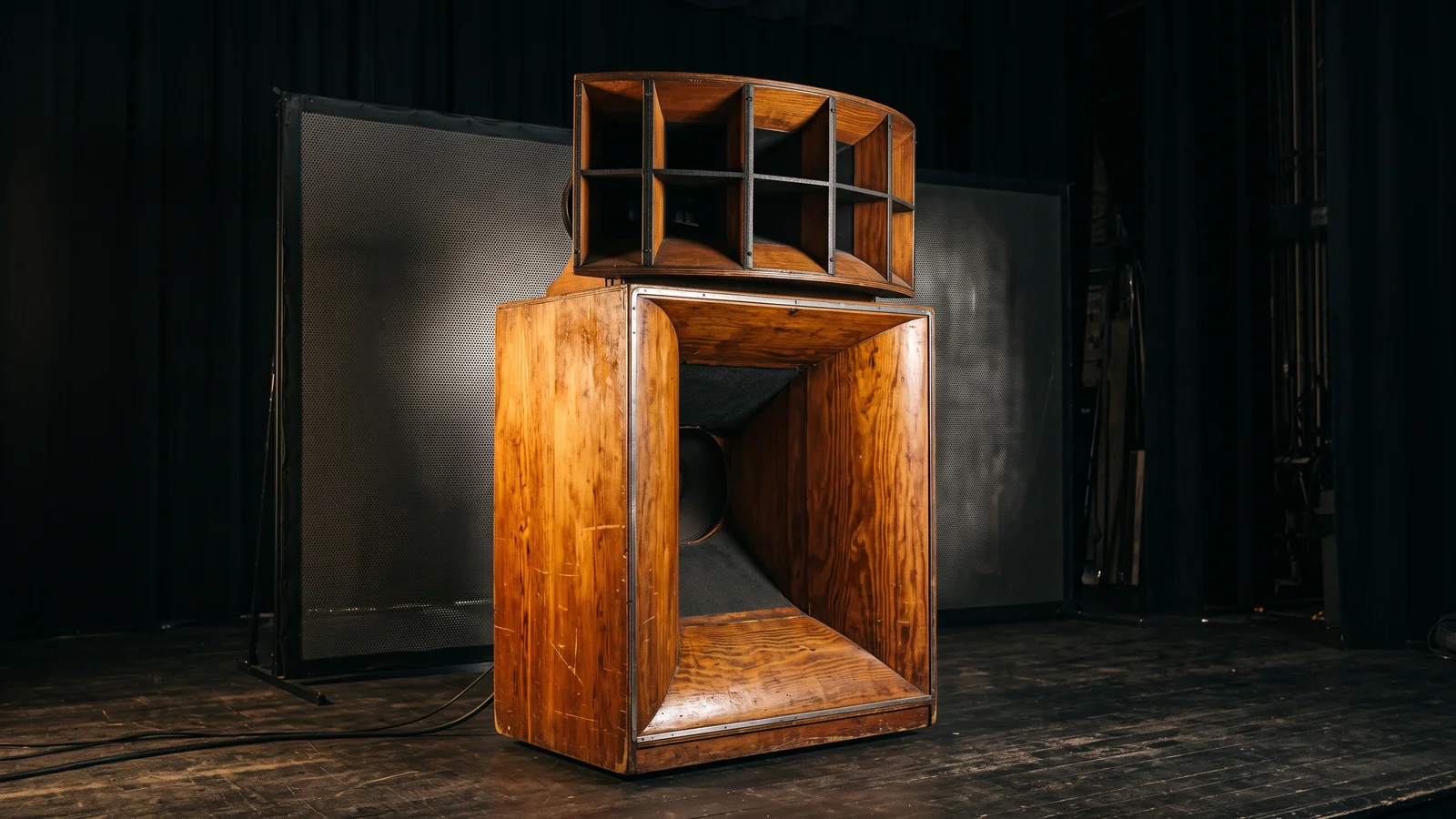
A vintage folded cinema horn, the Voice of the Theatre era
The Voice of the Theatre became the de facto cinema standard for decades. If you sat in a movie house from the late 1940s into the 1970s, odds are good a Voice of the Theatre was pointed at you. I've heard restored A7s, and there's a reason people still chase them. Big horn, big sound, and efficient enough to run on a whisper of power.
Klipsch brings the horn home
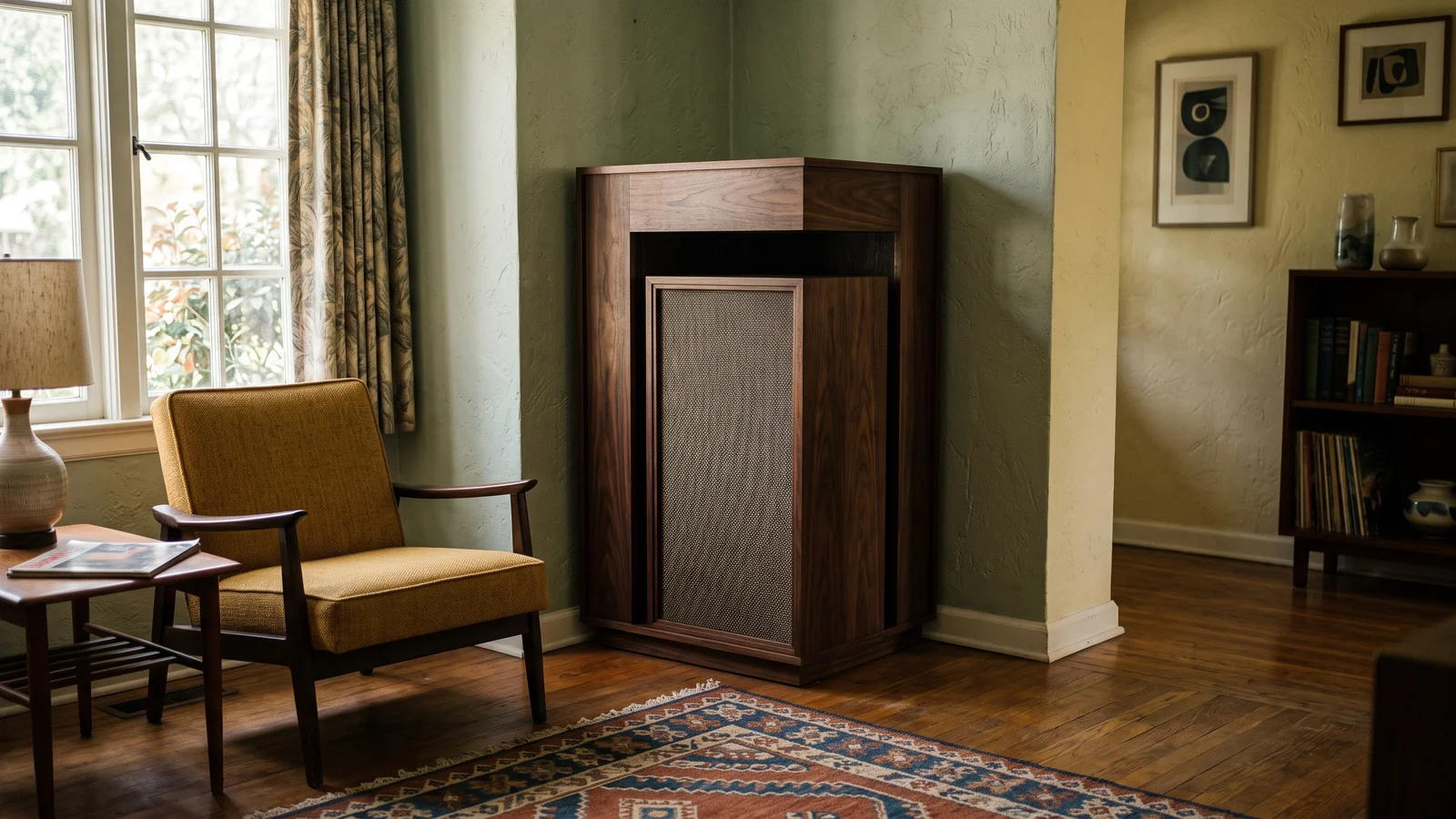
While the theater guys went big, one stubborn engineer went domestic. Paul W. Klipsch (1904-2002) refined a corner-loaded folded horn during World War II at the Southwest Proving Ground in Hope, Arkansas, patented it in 1945, and started Klipsch & Associates in 1946 (Wikipedia: Paul Wilbur Klipsch). The Klipschorn used the room's own corner as part of the horn, which is how he got theater-grade efficiency out of a cabinet you could live with.
Klipsch rates the Klipschorn at 105 dB sensitivity (2.83V/1m), and independent measurements can land a bit differently than a factory spec (Klipsch: Klipschorn). Either way, it's wildly efficient by modern standards, and it's still in production, one of the longest continuous runs of any loudspeaker ever built. That's the moment horn loading stopped being a cinema-only trick and moved into the living room.
JBL and THX close out the era
James B. Lansing wasn't done. After leaving Altec he founded JBL in 1946, and though he died in 1949, the company carried on under Bill Thomas with engineers like Bart Locanthi (audioheritage: JBL Beginnings). In 1954 JBL shipped the 375, the first commercial four-inch-diaphragm high-frequency compression driver, flat out to around 9 kHz. That driver, per JBL's own history, put the company into the theater business, and JBL cinema eventually dominated it.
The bookend came in 1983. Tomlinson Holman, working at Lucasfilm, founded THX to make sure films sounded in the theater the way they sounded in the mixing room, timed to the release of Return of the Jedi (Wikipedia: THX). The name stands for "Tomlinson Holman's eXperiment," with a nod to Lucas's film THX 1138. If the compression driver made cinema loud, THX made it consistent. That's the standards-era capstone.
Are horn speakers actually better?
That depends entirely on who you ask, and audiophiles have been arguing about it for seventy years. Horns win decisively on two things nobody disputes: efficiency and pattern control. A horn can hit 100-plus dB where a typical modern speaker sits around 85 to 95 dB (Benchmark Media), and its flare aims sound where you want it instead of spraying the room.
The knock is tone. Critics in the long-running audiophile debate argue that horns can add a coloration, sometimes described as a "cupped-hands" or honky character, and that big horns can beam at high frequencies. Defenders counter that a well-designed modern horn is clean and lifelike, and that the dynamic ease is worth it. Both camps have a point. What's not up for debate is physics: a true full-range bass horn has to be enormous, which is exactly why Klipsch had to fold his into a corner. Horns persist in pro sound, cinema, and high-efficiency home speakers because when you need lots of clean output from modest power, nothing else comes close.
What happened to Altec Lansing?
This is the sad part, and it's a pattern you'll see over and over in this series. Altec Lansing, the company that made the gold-standard cinema horn, got swallowed by the spreadsheet. A run of mergers starting in 1969 led to a Chapter 11 bankruptcy in 1974, and by the 1990s the once-legendary name survived mostly as a badge slapped on budget computer speakers (Wikipedia: Altec Lansing).
There's a word for taking a great name and hollowing it out until it's a logo on cheap plastic: enshittification. The Voice of the Theatre earned its reputation one hand-assembled horn at a time, then decades of ownership churn spent that reputation down to a sticker. I find that genuinely sad, because efficiency and craftsmanship aren't nostalgia to me. They're a living philosophy. In our Arizona workshop we still hand-build high-sensitivity on-wall and tower speakers meant to last, driven by the same idea Wente and Klipsch chased: get the most honest sound out of every watt, and build the thing to outlive its owner.
Frequently Asked Questions
What is a compression driver?
A compression driver is a high-efficiency speaker designed to feed a horn. It uses a diaphragm larger than the horn throat in front of it, so the air gets "compressed" into a small chamber, and a phase plug channels the sound to the throat in phase (Wikipedia: Compression driver). That design produces far more output per watt than an ordinary cone.
How does horn loading work, and why are horns so efficient?
A horn acts as an acoustic impedance transformer, like a megaphone. The narrow throat lets the diaphragm build real pressure with tiny motion, and the flaring mouth steps that pressure down to match open air. That match lifts efficiency from under 1% for a bare cone to roughly 10 to 50%, about +10 dB more output for the same power (HandWiki).
A corner-loaded folded-horn speaker in a 1950s living room
Who invented the compression driver?
The compression driver was developed at Bell Labs in the mid-1920s and defined by the 1928 Bell System Technical Journal paper of Edward C. Wente and Albert L. Thuras, whose key innovation was the phase plug (Wente & Thuras, 1928). William Hanna and Joseph Slepian floated the concept in 1924; Bell Labs executed it, and the Western Electric 555 was the first commercial unit.
What was the Voice of the Theatre?
The Voice of the Theatre was a line of large horn loudspeakers launched by Altec Lansing in 1945, designed by John Hilliard with James B. Lansing, with the famous A7 model arriving in 1947 (audioXpress). It became the de facto standard cinema speaker for decades and is still prized by vintage-audio collectors today.
Are horn speakers better than regular speakers?
It's a long-running audiophile debate. Horns clearly win on efficiency and pattern control, often topping 100 dB versus 85 to 95 dB for typical speakers (Benchmark Media). Critics argue horns can add a "cupped-hands" coloration and can beam; defenders say a good modern horn sounds clean and effortless. There's no single right answer, only trade-offs.
What is the Klipschorn?
The Klipschorn is a corner-loaded folded-horn loudspeaker that Paul Klipsch patented in 1945 and put into production in 1946 (Klipsch). By using the room's corner as part of the horn, it delivers theater-grade efficiency, rated by Klipsch at 105 dB, in a home-sized cabinet. It's one of the longest continuously produced speakers in history.
Sources
Edward C. Wente & Albert L. Thuras, "A High-Efficiency Receiver for a Horn-Type Loud Speaker of Large Power Capacity," Bell System Technical Journal, Vol. 7 No. 1 (Jan 1928): https://archive.org/details/bstj7-1-140
Wikipedia — "Compression driver": https://en.wikipedia.org/wiki/Compression_driver
Wikipedia — "Horn loudspeaker": https://en.wikipedia.org/wiki/Horn_loudspeaker
Mix — "1926 Western Electric 555-W, First Compression Driver": https://www.mixonline.com/technology/1926-western-electric-555-w-first-compression-driver-383720
Mix — "1926 Western Electric/Bell Labs Vitaphone Film Sound": https://www.mixonline.com/technology/1926-western-electricbell-labs-vitaphone-film-sound-383582
John Hilliard — "A Study of Theater Loud Speakers and the Resultant Development of the Shearer Two-Way Horn System" (1936, PDF): http://www.nutshellhifi.com/library/Hilliard_1936_Shearer_Theater.pdf
Wikipedia — "Douglas Shearer": https://en.wikipedia.org/wiki/Douglas_Shearer
Wikipedia — "Academy Scientific and Technical Award": https://en.wikipedia.org/wiki/Academy_Scientific_and_Technical_Award
Wikipedia — "Altec Lansing": https://en.wikipedia.org/wiki/Altec_Lansing
audioXpress — "Altec Lansing's Voice of the Theatre Speakers: What You Need to Know": https://audioxpress.com/article/altec-lansing-s-voice-of-the-theatre-speakers-what-you-need-to-know
Wikipedia — "Paul Wilbur Klipsch": https://en.wikipedia.org/wiki/Paul_Wilbur_Klipsch
Audio Heritage — "JBL Professional Beginnings": https://www.audioheritage.org/html/history/jbl-pro/beginnings.htm
Wikipedia — "THX": https://en.wikipedia.org/wiki/THX
Benchmark Media Systems — "Speaker Efficiency and Amplifier Power": https://benchmarkmedia.com/blogs/application_notes/speaker-efficiency-and-amplifier-power
Mike Vincent is the founder of Mike Knows Audio Video and WubWub Audio, where he designs and hand-builds custom loudspeakers and home theaters in Arizona, the old way, for about fifteen clients a year. He has a soft spot for anything that wrings honest volume out of a small amplifier; if you want high-sensitivity speakers built to last instead of built to a price, start with our custom loudspeakers.
Stay Updated
Get notified when we publish new articles about home theater and custom speakers.

Comments
Leave a Comment