
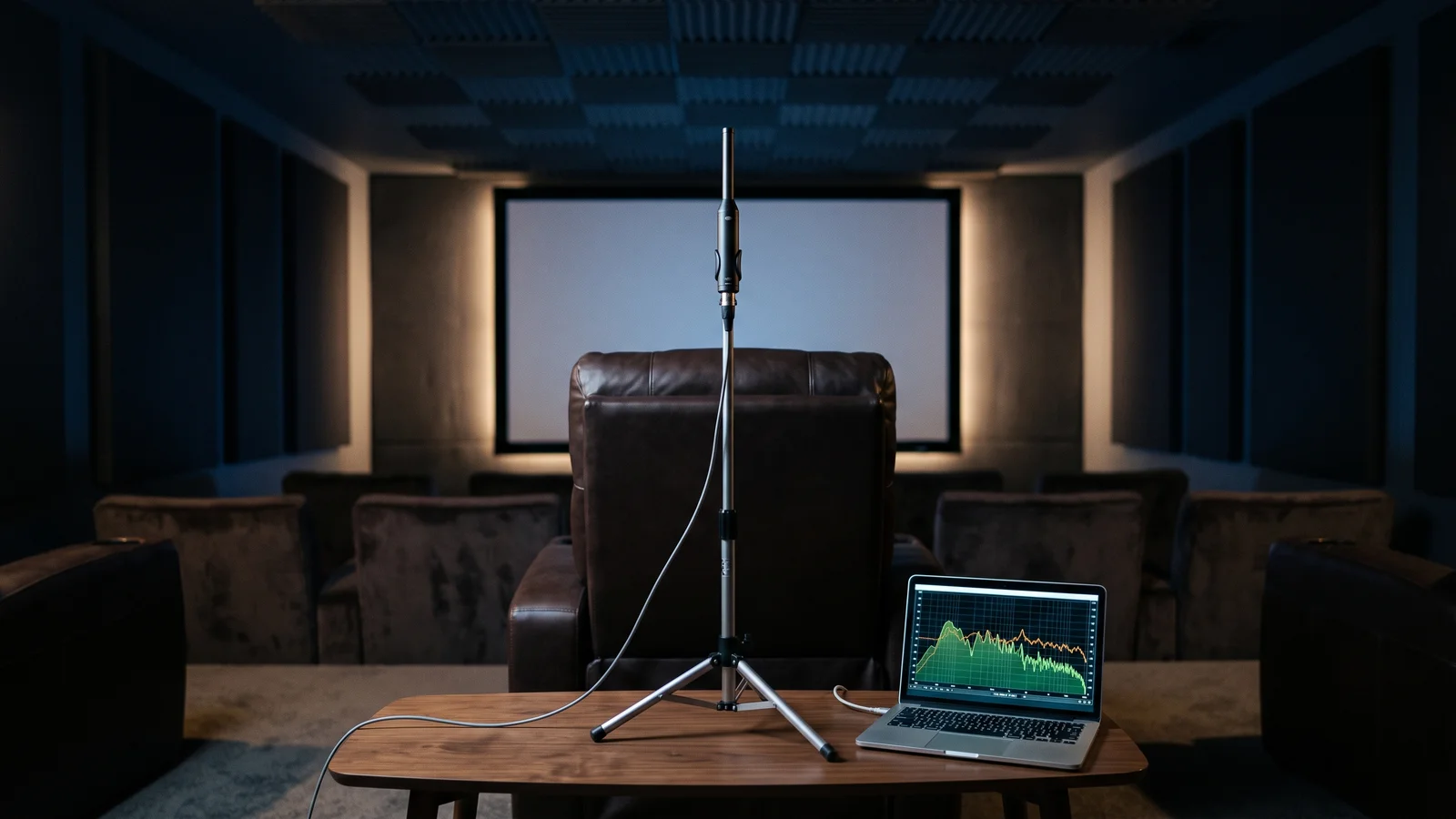
Audyssey, Dirac, Trinnov, Anthem ARC: what a calibration mic and a pile of math can actually fix in your room, and the three things it can't.
Here's a truth that stings a little when you've spent real money on speakers: the room you put them in matters more than the speakers themselves. You can buy a perfect loudspeaker, drop it in a bad room, and hear a mess. The four walls, the floor, the ceiling, and the couch do most of the damage, especially in the bass.
For decades the only fix was moving furniture and hanging heavy stuff on the walls. Then, sometime in the early 2000s, the computer showed up with a microphone and offered to tune your system for you. That's room correction, and I run it on nearly every job I calibrate. It's a genuinely useful tool. It's also wildly oversold. Let's get into what it really does.
Key Takeaways
- The room, not the speaker, dominates what you hear below roughly 200 Hz, where standing waves create big peaks and deep dips.
- Room correction measures your room with a mic, then builds digital filters that reshape the signal before it reaches the amp.
- DSP works well on bass peaks because low-frequency room resonances are minimum-phase, so fixing the level also fixes the timing.
- It cannot fix deep nulls, reflections above the transition frequency, or bad speaker placement. A measured 6 dB dip can actually be a 17 dB narrow null, per Room EQ Wizard.
- Audyssey (founded 2002), Dirac (2001), Trinnov (2003), and Anthem ARC (2008) all built on the same science Floyd Toole helped establish.
- Auto-correction is a finishing tool, not a substitute for placement, bass traps, and a trained ear.
Why does the room matter more than the speaker?
Below roughly 100 to 250 Hz, your room stops being a neutral box and becomes an instrument of its own, according to acoustics research summarized by GIK Acoustics and PS Audio. Sound waves bounce between parallel surfaces and reinforce or cancel each other. The result is room modes: bass notes that boom in one spot and vanish in another.
Those modes create standing waves. At certain frequencies the wall traps a pressure peak while the middle of the room sits in a null, a spot where two waves cancel and the bass just disappears. This is why the "my subwoofer sounds great on one song and gone on the next" complaint is almost never the subwoofer. It's the room deciding which notes live and which die based on where you're sitting.
Boundary reinforcement piles on. Push a speaker into a corner and the nearby walls add gain to the low end, sometimes 6 dB or more. Above the transition frequency, often called the Schroeder frequency, the behavior flips: instead of a few big resonances, you get a dense field of reflections your ear treats differently. That crossover point, roughly 100 to 250 Hz in a small room, is the single most important number in this whole conversation.
How does room correction actually work?
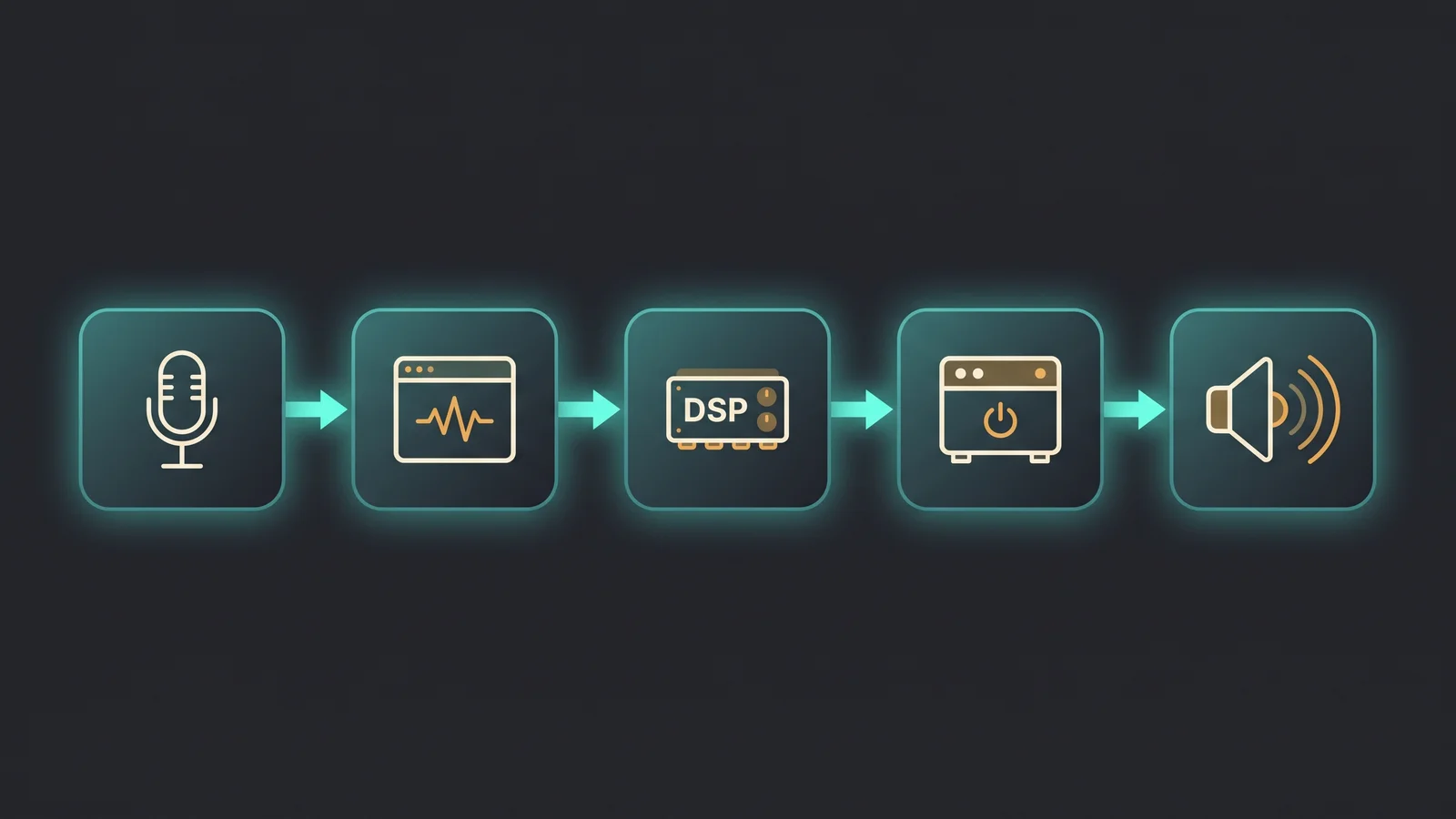
Room correction is a four-step loop: measure, analyze, filter, play. A calibration microphone captures the speaker's actual output at your seat, software compares that measured curve to a target curve, and the system builds digital filters that pre-shape the signal so the room's damage partly cancels out, as Wikipedia's overview of digital room correction lays out. The corrected signal then hits your amp and speakers.
The mic is the whole game. Garbage in, garbage out. On real jobs I take measurements at multiple seats, not just one, because a single sweet-spot reading tells you almost nothing about what the rest of the couch hears. Good systems average several positions on purpose.
Then the math goes to work. The software calculates the difference between what it measured and what it wants, then generates equalization filters, delay for each channel, and level trims. Modern processors run all of this in real time as the movie plays. It's clever engineering, and when it's aimed at the right problem, the improvement is obvious and immediate.
What can room correction actually fix?
Room correction is genuinely powerful in the bass, and here's the reason: low-frequency room resonances are minimum-phase, meaning the amplitude problem and the timing problem are locked together, as detailed in Floyd Toole's Sound Reproduction. Fix the level of a bass peak with EQ and you fix its ringing at the same time. That's why EQ works so well on room modes.
So what's on the "can fix" side? Modal peaks below the transition frequency, the biggest offenders in most rooms, respond beautifully to a well-placed cut. Look at the chart: a nasty 30 Hz peak sitting at +9 dB drops to about +2 dB, and a 60 Hz bump goes from +8 to +1. The DSP tames the resonance without adding energy that fights the room.
Correction also handles the housekeeping most people get wrong by hand. It sets each speaker's distance and delay so the sound arrives at your seat time-aligned, and it matches channel levels so the center isn't buried under the surrounds. Honestly, the timing and level automation alone justifies running it, even if you turned off every EQ filter afterward. That part is nearly foolproof, and it's tedious to nail by ear.
What can room correction NOT fix?
Here's where the marketing quietly stops talking. Room correction cannot fill a deep null, because a null is cancellation, not a shortage of energy, as Room EQ Wizard's guide to EQ spells out. Boost a cancellation and you just pour more energy into the exact waves that are cancelling, burning amplifier headroom for nothing. Worse, a dip that measures 6 dB with a slow sweep is often a razor-thin 17 dB null hiding underneath.
The second thing it can't fix well is everything above the transition frequency. Up there you're dealing with reflections and a dense modal field, and EQ that flattens the direct sound often wrecks the reflected sound your ear also hears, a problem laid out plainly in audioXpress's "Trouble with the Curve." The cure for reflections isn't math. It's absorption and diffusion.
Third, and this one bites people: correction is position-dependent. A filter that flattens the response at your chair can dig a fresh hole one meter away, because the room's peaks and nulls shift as you move. You can't EQ your way out of a speaker in the wrong spot. Move the speaker, move the seat, add bass traps. Then let the DSP handle what's left.

Who built room correction? Audyssey, Dirac, Trinnov, and Anthem ARC
Automated room correction went mainstream in the 2000s, riding the same home theater boom that put surround receivers in living rooms, led by four names that still dominate the category today. Audyssey, founded in 2002 as a spin-off from the University of Southern California's Integrated Media Systems Center, shipped what Wikipedia and Sound & Vision describe as the first automated multi-position room compensation, landing in AV receivers around 2004. Its founders included Chris Kyriakakis, Tomlinson Holman, Sunil Bharitkar, and Philip Hilmes.
Dirac Research came slightly earlier, founded in 2001 as an Uppsala University spin-off in Sweden. Its differentiator, described on Dirac's site and by NAD, is mixed-phase impulse-response correction: it addresses both magnitude and timing, not just the frequency response. That's a meaningful step, and it's why a lot of enthusiasts pay to upgrade to it.
Then there's the high end. Trinnov Audio, founded in France in 2003, debuted its Optimizer at an AES convention in 2005, and Wikipedia traces its rise from there. Anthem's ARC, with roots at Canada's National Research Council and work by Peter Schuck and Marc Bonneville, first shipped in 2008, per Anthem's own history of ARC. Lyngdorf, for its part, claims its RoomPerfect grew from the first full-range digital room correction in 1993, though that's the company's own telling.
The science underneath: Floyd Toole
None of these tools would exist without the research that connected measurements to what people actually prefer. Floyd Toole, who joined Harman in 1991 after years at the National Research Council of Canada, spent decades proving through blind listening tests that specific speaker and room behaviors predict listener preference. His book Sound Reproduction, first published in 2008, is the reason we know which problems are worth correcting and which are better left alone. Every good correction algorithm is an argument built on his data.
Why does a human calibration still beat auto-correction?
Auto-correction is a tool, not a technician, and the gap shows up the moment a room fights back. In my experience the software makes reasonable choices about 80 percent of the time and questionable ones the rest, especially when it tries to EQ a null or flatten the top end into something lifeless. The wins on a real job almost always come before the mic goes up: speaker placement, seat placement, and treatment.
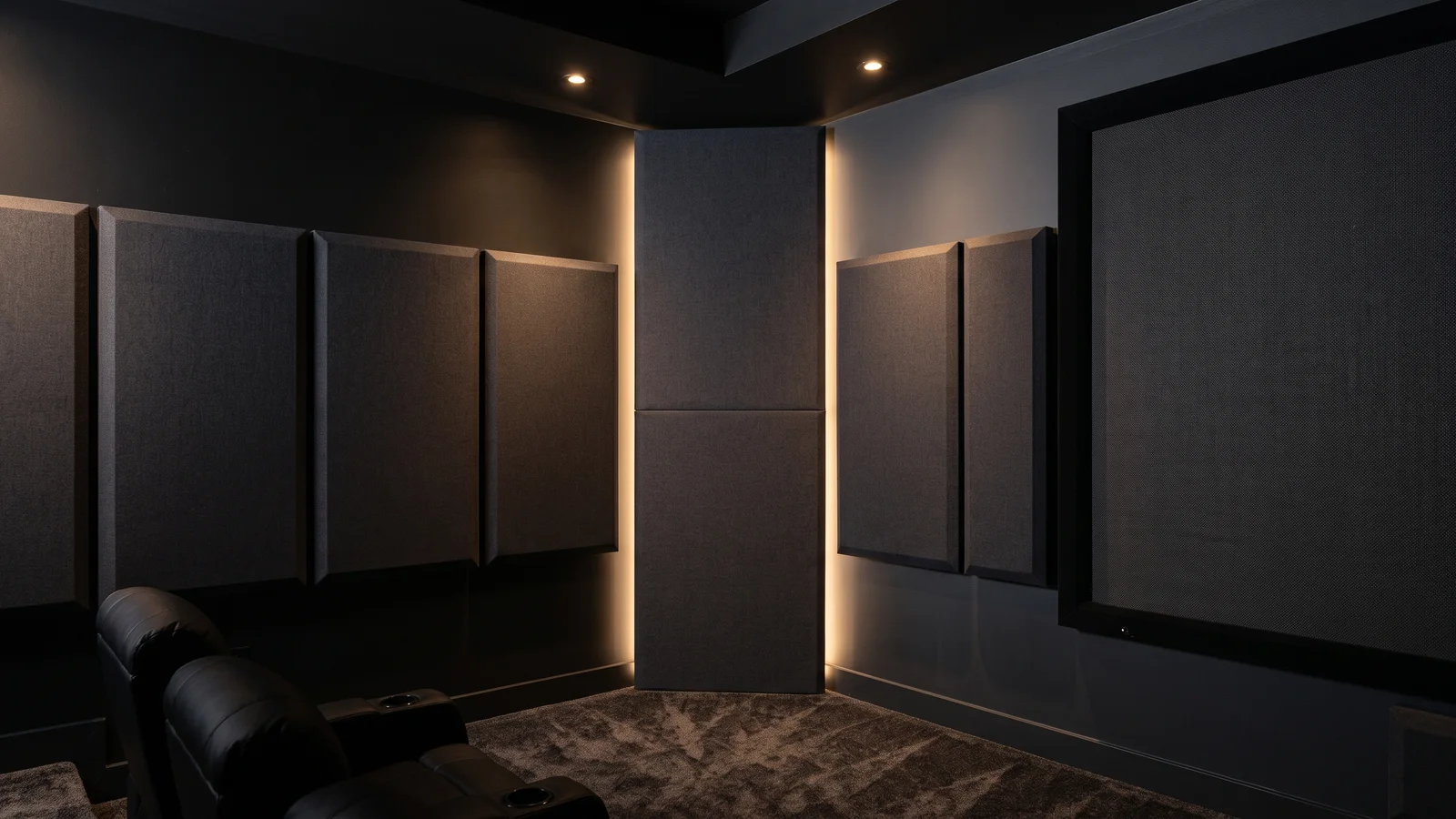
Here's the honest order of operations. First, put the speakers and seats where the physics wants them, then trap the corners to kill the worst modes, then hang absorption at the first reflection points. Only after the room is behaving do you run correction, and even then a good calibrator overrides the automatic curve, protects the top octave, and refuses to boost cancellations. That's the difference between a measurement and a mix.
This is exactly why we treat calibration as a craft, not a button. If you want the full walkthrough of how a room gets dialed in by hand, we cover it in our guides to home-theater calibration in Scottsdale and the calibration process for Paradise Valley rooms.
And if you're building from scratch, the acoustics get baked in early. That's why our custom home theater timeline puts treatment and placement long before the DSP ever runs. Get those right, and the computer's job gets easy.
Frequently Asked Questions
What is room correction?
Room correction is a process where a calibration microphone measures your speakers at your listening seat, then software builds digital filters that reshape the signal to counter the room's effect, as Wikipedia explains. It sets speaker distances, matches levels, and equalizes bass peaks before the sound reaches your amplifier.
Does room correction really work?
Yes, within limits. It works very well on bass modal peaks below the transition frequency because those resonances are minimum-phase, so correcting the level also fixes the timing, per Floyd Toole's research. It works poorly on deep nulls, reflections above roughly 200 Hz, and bad placement.
Audyssey vs Dirac: what's the difference?
Audyssey, founded in 2002, pioneered automated multi-position room compensation and ships built into many receivers, according to Wikipedia. Dirac Live, from Sweden's Dirac Research (founded 2001), uses mixed-phase correction that addresses both magnitude and timing, per NAD. Dirac is generally considered the more capable, and it's usually a paid upgrade.
Can EQ fix a bad room?
No, not on its own. EQ can tame bass peaks, but it cannot fill a deep null because a null is cancellation, and boosting it just adds more cancelling energy while draining amplifier headroom, as Room EQ Wizard explains. A measured 6 dB dip can actually be a 17 dB narrow null. Reflections and placement need physical fixes.
Do I still need acoustic treatment or a pro calibration?
Yes. Room correction cannot fix reflections above the transition frequency or cancellation nulls, so bass traps, absorption, and correct speaker placement do work the DSP can't, per audioXpress. A trained calibrator also overrides the automatic curve where the software makes poor choices, protecting the high end and refusing to boost nulls.
Sources
- Wikipedia - "Digital room correction": https://en.wikipedia.org/wiki/Digital_room_correction
- Wikipedia - "Audyssey Laboratories": https://en.wikipedia.org/wiki/Audyssey_Laboratories
- Wikipedia - "Trinnov Audio": https://en.wikipedia.org/wiki/Trinnov_Audio
- Routledge - Floyd Toole, "Sound Reproduction: The Acoustics and Psychoacoustics of Loudspeakers, Rooms and Headphones": https://www.routledge.com/Sound-Reproduction-The-Acoustics-and-Psychoacoustics-of-Loudspeakers-Rooms-and-Headphones/Toole-Olive-Welti/p/book/9781032761930
- audioXpress - "Trouble with the Curve": https://audioxpress.com/article/trouble-with-the-curve
- Room EQ Wizard - "Is EQ the answer?": http://www.roomeqwizard.com/help/help_en-GB/html/iseqtheanswer.html
- Sound & Vision - "Audyssey's Acoustic Odyssey": https://www.soundandvision.com/content/audyssey-s-acoustic-odyssey
- Dirac Research: https://www.dirac.com/
- NAD Electronics - "Dirac Live Room Correction": https://nadelectronics.com/nad-electronics-amplifiers-dirac-live-room-correction
- Trinnov Audio - "Optimizer": https://www.trinnov.com/en/technologies/active-acoustics/optimizer/
- Anthem - "The Science of ARC": https://www.anthemarc.com/advanced-topics/the-science-of-arc.php
- Anthem - "The History of ARC": https://www.anthemarc.com/advanced-topics/the-history-of-arc.php
- Lyngdorf - "RoomPerfect": https://lyngdorf.steinwaylyngdorf.com/roomperfect/
- GIK Acoustics - "What Are Room Modes?": https://www.gikacoustics.com/blogs/knowledge-base/what-are-room-modes
- PS Audio - "Dealing with Small-Room Acoustics, Part One": https://www.psaudio.com/blogs/copper/dealing-with-small-room-acoustics-part-one
Mike Vincent is the founder of Mike Knows Audio Video and WubWub Audio, where he designs and hand-builds custom loudspeakers and home theaters in Arizona, the old way, for about fifteen clients a year. He runs Audyssey, Dirac, and the rest on real jobs every week and still trusts his ears over the automatic curve; if you want a room tuned by a person instead of a preset, start with our custom home theater systems.
Comments
Leave a Comment