
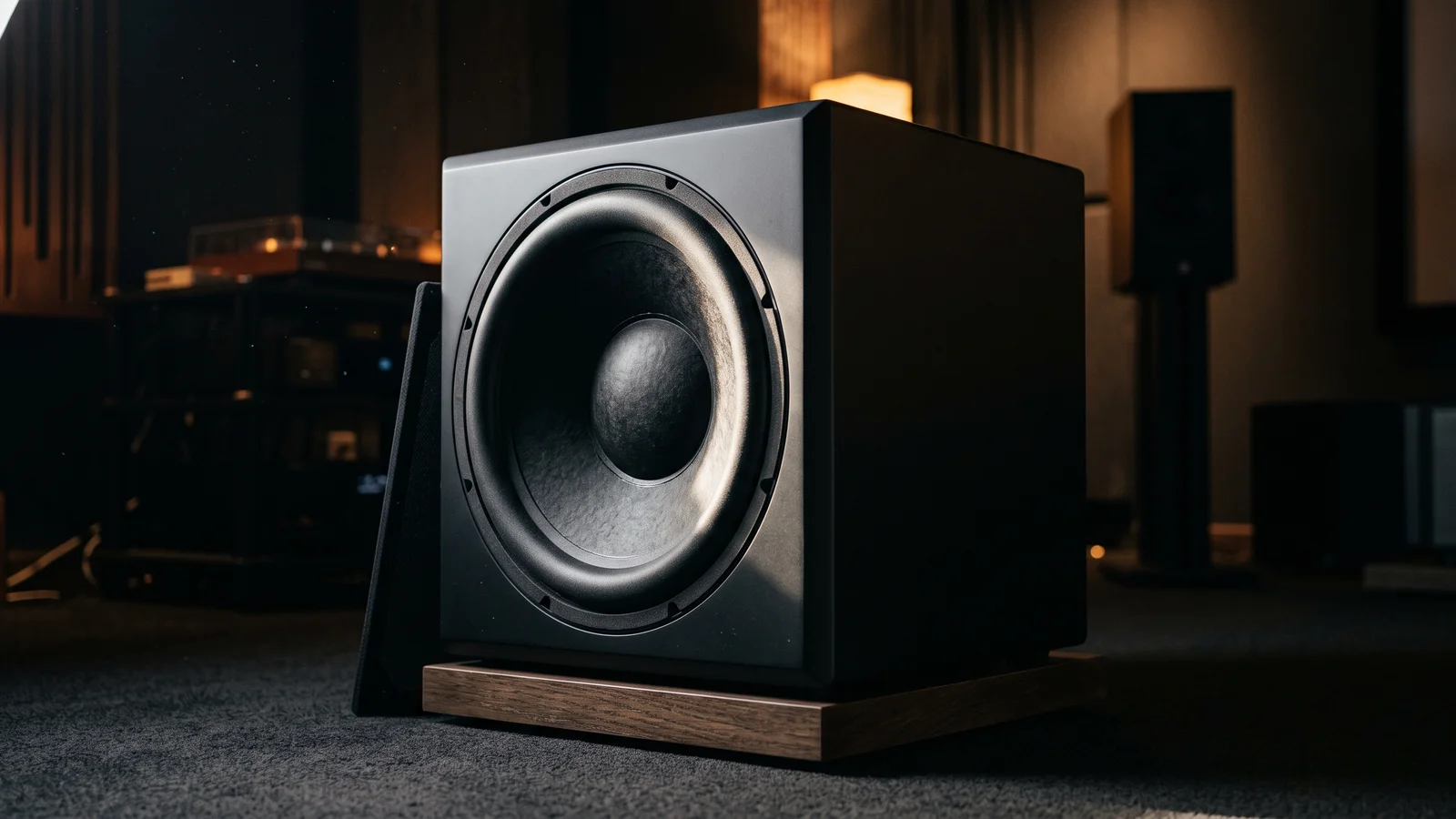
There's no single inventor of the subwoofer. There's a messy lineage, a lot of moving air, and one long fight against physics. Here's how we got the bottom end.
Going low is the hardest thing a speaker does. Mids and highs are easy: a small cone barely twitching moves enough air to fill a room. Bass is a different animal. To make a 30 Hz note you feel in your chest, you have to physically shove a huge volume of air back and forth, and the deeper you go, the worse the math gets.
That's the whole story of the subwoofer, really. One long fight against physics. I build sealed subs for a living out here in Arizona, so I've spent more hours than I'd admit thinking about how to move a lot of air without smearing the punch. And the history of who cracked that problem first is messier than the internet will tell you. So let's go low.
Key Takeaways
- There's no single inventor. The lineage runs from Raymon Dones's 1964 patent to Infinity's 1968 servo woofer to Ken Kreisel's M&K, the best-documented consumer origin.
- Kreisel built a powered woofer in the late 1960s because electrostatic speakers lacked bass; the first subwoofer used in a session mixed Steely Dan's "Pretzel Logic" in 1973.
- Sensurround (1974) dragged deep bass into theaters for "Earthquake," hitting 100 to 120 dB from around 17 Hz and winning a 1974 Academy Award.
- The ".1" LFE channel carries roughly 3 to 120 Hz, about a tenth of a full channel's bandwidth; Dolby Digital 5.1 formalized it in 1992, it did not invent it.
- Sealed boxes give the best transient response and the lowest group delay, around 8 to 10 ms at 30 Hz, which is exactly why we build them.
Who invented the subwoofer?
Nobody invented the subwoofer cleanly, so treat anyone who claims a single name with suspicion. The earliest well-documented patent belongs to Raymon Dones, whose "Octavium" earned US Patent 3,150,739 in September 1964, per Wikipedia's subwoofer history. His cabinets were used by the Grateful Dead and the Pointer Sisters, and the patent predates the famous consumer names by nearly a decade.
Then there's Infinity. In 1966 the Servo-Statik 1 paired an electrostatic panel with a servo-controlled woofer, and Stereophile reviewed it in 1968 at roughly $1,795, as chronicled by AURAL HiFi. It's the first servo-controlled consumer woofer on record. But it was half of a full-range speaker, not a standalone sub you'd add to a system.
The best-documented consumer origin is Ken Kreisel. In the late 1960s his partner Jonas Miller kept hearing the same complaint: electrostatic speakers sounded gorgeous but had no bottom. So Kreisel built a separate powered woofer to fill in the low end, which is the exact satellite-plus-sub idea we still use today, as Miller & Kreisel tells it.
Here's the part I love. The first subwoofer used in a real recording session showed up in 1973, when engineer Roger Nichols arranged for one of Kreisel's woofers to help mix Steely Dan's Pretzel Logic at Village Recorders. They nicknamed it "The Bottom End." M&K Sound was founded in 1974, and its 1976 "David and Goliath" was the first satellite-plus-subwoofer system you could buy (M&K Sound).
M&K also markets itself as the maker of the "world's first balanced dual-drive subwoofer." That's a company claim, so take it as M&K's own framing rather than settled history. The honest version is a relay race: Dones patented it, Infinity servo-controlled it, and Kreisel turned it into the consumer product category we all know. The "who was first" fight only makes sense once you separate the patent, the servo woofer, and the standalone consumer sub. They're three different firsts.
How does a subwoofer actually work, and what's inside the box?
A subwoofer is a specialist that does one job: move enough air to reproduce the lowest octaves. The trouble is displacement. Every octave you go down, a driver must move roughly four times the air to hold the same loudness, a brutal rule of radiation physics discussed by Audioholics. That's why subs use big cones, long excursion, and their own amplifier.
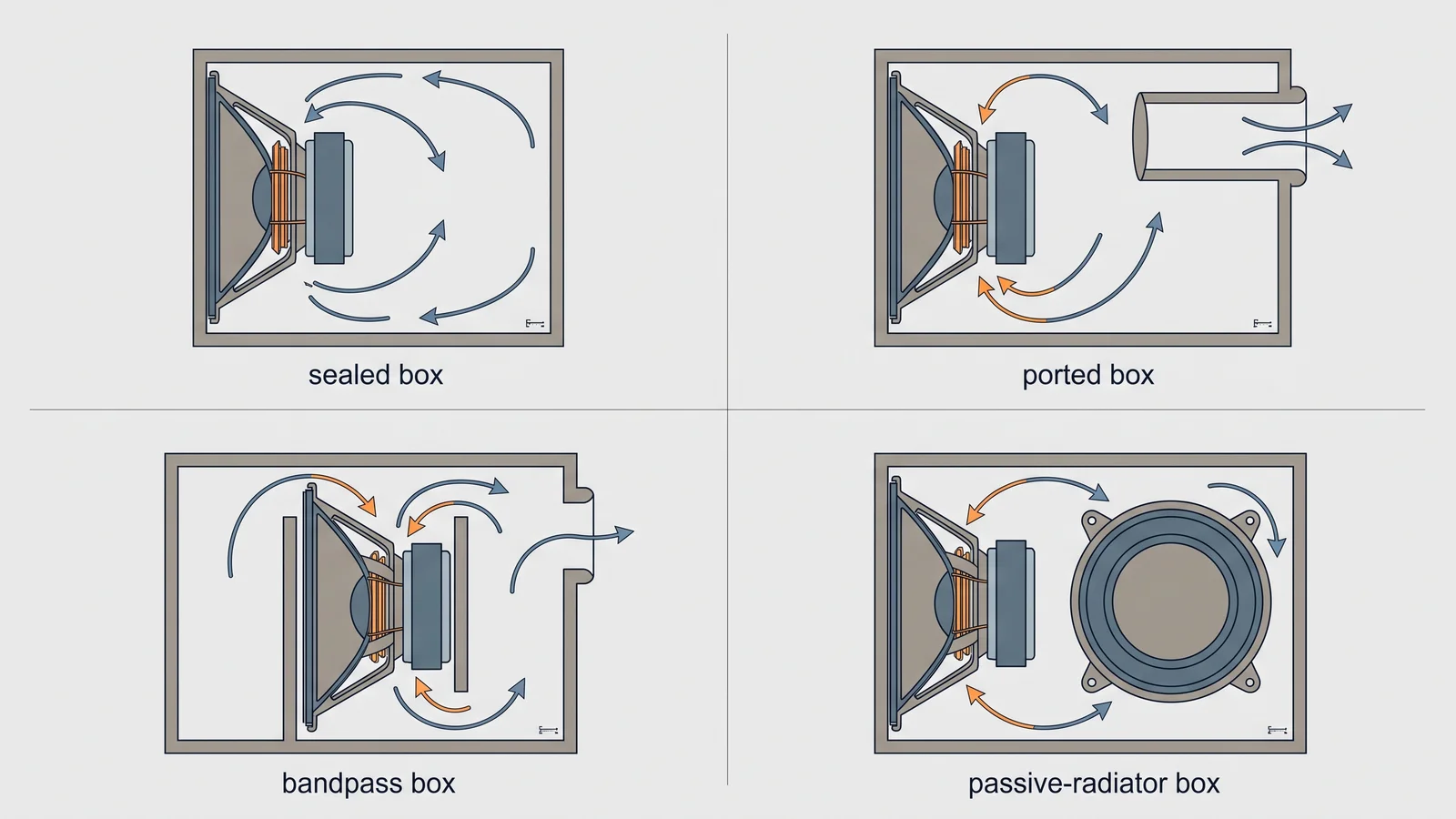
The enclosure is where the real design fight happens. The box isn't just a place to bolt the driver; it controls how that cone behaves and shapes the sound you actually hear. There are five main approaches, and every one is a trade. I've built and measured all of these on the bench, and none of them is free. You're always trading one thing for another.
Sealed, ported, bandpass, passive radiator
A sealed box traps air behind the cone so it acts like a spring. It rolls off gently, about 12 dB per octave, and gives the best transient response with the lowest group delay, roughly 8 to 10 ms at 30 Hz. It's the smallest, tightest option. SVS and Audioholics both frame sealed as the accuracy choice (SVS, Audioholics).
A ported box adds a tuned vent that reinforces output, buying roughly 3 dB more at 20 Hz and higher efficiency. The catch: below the tuning frequency it falls off a cliff at about 24 dB per octave, and port air settling can smear the leading edge of a note. That's the classic movies-versus-music split, as SVS lays out.
A bandpass box is very efficient inside a narrow band, but it's big, and it's easy to overdrive outside that band. A passive radiator swaps the port for a "drone" cone, giving ported-like extension without the port noise. And a servo design puts a sensor on the driver so the amp can correct the cone's motion in real time. More on that one next.
What is a servo subwoofer?
A servo subwoofer watches its own cone and fixes mistakes on the fly. A sensor tracks the exact motion of the driver, compares it to the input signal, and the amplifier corrects the difference, cutting distortion hard. Velodyne's 1983 High Gain Servo measured cone position around 3,500 times a second and claimed under 1% distortion, per Stereophile. It's feedback control, borrowed from aerospace.
That aerospace link is literal. Infinity's Arnie Nudell got the servo idea from his missile-guidance work at Litton, then built it into the Servo-Statik 1 with co-founders Cary Christie and John Ulrick, as Stereophile recounts. They used a Cerwin-Vega 18-inch driver fitted with a second voice-coil winding to sense motion. A guided-missile trick, aimed at your low end instead.
Velodyne took the concept mainstream. David Hall founded the company in 1979, and its accelerometer-based servo woofers, headlined by the ULD-18, earned a 1984 CES Special Engineering Award, per Wikipedia). The broader story of feedback control in audio, from motional feedback to modern sensors, is traced well by audioXpress.
One quick myth-buster, because people mix this up. Bob Carver's mid-1990s Sunfire True Subwoofer was a genuine milestone, a tiny sealed box with a high-excursion driver and a tracking amp that got huge output from a small cabinet. But it wasn't a servo sub. Small, sealed, and loud is not the same as motional feedback, so don't let anyone tell you it was.
How did the subwoofer conquer the movie theater?
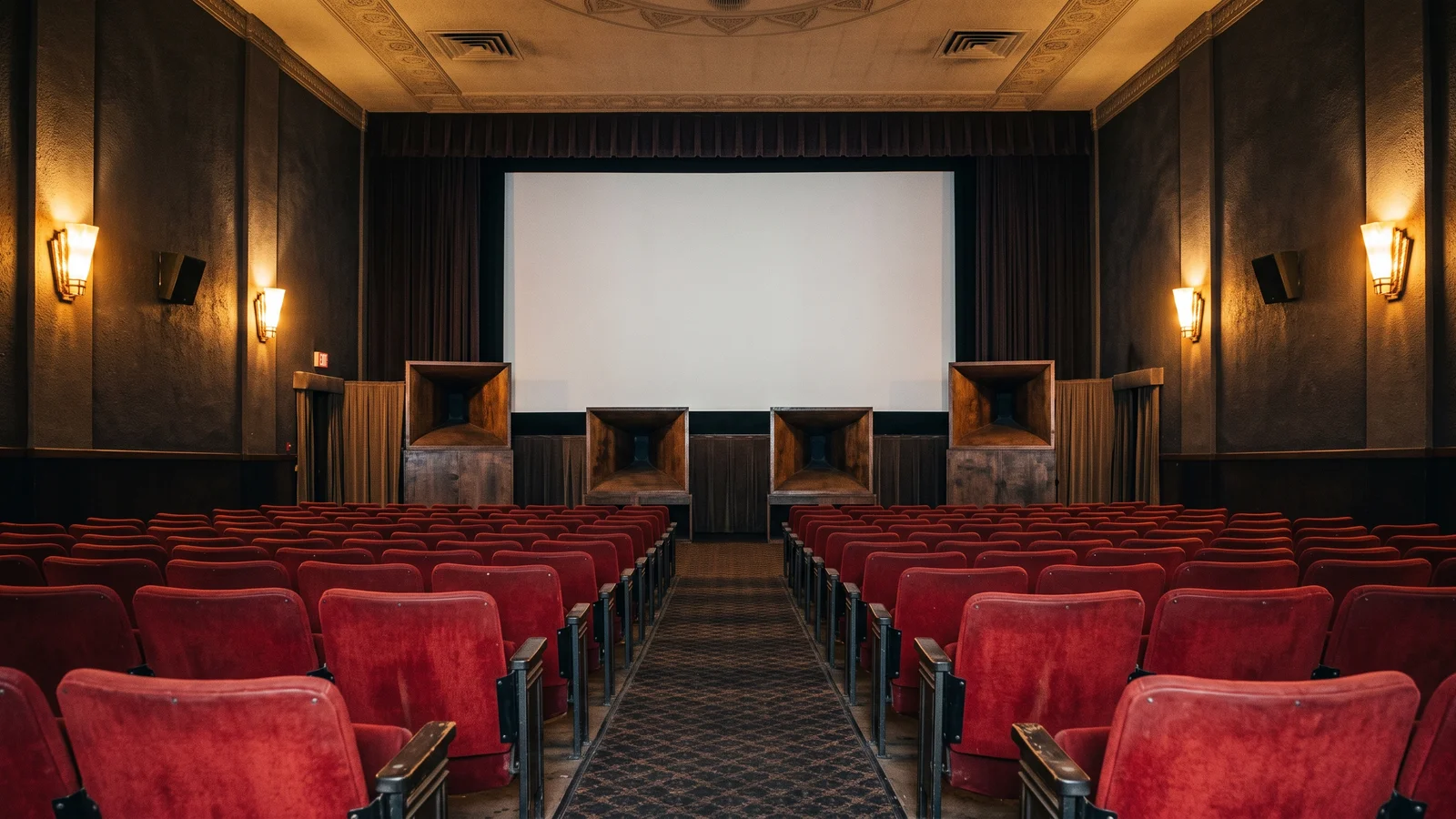
The subwoofer went to the movies in 1974, and it did it by shaking the building. Universal's Earthquake debuted Sensurround, a system that reproduced roughly 17 to 120 Hz at 100 to 120 dB, driven by 1,600-watt BGW amplifiers, per Wikipedia. It won a 1974 Special Scientific and Engineering Academy Award. Audiences reported the theater literally rumbling.
The engineering was clever and a little insane. MCA teamed with Cerwin-Vega, whose founder Gene Czerwinski designed a folded-horn subwoofer, while D.B. Keele Jr. built the noise generator that produced the low-frequency roar, as Red Bull Music Academy documented. Hidden 25 Hz and 35 Hz control tones on the film print triggered the effect at the right moments. Six films ended up using Sensurround before it faded.
Sensurround was crude by modern standards, but it proved something important: low bass wasn't a luxury add-on for cinema, it was part of the emotional payload. Get the floor to move and the audience believes the earthquake. That lesson never left the movie business, and it's why every serious theater since, and every home theater built to match it, has had dedicated low-frequency muscle behind the screen.
What is the .1 in 5.1, and is it the same as the subwoofer?
The ".1" is the Low-Frequency Effects channel, and it is not your subwoofer. LFE carries roughly 3 to 120 Hz, about a tenth of a full channel's bandwidth, which is where the "point one" name comes from, per Wikipedia. It's a dedicated track for effects like explosions and rumble, mixed separately by the sound team. That's a channel, not a speaker.
The concept is older than most people think. A dedicated low-frequency channel first appeared in Dolby's 70mm six-track film format in the late 1970s, so Dolby Digital 5.1 didn't invent the idea in 1992. It formalized and popularized it for the digital era, as the 5.1 record shows. Worth keeping straight when someone credits the whole thing to the 1990s.
Speaking of the 1990s, the "first Dolby Digital 5.1 movie" claim needs a caution. Batman Returns (1992) is best described as the first commercial Dolby Digital 5.1 release, and even then only about 11 theaters were actually equipped to play it. It's a real milestone, just a smaller one than the trivia suggests. Attribute it carefully and you'll be right more often than the internet.
Here's the crucial part for anyone setting up a system. Your subwoofer does not just play the LFE channel. A receiver's bass management sums the low frequencies from all the speakers, then adds the LFE track, and sends that combined signal to the sub. So the sub reproduces far more than ".1" worth of content. LFE is one ingredient; the sub plays the whole soup.
Why we build sealed subs
Sealed is the accuracy choice, and the numbers back it up. A sealed box rolls off gently and delivers the lowest group delay, around 8 to 10 ms at 30 Hz, which means the leading edge of a kick drum arrives intact instead of smeared, as SVS and Audioholics both note. That tight transient response is the reason I've built sealed custom subwoofers for years.
Room placement matters as much as the box. Shove a sub into a corner and you can gain up to about 6 dB of free output from room gain, but corners also excite room modes the worst, giving you boom in one seat and nothing in the next, per SVS. The fix is two subs placed asymmetrically, which smooths the bass across every seat, not just the sweet spot.
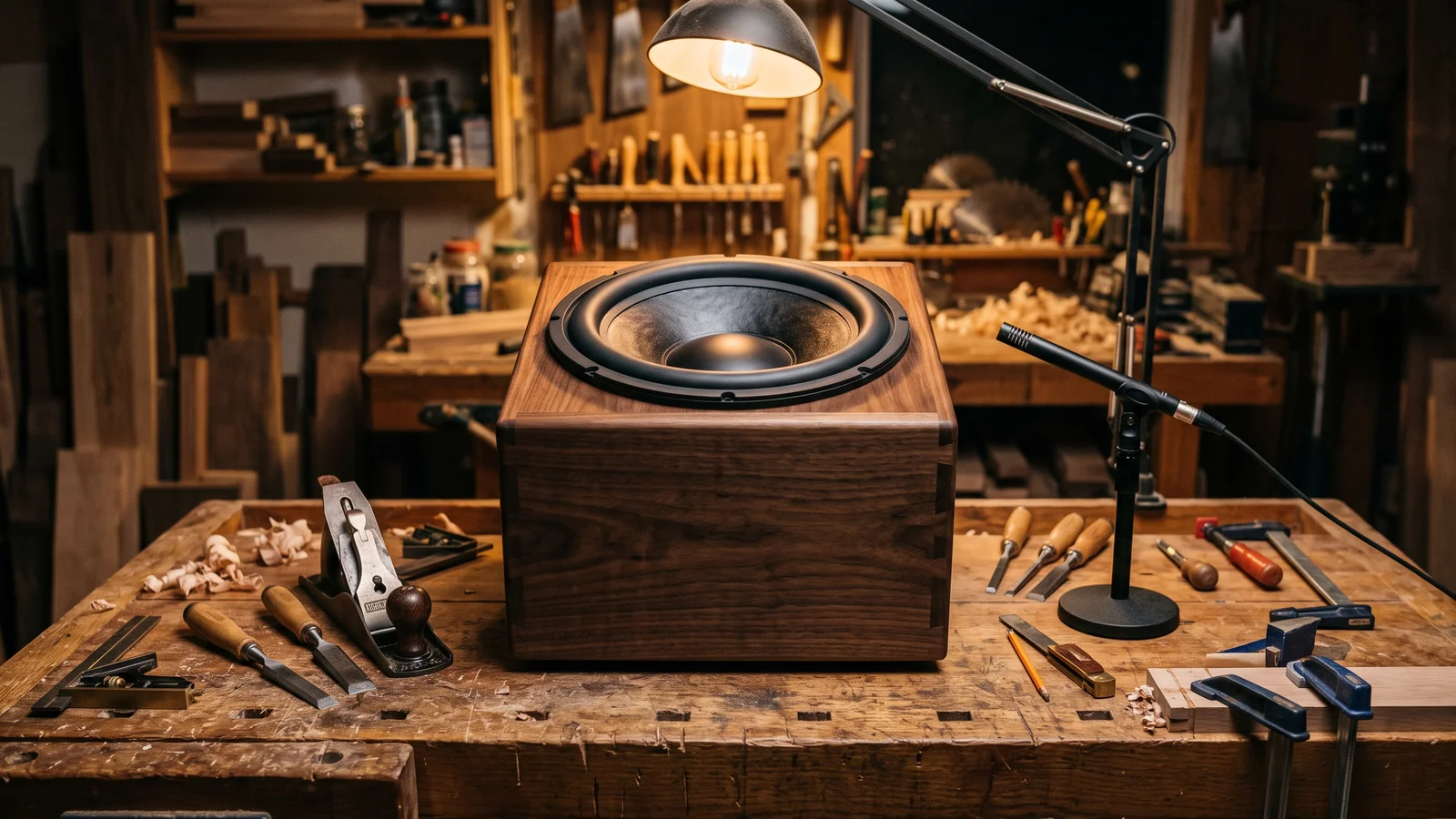
In our Arizona workshop, we tune the sealed alignment to the room, not to a spec sheet. Ported subs win on raw output for the money, and for a lot of movie rooms that's a fair trade. But when a client wants bass that starts and stops with the music, that follows a bass line instead of just hitting it, sealed is the answer. That's the philosophy behind the hand-built speakers we make: accuracy first, low group delay, no smear.
The subwoofer is a hundred-year fight against the same enemy, moving a lot of air without lying about it. From Dones's patent to Kreisel's bottom end to Sensurround shaking a theater, the good ones all respected the physics. That's the tradition we build in.
Frequently Asked Questions
Who invented the subwoofer?
There's no single inventor. Raymon Dones patented the "Octavium" (US 3,150,739) in September 1964, the earliest well-documented patent. Infinity's Servo-Statik 1 (reviewed 1968) was the first servo-controlled consumer woofer, and Ken Kreisel's M&K is the best-documented consumer origin, building a powered woofer in the late 1960s that became the modern satellite-plus-sub category.
What is a subwoofer?
A subwoofer is a specialized loudspeaker built to reproduce the lowest audio frequencies, typically below about 120 Hz, that ordinary speakers can't move enough air to reproduce cleanly. It uses a large, long-excursion driver and usually its own amplifier. In a home theater, it handles deep effects and the low end summed from every other channel.
Sealed vs ported subwoofer: what's the difference?
A sealed subwoofer uses trapped air as a spring, rolling off gently at about 12 dB per octave with the tightest transient response and lowest group delay, around 8 to 10 ms at 30 Hz. A ported subwoofer adds a tuned vent for roughly 3 dB more output near 20 Hz and higher efficiency, but rolls off steeply below tuning. Sealed favors music accuracy; ported favors movie output.
What is the .1 or LFE channel?
The ".1" is the Low-Frequency Effects channel, carrying roughly 3 to 120 Hz, about a tenth of a full channel's bandwidth. It's a dedicated effects track, not the subwoofer itself. Your sub actually reproduces the LFE channel plus the low frequencies summed from every other speaker through the receiver's bass management, so it plays far more than just the ".1".
What is a servo subwoofer?
A servo subwoofer uses a sensor to track the driver's actual cone motion, then the amplifier corrects any difference from the input signal in real time, cutting distortion. Infinity pioneered the idea in 1968 using missile-guidance feedback, and Velodyne's 1983 accelerometer-based design measured cone motion around 3,500 times a second, claiming under 1% distortion.
Sources
- Wikipedia — "Subwoofer": https://en.wikipedia.org/wiki/Subwoofer
- Wikipedia — "Sensurround": https://en.wikipedia.org/wiki/Sensurround
- Wikipedia — "Low-frequency effects": https://en.wikipedia.org/wiki/Low-frequency_effects
- Wikipedia — "5.1 surround sound": https://en.wikipedia.org/wiki/5.1_surround_sound
- Wikipedia — "David Hall (American inventor and businessman)": https://en.wikipedia.org/wiki/David_Hall_(American_inventor_and_businessman)
- AURAL HiFi — "Infinity Servo-Statik 1 (The Original, 1968)": https://auralhifi.com/products/infinity-servo-statik-1-speakers-the-original-1968
- AURAL HiFi — "The History of Infinity": https://auralhifi.com/pages/infinity
- PS Audio — "Arnie Nudell, RIP": https://www.psaudio.com/blogs/copper/arnie-nudell-rip
- Stereophile — "Arnie Nudell: Here at Infinity": https://www.stereophile.com/content/arnie-nudell-here-infinity
- Stereophile — "Velodyne ULD-18 & ULD-15 Subwoofers": https://www.stereophile.com/content/velodyne-uld-18-uld-15-subwoofers-page-2
- audioXpress — "Servo Control in Mainstream Audio": https://audioxpress.com/article/servo-control-in-mainstream-audio-from-motional-feedback-to-the-bend-sensor
- M&K Sound — "The M&K Legacy": https://www.mksound.com/?enfold_repeatable=the-mk-legacy
- SVS — "Sealed vs Ported Subwoofers": https://www.svsound.com/blogs/subwoofer-setup-and-tuning/75367747-sealed-vs-ported
- Audioholics — "Sealed vs Ported Subwoofers": https://www.audioholics.com/loudspeaker-design/sealed-vs-ported-subwoofers
- SVS — "What Is Subwoofer Room Gain": https://www.svsound.com/blogs/subwoofer-setup-and-tuning/what-is-subwoofer-room-gain
- Red Bull Music Academy — "Earthquake: The Story of Sensurround": https://daily.redbullmusicacademy.com/2019/07/earthquake-sensurround-cerwin-vega/
Mike Vincent is the founder of Mike Knows Audio Video and WubWub Audio, where he designs and hand-builds custom loudspeakers and home theaters in Arizona, the old way, for about fifteen clients a year. He's a firm believer that bass should start and stop with the music, which is why every sub he builds is sealed; if you want low end that punches instead of booms, start with our custom sealed speakers and subwoofers.
Comments
Leave a Comment