
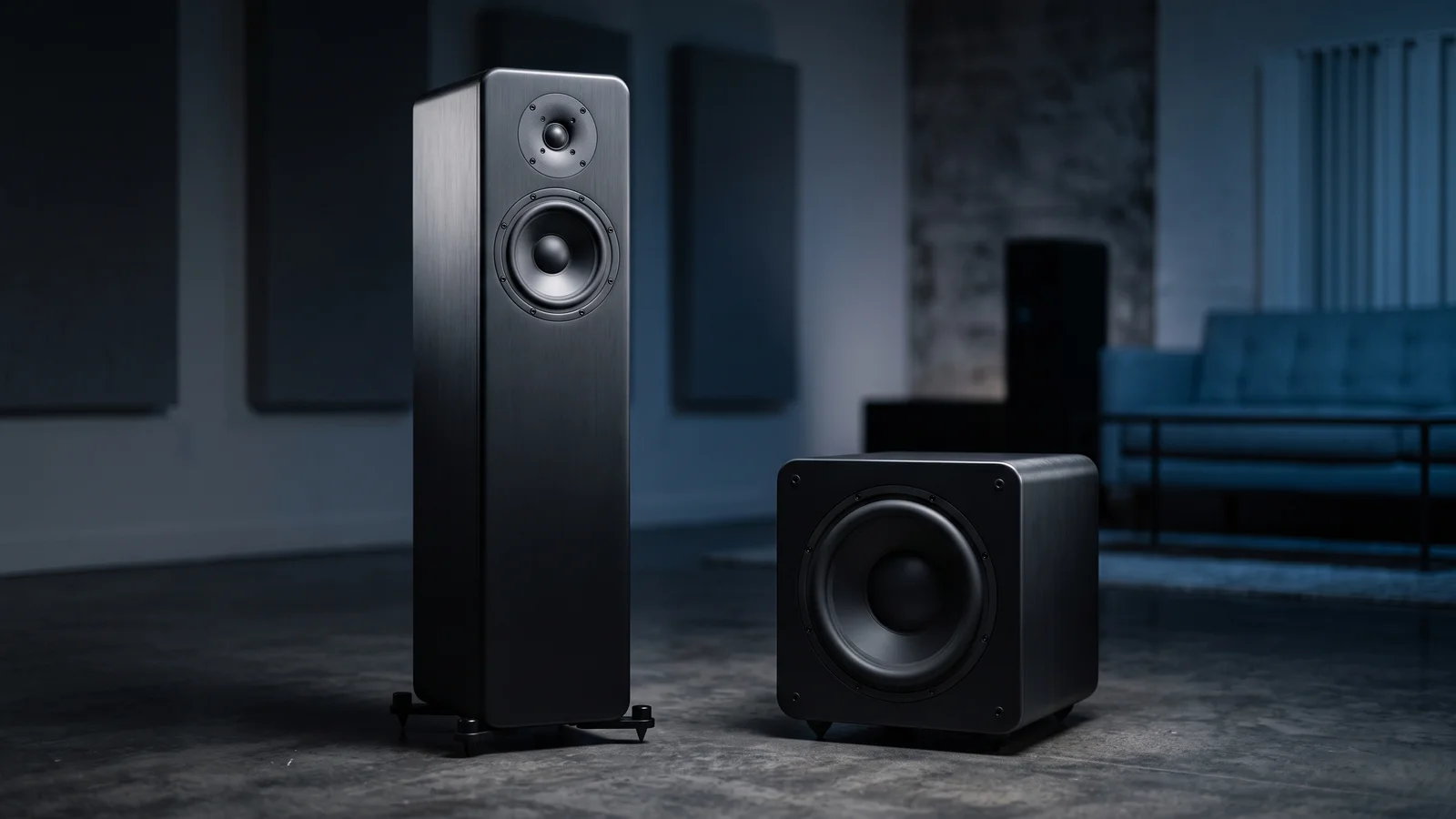
The single most important argument in speaker design, explained so anyone gets it, plus why a builder still chooses sealed subs on purpose.
Put two speaker guys in a room and eventually someone says the word "ported." Then it's on. This is the oldest argument in loudspeaker design, older than the CD, older than surround sound, older than most of the brands you grew up with. Sealed box or vented box? It sounds like a small question. It decides almost everything about how a speaker behaves down low.
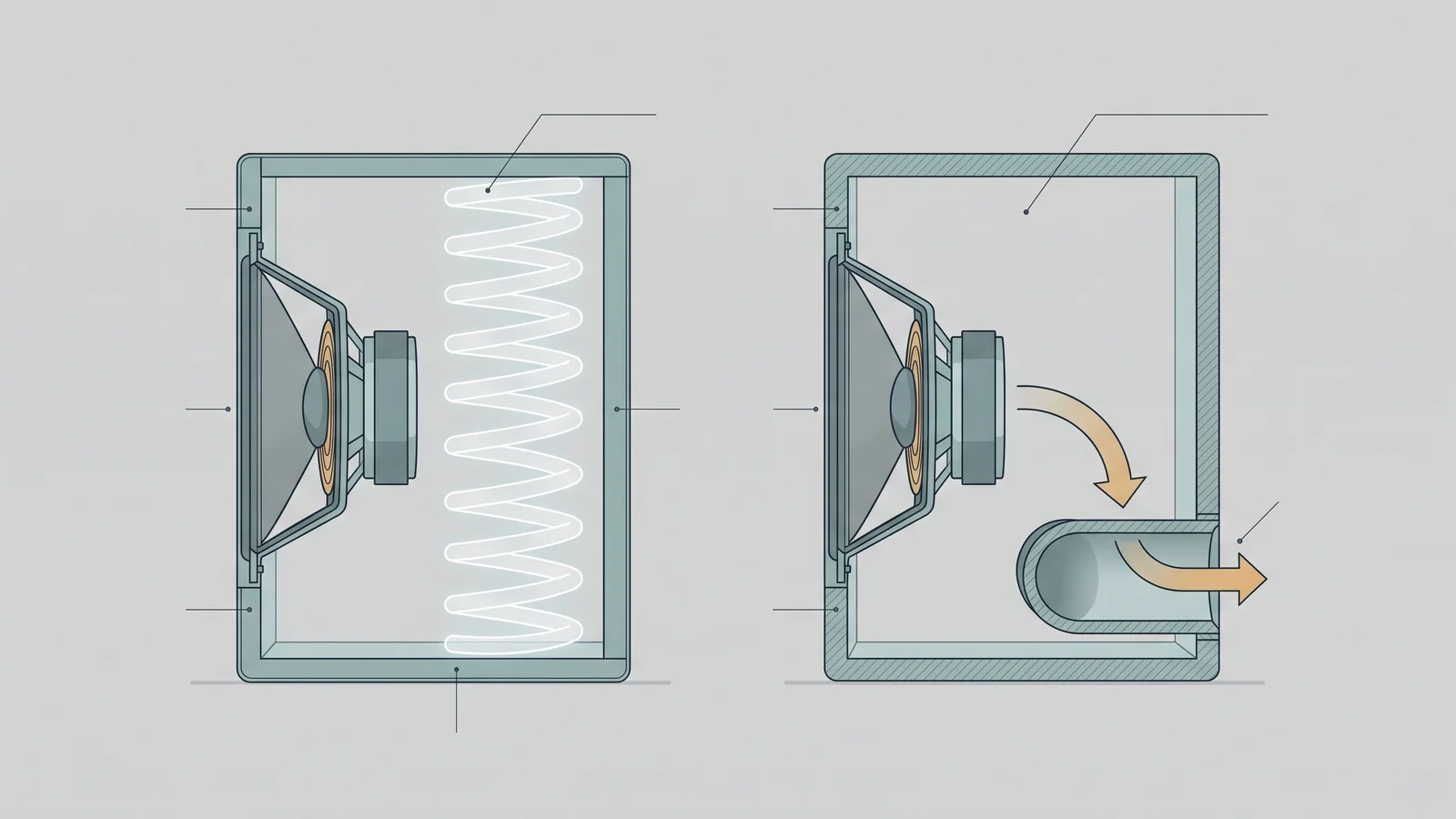
Here's the short version before we get into it. Every box does one job: control what happens behind the cone. A speaker cone pumps air out the front and out the back, and that rear wave has to go somewhere. Trap it, and you get acoustic suspension. Tune it and let it out a hole, and you get bass reflex. Two answers to the same problem, invented decades apart, and I've built plenty of both. Let me show you why I keep choosing one.
Key Takeaways
- A sealed (acoustic-suspension) box traps the air behind the cone and uses it as a spring, giving low distortion and a gentle rolloff of roughly 12 dB/octave (a 2nd-order slope).
- A ported (bass-reflex) box tunes a vent as a Helmholtz resonator for more output and about 2.9 dB more efficiency than an equal sealed box, but rolls off steeper, near 24 dB/octave (4th order), per Audioholics.
- Bass reflex came first: Albert L. Thuras at Bell Labs, patent filed August 15, 1930, granted July 26, 1932.
- Acoustic suspension came in 1954 from Edgar Villchur, with U.S. patent 2,775,309 issued December 25, 1956, and the AR-1 selling for around $185.
- Neville Thiele (1961) and Richard Small (1972) turned box design into predictable math, the Thiele/Small parameters every engineer still uses.
- WubWub builds sealed subwoofers on purpose: tighter transients and lower distortion, accepting a few dB less efficiency and a bit more amplifier.
How does a sealed acoustic-suspension speaker work?
A sealed speaker uses the trapped air inside the cabinet as a spring. The woofer compresses that air on every stroke, and the air pushes back, which keeps the cone linear and controlled. That air spring is why acoustic-suspension designs roll off gently at roughly 12 dB per octave, a 2nd-order slope, as the acoustic-suspension record documents.
Why does that spring matter so much? Because a bare woofer's own suspension, the rubber surround and the spider, isn't very linear. Push the cone far enough and the mechanical suspension starts fighting back unevenly, and uneven restoring force means distortion. Seal the box and the dominant spring becomes the air itself, which is far more linear than any rubber part. You trade some efficiency for a woofer that behaves.
I've measured this on the bench, and the difference in the low end is real. A well-built sealed box tends to produce cleaner bass at high excursion because the restoring force stays predictable. The cone goes where the signal tells it to go and comes back the same way. No port, no extra tuning, no resonance to manage. Just a driver, a sealed volume of air, and physics doing the heavy lifting.
How does a bass-reflex ported speaker work?
A bass-reflex box adds a tuned port that turns the wasted rear wave into extra output. The port and the box air form a Helmholtz resonator, the same effect as blowing across a bottle top, and near the tuning frequency the port radiates in phase with the cone. That's why a vented box is roughly 2.9 dB more efficient than an equal sealed box, per Audioholics.
Think about what that buys you. The rear wave inside a sealed box is just heat, energy the driver throws away. A port recycles it. Tune the vent right and the box gets louder in the low bass for the same driver and the same watts, or it reaches the same depth from a smaller enclosure, as the bass-reflex record explains. For a lot of speakers, that free output is exactly the point.
There's a catch, and it's baked into the physics. Below the port's tuning frequency the cone unloads, the port stops helping, and output drops off a cliff. A vented box rolls off at roughly 24 dB per octave, a steeper 4th-order slope (Bass reflex). It also adds group delay near tuning, a topic port designers spend real effort taming. Companies like Genelec put a lot of engineering into reflex-port shaping precisely because a lazy port whistles, chuffs, and rings.
Rear-ported designs also get fussy about placement, which is why KEF has to coach owners on giving rear ports room to breathe. Shove a rear-ported speaker against a wall and the tuning shifts and the bass turns to mud. A sealed box couldn't care less where you put it. That's not a knock on ported design. It's just the trade you sign up for.
Who actually invented sealed and ported speakers?
The two designs are separated by about a quarter century, and the ported box came first. Albert L. Thuras of Bell Telephone Laboratories filed the patent for the bass-reflex enclosure on August 15, 1930, and it was granted as U.S. Patent 1,869,178 on July 26, 1932, as the patent record shows. Thuras figured out you could tune a vent to reinforce a loudspeaker's low end decades before it went mainstream.
The ported box didn't take over overnight. For years the vented enclosure was more art than science, tuned by ear and educated guessing. Engineers knew a port could add output, but predicting exactly what a given box would do was another matter. That gap between "it works" and "here's why" is where the next big idea walked in, and it came from an unlikely place: a guy teaching night classes in New York.
Edgar Villchur and the sealed-box revolution
Edgar Villchur worked out acoustic suspension in 1954 and filed the idea that became U.S. Patent 2,775,309, issued December 25, 1956, according to the patent database. His insight flipped the usual thinking. Instead of treating the small sealed box as a compromise, he used the trapped air as the main spring and paired it with a floppy, high-compliance woofer that would've been useless on its own.
The result stunned the industry. Villchur's Acoustic Research AR-1 arrived in 1954 for around $185, and it produced deep, clean bass from a bookshelf-sized cabinet when the giants still needed furniture-sized boxes (Acoustic suspension). A schoolteacher had shrunk the speaker and improved the bass at the same time. He later laid out the science in his AES paper, "Problems of Bass Reproduction in Loudspeakers," JAES Vol 5 No 3, July 1957. I've had a pair of old ARs on the bench, and even by modern standards the low end is honest.
Thiele and Small make it a science
For a long time, designing a box was guesswork. That ended with two Australians. A. Neville Thiele published a set of box alignments in 1961 that mathematically linked a driver's parameters to enclosure behavior, work re-published in the JAES in 1971, as the Thiele/Small record documents. Suddenly you could predict a box's response on paper before cutting a single panel.

Richard H. Small extended and systematized that work in a series of JAES papers starting in 1972, per his biography. Together they gave us the Thiele/Small parameters, the handful of numbers, Fs, Qts, Vas, and their cousins, that tell a designer whether a driver wants a sealed box, a ported box, or a fresh start. Here's what most people miss: Thiele and Small didn't pick a winner between sealed and ported. They made both designs honest, turning a decades-old argument into a spec sheet you can actually calculate. Every simulator today, and every box I model, runs on their math.
Sealed vs ported: what are the honest trade-offs?
Neither design wins outright, and anyone who tells you otherwise is selling something. The core trade is efficiency against extension and control: a ported box gives you roughly 2.9 dB more efficiency, or the same depth from about half the box volume, while a sealed box gives you a gentler 12 dB/octave rolloff and lower group delay, as Audioholics lays out.
Let me translate that into where each one wins. Want maximum output for the money, or the deepest tuned bass for movies at reference level? Ported has a real edge, which is why most home-theater subs are vented. Want the tightest, most predictable low end, easy placement, and clean behavior below the tuning point? Sealed earns its keep. A sealed box also keeps making usable output below its own minus-3 dB point instead of dropping off a cliff, which room gain can pick right back up.
Now the part where I stay honest. The "sealed just sounds tighter" line is a genuine belief in the audiophile and design community, and I lean that way myself. But it's a preference, not a physical law. Genelec and Audioholics both make the case that a well-engineered port can push group delay below the threshold where anyone can actually hear it, so the ringing people describe often comes from a bad port, not from porting itself (Genelec). Any specific delay figure in milliseconds is fuzzy and depends on tuning, so treat "roughly" as doing real work there.
Here's the whole argument in one table.
| Trait | Sealed (acoustic suspension) | Ported (bass reflex) |
|---|---|---|
| Efficiency | ~2.9 dB less efficient than an equal ported box; needs about twice the amplifier power for the same low-frequency output | ~2.9 dB more efficient than an equal sealed box |
| Low-end rolloff slope | Gentle ~12 dB/octave (2nd order) | Steep ~24 dB/octave (4th order) below tuning |
| Transient / group-delay behavior | Tighter transients, lower group delay; air spring keeps the cone predictable | Adds group delay near the tuning frequency; a well-engineered port can push it below audibility |
| Room / wall placement sensitivity | Placement-insensitive; doesn't care where you put it | Fussy, especially rear-ported; tuning shifts and bass muddies against a wall |
| Box size for same bass | Larger box for equal extension | Same depth from about half the box volume |
| Best use-case | Tight, predictable, low-distortion bass; easy placement; blends with room gain and DSP calibration | Maximum output for the money; deepest tuned bass for movies at reference level |
Why does WubWub build sealed subwoofers?
We build sealed subs because accuracy is the whole point, and the air spring is the most linear restoring force you can hand a woofer. That linearity means low distortion and tight transients: a kick drum stops when the recording says stop. We accept the trade, roughly a few dB less efficiency and the need for more amplifier and box, because clean beats loud in a room built for real listening (acoustic suspension patent review).
There's a practical reason too, and it shows up in every room I calibrate. A sealed sub's gentle 12 dB/octave rolloff blends beautifully with room gain and DSP. Rooms naturally reinforce the deepest bass as you go low, so a sealed sub that's easing off can ride that boost and end up flatter and deeper in the room than it ever measures in free space. A steep ported rolloff fights that. The math just works out cleaner for calibration.
So no, sealed isn't the "better" design in a vacuum. It's the right design for what we're after: predictable, low-distortion bass that a human being can tune to a specific room. If that philosophy sounds like your kind of thing, that's exactly how we approach every custom speaker we build by hand in Arizona. Loud is easy. Right is the hard part, and it's the only part worth doing.
Frequently Asked Questions
Sealed vs ported subwoofers: which is better?
Neither is universally better; they trade efficiency for control. A ported (bass-reflex) sub is about 2.9 dB more efficient and hits deeper tuned bass, ideal for max-output home theater. A sealed (acoustic-suspension) sub rolls off gently at roughly 12 dB/octave with tighter transients and lower distortion, per Audioholics. Pick the trade that fits your room.

What is acoustic suspension?
Acoustic suspension is a sealed-box speaker design that uses the trapped air behind the cone as the main spring. Edgar Villchur worked it out in 1954 and patented it in 1956 (Acoustic suspension). The air spring is very linear, so it lowers distortion, and it lets a small cabinet produce deep, clean bass with a gentle 12 dB/octave rolloff.
What is a bass reflex port?
A bass reflex port is a tuned vent that turns a speaker's wasted rear wave into extra output. The port and box air form a Helmholtz resonator, radiating in phase with the cone near the tuning frequency, per the bass-reflex record. That adds about 2.9 dB of efficiency versus a sealed box, but below tuning the output rolls off steeply at roughly 24 dB/octave.
Do sealed speakers need more power?
Yes, a bit. A sealed box is roughly 2.9 dB less efficient than an equal-size ported box, so it needs about twice the amplifier power for the same low-frequency output, or a larger box for equal extension (Audioholics). In exchange you get tighter transients, lower distortion, and a gentler rolloff that blends well with room gain.
What are Thiele/Small parameters?
Thiele/Small parameters are the numbers that predict how a driver behaves in a given enclosure. Neville Thiele published the box alignments in 1961, and Richard Small extended the work from 1972 (Thiele/Small parameters). Values like Fs, Qts, and Vas let a designer calculate whether a driver suits a sealed box, a ported box, or neither, before cutting wood.
Sources
- Google Patents - Albert L. Thuras, U.S. Patent 1,869,178 (bass-reflex enclosure, filed 1930, granted 1932): https://patents.google.com/patent/US1869178A/en
- DATAMP - Edgar Villchur, U.S. Patent 2,775,309 (acoustic suspension, issued December 25, 1956): https://www.datamp.org/patents/displayPatent.php?pn=2775309&id=84395
- Wikipedia - "Acoustic suspension": https://en.wikipedia.org/wiki/Acoustic_suspension
- Wikipedia - "Bass reflex": https://en.wikipedia.org/wiki/Bass_reflex
- Wikipedia - "Thiele/Small parameters": https://en.wikipedia.org/wiki/Thiele/Small_parameters
- Wikipedia - "Richard H. Small": https://en.wikipedia.org/wiki/Richard_H._Small
- AES E-Library - Edgar Villchur, "Problems of Bass Reproduction in Loudspeakers," JAES Vol 5 No 3, July 1957: https://aes2.org/publications/elibrary-page/?id=267
- Genelec - "Reflex Port Design": https://www.genelec.com/key-technologies/reflex-port-design
- KEF - "How to Get the Most Out of Your Rear-Ported Speakers": https://us.kef.com/blogs/news/how-to-get-the-most-out-of-your-rear-ported-speakers
- Audioholics - "Sealed vs. Ported Subwoofers": https://www.audioholics.com/loudspeaker-design/sealed-vs-ported-subwoofers
- audioXpress - "Patent Review: Loudspeaker Enclosure with a Sealed Acoustic Suspension Chamber": https://audioxpress.com/article/patent-review-loudspeaker-enclosure-with-a-sealed-acoustic-suspension-chamber
- AES Media - "Loudspeaker History": https://web.archive.org/web/20260415201347/https://www.aes-media.org/historical/html/recording.technology.history/loudspeaker.html
Mike Vincent is the founder of Mike Knows Audio Video and WubWub Audio, where he designs and hand-builds custom loudspeakers and home theaters in Arizona, the old way, for about fifteen clients a year. He builds sealed subwoofers on purpose because tight, low-distortion bass beats loud every time; if you want speakers designed around accuracy instead of a spec sheet, start with our custom speakers built by hand.
Comments
Leave a Comment