
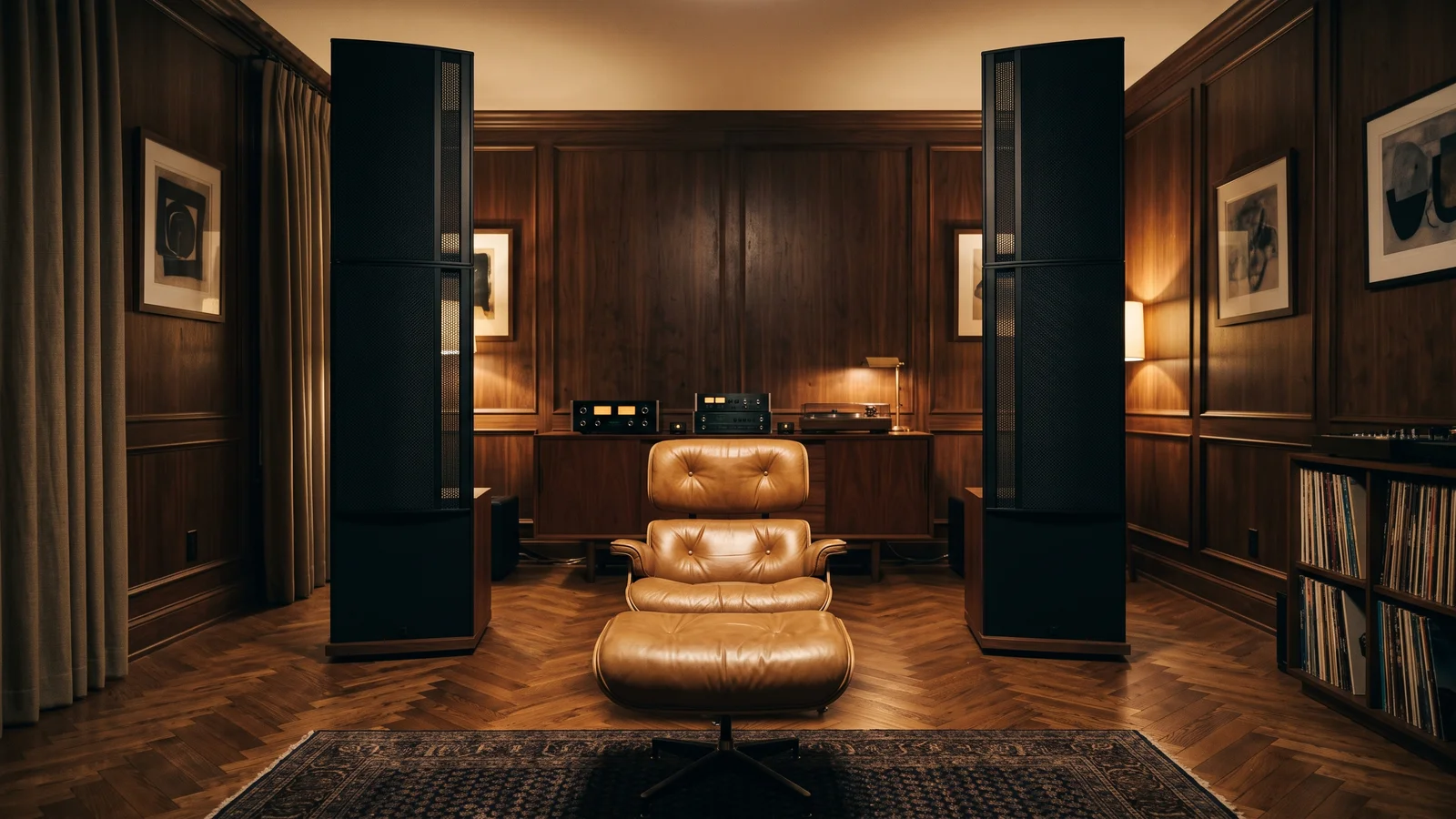
A pair of defense-lab physicists built one of the greatest loudspeakers on Earth, then the name drifted all the way down to car doors. This is what happened to Infinity.
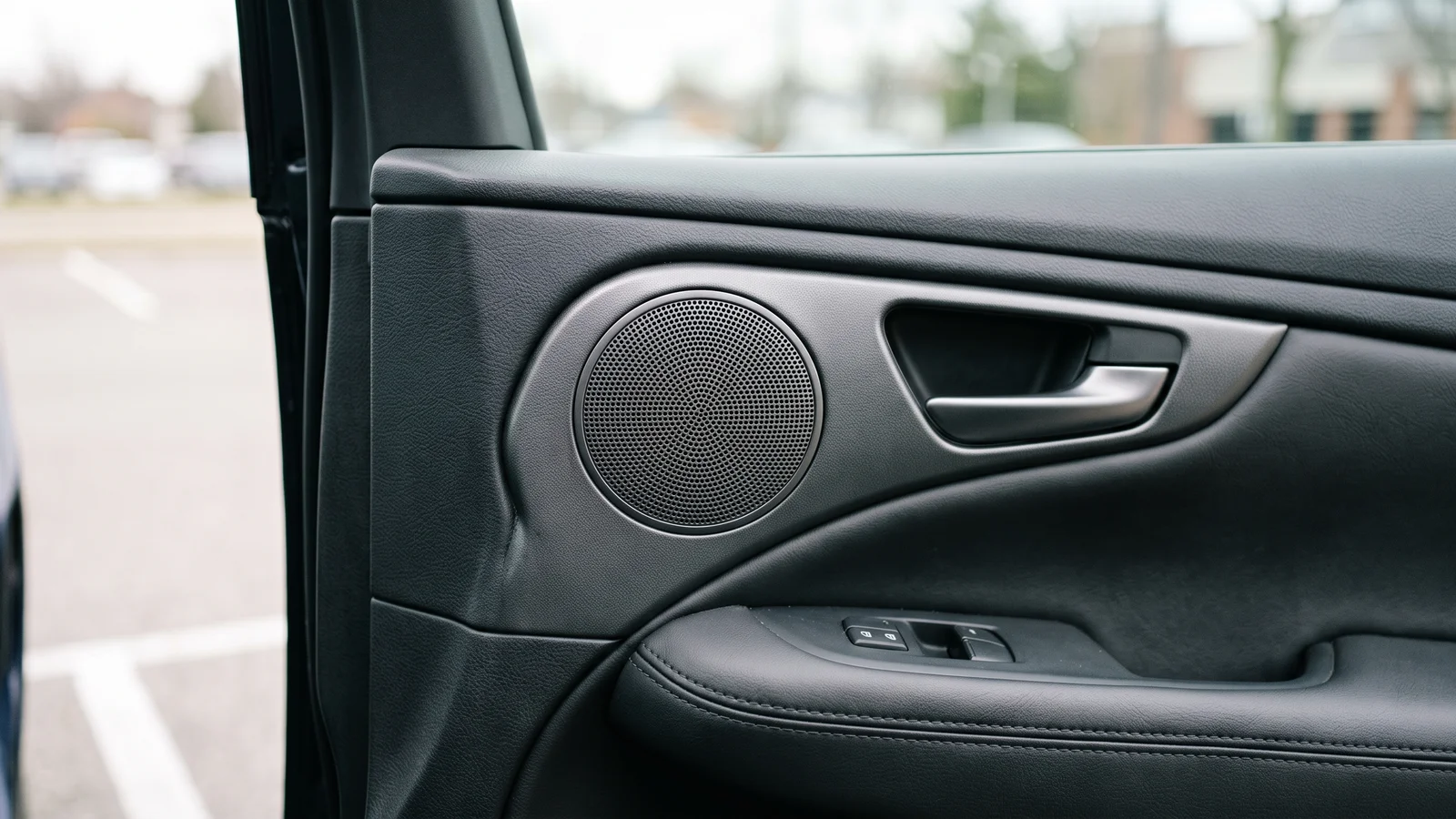
You have probably seen the name on a car door. Little chrome badge on a speaker grille, tucked into a Hyundai or a Kia, playing your podcast on the way to work. That is Infinity today. And if that is the only Infinity you know, you have missed one of the wildest arcs in audio history.
Because for a stretch of years, Infinity built what a lot of serious listeners still call the finest loudspeaker ever made. Not a good speaker. Not a great one. The best. It cost more than a house down payment, it stood taller than the people who owned it, and its bass came out of principles two of the founders learned building missile guidance systems. I have chased that kind of ambition my whole career, so let me tell you how a name that once meant "cost no object" ended up in a clearance bin.
Key Takeaways
- Infinity was founded in 1968 in Los Angeles by physicist Arnie Nudell, electrical engineer John Ulrick, and Cary Christie.
- Its bass technology grew out of servo-feedback principles Nudell and Ulrick worked with at Litton Guidance & Control, a defense contractor.
- The Infinity Reference Standard (around 1980) was a four-tower dipole priced roughly $45,000 to $65,000, widely called one of the finest speakers in the world.
- Harman International bought Infinity in 1983; Harman itself became a Samsung subsidiary in 2017.
- The high-end home line was effectively wound down, and the Infinity name today survives mainly as car audio and OEM factory systems.
- Arnie Nudell (1937-2017) later co-founded Genesis Technologies and built ultra-high-end speakers all over again.
Who founded Infinity, and why were physicists building speakers?
Infinity Systems was founded in 1968 in Los Angeles by three people with unusual resumes: physicist Arnie Nudell, electrical engineer John Ulrick, and Cary Christie, according to the company's history. Nudell and Ulrick were not hobbyists. They came out of Litton Guidance & Control, a defense and aerospace outfit, as Stereophile documented.
That background is the whole reason Infinity sounded like Infinity. When you spend your days making instruments behave in aerospace tolerances, you do not accept "close enough" from a woofer. Nudell in particular treated a loudspeaker like an engineering problem with a right answer, not a matter of taste, as PS Audio's Paul McGowan recalled of his old friend.
The missile-guidance connection
Here is the detail that gets me. The signature Infinity bass came from servo feedback, the same closed-loop control idea used to keep a guided missile on target. A sensor on the woofer cone watched what the driver actually did, compared it to the signal it was supposed to reproduce, and corrected the error in real time, as Stereophile described in its Servo-Statik writeup. Nudell adapted control principles he knew from guidance work and pointed them at a woofer instead of a warhead.
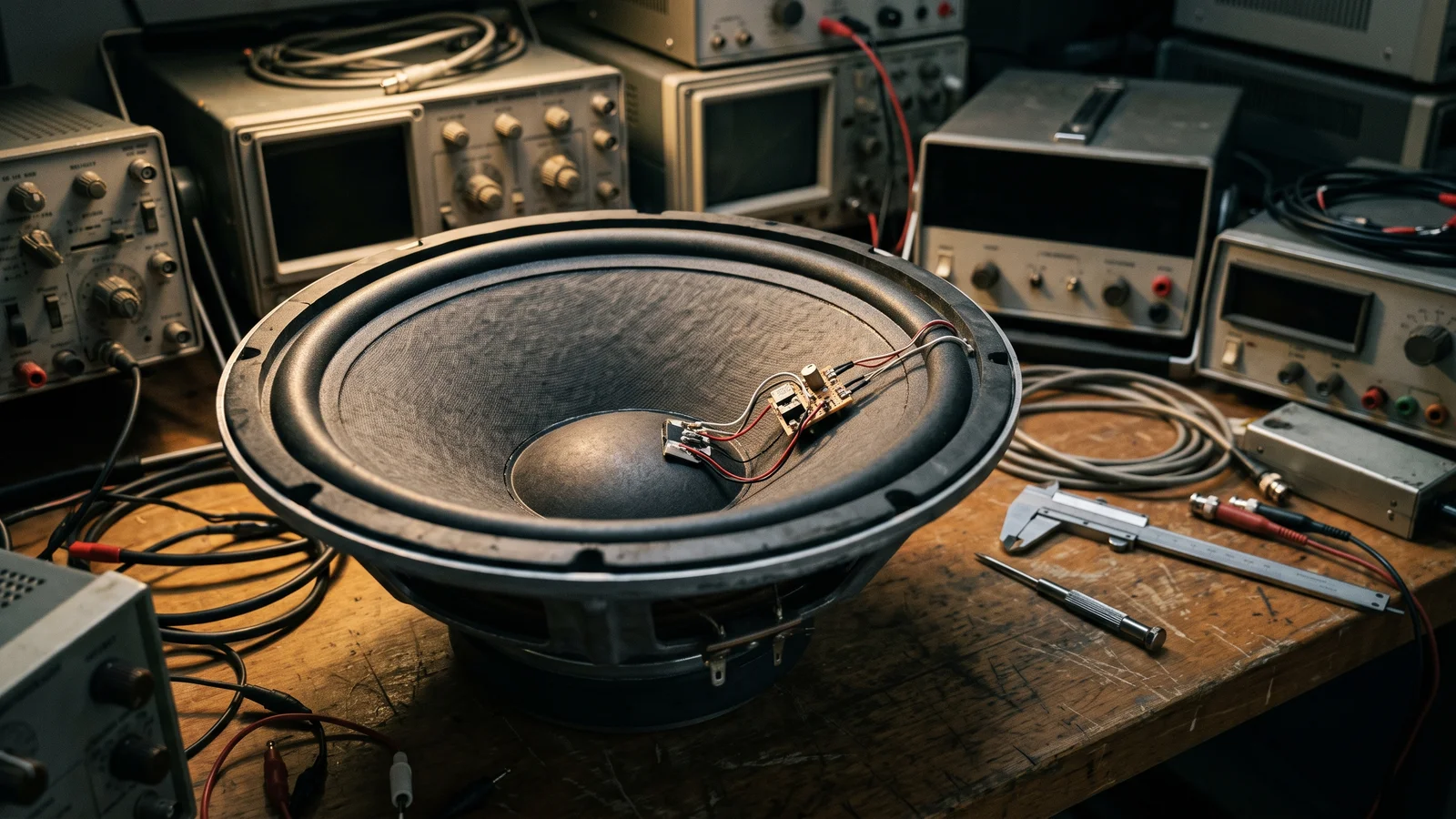
Most speaker companies of that era started with a guy who loved music and taught himself electronics. Infinity ran the other way. It started with the electronics discipline and worked backward to the music. Different DNA, and you could hear it.
What was the Servo-Statik 1, Infinity's first speaker?
The Servo-Statik 1 arrived in 1968 as Infinity's debut, a four-piece system priced around $2,000 in period dollars, per Stereophile's account. It paired electrostatic panel arrays for the mids and highs with a single servo-controlled 18-inch woofer, plus a separate crossover and amplifier. Nobody was shipping anything quite like it.
Think about how bold that is for a first product. Instead of a safe two-way box, three guys with a defense-lab pedigree led with a hybrid electrostatic-plus-servo-woofer system that needed its own dedicated bass amp. The special 18-inch woofer was built by Gene Czerwinski, a name that would go on to matter in pro audio, as PS Audio recounted in its history of the design. The servo loop tamed that big cone so it moved a lot of air without the boom and overhang most big woofers give you.
The Servo-Statik did not sell in huge numbers. It did not need to. It planted a flag: Infinity would chase the best possible reproduction and let the price land where it landed. That philosophy built the legend, and eventually it left the company vulnerable, but we will get to that.
What made the Infinity Reference Standard the finest speaker of its era?
The Infinity Reference Standard, or IRS, appeared around 1980 as a towering four-tower dipole line source priced roughly $45,000 to $65,000 depending on the version, and reviewers routinely called it one of the finest loudspeakers in the world, as The Absolute Sound recalled in its Nudell tribute. This was not a speaker. It was an installation.
Picture four towers taller than a person. Two of them were pure woofer columns, each carrying six 12-inch servo-driven woofers with their own dedicated servo amplifier, as Stereophile detailed in Anthony Cordesman's review of the IRS. The other two towers handled everything above the bass, packed with midrange planars and dozens of tweeters arranged as a floor-to-ceiling line source. Twelve twelve-inch woofers, driven by servo control, in a domestic living room. That is the kind of number that still makes builders grin.
I have never had an IRS on the bench, and I will be honest about that. But I have read the measurements and the owner accounts for decades, and the through-line is consistent: this thing did dynamics, scale, and low-end control that boxed speakers simply could not touch, as Stereophile's coverage of the later IRS Beta reflected. When people say "reference," this is the speaker the word was built around.
The EMIT and EMIM drivers that made it sing
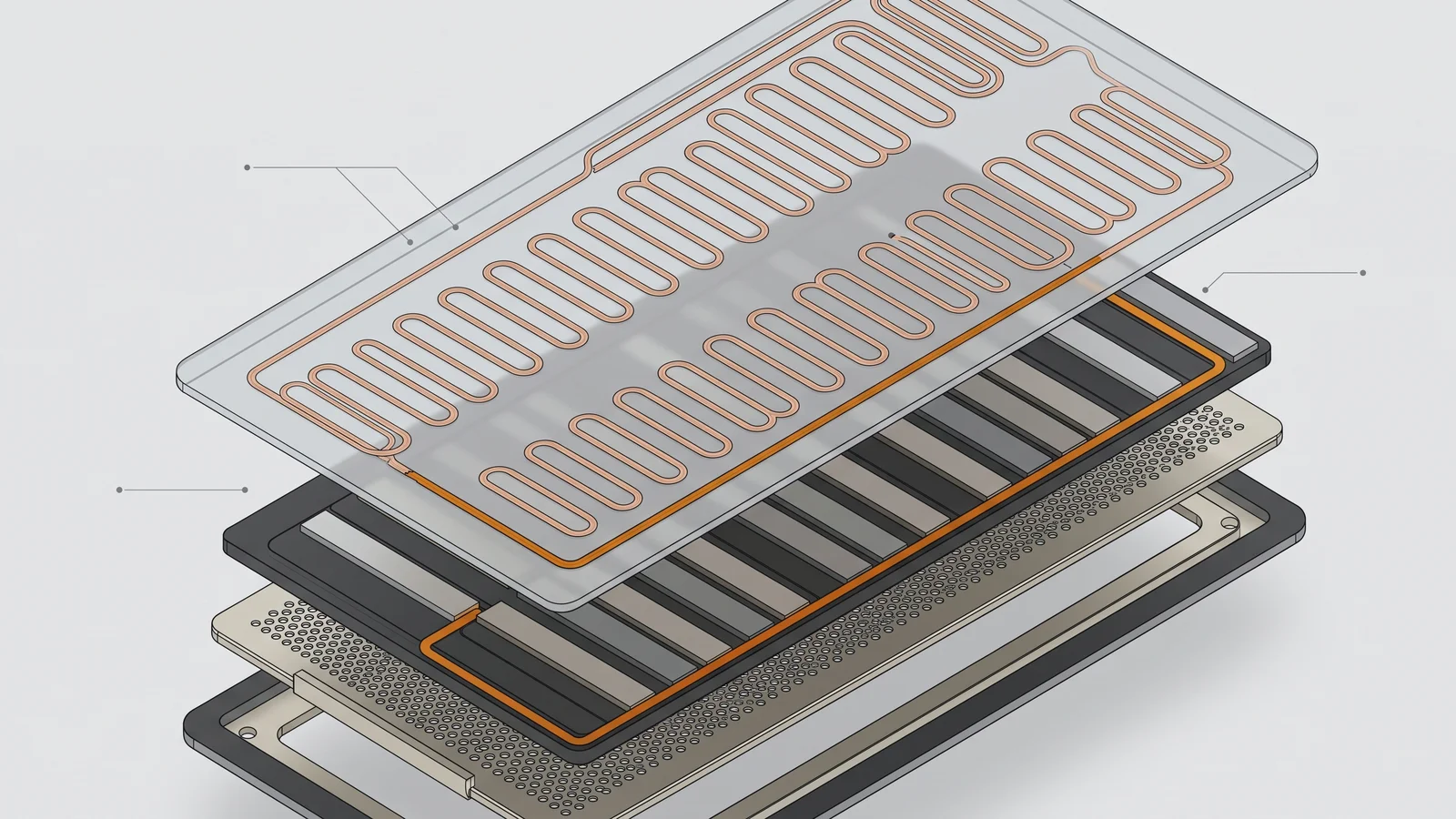
The reason those upper towers sounded so fast and open comes down to two Infinity inventions from the late 1970s: the EMIT tweeter and the EMIM midrange. EMIT stood for electromagnetic induction tweeter, and both drivers were thin planar quasi-ribbon designs using samarium-cobalt rare-earth magnets, as the enthusiast history at Aural HiFi documents. Rare-earth magnets were exotic and expensive then. Infinity used them anyway.
A planar driver moves almost no mass compared to a conventional dome, so it starts and stops with the signal instead of lagging behind it. That is what people meant when they described Infinity's highs as effortless. The EMIT and EMIM ideas trickled down for years into the Kappa series and beyond, as Stereophile noted across its Infinity coverage. For a while, a slice of that reference technology showed up in speakers regular people could actually buy.
How did Infinity slide from reference standard to OEM nameplate?
The turn came in 1983, when Harman International acquired Infinity, and it accelerated when Harman itself became a Samsung subsidiary in 2017, as BGR reported in its roundup of Samsung-owned audio brands. Under corporate ownership the brand drifted steadily down-market: from cost-no-object reference speakers, to mass-market home audio, to predominantly car audio and OEM factory systems.
Follow the descent and it is almost a textbook. The IRS and its planar magic sat at the top. Then came affordable home towers and bookshelves carrying a few of those ideas. Then home audio faded into the background and the volume moved to car speakers and factory-installed sound systems for automakers like Hyundai, Kia, and Chrysler, as Sound & Vision noted in its remembrance of Nudell's career. The badge stayed prestigious-sounding. The mission behind it quietly changed.
This is the pattern the writer Cory Doctorow named enshittification: a thing that was built to be the best gets slowly optimized for margins and volume until the name is worth more than the product under it. A company that once shipped a four-tower, twelve-woofer statement loudspeaker for the price of a luxury car became, over decades, a nameplate stamped on OEM speakers inside someone else's dashboard. The engineering that earned the name and the spreadsheet that later monetized it are two very different animals.
Now let me be fair, because the IRS-era engineering was the real thing, and so was the talent. The magic did not evaporate. It walked out the door with the people who made it, which is exactly where this story turns hopeful.
Who owns Infinity now, and are the speakers still made?
Infinity is owned today by Harman International, a Samsung subsidiary since 2017, and its center of gravity has moved almost entirely to car and OEM audio, as BGR laid out in its list of Samsung's audio holdings. The high-end home loudspeaker line that built the brand's reputation has been effectively wound down. Today the Infinity name lives on primarily as car speakers and OEM factory systems inside the Harman portfolio.
I want to be precise here, because sloppy takes overstate this. I am not telling you zero Infinity home products have ever existed since. The car-audio side, the Reference, Kappa, and Primus lines, is unambiguously alive and selling in 2026. What is gone is the thing that made the name mean something: the pursuit of the absolute best, cost be damned. Longtime enthusiasts have tracked that home-line fade for years, as owners have discussed at length on the AVS Forum. The badge survived. The mission retired.
Where Nudell's magic actually went
Here is the part that redeems the whole story. Arnie Nudell (1937-2017) did not stop when the corporate era took over. He co-founded Genesis Technologies with PS Audio's Paul McGowan to build ultra-high-end loudspeakers all over again, chasing the same reference ideals that made the IRS legendary, as Stereophile recounted in its interview tracing his path from Infinity to Genesis. When Nudell died in 2017, the tributes did not mourn a brand. They mourned the man, as The Absolute Sound made clear.
That is the lesson under all of this. The talent carried the magic, not the nameplate. A logo can be bought, relocated, and printed on a car door. The person who actually knows how to make a speaker disappear and leave only the music behind cannot be acquired in a merger.
That is why, in our Arizona workshop, the builder's name stays on the work. A nameplate optimized for conglomerate margins and OEM volume answers to a spreadsheet. A hand-built, made-to-order speaker answers to the person who signed it. We build custom loudspeakers one small batch a year, by hand, the way Nudell and his crew built the ones people still talk about. Not for a balance sheet. For the room they are going into.
Frequently Asked Questions
What happened to Infinity speakers?
Infinity started in 1968 building reference-grade home speakers, peaking with the Infinity Reference Standard around 1980. After Harman International bought the company in 1983, and Samsung acquired Harman in 2017, the brand drifted down-market. Today Infinity survives mainly as car audio and OEM factory systems, and the flagship home line was effectively wound down.
Who owns Infinity now?
Infinity is owned by Harman International, which has been a Samsung subsidiary since 2017. Under this corporate structure, Infinity's focus shifted almost entirely to car audio and factory-installed OEM systems for automakers. The prestigious high-end home loudspeaker line that originally built the brand's reputation has been effectively discontinued.
What was the Infinity Reference Standard (IRS)?
The Infinity Reference Standard, introduced around 1980, was a towering four-tower dipole loudspeaker system priced roughly $45,000 to $65,000. Two towers held six 12-inch servo-controlled woofers each, while two more carried planar midranges and dozens of EMIT tweeters. Reviewers widely regarded it as one of the finest loudspeakers ever made.
Are Infinity speakers still made?
Yes, but not the kind that made the brand famous. Infinity car-audio lines like Reference, Kappa, and Primus remain active in 2026, and the name still appears in OEM factory systems. However, the cost-no-object high-end home loudspeakers that defined Infinity's golden age have been effectively wound down under Samsung's Harman.
Who founded Infinity?
Infinity was founded in 1968 in Los Angeles by physicist Arnie Nudell, electrical engineer John Ulrick, and Cary Christie. Nudell and Ulrick came from Litton Guidance & Control, a defense and aerospace contractor, and adapted servo-feedback principles from missile guidance into Infinity's signature bass technology. Nudell later co-founded Genesis Technologies.
Sources
- Wikipedia, "Infinity Systems": https://en.wikipedia.org/wiki/Infinity_Systems
- The Absolute Sound, "Arnie Nudell, 1937-2017" (obituary): https://www.theabsolutesound.com/articles/arnie-nudell-1937-2017/
- The Absolute Sound, "TAS Legacy: The Infinity Reference Standard": https://www.theabsolutesound.com/articles/tas-legacy-the-infinity-reference-standard/
- Stereophile, "Arnie Nudell: From Infinity to Genesis": https://www.stereophile.com/interviews/arnie_nudell_from_infinity_to_genesis/
- Stereophile, "From Here to Infinity": https://www.stereophile.com/content/here-infinity
- Stereophile, "Infinity Servo-Statik 1 Loudspeaker System": https://www.stereophile.com/content/infinity-servo-statik-1-loudspeaker-system
- Stereophile, "Infinity IRS Loudspeaker System" (Anthony Cordesman, IRS 1B): https://www.stereophile.com/content/infinity-irs-loudspeaker-system
- Stereophile, "Infinity IRS Beta Loudspeaker" (John Archibald, 1989): https://www.stereophile.com/floorloudspeakers/infinity_irs_beta_loudspeaker/
- PS Audio, "Infinity's First Line Source": https://www.psaudio.com/blogs/pauls-posts/infinitys-first-line-source
- PS Audio, "Arnie Nudell, RIP": https://www.psaudio.com/blogs/pauls-posts/arnie-nudell-rip
- Sound & Vision, "RIP Arnie Nudell": https://www.soundandvision.com/content/rip-arnie-nudell
- Aural HiFi, "The History of Infinity Speakers": https://www.auralhifi.com/blogs/news/the-history-of-infinity-speakers
- BGR, "Audio Brands You Didn't Know Are Owned By Samsung": https://bgr.com/tech/audio-brands-you-didnt-know-are-owned-by-samsung/
- AVS Forum, "Whatever happened to Infinity speakers" (owner discussion, home-line wind-down corroboration): https://www.avsforum.com/threads/whatever-happened-to-infinity-speakers.3084514/
Mike Vincent is the founder of Mike Knows Audio Video and WubWub Audio, where he designs and hand-builds custom loudspeakers and home theaters in Arizona, the old way, for about fifteen clients a year. He has enormous respect for the defense-lab physicists who once made Infinity mean "the best there is"; if you want a speaker built with that kind of care and signed off by hand instead of stamped for a balance sheet, start with our custom loudspeakers.
Comments
Leave a Comment