
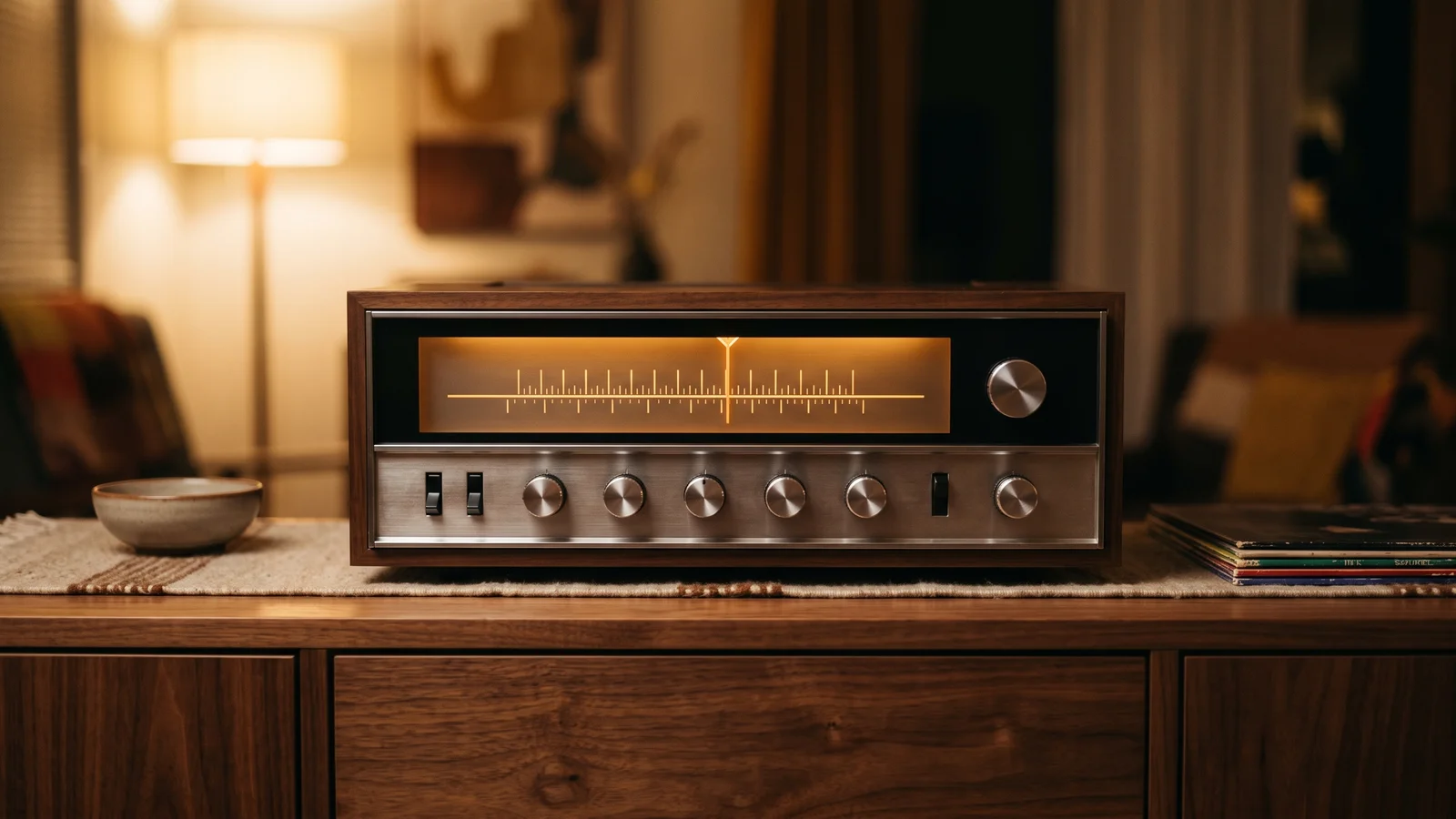
He co-built the first hi-fi receiver, assembled a house of brands from JBL to Mark Levinson, then bought Newsweek for a dollar at 91. Audio's great Renaissance man.
Look at the back of almost any modern AV receiver and you're staring at an idea one man made real in 1954. Before that, hi-fi meant a stack of separate boxes: a tuner here, a preamp there, an amplifier underneath, all wired together by whoever was brave enough. Sidney Harman put the whole works on one chassis and called it a receiver. Then he did something even bigger. He built a company that swallowed half the great names in audio.
Here's the part that makes me shake my head with genuine admiration. This was a guy who ran a global electronics empire, earned a PhD in social psychology on the side, served in a president's cabinet, and bought Newsweek magazine for a dollar when he was 91. Most people would be thrilled to nail one of those. Harman collected them like knobs on a preamp. And the empire he spent a lifetime assembling? It ended up getting consolidated itself, six years after he was gone.
Key Takeaways
- Sidney Harman (1918-2011) co-founded Harman Kardon in 1953 in Westbury, New York, with just $10,000 in startup cash split between two partners.
- The Harman Kardon Festival D-1000, launched in 1954 at $189.50, is widely credited as the first integrated hi-fi receiver, putting tuner, preamp, and amplifier on one chassis.
- He assembled a "house of brands" including JBL, Infinity, AKG, Crown, dbx, Lexicon, and Mark Levinson under Harman International.
- He served as U.S. Under Secretary of Commerce under President Carter and bought Newsweek for $1 in 2010 at age 91.
- Samsung acquired Harman International for roughly $8 billion, closing the deal on March 10, 2017, at $112.00 per share.
Who was Sidney Harman, the man behind the empire?
Sidney Harman (1918-2011) was born in Montreal, Canada, on August 4, 1918, and earned a business degree from the City College of New York in 1940, according to Wikipedia. What followed reads like four careers stacked on one resume: engineer, executive, academic, and cabinet-level government official. He didn't just build audio gear. He kept reinventing himself.
The audio chapter started at the David Bogen Company, a maker of public-address systems, where Harman worked alongside the firm's chief engineer, Bernard Kardon (Wikipedia). One man had the business instincts, the other had the engineering chops. That's a combination I've seen work beautifully and I've seen crater. For these two, it worked. They saw where home audio was headed and decided to bet on it themselves.
The Renaissance man who never sat still
Harman's curiosity didn't stop at circuit boards. In 1973, decades into running a major company, he earned a PhD in social psychology from the Union Graduate School, per Wikipedia. He wrote about workplace dignity and the human side of manufacturing long before that was fashionable. He also married Jane Lakes Harman, who went on to serve nine terms in the U.S. House of Representatives. This was not a man content to be one thing.
Did Sidney Harman really invent the receiver?
The Harman Kardon Festival D-1000, released in 1954 at $189.50, is widely credited as the first integrated hi-fi receiver, combining a tuner, preamplifier, and amplifier on a single chassis, as Harman Kardon frames it in its own 70th-anniversary history. "Credited with" is the honest phrasing here. Even Wikipedia presents it as the company's claim, not settled fact.
That nuance matters, so let me be straight about it. Firsts in audio are notoriously slippery, and someone can always point to an earlier oddball prototype. What's not in dispute is the impact. Before the Festival, buying hi-fi meant assembling a separates rack and praying it all played nice. Harman Kardon put it in one box a normal person could carry home, plug in, and enjoy. That's the idea every AV receiver since has been built on.
Founding Harman Kardon on a shoestring
Harman and Bernard Kardon co-founded Harman Kardon in 1953 in Westbury, New York, each putting in $5,000 for $10,000 total, according to Wikipedia. Ten grand. That's the whole war chest that started one of the biggest names in audio. As someone who knows exactly how far a small budget stretches in this business, I find that number equal parts inspiring and terrifying.
The partnership was short-lived, though not bitter. Harman bought out Kardon in 1956, and Kardon retired the following year (Wikipedia). From there, the company carried both their names but ran on Harman's ambition alone. And ambition is the right word, because he was just getting warmed up.
How did Sidney Harman build his house of brands?
Harman turned a single receiver company into a sprawling audio conglomerate, and the anchor purchase came in 1969 when he acquired the legendary loudspeaker maker JBL, according to Wikipedia's account of the company. JBL gave him professional and consumer speaker credibility in one stroke. From there, the shopping list only grew, and it read like a hall of fame.
Through the 1980s, the group added Infinity, AKG, Crown, dbx, Soundcraft, Studer, and Lexicon, as documented in Wikipedia's history of Harman International. Studio microphones, power amps, mixing consoles, digital reverb, the works. Later came the high-end jewel in the crown: Mark Levinson and Revel joined via the acquisition of Madrigal Audio in 2003. Martin followed in 2013, AMX in 2014, and Bang & Olufsen's automotive business in 2015. Each buy filled a gap. Together they formed an empire.
From receivers to the road
Here's the strategic pivot most people miss. Harman quietly became one of the biggest names in car audio and connected-car electronics, and by the 2010s that division was the real engine. The living-room speaker was the origin story. The dashboard was the future. That shift is exactly why the company became a takeover target worth billions, and it's the thread that leads straight to the final act.
What did Sidney Harman do besides audio?
Harman's second and third acts would each make a full biography, and the strangest may be his cabinet post: he served as U.S. Under Secretary of Commerce under President Jimmy Carter around 1977 to 1978, per Wikipedia. To take the job and avoid a conflict of interest, he sold Harman Kardon to Beatrice Foods in 1977. Yes, a food conglomerate briefly owned one of hi-fi's founding names.
Then he did the thing almost nobody does. In 1980 he bought the audio business back and rebuilt it as Harman International (Wikipedia). Before all that, he'd even served roughly three years as president of Friends World College, a small experimental Quaker school. Government, academia, and a global manufacturer, and he treated each like a puzzle worth solving. The man simply refused to retire into a hobby.
Buying Newsweek for a dollar at 91
The final flourish is my favorite. On August 2, 2010, at age 91, Sidney Harman bought Newsweek magazine from The Washington Post Company for $1 plus assumed liabilities, as Graham Holdings announced at the time. One dollar. Most people that age are managing their nap schedule. Harman took over a struggling national magazine because he thought he could fix it. That's not a business decision. That's a personality.

Who owns Harman now, and what happened to the empire?
Samsung Electronics acquired Harman International, closing the deal on March 10, 2017, at $112.00 per share for roughly $8 billion, as Harman announced in its own press release. Harman became a standalone Samsung subsidiary and was delisted from the New York Stock Exchange that March, confirmed in the SEC filing. The consolidator, at last, had been consolidated.
The driver wasn't your living-room speaker. Samsung wanted the automotive and connected-car business, as its own newsroom made plain. Harman spent decades buying up the great names of audio, and then a bigger fish bought Harman for reasons that had more to do with dashboards than dust caps. There's a grim symmetry to that. The empire builder became a line item in someone else's growth strategy.
The honest part: this isn't the brand's funeral
Now let me be fair, because this series has a temper about corporate buyouts and I don't want to swing it unfairly here. Harman Professional, which includes JBL Pro, Crown, Soundcraft, Studer, Lexicon, AKG, and Martin, remains genuinely serious, industry-leading gear. Walk into a real concert or recording studio and you'll still see those names doing hard work. The automotive division is a legitimate leader too. This is an ownership and character shift, not a death.
That said, there's a word for what tends to happen when a corporate parent starts optimizing a beloved name for volume and margin instead of the person who buys it, and that word is enshittification. On the consumer side you feel it: a storied badge stamped on a Bluetooth puck, the soul quietly value-engineered out. It doesn't erase the great professional gear. It just means the logo now answers to a spreadsheet in a different country.
The other direction
I build in the exact opposite direction from all this, and I say that with respect for what Harman accomplished, not a sneer. Empire-scale means one company owning a hundred names and answering to shareholders. My whole thing is one workshop, one client at a time, custom loudspeakers hand-built here in Arizona for about fifteen households a year. Sidney Harman consolidated the industry. Some of us would rather stay small enough to still care whose living room the speaker is going into, which is the entire idea behind how we build custom home theater systems.
Frequently Asked Questions
Who was Sidney Harman?
Sidney Harman (1918-2011) was a Canadian-born American businessman who co-founded Harman Kardon in 1953 and built Harman International into a global audio empire (Wikipedia). He also earned a PhD in social psychology, served as U.S. Under Secretary of Commerce, and bought Newsweek magazine for $1 in 2010 at age 91.
Who invented the receiver?
Sidney Harman and Bernard Kardon are widely credited with the first integrated hi-fi receiver, the Harman Kardon Festival D-1000, released in 1954 at $189.50 (Harman Kardon). It combined a tuner, preamp, and amplifier on one chassis. This is framed as the company's claim rather than an undisputed historical fact.
What brands does Harman own?
Harman International owns a large house of brands including JBL, Infinity, AKG, Crown, dbx, Soundcraft, Studer, Lexicon, Mark Levinson, Revel, Martin, and AMX (Wikipedia). Many were acquired across the 1980s, with Mark Levinson and Revel arriving in 2003 through the purchase of Madrigal Audio.
Who owns Harman now?
Samsung Electronics owns Harman International. Samsung completed the acquisition on March 10, 2017, paying $112.00 per share for roughly $8 billion, and Harman now operates as a standalone Samsung subsidiary (Harman). Samsung's main goal was Harman's automotive and connected-car technology business.
Is JBL still part of Harman?
Yes. JBL has been part of Harman since 1969 and remains so under Samsung's ownership (Wikipedia). JBL spans both consumer products, like portable Bluetooth speakers, and JBL Professional, whose loudspeakers and cinema systems are still standard equipment in concert venues and recording studios worldwide.
Sources
- Wikipedia — "Sidney Harman": https://en.wikipedia.org/wiki/Sidney_Harman
- Wikipedia — "Harman Kardon": https://en.wikipedia.org/wiki/Harman_Kardon
- Wikipedia — "Harman International": https://en.wikipedia.org/wiki/Harman_International
- Wikipedia — "JBL": https://en.wikipedia.org/wiki/JBL
- Harman — "Samsung Electronics Completes Acquisition of Harman": https://news.harman.com/releases/samsung-electronics-completes-acquisition-of-harman
- Harman Kardon — "Harman Kardon Celebrates 70 Years of Beautiful Sound": https://news.harman.com/releases/harman-kardon-celebrates-70-years-of-beautiful-sound
- Samsung Newsroom — "Samsung Electronics to Acquire Harman": https://news.samsung.com/global/samsung-electronics-to-acquire-harman-accelerating-growth-in-automotive-and-connected-technologies
- U.S. Securities and Exchange Commission — Harman International Form 8-K (March 2017): https://www.sec.gov/Archives/edgar/data/800459/000119312517078968/d184457d8k.htm
- Graham Holdings — "Dr. Sidney Harman to Purchase Newsweek from The Washington Post Company": https://web.archive.org/web/20251206172257/https://www.ghco.com/news-releases/news-release-details/dr-sidney-harman-purchase-newsweek-washington-post-company
- Forbes — "Audio Pioneer And Newsweek Owner Sidney Harman Dies": https://www.forbes.com/sites/danbigman/2011/04/13/audio-pioneer-and-newsweek-owner-sidney-harman-dies-at-93/
- NPR — "Sidney Harman Has Died; He Was An Audio Pioneer And Philanthropist": https://www.npr.org/sections/thetwo-way/2011/04/13/135379381/sidney-harman-has-died-he-was-an-audio-pioneer-and-philanthropist
- Sound & Vision — "Audio Industry Loses Pioneer Sidney Harman": https://www.soundandvision.com/content/audio-industry-loses-pioneer-sidney-harman
- What Hi-Fi? — "Harman/Kardon co-founder Sidney Harman dies aged 92": https://www.whathifi.com/news/harmankardon-co-founder-sidney-harman-dies-aged-92
Mike Vincent is the founder of Mike Knows Audio Video and WubWub Audio, where he designs and hand-builds custom loudspeakers and home theaters in Arizona, the old way, for about fifteen clients a year. He has spent enough time reading the backs of receivers to appreciate the man who put the whole thing on one chassis; if you want a system built by hand instead of assembled by a spreadsheet, start with our custom home theater systems.
Comments
Leave a Comment