
The suits bought the names, offshored the soul, and sold you the logo. Here's the map of who really owns your audio brands now, with the receipts.
Somewhere in a spreadsheet right now, a name you trust is a line item. Maybe it's JBL, born in a California garage. Maybe it's Polk, hand-soldered in Baltimore. Maybe it's Marantz, which started on a guy's kitchen table in Kew Gardens, Queens. These brands were built by obsessives who cared more about the sound than the margin. Today most of them are assets, bought and sold like used cars.
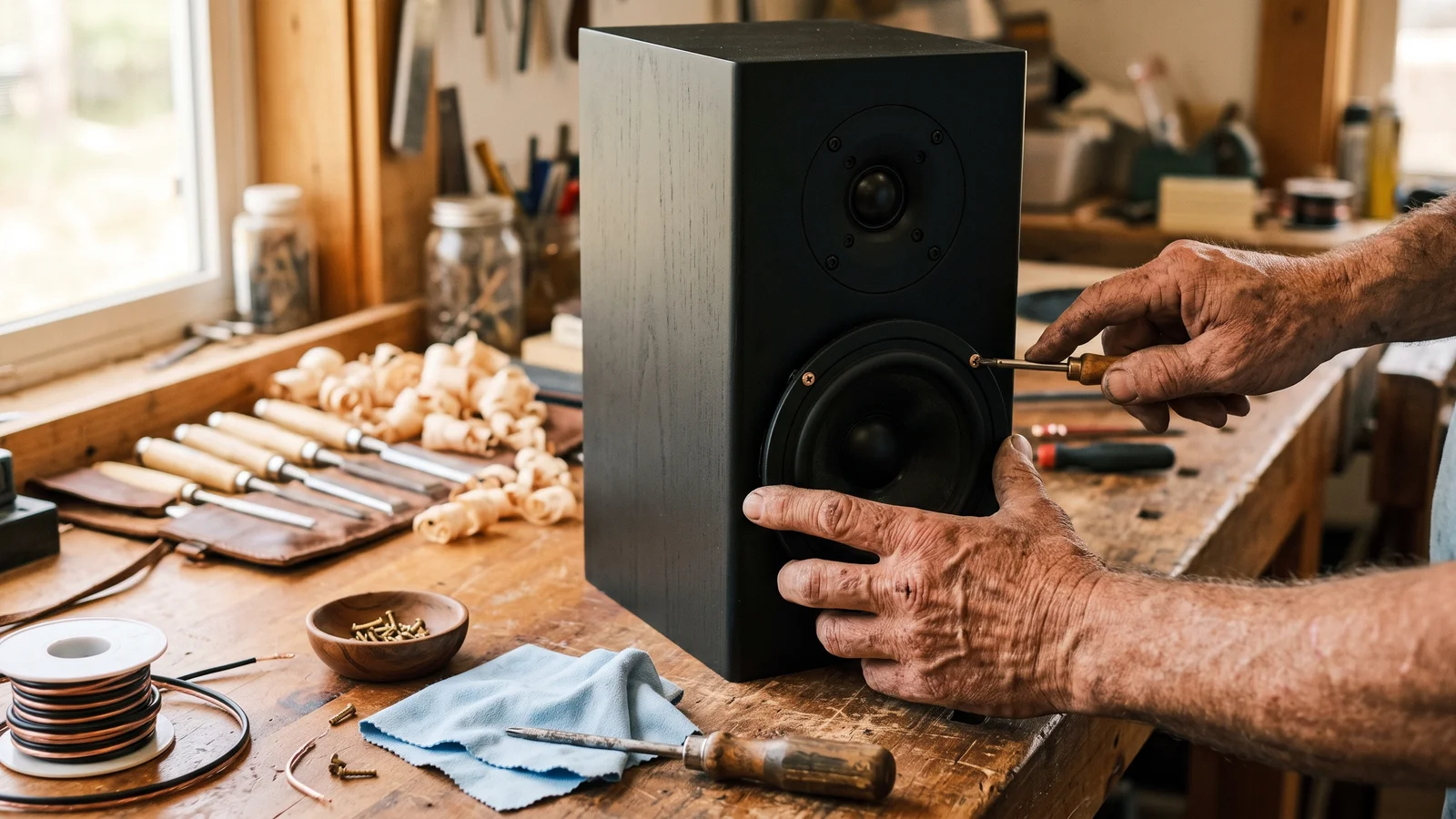
I build speakers by hand in Arizona, so I've watched this happen up close for years, one nameplate at a time. A great little company gets bought. The engineers get "streamlined." Production moves offshore. The logo stays, because the logo is the only thing worth money now. If you've ever wondered what happened to the American audio brands your dad swore by, this is the story, and it has a name.
Key Takeaways
- "Enshittification," coined by writer Cory Doctorow in January 2023, describes how platforms decay; here I'm applying it by analogy to physical hi-fi.
- Samsung closed its ~$8.0 billion purchase of Harman in 2017, absorbing JBL, AKG, Infinity, Revel, Mark Levinson, and Lexicon.
- Masimo, a medical-device maker, bought Sound United for $1.025 billion in 2022, then sold it to Samsung's Harman for just $350 million in 2025.
- An auto-parts company, Gentex, now owns Klipsch, Onkyo, and Pioneer's home line through its 2025 purchase of Voxx.
- The counter-examples matter: Dolby, McIntosh, Magnepan, PS Audio, and Schiit show it didn't have to go this way.
What is "enshittification," and who coined it?
Enshittification is a term coined by writer Cory Doctorow in January 2023 to describe how digital platforms decay over time, and the American Dialect Society named it the 2023 Word of the Year in a January 2024 vote. Doctorow was writing about apps and websites, not speakers. I'm borrowing his framework and pointing it at hi-fi, because the pattern rhymes.
Here's how Doctorow laid it out. "Here is how platforms die: first, they are good to their users; then they abuse their users to make things better for their business customers; finally, they abuse those business customers to claw back all the value for themselves. Then, they die," he wrote on his blog Pluralistic on January 21, 2023. Read that again with a speaker company in mind.
The word caught fire fast. It first surfaced online in late 2022, then exploded after Doctorow's January 2023 essay, and by the time the American Dialect Society held its vote, it had a life of its own. People reached for it because it named a feeling everyone already carried around: that the stuff they used to love was quietly getting worse while the companies selling it got richer. Sound familiar?
Now, fair's fair: Doctorow never said a word about audio gear. The three-stage decay he described lives in software and marketplaces, where a company can quietly change the product under your feet. So this is my analogy, clearly labeled as mine. But swap "platform" for "beloved speaker brand" and "users" for "the people who loved that sound," and the shoe fits ugly-well.
The audio version goes like this. A founder builds something great and sells it honestly. Then a bigger company buys the name and starts cutting corners the fans can't see: cheaper drivers, offshore assembly, thinner cabinets. Finally the brand becomes pure IP, a logo slapped on whatever the contract factory is making that season. The value gets clawed back to the owner. The sound? That's somebody else's problem now.
Who owns your audio brands now?
Most legendary audio names now sit inside a handful of conglomerates, and several of those parent companies don't even make audio. Samsung owns Harman. An auto-parts firm owns Klipsch. A medical-device company briefly owned your Denon receiver. If you want to know who owns JBL, Denon, Marantz, or Klipsch today, the honest answer is: probably not who you think.
Let's follow the money, because the receipts are public. Samsung Electronics closed its acquisition of Harman in March 2017 for roughly $8.0 billion, or $112 per share, according to the SEC filing. That one deal handed a phone maker JBL, AKG, Harman Kardon, Infinity, Revel, Mark Levinson, and Lexicon in a single afternoon. Decades of American and Austrian engineering, absorbed by a chaebol.
And Samsung wasn't done shopping. In 2025 Harman circled back and bought Sound United too, pulling Denon, Marantz, and Bowers & Wilkins into the same house as JBL. We'll get to that round-trip in a minute, because it's the most expensive lesson in this whole piece. For now, just clock the gravity of it: the big get bigger, and the names keep clustering into fewer and fewer hands.
The auto-parts twist: Gentex, Voxx, and a graveyard of names
The strangest owner on the map makes rearview mirrors. Gentex, an automotive-mirror company, completed its acquisition of Voxx International in April 2025 for about $196 million, or $7.50 per share. Voxx had spent years collecting fallen audio brands. So Klipsch, Onkyo, Integra, Pioneer's home-A/V line, Advent, and Acoustic Research now all live inside an auto-parts conglomerate.
Voxx built that pile deal by deal. It bought Klipsch in 2011 for $169.6 million, per its SEC filing. A decade later, in September 2021, a Voxx-Sharp joint venture called Premium Audio Company scooped up Onkyo and Integra's A/V assets. Klipsch, the horn-loudspeaker company Paul W. Klipsch started in Hope, Arkansas, is now a cousin of a mirror business. Try explaining that to the old man.
The rest of the map: IAG, Music Tribe, Edifier, inMusic, and Bose
The pattern goes global from here. The Chinese-owned International Audio Group, run by the Chang family out of a 400,000-square-meter plant in Ji'An, quietly bought the British hi-fi hall of fame: Wharfedale and Leak in 1997, Audiolab in 2004, and Mission in 2005. Those very English names are now designed and built in China. Meanwhile Music Tribe, founded by Uli Behringer, picked up Tannoy in April 2015 as part of the TC Group.
A few more, because the list gets long. China's Edifier bought the revered electrostatic-headphone maker Stax in December 2011. The privately held U.S. company inMusic, run by the O'Donnell family, now holds Akai Professional, Numark, M-Audio, Denon DJ, Rane, and Moog. And in a genuine plot twist, Bose bought McIntosh in November 2024. So a company famous for wave radios now owns the most storied name in American high-end amplification. We'll get to why that one might actually be okay.
To be fair, foreign or corporate ownership isn't automatically a death sentence. A Chinese factory can build a fine speaker, and IAG has kept some of those British names in production that might otherwise be gone entirely. The problem was never the passport on the parent company or the size of its balance sheet. The only question that matters is whether anyone left in the building still cares how the thing sounds.
Why would a mirror company want a speaker brand?
Because a trusted brand name is worth more than the factory that made it. A logo like Klipsch carries decades of goodwill, dealer relationships, and pricing power, which is exactly why Voxx paid $169.6 million for it in 2011 before Gentex bought the whole collection. To a conglomerate, the sound is secondary; the shelf space is the asset.
That's the uncomfortable logic under every deal in this article. Brands are financial instruments now. A parent company can license the name, stretch it across a dozen price tiers, and keep selling the goodwill built by people who retired or died decades ago. Cutting the cost of the actual product only fattens the margin on that goodwill. The name does the selling; the factory is just overhead to be minimized.
None of this is illegal, and some of it is even rational on a spreadsheet. That's what makes it so effective and so quietly corrosive. Nobody wakes up planning to ruin a storied brand. They just optimize it, quarter by quarter, swap a part here and a supplier there, until the thing that made it special is a paragraph in a brand-guidelines PDF and a font nobody's allowed to change.
How does the audio version of this pattern actually play out?
The pattern is almost always the same three moves: buy the name, cut the cost, then treat the brand as a tradeable asset rather than a living company. Offshoring is the visible middle step, and it's a documented fact for brand after brand. Whether the sound got worse is a fair-comment debate, so I'll hand those judgments to the reviewers and owners who make them.
Watch for three tells and you'll spot the arc every time. First, the founders leave or get pushed out. Second, the "Made in" label quietly changes. Third, the model lineup balloons while the real flagship disappears without a goodbye. Every brand in this section hit at least two of those marks. Most of them hit all three, in order.
Polk Audio: from a Baltimore bench to a Tijuana line
Polk is the classic offshoring story. Matthew Polk and George Klopfer founded Polk Audio in Baltimore in 1972, hand-building speakers for people who wanted real sound without a mortgage. Then in 1995 the company moved most of its manufacturing to Tijuana, Mexico, citing wages that ran, by one account, seven to eight times lower than in the States, before more production later shifted to China.
The move offshore is fact. The "does it still sound like Polk" argument is opinion, and it's an argument audiophiles have had on forums for twenty years. I won't put words in reviewers' mouths. What I'll say as a builder is this: when you separate the people who design a speaker from the people who build it by a border and a spreadsheet, something usually gets lost in translation, and the fans are rarely wrong when they notice.
Boston Acoustics: a nameplate quietly switched off
Some brands don't get offshored. They just get turned off. Boston Acoustics, founded in Massachusetts in 1979 and beloved for punching way above its price, was effectively retired by around 2018, when its then-owner Sound United reportedly stopped shipping the brand to dealers. No press release, no funeral. The nameplate was simply allowed to go dark.
I'll flag the sourcing here honestly, because I'd want you to. The exact date is murky, traced mostly through trade chatter and forum reports rather than a clean corporate statement, so I'll say "around 2018" and leave it hedged. But the outcome isn't in dispute: a genuinely great American speaker brand exists today mostly as a memory. That's enshittification's quietest ending, the one where the value just stops.
Onkyo: an Osaka legend into bankruptcy
Onkyo shows the harshest version of the arc. The Osaka company was a giant of Japanese hi-fi for decades. Its A/V assets went to the Voxx-Sharp joint venture in 2021, and then the legacy entity, Onkyo Home Entertainment, filed for bankruptcy in May 2022 with liabilities of roughly ¥3.1 billion, about $24 million, as Forbes reported.
The name didn't die, though. It lives on today, largely licensed onto budget-tier gear, which is its own kind of sad ending for a company that once built serious receivers. A famous name, a bankruptcy filing, and a logo that keeps working the door long after the original crew went home. If you can find a cleaner illustration of a brand outliving its soul, I'd like to see it.
Sound United: the $675 million round-trip
The Sound United saga is the purest example of brands-as-assets, and the numbers tell it without any help from me. Masimo, a medical-device company, bought Sound United for $1.025 billion in April 2022, acquiring Bowers & Wilkins, Denon, Marantz, Polk, Definitive Technology, Classé, and Boston Acoustics. Three years later it sold the whole thing for a fraction of that.
Here's the round-trip. In May 2025 Masimo agreed to sell its consumer-audio business to Samsung's Harman for $350 million, a deal that closed in September 2025. Do the math: about $675 million in value, roughly two-thirds of the price, evaporated in three years. The sale followed an activist-investor proxy war, led by Politan Capital, that ousted Masimo's founder-CEO Joe Kiani in 2024.
So who owns Denon and Marantz now? Samsung's Harman, as of late 2025. Which means Marantz, the amplifier Saul Marantz built at his kitchen table, and Denon, and B&W, all rode from a medical-device balance sheet to a phone giant's portfolio in three years flat. Stereophile framed it plainly: Sound United found a new home at Harman. Nobody in that sentence is an audio founder. That's the whole point.
Is every acquisition a hit job?
No, and I'd be a hypocrite to pretend otherwise. Plenty of great audio survives inside big companies, and a few founders built their businesses so smartly that no spreadsheet could gut them. Fairness matters here, because the villain isn't "being owned by a corporation." The villain is treating a sound like a stock. Some owners get that.
Dolby is the cleanest counter-example, and it's a whole story on its own. Ray Dolby went public in 2005 but structured the company so his family kept voting control, and Dolby licenses its engineering instead of selling boxes, posting roughly $1.35 billion in FY2025 revenue as an R&D-first company. There's no factory to offshore and no soul to sell, because the soul is the patents. That's a moat, built on purpose.
McIntosh is the nuanced one. It was owned by private equity, Highlander Partners of Dallas, which bought the McIntosh Group in 2022. But Highlander kept McIntosh's manufacturing in Binghamton, New York, and then sold it to Bose in November 2024, as Forbes covered. PE-owned, American-built, quality intact. I won't guess what Bose does next, but the McIntosh story proves an owner can hold a legend without hollowing it out.
And then there are the stubborn independents still doing it their own way. Magnepan is still building its planar-magnetic panels in Minnesota. PS Audio and Schiit Audio both build in the U.S. and are vocal about staying vertically integrated instead of chasing the cheapest contract factory. These companies exist. That's the important part. The offshore-and-gut playbook is a choice, not a law of physics.
The lesson in the good cases is remarkably consistent. When the people who own a brand still care about what it makes, and keep the makers close, the sound survives the sale. When the brand is just an entry in a portfolio to be optimized, it doesn't. Ownership structure isn't destiny, exactly, but it sure loads the dice.
What's really lost when a spreadsheet owns a sound?
What's lost is the thing that never shows up on a balance sheet: the obsessive who cared. A speaker isn't just a parts list. It's a thousand small judgment calls made by someone who listened, argued with the marketing department, and refused to ship it until it was right. You can offshore the parts list. You cannot offshore that person.
I've had enough vintage gear on my bench to feel the difference in my hands. The old stuff was overbuilt by people who signed their work, sometimes literally. The cabinets weigh more than they need to. The crossovers use better parts than the price ever justified. That's what care looks like when it's baked into an object, and it's exactly what gets value-engineered out first, because a customer can't see it in the store.
A brand can survive its founder. A sound rarely survives the accountant who inherits it.
So that's the real cost of the enshittification arc, applied to audio. It isn't that the logos vanish. Most of them don't. It's that they keep selling long after the reason to trust them is gone. The badge becomes a ghost wearing the good name of the dead, and the buyer, who just wanted the speaker their dad loved, ends up with a different thing wearing the same clothes.
So what's the antidote to all this?
The antidote is simple, and it's the same one it's always been: keep the people who design the sound and the people who build it under one roof, and refuse to treat the product as a line item. That's not nostalgia. It's just the only structure that has ever reliably protected a sound from a spreadsheet, and the counter-examples prove it works.
I'll be straight about where I stand, since it's my byline on this thing. I build custom loudspeakers by hand in Arizona, for about fifteen clients a year, and I do it precisely because I watched the industry I love get turned into a catalog of logos. When you own the whole process, nobody can quietly swap the drivers to save forty cents a pair. The sound is the product, not the badge on the front.
That's the WubWub thesis in one breath, and the story behind it is the same story you just read, told from the other side. Made in the USA, built to last, backed by real service, sold to people instead of moved as inventory. The golden age of audio wasn't magic. It was just companies that hadn't been eaten yet. Some of us are still cooking.
Frequently Asked Questions
What does "enshittification" mean, and who coined it?
Enshittification is a term coined by writer Cory Doctorow in January 2023 to describe how digital platforms decay: first they treat users well, then they exploit users for business partners, then they claw all the value back for themselves (Pluralistic). The American Dialect Society named it the 2023 Word of the Year. Applying it to physical audio gear is an analogy.
Who owns JBL now?
Samsung owns JBL. Samsung Electronics completed its acquisition of Harman International in March 2017 for roughly $8.0 billion, and Harman's portfolio includes JBL along with AKG, Harman Kardon, Infinity, Revel, Mark Levinson, and Lexicon. So the brand born in James B. Lansing's California workshop is now part of a South Korean electronics giant.
Who owns Denon and Marantz now?
Samsung's Harman owns Denon and Marantz as of late 2025. Medical-device maker Masimo bought their parent, Sound United, for $1.025 billion in 2022, then sold the consumer-audio business to Harman for $350 million in a deal that closed in September 2025. Bowers & Wilkins and Polk came along in the same sale.
Who owns Klipsch now?
An automotive-mirror company, Gentex, owns Klipsch. Gentex closed its acquisition of Voxx International for about $196 million in April 2025, and Voxx had owned Klipsch since buying it for $169.6 million in 2011. Onkyo, Integra, and Pioneer's home-A/V line came in the same deal.
Did these brands really get worse, or is that just nostalgia?
The offshoring and ownership changes are documented facts. Whether the products sound worse is fair-comment opinion, and it varies by brand and model. Some acquired brands held their quality; McIntosh kept its manufacturing in Binghamton, New York, even under private equity, as Forbes reported. The honest answer is: sometimes yes, sometimes no, and the fans usually notice first.
Are any audio companies still independent and made in the USA?
Yes. Dolby stayed independent through a family-controlled share structure and posted roughly $1.35 billion in FY2025 revenue as a licensing and R&D company. Magnepan builds in Minnesota, PS Audio and Schiit Audio build in the U.S., and McIntosh kept manufacturing in New York. Independent, domestically built audio still exists; it's a choice some companies keep making.
Sources
- Cory Doctorow - "The 'Enshittification' of TikTok" (Pluralistic), Jan 21, 2023: https://pluralistic.net/2023/01/21/potemkin-ai/
- American Dialect Society - 2023 Word of the Year is "enshittification": https://americandialect.org/2023-word-of-the-year-is-enshittification/
- Wikipedia - "Enshittification": https://en.wikipedia.org/wiki/Enshittification
- Harman - "Samsung Electronics Completes Acquisition of Harman": https://news.harman.com/releases/samsung-electronics-completes-acquisition-of-harman
- U.S. Securities and Exchange Commission - Harman 8-K (Samsung merger, ~$8.0B / $112 per share): https://www.sec.gov/Archives/edgar/data/0000800459/000119312517078968/d184457dex991.htm
- U.S. Securities and Exchange Commission - Masimo 10-Q (Sound United acquisition, $1.025B): https://www.sec.gov/Archives/edgar/data/937556/000093755622000090/masi-20220402.htm
- Masimo Investor Relations - "Masimo to Sell Consumer Audio Business to HARMAN International" ($350M): https://investor.masimo.com/news/news-details/2025/Masimo-to-Sell-Consumer-Audio-Business-to-HARMAN-International/default.aspx
- Harman - "Masimo to Sell Consumer Audio Business to Harman International": https://news.harman.com/releases/masimo-to-sell-consumer-audio-business-to-harman-international
- Stereophile - "Sound United Finds New Home at Harman": https://www.stereophile.com/content/sound-united-finds-new-home-harman
- MedTech Dive - Masimo consumer-audio sale and Politan proxy fight: https://www.medtechdive.com/news/Masimo-consumer-audio-sale-Harman-Q1/747448/
- Voxx International - "Audiovox Completes Its Acquisition of Audio Leader Klipsch": https://web.archive.org/web/20211027041629/https://investors.voxxintl.com/news-releases/news-release-details/audiovox-completes-its-acquisition-audio-leader-klipsch
- U.S. Securities and Exchange Commission - Voxx 10-Q (Klipsch, $169.6M): https://www.sec.gov/Archives/edgar/data/0000807707/000080770712000003/q3201210q.htm
- Premium Audio Company / Voxx - statement on Onkyo Home Entertainment bankruptcy (Internet Archive): https://web.archive.org/web/20240803161205/https://investors.voxxintl.com/news-releases/news-release-details/premium-audio-company-llc-comments-onkyo-home-entertainment
- Forbes (Mark Sparrow) - "Classic Japanese Audio Brand Onkyo Finally Files For Bankruptcy": https://www.forbes.com/sites/marksparrow/2022/05/14/classic-japanese-audio-brand-onkyo-finally-files-for-bankruptcy/
- Gentex - "Gentex Announces Closing of Voxx International Acquisition" (~$196M / $7.50 per share): https://ir.gentex.com/news-releases/news-release-details/gentex-announces-closing-voxx-international-acquisition
- ecoustics - "Gentex Acquires Voxx": https://www.ecoustics.com/news/gentex-acquires-voxx/
- PR Newswire - "Highlander Partners Announces the Sale of McIntosh Group to Bose Corporation": https://www.prnewswire.com/news-releases/highlander-partners-announces-the-sale-of-mcintosh-group-to-bose-corporation-302310261.html
- Forbes (Mark Sparrow) - "Bose Corporation Snaps Up High-End Audio Brand McIntosh": https://www.forbes.com/sites/marksparrow/2024/11/19/bose-corporation-snaps-up-high-end-audio-brand-mcintosh/
- Wikipedia - "International Audio Group": https://en.wikipedia.org/wiki/International_Audio_Group
- Synthtopia - "Behringer Announces Major Corporate Acquisition, Buys TC Group" (Tannoy): https://www.synthtopia.com/content/2015/04/30/behringer-announces-major-corporate-acquisition-buys-tc-group/
- Encyclopedia.com - "Polk Audio, Inc." (Tijuana manufacturing move): https://www.encyclopedia.com/books/politics-and-business-magazines/polk-audio-inc
Mike Vincent is the founder of Mike Knows Audio Video and WubWub Audio, where he designs and hand-builds custom loudspeakers and home theaters in Arizona, the old way, for about fifteen clients a year. He's spent a lot of time watching great names become line items, which is exactly why he keeps the whole build under one roof, in America, where nobody can quietly swap the sound to save a nickel.
Comments
Leave a Comment