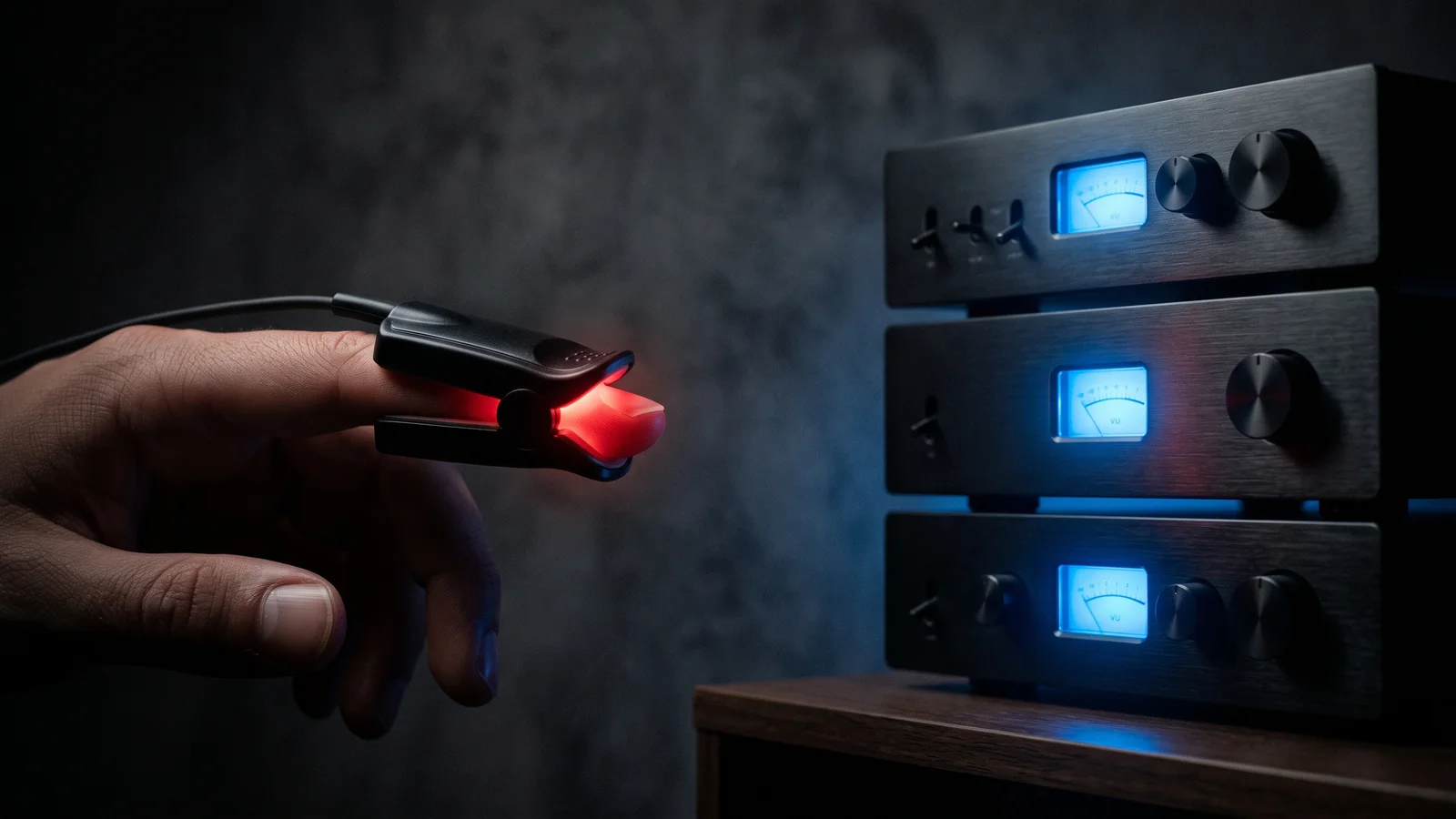
Follow the money. How Denon, Marantz, and Bowers & Wilkins rode from a pulse-oximeter company's balance sheet to Samsung's Harman, and lost two-thirds of their price on the way.
Here's a sentence I never thought I'd write: for about three years, the same company that makes the finger clip hospitals use to check your blood oxygen also owned Denon, Marantz, and Bowers & Wilkins. Not a coincidence. A deal. A real, board-approved, billion-dollar deal.
I build speakers by hand in Arizona, so I follow who owns what the way some people follow trades. And the story of Sound United is the cleanest example I've ever seen of a simple, uncomfortable truth: your favorite audio brands aren't companies anymore. They're assets. They get bought, bundled, marked down, and sold again, and the sound has almost nothing to do with the price on the paperwork. Let's follow the money.
Key Takeaways
- Denon, Marantz, and Bowers & Wilkins are owned by Samsung's Harman division as of late 2025, after Harman bought the whole Sound United group for $350 million (Harman).
- Sound United was assembled over two decades from eight brands: Denon, Marantz, Bowers & Wilkins, Polk Audio, Definitive Technology, Classé, Boston Acoustics, and HEOS.
- Medical-device maker Masimo bought Sound United for about $1.025 billion in 2022, betting on "consumer health" (SEC 10-Q).
- Three years later Masimo sold it for $350 million, roughly two-thirds less than it paid, after an activist investor ousted the founder-CEO.
- The brands still ship good, well-reviewed gear. The story isn't "they're ruined." It's "this is what happens when your speakers are a line item."
Who owns Denon and Marantz now?
Denon and Marantz are owned by Harman International, a Samsung subsidiary, which closed its purchase of the Sound United audio group for $350 million on September 23, 2025 (Harman). Bowers & Wilkins, Polk Audio, and four other brands came in the same box. Before Harman, the owner was a medical-device company.
That's the short answer. The long answer is a two-decade game of pass-the-parcel, and it's worth walking through, because the names on the deals tell you everything about how the audio business actually works now. Marantz started on Saul Marantz's kitchen table in Queens. Denon traces back to 1910 in Japan. B&W built the speakers Abbey Road mastered on. Today all three answer to a phone maker in Suwon, South Korea, and honestly, that might be the happiest ending in this whole story.
Here's the part that gets people. The step right before Samsung wasn't another audio company. It was a firm best known for hospital sensors. So before we get to how that ends, we have to talk about how the bundle got built in the first place.

What is Sound United, and how was it built?
Sound United is a collection of eight audio brands assembled through roughly 15 years of acquisitions, starting from a car-alarm company called Directed Electronics (Wikipedia). It began buying speaker makers in 2004, spun up the "Sound United" name in April 2013, and kept shopping until it held some of the most respected names in hi-fi.
Follow the trail. Directed Electronics bought Definitive Technology in 2004 and Polk Audio in 2006, then restructured as DEI Holdings in 2008 (Wikipedia). In 2011 the private-equity firm Charlesbank Capital Partners took control. Two years later, in April 2013, DEI created a division called Sound United to house its audio brands, bundling Polk, Definitive Technology, and a portable-speaker line called Boom Movement (Residential Systems).
Then came the big swings. Sound United acquired the D+M Group, which brought Denon, Marantz, HEOS, and Boston Acoustics, in a deal that closed at the end of February 2017, terms undisclosed (PR Newswire). It added the Canadian high-end maker Classé in January 2018. And on October 9, 2020, it finalized its purchase of Bowers & Wilkins from EVA Automation (audioXpress).
One quick myth to kill, because I see it repeated constantly. The B&W deal did not include Rotel. Rotel had already been sold off to Sumiko, effective June 1, 2020, before the B&W close (Residential Systems). So the eight brands under the Sound United umbrella are Denon, Marantz, Bowers & Wilkins, Polk Audio, Definitive Technology, Classé, Boston Acoustics, and HEOS. Rotel isn't one of them. Neither Masimo nor Harman ever owned it.
That's a serious stack of audio history in one holding company. Which is exactly why the next owner raised so many eyebrows.
Why would a medical-device company buy a speaker business?
Because it was chasing a future that never showed up. In February 2022, Masimo Corporation, a Nasdaq-listed medical-device maker famous for pulse oximetry, agreed to buy Sound United, and its founder-CEO framed it as a bet on "consumer health" and audio-wearable convergence (SEC). The deal closed that April for about $1.025 billion.
Let me set the scene, because it matters. Masimo isn't some fly-by-night outfit. It makes the finger-clip sensors that hospitals use to read your blood oxygen, and it's a genuinely serious medical company. It even went toe-to-toe with Apple over the blood-oxygen patents in the Apple Watch, and won rounds. This is a company with real engineering credibility in a field where people's lives are on the line.
So why buy floorstanders and AV receivers? The pitch from founder Joe Kiani was that health tech and the home were converging, that Masimo could put its sensors into audio wearables and use Sound United as a beachhead into the living room (SEC 10-Q). On a slide, maybe that connects. In a store, where the actual products were Denon AV receivers and B&W towers, the logic never obviously reached the shelf.
I'll be fair here, because it's easy to dunk and harder to be honest. Companies buy their way into new markets all the time, and "we see a convergence nobody else sees yet" is how a lot of good bets start. This just wasn't one of them. And Masimo's own shareholders noticed fast.
How did the Masimo experiment fall apart?
It fell apart through a shareholder revolt. The activist investor Politan Capital Management, which had built a stake of roughly 9%, ran a proxy campaign attacking the Sound United purchase and won its first two Masimo board seats in June 2023 (MedTech Dive). The audio deal became the lightning rod for everything wrong.
Politan, run by Quentin Koffey, argued the ~$1 billion audio buy was a value-destroying distraction from Masimo's core healthcare business. The market broadly agreed. After the first two seats, Politan came back and won two more on September 19, 2024, and founder-CEO Joe Kiani was pushed off the board he'd built (CNBC). For a founder, that's about as public an ouster as it gets.

New leadership arrived with a clear mandate. CEO Katie Szyman refocused Masimo on what it does well, hospital and consumer health tech, and the consumer-audio business went from "strategic beachhead" to "asset we need to unload." The story wrote itself from there. What gets bought as a vision gets sold as a mistake, and the people who loved the actual speakers were never part of either conversation.
How much did Masimo lose on Sound United?
Masimo took a gross markdown of roughly two-thirds. It paid about $1.025 billion for Sound United in 2022 and agreed to sell the entire consumer-audio business to Harman for $350 million on May 6, 2025, a purchase-price delta of about $675 million in three years (SEC). The sale closed on September 23, 2025.
Say that out loud and let it land. Eight legendary audio brands went in at about a billion dollars and came out, 36 months later, worth about a third of that on the same kind of paperwork (Strata-gee). I want to be precise with the language, because the internet loves to get this wrong. That's a gross purchase-price difference, roughly two-thirds of what Masimo paid, not a formal accounting loss line you'd find stated exactly that way in a 10-K. The real net figure runs through impairments, allocations, and tax that I'm not going to pretend to calculate for you.
But directionally, the point is brutal and clear. The brands themselves didn't get two-thirds worse in three years. Denon still shipped strong-selling receivers. B&W still won reviews. What changed was the market's appetite for owning them inside the wrong company, and the pressure from investors who wanted the whole experiment gone. The gear held its value with listeners far better than it held its value on a spreadsheet.
Here's the genuinely good news, and I mean that. Landing at Harman may be the most natural home these brands have had in years. Harman already owns JBL, AKG, Revel, Mark Levinson, and Infinity. It is, whatever else you think of the consolidation, an actually audio-rooted owner. Denon, Marantz, and B&W went from a pulse-oximetry company's balance sheet to a house that's made speakers and amps for decades. On paper, that's a promotion.
What does the Sound United round-trip tell us?
It tells us that beloved audio brands now trade as portfolio assets, priced by market appetite rather than by how good the speakers sound. Masimo's $1.025 billion buy and $350 million sale, about three years apart, is the clearest case study I know of (SEC 10-Q). The product barely moved. The paperwork moved a fortune.
This is the mechanism I keep coming back to, and it has a name that the internet settled on for a reason: enshittification, the slow logic by which a name you trust becomes a disposable asset, acquired and discarded on a spreadsheet. In the Sound United case it's almost cartoonishly literal. Marantz, a name built by a graphic artist who cared about music, spent three years as a line item on a medical-device company's balance sheet, bundled with a blood-oxygen sensor business, then sold at a two-thirds markdown to whoever would take the whole lot.
Now, let me be fair, because fairness is the whole point of a piece like this. Denon, Marantz, and B&W all still ship real, well-reviewed product today. Nobody hollowed out the drivers overnight. The brands aren't ruined, and Harman is a serious steward. This isn't a "your gear is garbage now" story. It's a "your gear is a chess piece now" story, and those are different things.
But that's exactly what should bother you if you love this stuff. When a speaker's fate depends on an activist investor's proxy math and a parent company's quarterly mood, the person who obsessed over the crossover isn't in the room anymore. The sound survives on momentum and the goodwill of whoever currently holds the deed. Sometimes that goodwill is real. Sometimes it's the next thing to get optimized.
There's another way to build, and I'll admit my bias up front, since it's my name on this. I hand-build custom loudspeakers in our Arizona workshop for about fifteen clients a year, and the whole point is that they can't become a line item on somebody's balance sheet. There's no holding company to sell me. No proxy fight can quietly swap the drivers to fatten a margin. When you own the whole build and answer to the person who bought it, the sound is the product, not the badge, and nobody three owners from now gets to mark it down.
Frequently Asked Questions
Who owns Denon and Marantz?
Denon and Marantz are owned by Harman International, a subsidiary of Samsung Electronics, as of late 2025. Harman bought the entire Sound United audio group, which includes both brands plus Bowers & Wilkins and Polk, for $350 million in a deal that closed on September 23, 2025. Before Harman, the owner was medical-device maker Masimo.

What is Sound United?
Sound United is a holding company for eight audio brands: Denon, Marantz, Bowers & Wilkins, Polk Audio, Definitive Technology, Classé, Boston Acoustics, and HEOS. It was assembled over roughly 15 years, starting from a car-electronics firm, Directed Electronics, and formally created as the "Sound United" division in April 2013 before later acquisitions filled it out.
Why did Masimo, a medical-device company, buy Sound United?
Masimo's founder-CEO, Joe Kiani, framed the roughly $1.025 billion 2022 purchase as a bet on "consumer health" and audio-wearable convergence, a beachhead into the living room. Masimo is best known for hospital pulse-oximetry sensors. The strategic logic never obviously connected to selling AV receivers and floorstanding speakers, and investors soon revolted against the deal.
Did Masimo sell Sound United?
Yes. After activist investor Politan Capital won board seats and ousted founder-CEO Joe Kiani, Masimo refocused on core healthcare and agreed to sell its entire consumer-audio business to Samsung's Harman International on May 6, 2025, for $350 million. That sale closed on September 23, 2025, moving Denon, Marantz, and B&W to Harman.
How much did Masimo lose on Sound United?
Masimo paid about $1.025 billion in 2022 and sold for $350 million in 2025, a gross purchase-price delta of roughly $675 million, or about two-thirds of what it paid, in three years. That's the headline drop in what the business changed hands for, not a formal accounting loss figure, which involves impairments, allocations, and tax.
Sources
- Harman - "Masimo to Sell Consumer Audio Business to Harman International" (eight audio brands; $350M; close Sept 23, 2025): https://news.harman.com/releases/masimo-to-sell-consumer-audio-business-to-harman-international
- Masimo Investor Relations - "Masimo to Sell Consumer Audio Business to HARMAN International": https://investor.masimo.com/news/news-details/2025/Masimo-to-Sell-Consumer-Audio-Business-to-HARMAN-International/default.aspx
- U.S. Securities and Exchange Commission - Masimo 10-Q (Sound United acquisition, ~$1.025B): https://www.sec.gov/Archives/edgar/data/937556/000093755622000090/masi-20220402.htm
- U.S. Securities and Exchange Commission - Masimo 8-K filings index (Feb 2022 agreement; May 2025 sale): https://www.sec.gov/cgi-bin/browse-edgar?action=getcompany&CIK=0000937556&type=8-K
- U.S. Securities and Exchange Commission - Masimo 8-K exhibit, "Masimo to Acquire Sound United" (Feb 15, 2022; ~$1.025B): https://www.sec.gov/Archives/edgar/data/937556/000093755622000024/masi-20220215xex991.htm
- PR Newswire - "Sound United Announces Acquisition of D+M Group" (Denon, Marantz, HEOS, Boston Acoustics; Feb/Mar 2017): https://www.prnewswire.com/news-releases/sound-united-announces-acquisition-of-dm-group-300415537.html
- Forbes (Mark Sparrow) - "Sound United Snaps Up D+M Group" (2017): https://www.forbes.com/sites/marksparrow/2017/03/01/sound-united-snaps-up-dm-group-owner-of-denon-marantz-and-boston-acoustics-audio-brands/
- Forbes (Mark Sparrow) - "Sound United Inks The Deal On Acquisition Of Bowers & Wilkins" (2020): https://www.forbes.com/sites/marksparrow/2020/10/09/sound-united-inks-the-deal-on-acquisition-of-bowers--wilkins/
- TechCrunch - Sound United and Polk acquire Denon and Marantz (2017): https://techcrunch.com/2017/03/01/sound-united/
- audioXpress - "Sound United Finalizes Acquisition of Bowers and Wilkins" (Oct 9, 2020): https://audioxpress.com/news/sound-united-finalizes-acquisition-of-bowers-and-wilkins
- Residential Systems - "Sumiko Announces Acquisition of Rotel U.S. and LATAM Distribution" (effective June 1, 2020): https://www.residentialsystems.com/news/sumiko-announces-acquisition-of-rotel-u-s-and-latam-distribution
- Residential Systems - "DEI Holdings Establishes New Audio Division, Sound United" (April 2013; Polk + Definitive Technology + Boom Movement): https://www.residentialsystems.com/news/dei-holdings-establishes-new-audio-division-sound-united
- CNBC - "Masimo CEO Joe Kiani ousted from board after proxy fight; Politan wins two seats" (Sept 19, 2024): https://www.cnbc.com/2024/09/19/masimo-ceo-joe-kiani-ousted-from-board-politan-wins-two-seats.html
- MedTech Dive - "Masimo shareholders elect activist investor's two board candidates" (Politan wins first two seats, 2023): https://www.medtechdive.com/news/masimo-proxy-MASI-Politan-board-shareholder-vote/654014/
- Strata-gee - "Masimo Completes Sale of Sound United to Harman International" (close Sept 23, 2025; $350M): https://www.strata-gee.com/masimo-completes-sale-of-sound-united-to-harman-international/
- Wikipedia - "DEI Holdings" (Directed Electronics; Definitive Technology 2004; Polk 2006; Charlesbank 2011): https://en.wikipedia.org/wiki/DEI_Holdings
- Wikipedia - "Polk Audio" (founding; ownership history): https://en.wikipedia.org/wiki/Polk_Audio
Mike Vincent is the founder of Mike Knows Audio Video and WubWub Audio, where he designs and hand-builds custom loudspeakers and home theaters in Arizona, the old way, for about fifteen clients a year. He follows the ownership carousel closely, because he built his shop to stay off it: no holding company, no proxy fight, no next owner who gets to quietly change the sound. If you want a system that answers to you, see how the speakers are built.
Comments
Leave a Comment