
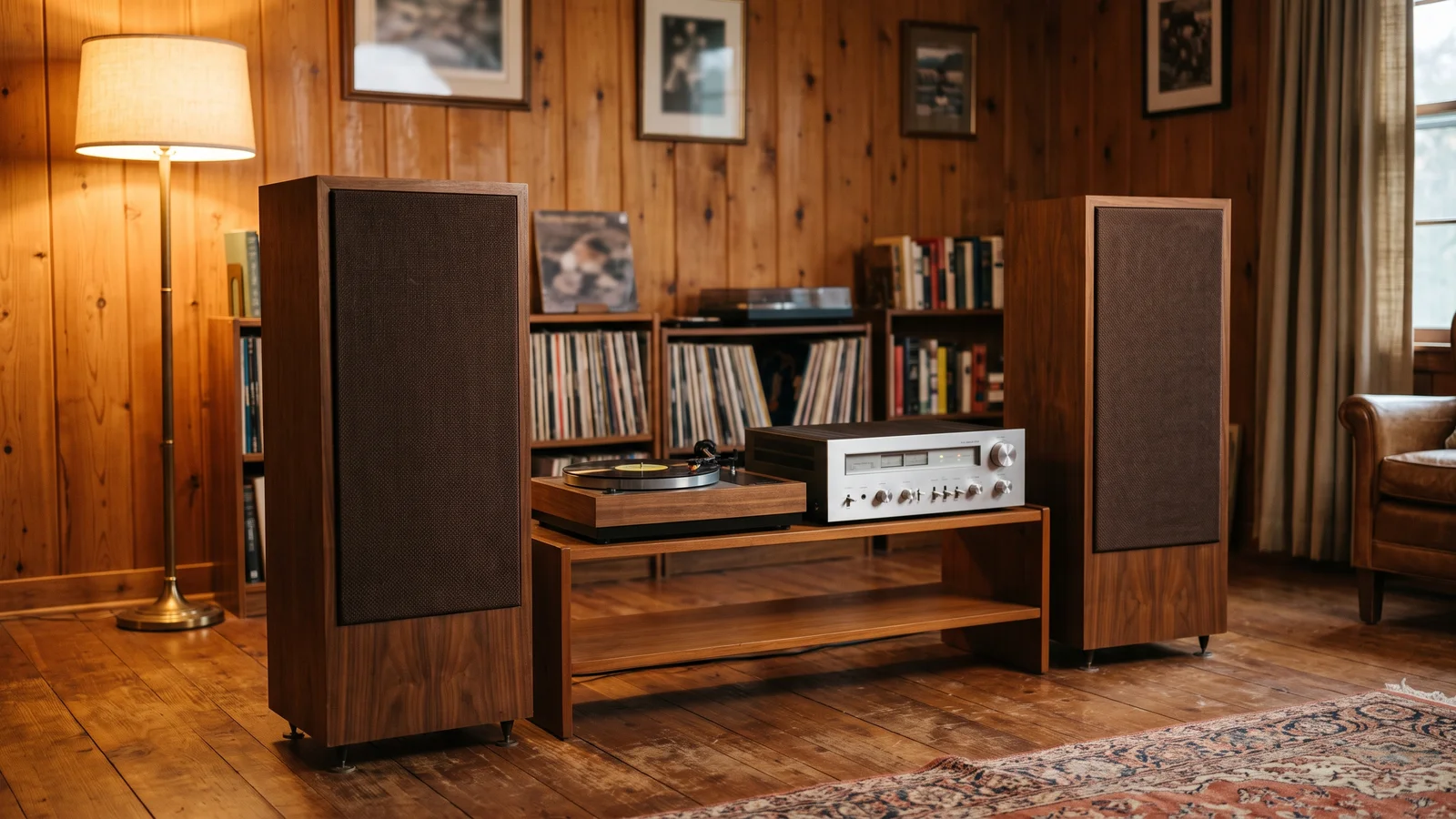
It started with two Johns Hopkins friends, a Baltimore garage, and about $200. Then the name got passed between four owners in under twenty years. This is the Polk Audio story.
You've seen Polk speakers. Big-box aisles, soundbars under wall-mounted TVs, a subwoofer in half the basements in America. The name is everywhere, which is exactly why most people assume it was always a faceless brand. It wasn't.
Polk Audio started as a few friends who met at Johns Hopkins, a garage in Baltimore, and reportedly about two hundred bucks. Decades later, that same name became a line item that changed hands four times in under twenty years. The garage half of the story is charming. The churn half is the one nobody tells you at the checkout counter. So let me tell both, and be fair to the gear caught in the middle.
Key Takeaways
- Polk Audio was founded in 1972 in Baltimore by Matthew Polk, George Klopfer, and Sandy Gross, three friends from Johns Hopkins.
- The Monitor 7 (1974) established the brand's American value-high-performance reputation, and SDA (Stereo Dimensional Array) became its signature innovation.
- SDA reached production with the SDA-1 in 1983, cancelling inter-aural crosstalk acoustically.
- The name was sold four times between 2006 and 2025: DEI Holdings, then Sound United, then Masimo, then Samsung's Harman.
- Masimo paid about $1.025 billion for Sound United in 2022; Harman bought the group for $350 million in 2025.
- The engineering legacy is genuine, and Polk still ships competent value gear, but ownership and incentives are two different things.
What happened to Polk Audio?
Polk Audio grew from a 1972 Baltimore garage into one of America's best-known value-audio brands, then passed through four corporate owners between 2006 and 2025, ending with Samsung's Harman, per Wikipedia's company history. Two things are true at once here. The engineering legacy is real. The ownership story is a carousel.
That tension runs through this whole piece. Polk built a genuine American hi-fi reputation on clever acoustics and honest value, then spent the last two decades getting bought, bundled, moved, and re-sold by companies that mostly do not make speakers. Car alarms. Pulse oximeters. A Korean electronics giant. The brand outlived the incentives that created it, which is the part worth understanding.
How did two Hopkins grads start Polk Audio in a Baltimore garage?
Polk Audio was founded in 1972 by Matthew Polk, George Klopfer, and Sandy Gross, who met at Johns Hopkins, and company lore puts the startup capital at roughly $200 in an unheated Baltimore garage, according to Encyclopedia.com's profile of the firm. The name "Polk" was reportedly chosen simply because it was the easiest of the three to pronounce.

The origin has that hand-built ring I love. As the company and encyclopedia accounts tell it, the founders had been building PA systems for fiddlers' conventions before they ever sold a home speaker, as Encyclopedia.com's company history records. That's how a lot of great gear starts: not with a business plan, but with people who needed better sound and decided to make it themselves. Two hundred dollars and a cold garage will teach you what a spreadsheet never can.
Their first real hit came fast. The Monitor 7, introduced in 1974, was the brand's first successful model, and the Monitor line that followed built Polk's reputation for American value-high-performance sound, as Wikipedia documents. Regular people could afford a Monitor and still hear something that measured and sounded serious. That combination, real performance at a fair price, became the Polk signature for a generation.
One of those three founders, Sandy Gross, would go on to shape Definitive Technology and GoldenEar too, a career worth its own telling.
What is Polk SDA, and why does it still matter?
Polk's signature innovation, SDA (Stereo Dimensional Array), reached production with the SDA-1 in 1983, cancelling inter-aural crosstalk acoustically with an extra out-of-phase "dimensional array" of drivers, as period coverage in High Fidelity's January 1983 archive shows. The concept is often dated to the late 1970s, but 1983 is when it shipped.
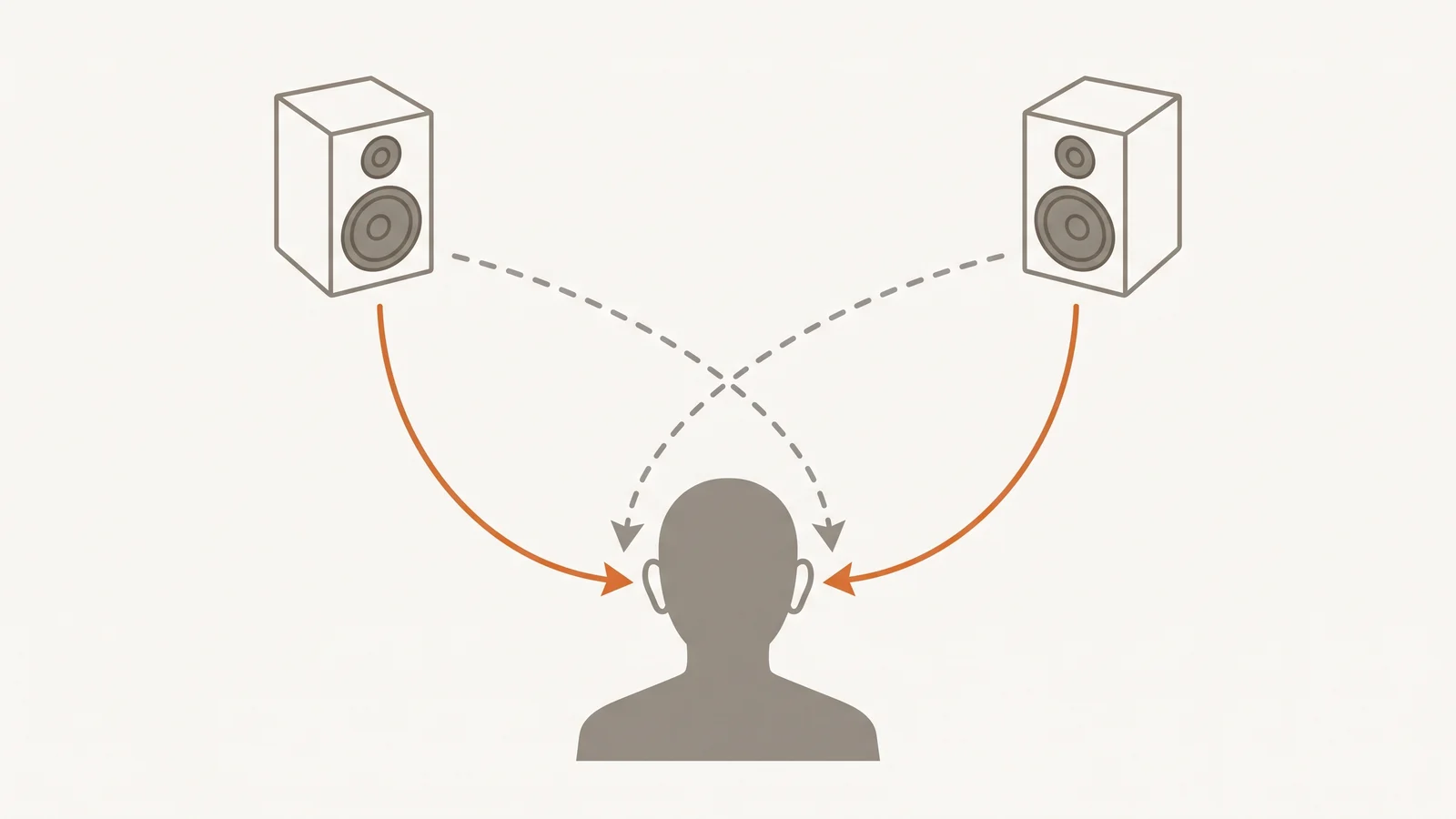
Here's the problem SDA set out to solve. In normal stereo, your left ear hears a little of the right speaker and vice versa, a smearing called inter-aural crosstalk that flattens the soundstage. Polk's fix was acoustic, not digital: add a second set of drivers wired out of phase to actively cancel the crosstalk before it reaches the wrong ear, as the January 1983 High Fidelity review details. When it worked, the stereo image opened up wide and deep, well past the physical speakers.
The refined SDA-1A followed in 1984 to 1985, tightening the design that made the family famous, as the Vintage Technology Archive records. I want to be clear about this: SDA was a genuinely original idea, executed in hardware, by people trying to make stereo sound better rather than cheaper. That legacy is real, and vintage SDA rigs still have a devoted following for a reason.
After SDA, the catalog kept broadening. The RTi and LSi lines carried the enthusiast torch, later joined by the Signature and Reserve series, as the company history notes. Then came the mass-market wave: soundbars, subwoofers, and smart speakers stacked on big-box shelves. Good, sensible gear for a lot of buyers. Also a very different mission from a garage full of crosstalk-cancelling towers.
Who owns Polk Audio now?
Polk Audio is now owned by Harman International, a Samsung subsidiary, which bought Sound United's eight-brand consumer-audio group for $350 million in a deal completed September 23, 2025, per HARMAN's own press release. That figure is striking, because it covered the whole group, and it was a fraction of what the previous owner had paid just three years earlier.
The full chain reads like a business-school cautionary tale. Directed Electronics, a car-alarm and mobile-electronics company also known as DEI Holdings, acquired Polk in 2006, as documented in the DEI Holdings record. Terms of that 2006 deal were not disclosed, so I won't invent a number. In April 2013, DEI folded Polk, Definitive Technology, and Boom into a new division called Sound United. Then in March 2017, Sound United acquired D+M Group, which brought Denon, Marantz, HEOS, and Boston Acoustics into the fold.
The corporate footprint moved around too. Sound United shifted its headquarters to the Carlsbad and San Diego area of California in 2015, while core R&D stayed at Owings Mills, Maryland, per company history. Then the strange part. On April 11, 2022, Masimo, a medical-device company best known for pulse oximeters, acquired Sound United for about $1.025 billion, as PR Newswire reported and Masimo confirmed in its SEC filings. A pulse-oximeter maker, buying the company that owned Polk.
That marriage lasted barely three years. Masimo announced in May 2025 that it would sell the consumer-audio group to Harman, and the $350 million sale price was disclosed in Masimo's SEC filing, as ecoustics reported and Masimo's 8-K confirmed. From a Baltimore garage to a pulse-oximeter company to Samsung, a brand can travel a long way while the drivers stay the same.
The engineering address stayed steadier than the corporate one. Through all of it, Owings Mills, Maryland kept doing the R&D work, even as the badge on the front door changed every few years.
Are Polk speakers still made in the USA, and does the churn matter?
Here's the honest answer, and it's the one you rarely get in a store: much of Polk's lineup is now built offshore, and that markdown from Masimo's $1.025 billion in 2022 to Harman's $350 million in 2025, roughly two-thirds off in three years, tells you how the market values a name passed between owners who don't build speakers, as Forbes noted in its coverage of the sale. Offshore manufacturing is an industry-wide trend, not a Polk-specific scandal, and I'll say that plainly.
So let me be fair. SDA was a real acoustic idea that shipped in real hardware, and its legacy earns respect. Polk still makes competent value gear today, and reviewers who spend time with the current Signature and Reserve lines generally like them, as Stereophile's coverage of the Harman deal acknowledges the group's standing. The current speakers are not bad. That's not the critique.
The critique is about incentives. When a founder builds a speaker, the person whose ear set the standard is the same person signing off on the product. When that name becomes a line item on a holding company's balance sheet, sold four times in under two decades, the sign-off moves to people optimizing a spreadsheet, not a soundstage. That slow drift from craft to corporate asset, breadth over depth, cost over care, is what the writer Cory Doctorow calls enshittification, and audio nameplates are textbook cases. The gear can still be decent while the mission quietly changes hands.
That's exactly why some of us still do it the slow way. Matthew Polk and his friends hand-built PA rigs for fiddlers before they ever sold a speaker, because they cared how it sounded, not how cheaply it could ship from an ocean away. We build custom speakers by hand in our Arizona workshop, one small batch a year, each pair signed off by the person whose name is on the shop and shipped with a birth certificate. When you buy one, you know exactly who is accountable for it. It never becomes someone's line item, and that's the whole point.

Frequently Asked Questions
What happened to Polk Audio?
Polk Audio was founded in 1972 in a Baltimore garage and became a major American value-audio brand, then was sold four times between 2006 and 2025, per Wikipedia. It passed from DEI Holdings to Sound United to the medical-device maker Masimo, and finally to Samsung's Harman, which completed its purchase in September 2025.
Who owns Polk Audio now?
Polk Audio is owned by Harman International, a Samsung subsidiary, which bought Sound United's consumer-audio group for $350 million in a deal completed September 23, 2025, per HARMAN's press release. That group also includes Denon, Marantz, Definitive Technology, and Boston Acoustics, previously owned by Masimo since 2022.
What is Polk SDA?
SDA stands for Stereo Dimensional Array, Polk's signature technology that reached production with the SDA-1 in 1983, as period coverage confirms. It cancels inter-aural crosstalk acoustically, using an extra out-of-phase set of drivers so each ear hears less of the opposite speaker, which widens and deepens the stereo image.
Are Polk speakers still made in the USA?
Much of Polk's current lineup is manufactured offshore, following an industry-wide trend, though core research and development long stayed at Owings Mills, Maryland, per company history. The brand's manufacturing footprint shifted over decades of ownership changes, so any single "made in" answer depends on the specific model and the year it was built.
Who founded Polk Audio?
Polk Audio was founded in 1972 by Matthew Polk, George Klopfer, and Sandy Gross, three friends who met at Johns Hopkins University, according to Encyclopedia.com. Company lore says they started with about $200 in an unheated Baltimore garage and chose the name "Polk" simply because it was the easiest to pronounce.
Sources
- Wikipedia, "Polk Audio": https://en.wikipedia.org/wiki/Polk_Audio
- Wikipedia, "Directed Electronics" (DEI Holdings): https://en.wikipedia.org/wiki/Directed_Electronics
- Encyclopedia.com, "Polk Audio Inc.": https://www.encyclopedia.com/books/politics-and-business-magazines/polk-audio-inc
- Polk Audio, "The Polk Story" (official company history): https://www.polkaudio.com/en-us/polklore/polk-story.html
- High Fidelity, January 1983, "Polk SDA-1" review (SDA crosstalk-cancellation mechanism): https://gammaelectronics.xyz/high-fidelity_mag_1983-01_polk.html
- Reference for Business, "Polk Audio, Inc. — Company History": https://www.referenceforbusiness.com/history2/38/Polk-Audio-Inc.html
- High Fidelity, January 1983 (World Radio History archive, SDA-1 dating): https://worldradiohistory.com/Archive-All-Audio/Archive-High-Fidelity/80s/High-Fidelity-1983-01.pdf
- Vintage Technology Archive, "Polk Audio SDA-1A" (1985): https://vintagetechnologyarchive.com/audio/polk/sda-1a/
- PR Newswire, "Sound United's Sale to Masimo for $1.025 Billion" (April 2022 completion): https://www.prnewswire.com/news-releases/ceo-coaching-international-congratulates-client-sound-united-on-its-sale-to-masimo-corporation-for-1-025-billion-301525402.html
- U.S. Securities and Exchange Commission, Masimo Form 10-K FY2022: https://www.sec.gov/cgi-bin/browse-edgar?action=getcompany&CIK=0000937556&type=10-K
- HARMAN, "HARMAN Completes Sound United Acquisition" (Sept 23, 2025): https://news.harman.com/releases/harman-completes-sound-united-acquisition-to-expand-premium-audio-leadership
- U.S. Securities and Exchange Commission, Masimo Form 8-K (Sept 2025, $350M sale): https://www.sec.gov/cgi-bin/browse-edgar?action=getcompany&CIK=0000937556&type=8-K
- Stereophile, "Sound United Finds a New Home: HARMAN": https://www.stereophile.com/content/sound-united-finds-new-home-harman
- Forbes, "Harman International Completes Deal To Buy Sound United's Audio Brands From Masimo": https://www.forbes.com/sites/marksparrow/2025/09/23/harman-seals-the-deal-and-buys-up-denon-marantz-bower--wilkins-polk-and-more/
- ecoustics, "Samsung's HARMAN Acquires Sound United from Masimo for $350M": https://www.ecoustics.com/news/harman-masimo-consumer-audio/
Mike Vincent is the founder of Mike Knows Audio Video and WubWub Audio, where he designs and hand-builds custom loudspeakers and home theaters in Arizona, the old way, for about fifteen clients a year. He has a real soft spot for garage-startup founders who cared more about the soundstage than the balance sheet; if you want a pair built with that kind of care and signed off by hand, start with our custom loudspeakers.
Comments
Leave a Comment