
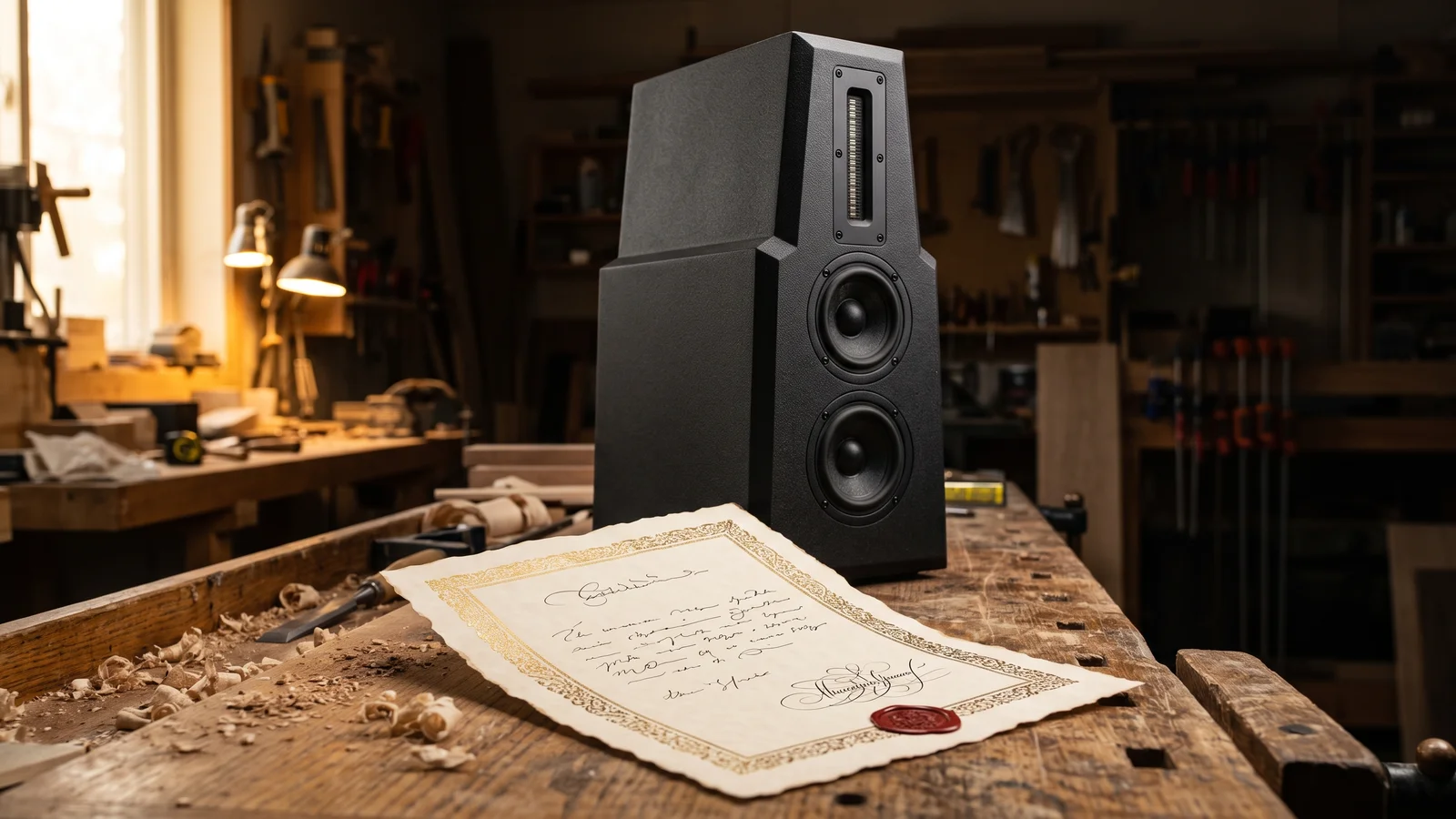
Storied audio names get traded between conglomerates. A signed, numbered birth certificate is the opposite. Here is how a custom WubWub speaker gets built and documented.
I have spent this whole series telling you what happens to famous audio names. They get sold. They get shuffled between holding companies. The person whose ear set the standard is long gone, and what's left is a logo on a spec sheet built by whoever bid lowest that quarter.
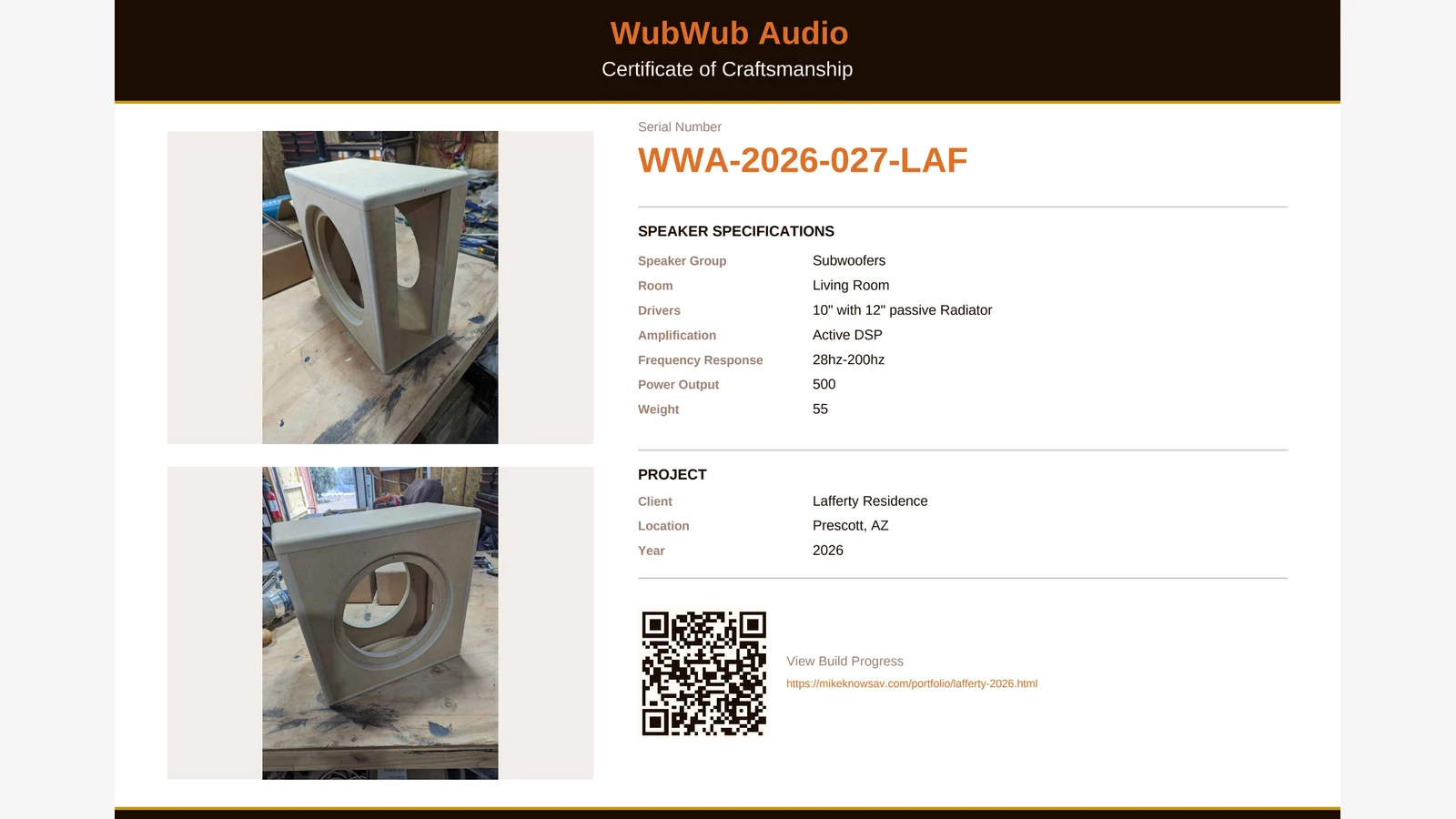
So let me tell you about the opposite of that. When a pair of WubWub speakers leaves our Arizona workshop, it ships with a document. It's signed by hand. It carries a serial number that belongs to that pair and no other. It's printed as our Certificate of Craftsmanship, but everyone just calls it the birth certificate, and it's not a marketing gimmick. It's a promise you can hold, a permanent link between the person who built the thing and the person who owns it. Here's how it gets made, and why I think it matters more now than it ever has.
Key Takeaways
- Every WubWub speaker is hand-built to order in our Arizona workshop and Made in the USA.
- Each pair ships with a birth certificate that is signed and numbered, tying the maker to the owner.
- The custom speaker build process runs roughly 6 to 12 weeks or more, depending on size and complexity.
- Clients follow their own build in real time through the online portfolio system, with photo updates as the work happens.
- We build for about fifteen clients a year, on-wall and tower speakers with sealed subwoofers, backed by a 10-year warranty.
What is a speaker birth certificate, and why does it matter?
A birth certificate is a signed, numbered document that ships with every WubWub speaker, recording who built it, when, and which serial number belongs to that exact pair. It's provenance you can file in a drawer. In a world where a certificate of authenticity is standard for fine watches and original art, a hand-built speaker deserves the same.
The idea is simple. You should be able to look at the thing making your music and know its whole story. Not a factory batch code. A name and a number. When something is signed, someone is accountable for it, and accountability is the first thing that disappears when a craft becomes a commodity.
Think about how the rest of the industry works now. A speaker rolls off a line by the thousand, and no single person could tell you which hands touched it or whether anyone listened to it before it boxed up. Our numbers run the other way. About fifteen clients a year means every pair gets attention, and the certificate is the paper trail that proves it.
There's a resale angle too, and I'll be honest about it. Provenance holds value. A documented, numbered, single-owner pair is worth more to the next person than an anonymous unit, the same way a signed print beats a poster. The certificate is partly for you and partly for whoever inherits these speakers in twenty years.
What does the custom speaker build process actually look like?
The custom speaker build process runs about 6 to 12 weeks or more from order to delivery, moving through six stages: design consult, cabinet build, driver assembly, voicing and measurement, the birth certificate, and delivery. Bigger and more complex systems land at the longer end. Nothing here is rushed, because rushing is how mistakes ship.
Let me walk you through each stage. This is the real sequence, the one your project actually follows, not a tidied-up brochure version. If you want the short answer, the chart below lays out the whole arc on one timeline.
The design consult
Everything starts with your room, not a product page. We talk through the space, the seating, the finish you want, and what you actually listen to. A room that's all glass and tile needs different answers than a carpeted den. This is where we decide on-wall or tower, how the center channel sits under the TV or on the mantle, and whether the plan calls for a sealed sub. We cap ceiling speakers at four, because more than that in a normal room is marketing, not acoustics.
The cabinet build
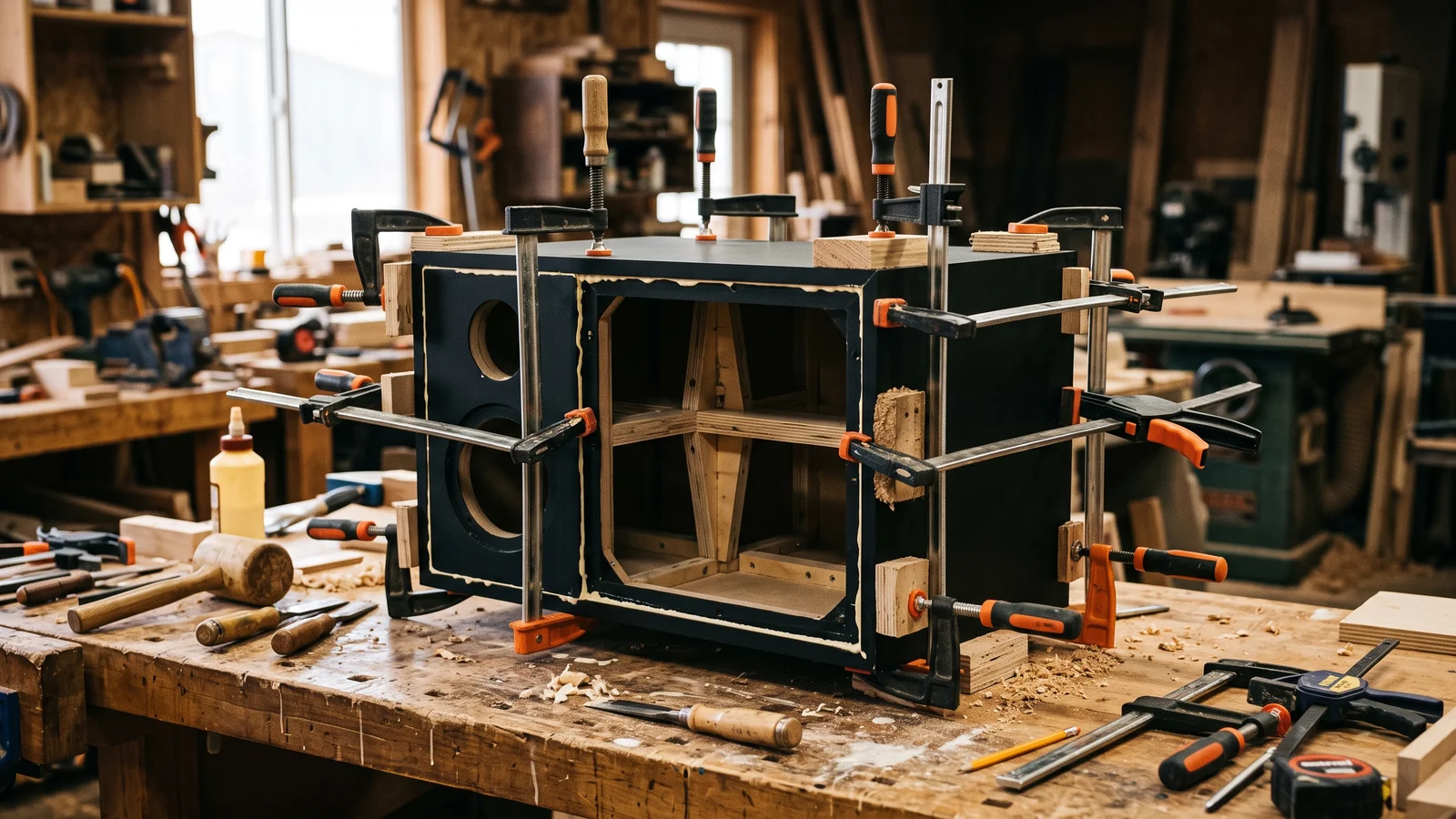
This is the longest single stretch, and for good reason. The enclosure is most of what you hear. We cut, glue, brace, and finish each cabinet by hand, and a good finish alone takes days of patient coats and cure time. A well-braced box kills the resonances that turn detail into mush. Cheap speakers skimp here because bracing and mass cost money and don't show up in a photo. We don't skimp here.
Driver and crossover assembly
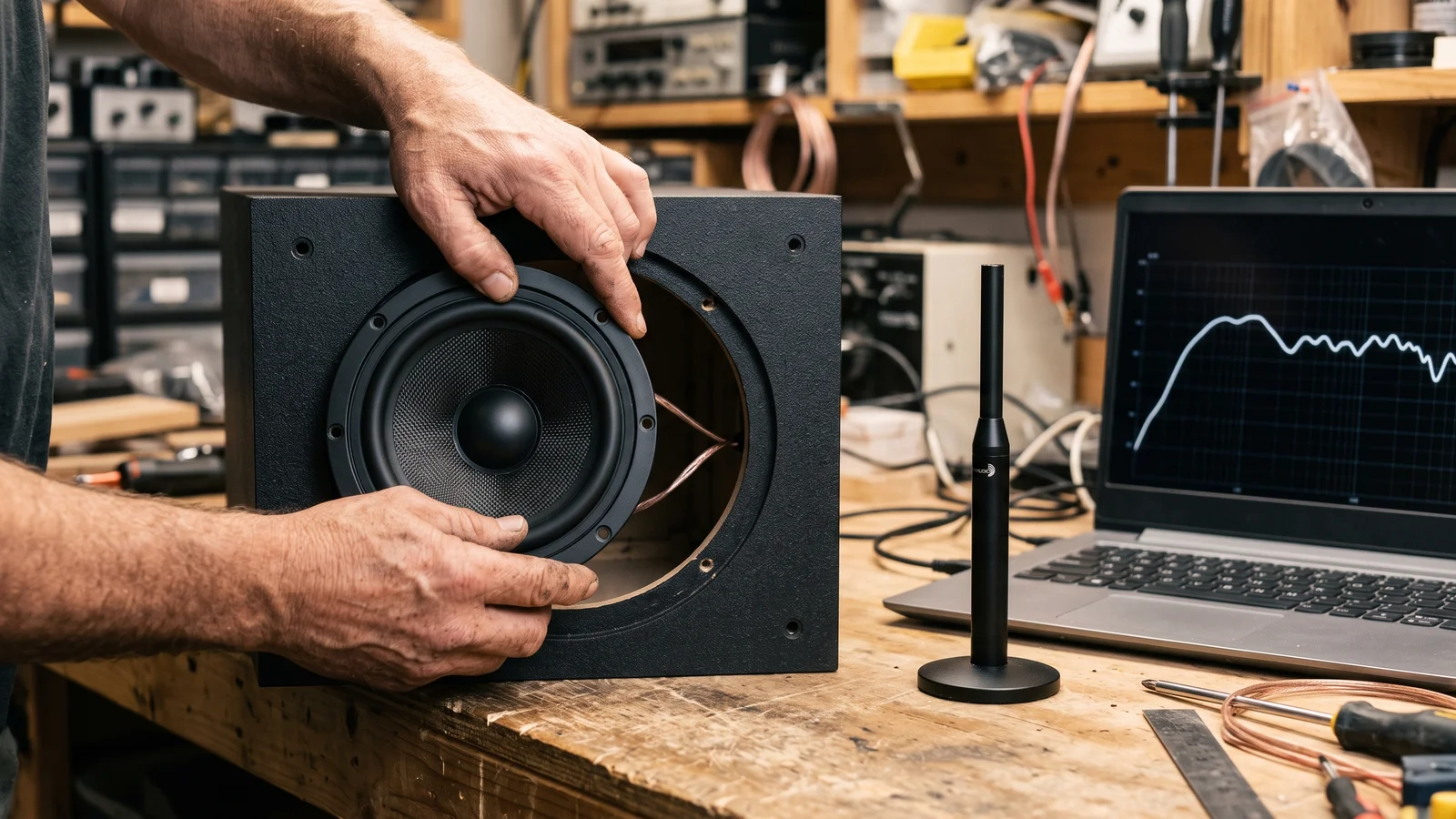
With the cabinets built, the drivers and crossover go in. This is where the design becomes a working instrument. Every solder joint, every driver seated square, every crossover component matched to its partner in the pair. It's slow, quiet work, and it's the part I still do myself because it's the part I trust least to anyone in a hurry.
Voicing and measurement
Here's where a hand-built speaker earns its keep. We measure each pair with a calibrated microphone and tune them to a matched target, so the left and right speaker are true siblings, not just the same model. Measurement keeps me honest. My ears tell me what I want to hear; the microphone tells me what's actually happening. You need both. A speaker that measures clean and then gets a final listen is a speaker I'll put my name on.
The birth certificate
Once the pair passes voicing, the certificate gets filled in, signed, and numbered. That signature isn't decoration. It means a person listened to these speakers, measured them, and decided they were right before they went in the box. The serial number ties this document to that exact pair, forever. It goes in the crate alongside the speakers and the warranty paperwork.
Delivery and setup
Then we bring them to you. Placement matters as much as the build, so we set them, connect them, and dial them in for your room. A speaker voiced perfectly on the bench still has to live in your space, with your walls and your furniture. The last hour of setup is where a good build becomes a great-sounding room.
How do you watch your own speakers get built?
You follow the entire build through our online portfolio system, which posts real-time photo updates as your speakers move through the shop. From the day your order enters the queue, you get a private, running record of your own project: raw cabinets, finish coats, drivers going in, measurement curves. No guessing, no black box.
This is how we keep the workshop private and still keep you in the loop. We don't do shop visits, and I'm upfront about why: the Arizona high desert workshop stays a working shop, not a showroom. But you don't need to stand in it to see your speakers take shape. The portfolio does that better than a visit would, because it's timestamped, it's yours to keep, and you can check it at 2 a.m. in your pajamas if you want.
I'll tell you what surprised me when we started doing this. Clients don't just check in at the end. They watch the whole thing, and they get attached to it. By the time the speakers arrive, they already know their build. That's ownership in the real sense, not just a receipt. The finished pair shows up with a story the owner watched unfold.
Why does provenance matter when the industry trades famous names like baseball cards?
Provenance matters because the alternative is what this series has documented forty-nine times over: a proud name gets sold, offshored, and hollowed out until the badge means nothing. When a brand becomes a line item on a holding company's balance sheet, no one signs anything. A birth certificate is the deliberate opposite of that drift.
The writer Cory Doctorow has a name for the slow rot that sets in when a product exists to serve shareholders instead of the people using it. He calls it enshittification, and audio nameplates are textbook cases. A founder builds something great, the name gets valuable, the name gets bought, and then the accountants find every corner worth cutting. The logo survives. The soul does not.
A signed, numbered document can't be enshittified. It's a fixed point. It says one person made this pair, stood behind it, and there is no committee to blame if it's wrong and no committee to thank if it's right. That's a heavier thing to put your name on than a spec sheet, and that weight is exactly the point. You can read the full story of why we build this way if you want the background.
Old-fashioned quality was never a marketing angle for the people who invented this hobby. It was just how they worked, because their name was on it and their neighbors would know if it broke. We build custom loudspeakers the same way, in small numbers, by hand, and we sign each one because we'd be embarrassed not to.
What does "Made in the USA" actually mean on a speaker?
Made in the USA is a legally defined claim, not a vibe. The Federal Trade Commission requires that a product labeled "Made in USA" be "all or virtually all" made in the United States, under its Made in USA Labeling Rule. Plenty of "designed in America" speakers are assembled overseas from imported parts. Ours are actually built here.
That distinction gets buried on purpose across the industry. A brand can headquarter in the States, run its marketing from a glass office, and still box up product from an offshore line. The label games are subtle, which is why the FTC bothers to police them at all, as its enforcement guidance spells out.
For us it's not a legal tightrope, because there's nothing to game. The cabinets get built here. The speakers get assembled and voiced here. The person who signs the certificate is the person who did the work, in our Arizona workshop, for a handful of clients a year. When the whole shop fits your entire annual output, "Made in the USA" isn't a claim you stretch. It's just a description of the room. And a 10-year warranty is easy to stand behind when you know exactly who built the thing and can put your finger on the serial number.
Frequently Asked Questions
What is a speaker birth certificate?
A speaker birth certificate is a signed, numbered document that ships with every WubWub speaker, recording who built the pair, when, and the serial number unique to those speakers. It functions like a certificate of authenticity for fine watches or art, providing provenance, accountability, and long-term resale value for a single, documented, hand-built pair.
How long does the custom speaker build process take?
The custom speaker build process takes roughly 6 to 12 weeks or more from order to delivery, moving through design consult, cabinet build, driver and crossover assembly, voicing and measurement, the birth certificate, and delivery. Larger, more complex systems sit at the longer end, because cabinet finishing and careful voicing are not steps you can safely rush.
Can I visit the workshop to see my speakers being built?
No, we do not offer workshop visits, and privacy is the reason. Instead, you follow your entire build through our online portfolio system, which posts real-time photo updates as your speakers move through each stage. It is timestamped, private to your project, and yours to keep, so you can check progress anytime without leaving home.
Are WubWub speakers really made in the USA?
Yes. WubWub speakers are hand-built and Made in the USA in our Arizona workshop, which meets the Federal Trade Commission's "all or virtually all" standard for the claim. Many competitors design domestically but assemble overseas from imported parts. Because we build for about fifteen clients a year, every cabinet and pair is genuinely built and voiced here.
What kind of speakers does WubWub build?
WubWub builds on-wall and tower speakers, with the center channel placed under the TV or on the mantle, plus sealed subwoofers and a maximum of four ceiling speakers in a system. We do not build in-wall speakers. Every speaker is custom-built to your room, signed and numbered, and backed by a 10-year warranty.
Sources
- Federal Trade Commission, "16 CFR Part 323: Made in USA Labeling Rule": https://www.ftc.gov/legal-library/browse/federal-register-notices/16-cfr-part-323-made-usa-labeling-rule
- Federal Trade Commission, "Complying with the Made in USA Standard": https://www.ftc.gov/business-guidance/resources/complying-made-usa-standard
- Federal Trade Commission, "Made in USA Labeling Rule" (16 CFR Part 323): https://www.federalregister.gov/documents/2021/07/14/2021-14610/made-in-usa-labeling-rule
- Cory Doctorow, "The 'Enshittification' of TikTok" and related essays: https://pluralistic.net/2023/01/21/potemkin-ai/
Mike Vincent is the founder of Mike Knows Audio Video and WubWub Audio, where he designs and hand-builds custom loudspeakers and home theaters in Arizona, the old way, for about fifteen clients a year. He signs every birth certificate himself, which is either stubborn or sentimental depending on who you ask; if you want speakers built and documented like that, start with our custom home theater systems.
Comments
Leave a Comment