
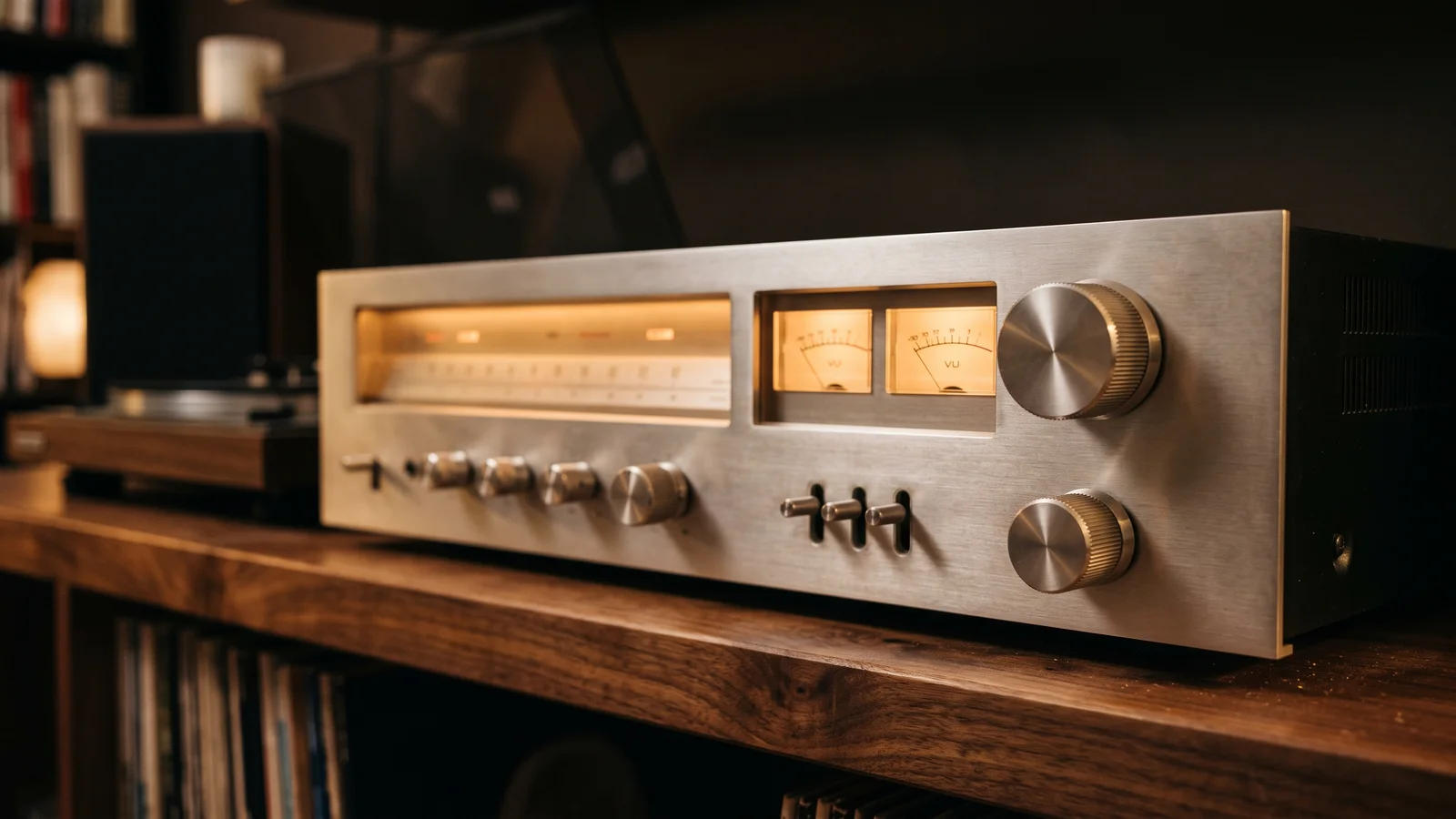
Sansui once meant transformer-grade Japanese engineering and 300-watt monster receivers. Then the company died and the name got rented out. This is the arc.
Say "Sansui" to anyone who was buying stereo gear in the 1970s and watch their face change. For a stretch there, that name meant something specific: heavy silver faceplates, transformers you could break your foot on, and receivers so overbuilt they still power living rooms half a century later. Collectors don't just remember Sansui. They hunt it.
So here's the question that makes me a little sad every time I sit with it. How does a name that once guaranteed some of the finest amplifier engineering on the planet end up as a sticker on one of the cheapest televisions at Walmart? Not through a slow slide into mediocrity. Through something stranger. Let me walk you through it, because the golden-era gear deserves the respect, and the ending deserves the honesty.
Key Takeaways
- Sansui was founded in Tokyo in 1947 by Kosaku Kikuchi, who had opened a transformer and radio-parts workshop there in 1944; the name 山水 means "mountain and water."
- Its golden-era gear is genuinely revered: the AU-series integrated amps and the "monster receivers" like the G-9000 and the roughly 300-watt-per-channel G-33000 are hotly collected today.
- The company struggled through the 1980s, stopped exporting in the early 1990s, and was dragged down when its majority owner, Britain's Polly Peck, collapsed in 1991 under about £1.3 billion of debt.
- Hong Kong's Grande Holdings bought Sansui's assets in 1999; the original Sansui Electric Co. formally went out of business in 2014.
- Today "Sansui" is a licensed logo on budget TVs, including a $799 55-inch 4K OLED sold largely at Walmart, built by companies that never made an amplifier.
Who founded Sansui, and what did the name mean?
Sansui Electric was founded in Tokyo in 1947 by Kosaku Kikuchi, who had already opened a small radio-parts and transformer workshop in the Yoyogi district in 1944, according to Wikipedia's company history. The name 山水 means "mountain and water." That transformer origin isn't a footnote. It's the whole personality of the company.
Kikuchi's shop started by winding transformers, and transformers stayed the throughline of everything Sansui did well for the next forty years. The 1944 workshop start sometimes gets folded into the company's history, though 1947 is the usual founding year. Either way, the DNA was the same: get the power supply and the output stage right, and the rest follows.
From transformer winder to amplifier maker
Sansui moved from parts into finished audio the way a lot of the great Japanese firms did, through kits. It offered tube amplifier kits starting around 1954 and shipped its first stereo tube amplifiers in 1958, as Tube-Amps.net documents in its Sansui history. Hobbyists built them, loved them, and the reputation grew from the bench up.
Kikuchi ran the company he built until he resigned in 1974, per Wikipedia. By then Sansui was no longer a parts shop. It was one of the "big three or four" Japanese hi-fi names heading into the receiver wars, and it was about to build the machines that made it immortal to collectors.
What made golden-era Sansui gear legendary?
Collector consensus is close to unanimous: golden-era Sansui integrated amplifiers set a benchmark for musicality and build, with the AU-717, AU-919, AU-9500, AU-20000, and later AU-D907 treated as reference pieces, as HQ Audios argues in its roundup of the best-sounding Sansui gear. These weren't spec-sheet specials. They were heavy, honest, and tuned to sound right.
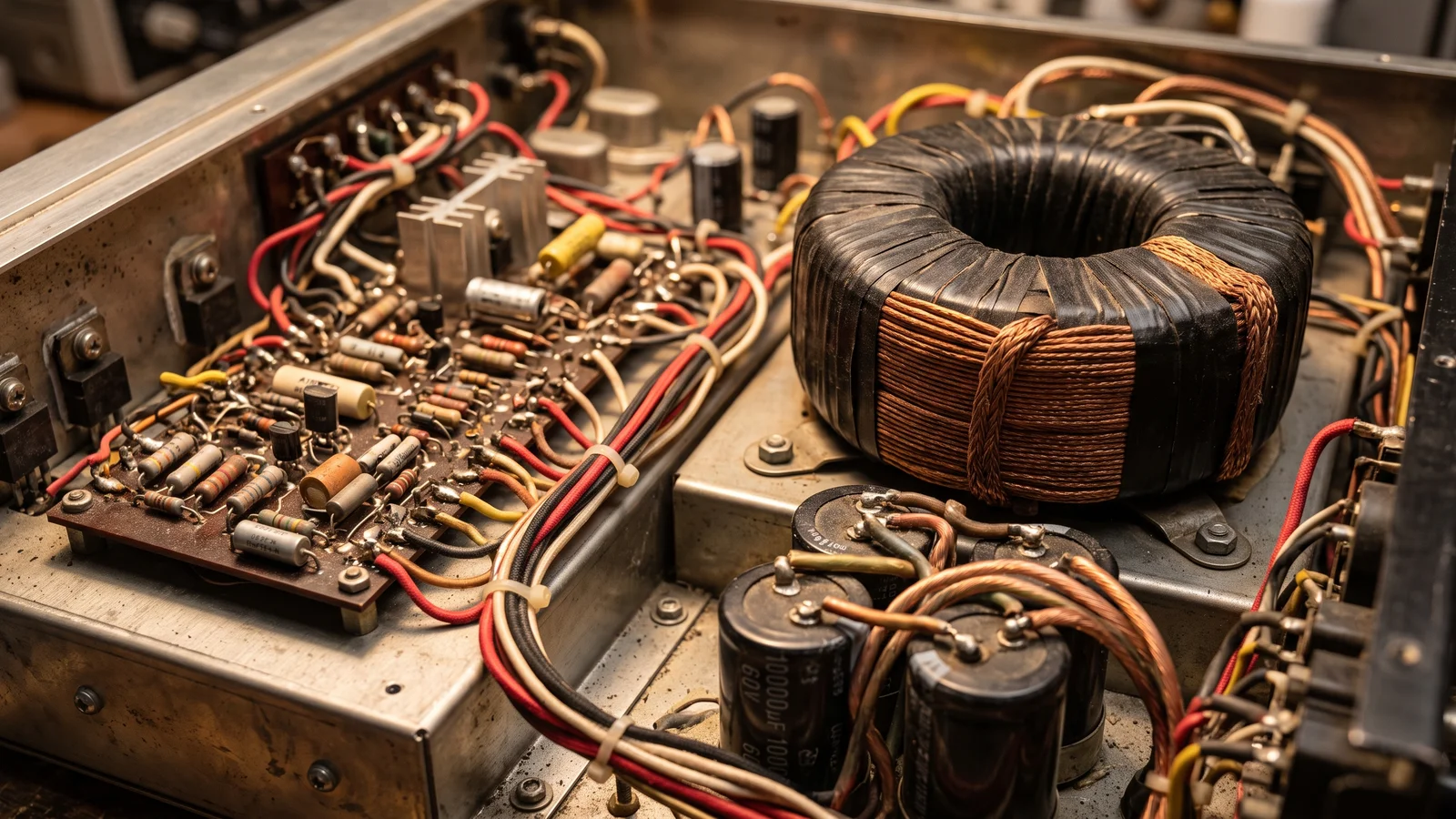
I've had a few of these across the bench, and the thing that always strikes you is how much metal is in the power supply. That's the transformer heritage showing. Sansui spent its weight budget where it mattered, on clean, stiff power, which is exactly why these amps still drive difficult speakers without flinching. The AU-series is where "warm but controlled" got its Japanese accent.
The monster receivers
Then there's the gear that turned Sansui into a legend rather than just a good brand. The G-9000, released in 1978 at roughly 160 to 170 watts per channel, is remembered as a "Godzilla" of vintage receivers, and still commands strong prices on the used market. It's a two-person lift and a showpiece, and people restore them lovingly.
Above even that sat the flagship G-33000, rated at about 300 watts per channel, one of the most powerful and sought-after receivers of the entire golden age, as The Vintage Knob catalogs. Sansui belongs on any short list of the most powerful vintage receivers ever built, a point Classic Receivers makes in its power rankings. The 9090DB receiver of 1975 and the QS-1 Quadphonic Synthesizer of 1971 round out an era where the company simply kept swinging for the fences, as its history records.
Collectors weren't wrong to love this stuff. It was that good. Which is what makes the next part hurt.
How did Sansui go from powerhouse to bankrupt?
Sansui's collapse wasn't caused by bad amplifiers. It was caused by a British fruit-and-electronics conglomerate imploding under about £1.3 billion of debt, as Wikipedia's account of Polly Peck International details. Sansui struggled through the 1980s as the market shifted toward cheaper mass gear, and by 1989 it had sold majority control to survive.
Here's where the story stops being about hi-fi. Polly Peck International, run by the businessman Asil Nadir, took a 51% majority stake in Sansui by 1989, per Wikipedia. Then the parent company detonated. The Serious Fraud Office raided Polly Peck on 20 September 1990, the company collapsed in 1991, and Nadir fled the country before eventually being convicted of theft in 2012, as Wikipedia's profile of Asil Nadir recounts. It was one of the biggest corporate frauds of its era, and Sansui was collateral damage.
The company had already ceased exporting in the early 1990s, cutting off the markets that made it famous. What was left of the assets got picked up by Hong Kong's Grande Holdings in 1999, as reflected in the corporate record. Grande held Sansui alongside other fallen Japanese names for a decade. Then Grande itself hit the wall, entering provisional liquidation on 1 June 2011, as the South China Morning Post reported at the time. The original Sansui Electric Co. formally went out of business in 2014, per Wikipedia.
Who owns Sansui now, and what is the name on today?
Nobody who makes amplifiers owns Sansui anymore. The brand rights outside Japan passed to Nimble Holdings, Grande's renamed successor, while Doshisha holds the rights inside Japan, as tracked in the brand's ownership history. The name is now sublicensed to television makers who had nothing to do with the original company.
In the United States, the Sansui name reappeared on a budget OLED TV line tied to the Express Luck group and an EliteLux and Orion Electric partnership, pitched as one of the cheapest OLEDs on the market at around $799 for a 55-inch 4K set, as HDTVtest reported when the revived brand launched. That revived line is still promoted on the brand's own US site, a company with no connection to the original amplifier maker. The exact chain of US licensees is layered and a bit contested, but the point that matters isn't in doubt: these are licensed logos, not products from a manufacturer named Sansui. You can buy them right now, mostly at Walmart, where the current Sansui TV listings live.
It went the same way overseas. In India, a Videocon license for Sansui lapsed in 2018, after which the rights passed to the Jaina Group and its Karbonn brand, as Electronics For You reported; the TVs are now built in India by Goodworth Electronics, a Jaina joint venture. Same badge, different building, different country, different owners.
This is the pattern the writer Cory Doctorow named enshittification, and Sansui is a near-perfect specimen of it. A name that once guaranteed transformer-grade Japanese engineering, the stuff of 300-watt monster receivers collectors still fight over, is now a sticker on the cheapest OLED on a Walmart shelf, applied by companies that never wound a transformer. Nothing carries over but the letters. Revered name, then dead company, then licensed logo.
Are golden-era Sansui receivers still worth restoring?
Yes, and demand is climbing. Original AU-series amps and G-series monster receivers are actively restored and traded, with clean examples fetching real money as collectors chase the golden-era sound, as vintage-audio writers note. The tragedy of Sansui isn't that it was overrated. It's the opposite.
Let me be fair about this, because it's the most important thing in the article. The golden-era gear was genuinely superb. It measured well, it sounded warm and powerful, and it was built to a standard that shames most of what ships today. A properly serviced AU-717 or 9090DB will outlast the person who restores it. That's why the ending stings. Plenty of brands faded because the product got worse. Sansui's product never got worse. The company just stopped existing, and the name got rented out to whoever bought the rights that decade.
If you own one, keep it running. Recap it, replace the tired parts, and it'll reward you. The letters on the faceplate of a 1978 receiver and the letters on a 2024 discount TV are the same five characters, but they don't mean the same thing, because there's no shared hands, no shared standard, nothing carried across but a trademark. That gap is the whole story of what happened to Sansui.
Why this matters for how we build
I take one lesson from this and build my whole shop around it. A name should mean the same hands and the same standards every single time you see it. Golden-era Sansui had that, right up until the company died and the badge went up for lease. We make custom loudspeakers by hand in our Arizona workshop, one small batch a year, each pair signed off by the person whose name is on the shop and shipped with a birth certificate. It's hand-built and accountable, not a trademark rented to whoever bought the rights this decade. Same hands, same standard, every time. That's the part no holding company can license.
Frequently Asked Questions
What happened to Sansui?
Sansui, a revered Japanese hi-fi maker founded in 1947, struggled through the 1980s and stopped exporting in the early 1990s. Its majority owner, Britain's Polly Peck, collapsed in 1991 amid fraud. Hong Kong's Grande Holdings bought the assets in 1999, and the original Sansui Electric Co. formally went out of business in 2014.
Who owns Sansui now?
No amplifier maker owns Sansui today. The brand rights outside Japan passed to Nimble Holdings, Grande's renamed successor, while Doshisha holds the rights in Japan. The name is sublicensed to budget television makers, including a US OLED line tied to the Express Luck group and, in India, the Jaina Group's Karbonn brand.
Are Sansui receivers still made?
No. The original Sansui Electric Co. stopped exporting in the early 1990s and formally went out of business in 2014, so no genuine Sansui receivers have been produced for decades. Products sold under the Sansui name today are budget televisions from licensees, not audio gear built by the original company or its engineers.
What was the best Sansui receiver?
Collectors point to the "monster receivers" of the late 1970s. The G-9000 delivered roughly 160 to 170 watts per channel, and the flagship G-33000 reached about 300 watts per channel, among the most powerful of the golden age. The 9090DB from 1975 is another prized favorite for its balance of power and musicality.
Is Sansui a good brand today?
The golden-era Sansui gear is superb and actively collected, so vintage Sansui is genuinely excellent. The modern "Sansui" is a different matter entirely: it's a licensed logo on budget TVs made by companies unrelated to the original firm. A cheap OLED wearing the badge shares nothing with a 1978 monster receiver but the name.
Sources
- Wikipedia, "Sansui Electric": https://en.wikipedia.org/wiki/Sansui_Electric
- Wikipedia, "Polly Peck": https://en.wikipedia.org/wiki/Polly_Peck
- Wikipedia, "The Grande Holdings": https://en.wikipedia.org/wiki/Grande_Holdings
- Wikipedia, "Asil Nadir": https://en.wikipedia.org/wiki/Asil_Nadir
- HDTVtest, "Revived Sansui brand launches world's cheapest OLED TV": https://www.hdtvtest.co.uk/news/revived-sansui-brand-launches-worlds-cheapest-oled-tv
- Walmart, Sansui TV brand listings: https://www.walmart.com/c/brand/sansui
- Sansui (US), official revived-brand site: https://sansui-corp.com/eng/
- The Vintage Knob, "Sansui G-33000": https://www.thevintageknob.org/sansui-G-33000.html
- HQ Audios, "The Best Sounding Sansui Receiver Models" (opinion): https://hqaudios.com/the-best-sounding-sansui-receiver-models/
- Classic Receivers, "The Most Powerful Vintage Receivers of All Time": https://classicreceivers.com/the-most-powerful-vintage-receivers-of-all-time
- Reverb, "Sansui G-9000" listing: https://reverb.com/p/sansui-g-9000
- Tube-Amps.net, "Sansui" early history: https://www.tube-amps.net/sansui.html
- Electronics For You (ACE), "Karbonn's Jaina Group holds Sansui brand license in India": https://ace.electronicsforu.com/headlines/confirmed-karbonns-jaina-group-holds-sansui-brand-license-in-india/
- South China Morning Post, Grande Holdings insolvency coverage: https://www.scmp.com/article/969393/scandal-hit-grande-insolvency
- ecoustics, "Iconic Sansui Amplifiers": https://www.ecoustics.com/articles/iconic-sansui-amplifiers/
Mike Vincent is the founder of Mike Knows Audio Video and WubWub Audio, where he designs and hand-builds custom loudspeakers and home theaters in Arizona, the old way, for about fifteen clients a year. He has a genuine soft spot for overbuilt silver-face receivers with transformers you could stub your toe on; if you want gear built to that standard and signed off by hand, start with our custom loudspeakers.
Comments
Leave a Comment