
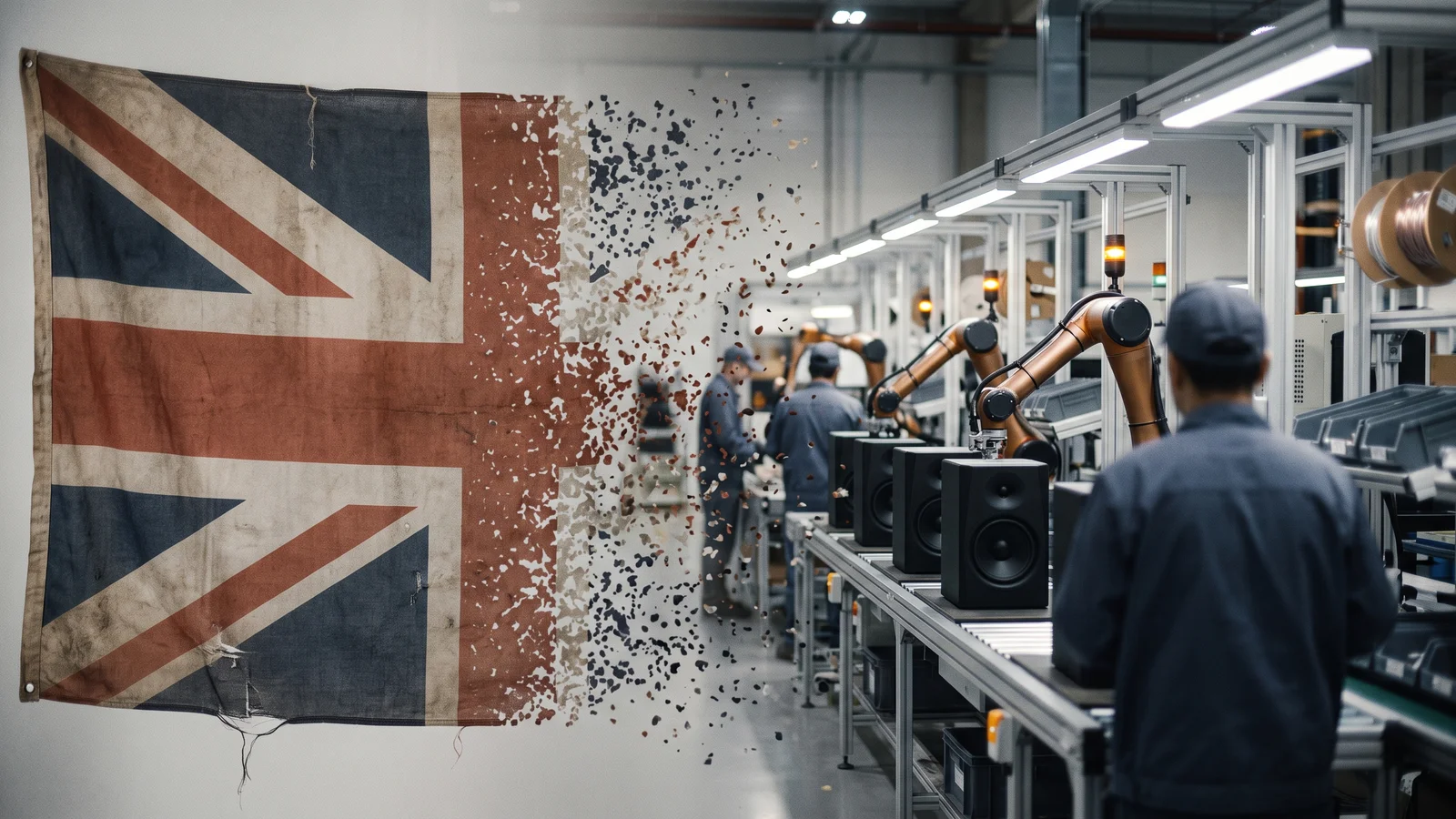
Wharfedale, Quad, Mission, Audiolab, Castle, and Leak all answer to one Chinese parent. Follow the money from Yorkshire to Jiangxi, with the receipts.
Follow the money on three of Britain's most beloved hi-fi names and you don't end up in Yorkshire or Cambridgeshire. You end up in Jiangxi. Wharfedale, born in 1932. Quad, born in 1936. Mission, born in 1977. Three houses that helped invent the sound of British hi-fi, and all three answer today to the same parent company: International Audio Group, run by twin brothers out of Shenzhen. The badges still say England. The boardroom and most of the assembly line don't. This is the story of how that happened. And, to IAG's genuine credit, why it might be the reason those names still exist at all.
Key Takeaways
- Wharfedale, Quad, and Mission are all owned by International Audio Group (IAG), a Chinese conglomerate run by twins Michael and Bernard Chang.
- IAG also owns Audiolab, Castle, the revived Leak nameplate, and Japan's Luxman, making it a genuine hall-of-fame collector.
- Most IAG production runs through a vertically integrated factory in Ji'an, Jiangxi province staffed by roughly 1,500 people, while acoustic design stays in the UK.
- Unlike owners who buy a name and bury it, IAG kept these British marques in continuous production for two-plus decades and revived a dead one, Leak, in 2020.
- Since a 2022 Made-in-the-UK push, select models like the Wharfedale Dovedale (2023) and Aston (2025) are again built in England.
So who actually owns Wharfedale, Quad, and Mission?
Wharfedale, Quad, and Mission are all owned by International Audio Group, or IAG, a Chinese conglomerate that runs a vertically integrated factory in Ji'an, Jiangxi province, staffed by roughly 1,500 people (International Audio Group, 2013; corroborated by Wikipedia). One parent, three legends. And that's before you count the rest of the collection.
Here's the thing most buyers never learn at the shop. When you bring home a Wharfedale bookshelf, a Quad electrostatic, or a Mission floorstander, you're buying from the same corporate house. The three brands compete on the same shelves, get reviewed against each other, and share a design team. They just don't advertise the family reunion.
IAG isn't a shell company flipping logos, either. It's a real manufacturer with real factories, real engineers, and a habit of buying storied names that were circling the drain and putting them back into production. Whether that counts as rescue or takeover depends on how much you care about the word "England" on the box. We'll get to that. First, the map.
What is International Audio Group?
International Audio Group is a Chinese audio manufacturer run by twin brothers Michael and Bernard Chang, whose corporate holding, IAG Group Ltd, was incorporated in Hong Kong in 1991 (International Audio Group; Wikipedia, flagged as thinly sourced, so treat the fine detail as approximate). The Changs' manufacturing story runs deeper than that date, though.
By the company's own account, the brothers were building audio in Taiwan back in the 1980s, then moved into mainland China in the late 1990s as costs and scale pushed them there. Today the group is headquartered in Shenzhen. The big move came in 2013, when IAG consolidated production into that large plant in Ji'an, Jiangxi province. I'm deliberately not quoting a square-footage number for it, because the figures floating around online don't hold up.
What matters is the shape of the operation. IAG designs a lot of what it sells at a UK research base in Huntingdon, Cambridgeshire, then builds the volume in China. Design in England, assembly in Jiangxi. Keep that split in your head, because it's the whole argument about these brands in one sentence.
Which British hi-fi legends does IAG own?
IAG owns a startling slice of the British hi-fi hall of fame: Wharfedale, Quad, Mission, Audiolab, Castle, and the revived Leak nameplate all sit under one roof, most of them acquired in a fifteen-year buying spree that started in 1997 (International Audio Group). Six storied English names, one Chinese owner. Here's how each one got there.
| Brand | Founded | Founder | Joined IAG |
|---|---|---|---|
| Quad | 1936 | Peter Walker | September 1997 (Verity Group deal) |
| Wharfedale | 1932, Ilkley, Yorkshire | Gilbert Briggs | Late 1997 (same Verity deal) |
| Audiolab | 1983 | Philip Swift & Derek Scotland | 2004 (name restored) |
| Mission | 1977 | Farad Azima | 2005 |
| Castle | 1973 | ex-Wharfedale engineers | 2006-07 (from receivership) |
| Leak | 1934 | Harold Joseph Leak | Revived 2020 |
Quad came first, in September 1997. Peter Walker founded Quad Electroacoustics in 1936, and the company's ESL-57 electrostatic panel remains one of the most revered speakers ever built (Quad). Wharfedale followed weeks later in the same Verity Group transaction. Gilbert Briggs had started Wharfedale in his cellar in Ilkley, Yorkshire, back in 1932 (Wharfedale).
Then the shopping continued. Audiolab, founded in 1983 by Philip Swift and Derek Scotland and famous for the 8000A integrated amp, had been renamed TAG McLaren Audio from 1997 to 2004. IAG restored the Audiolab name in 2004 and relaunched product the following year (Audiolab). Mission, founded by Farad Azima in 1977 and known for the Mission 770, joined in 2005 (Wikipedia). Castle Acoustics, started in 1973 by ex-Wharfedale engineers, was picked up out of receivership around 2006-07 (Wikipedia). Leak, Harold Joseph Leak's 1934 marque, had been dead for decades until IAG revived it in 2020 (Leak).
One more, so nobody thinks this is only a British story: IAG also bought Japan's Luxman in 2009, but Luxman's design and manufacture stay in Yokohama, Japan, untouched (hifiplus; International Audio Group). So the group can keep a marque local when it chooses to. Hold that thought too.
Are Wharfedale and Quad speakers made in China?
Mostly, yes. The bulk of Wharfedale and Quad production runs through IAG's Ji'an factory in Jiangxi province, while the acoustic engineering happens in the UK under long-serving Acoustic Director Peter Comeau, who has been with Wharfedale and IAG since 1999 (Darko.Audio). British-designed, Chinese-built, is the honest label for most of the range.
This is where a lot of buyers feel misled, and I understand why. A speaker with a heritage English name, sold on the strength of a Yorkshire cellar or a Cambridge lab, is largely assembled 5,000 miles away. Nobody's hiding it, exactly, but nobody's putting it on the front of the box either. The Wharfedale Super Linton, one of the brand's most talked-about recent designs, is a good example: widely praised by reviewers, and built in Ji'an (Stereophile; The Absolute Sound).
Does that make it a worse speaker? Not on the bench, from what the reviewers report, and I'm not going to pretend otherwise. A well-run Chinese factory building to a good engineer's spec can turn out an excellent loudspeaker. What moves is the provenance, not necessarily the performance. Those are two different things, and it's worth being precise about which one you're actually paying for.
Did IAG save these brands or hollow them out?
Here's the part the cynics skip: IAG mostly saved them. Where other owners bought storied names and quietly euthanized them, IAG kept Wharfedale, Quad, Mission, Audiolab, and Castle in continuous production for more than two decades, all still designed, shipping, and seriously reviewed today (International Audio Group). That's the fair core of this story, and it deserves top billing.
Think about what nearly happened instead. The Verity Group that once held Wharfedale and Quad was in trouble in 1997. Audiolab had been swallowed and buried inside TAG McLaren. Castle went into receivership. Leak had been a ghost since the 1970s. Every one of these names was a candidate to vanish entirely, the way so many great marques have. Moving manufacturing to China, first Shenzhen, then Ji'an, is precisely what made them viable enough to keep going.
And IAG didn't just maintain them. It revived a genuinely dead brand. In 2020 the company brought Leak back with the Stereo 130 integrated amp and a matching CD transport, a proper relaunch, not a logo sticker (Darko.Audio; Leak). Reviving a nameplate that had been cold for half a century is the opposite of asset-stripping. It's the behavior of a company that actually likes this stuff.
Then came the move that surprised even the skeptics. Under a 2022 Made-in-the-UK initiative, IAG began returning select heritage models to British manufacture. The Wharfedale Dovedale, launched around the brand's 90th anniversary in 2023, is designed and built in the UK at a new production facility in Huntingdon (Stereophile). The Aston followed in 2025, hand-built in Huntingdon and limited to 500 pairs (Wharfedale).
Be clear about the scope, though. The UK line is selective, not wholesale. The Super Linton, launched in 2024, is still built in Ji'an (The Absolute Sound). So IAG is offering a British-made tier for buyers who want it, at a price, while the volume stays in China. That's a smart, honest compromise, and it's more than most conglomerates would ever bother to do.
So what's actually lost, then?
If you want the uncomfortable version, here it is. Three of Britain's most storied hi-fi houses, Wharfedale, Quad, and Mission, are today owned by a Chinese conglomerate and largely built in a factory in Jiangxi. The badges are British. The boardroom and most of the assembly line are not. Call it a soft enshittification if you like, the slow drift of a name away from the place and the people that first made it mean something.
For a lot of listeners, that drift doesn't matter one bit. If the speaker measures well, sounds great, and carries a fair warranty, who cares where the screws went in? That's a completely reasonable position, and on the merits IAG has earned it. The products are good. The reviews are good. The names are alive because of decisions the Changs made, not in spite of them.
But provenance is a real thing to some of us. For the collector who prizes a Yorkshire cellar or a Cambridge lab as part of what he's buying, the shift is a genuine loss, however good the current product happens to be. A Quad electrostatic designed by Peter Walker's company in England and one assembled to spec in Jiangxi are not the same object to that buyer, even if the frequency response overlaps. That's not snobbery. It's just what provenance means.
So the honest ledger reads like this. IAG kept the flame lit, revived the dead, and even brought some of it home to England. That outweighs the complaint. The complaint is real anyway: the story a name tells and the place it now comes from have quietly parted ways, and once that happens, you can't fully put it back.
Here's where I come in, briefly, since it's my name on this. I build loudspeakers by hand in our Arizona workshop, for about fifteen clients a year, and every pair ships with a birth certificate naming the person who made it. Some listeners still want gear designed and built under one roof by the people who answer the phone. That's the model at Mike Knows AV. It isn't better than IAG on a spec sheet, and I won't pretend it is. It's just a different answer to a plain question, where does this come from, and if that question matters to you, that's what our custom loudspeakers are about.
Frequently Asked Questions
Who owns Wharfedale?
Wharfedale is owned by International Audio Group (IAG), a Chinese conglomerate run by twin brothers Michael and Bernard Chang. IAG acquired Wharfedale in late 1997 from the Verity Group. The brand's acoustic design still happens in the UK, while most manufacturing runs through IAG's factory in Ji'an, Jiangxi province.
Who owns Quad?
Quad, or Quad Electroacoustics, is owned by International Audio Group (IAG). IAG bought Quad in September 1997 as part of the same Verity Group deal that brought in Wharfedale. Quad still trades on its electrostatic heritage, the famous ESL-57, though it now sits inside a Shenzhen-headquartered group.
Who owns Mission?
Mission is owned by International Audio Group (IAG), which acquired the brand in 2005. Farad Azima founded Mission in 1977, and its Mission 770 became a British classic later revived under IAG. Like its stablemates, Mission keeps UK acoustic design while most production runs through IAG's Chinese factory.
What is International Audio Group?
International Audio Group (IAG) is a Chinese audio manufacturer run by twin brothers Michael and Bernard Chang. IAG Group Ltd was incorporated in Hong Kong in 1991, with roots in 1980s Taiwan. Headquartered in Shenzhen, it owns Wharfedale, Quad, Mission, Audiolab, Castle, Leak, and Japan's Luxman.
Are Wharfedale and Quad speakers made in China?
Mostly, yes. Wharfedale and Quad are largely built at IAG's factory in Ji'an, Jiangxi province, while acoustic design stays in the UK under Acoustic Director Peter Comeau. Since a 2022 Made-in-the-UK push, select models like the Wharfedale Dovedale and Aston are again designed and built in Huntingdon, England.
Sources
- International Audio Group - About Us (company history, Ji'an plant, ~1,500 employees): https://www.iaggroup.com/about-us/
- International Audio Group - Our Brands: https://www.iaggroup.com/our-brands/
- International Audio Group - Luxman brand page: https://www.iaggroup.com/our-brands/luxman/
- Wikipedia - "International Audio Group" (note: flagged as thinly sourced; corroborate): https://en.wikipedia.org/wiki/International_Audio_Group
- Wikipedia - "Luxman": https://en.wikipedia.org/wiki/Luxman
- Wikipedia - "Castle Acoustics": https://en.wikipedia.org/wiki/Castle_Acoustics
- Wikipedia - "Farad Azima" (Mission, 1977): https://en.wikipedia.org/wiki/Farad_Azima
- Wharfedale - History (Gilbert Briggs, 1932; Aston, UK-built): https://www.wharfedale.co.uk/pages/history
- Quad - Our Story (Peter Walker, 1936; ESL-57): https://www.quad-hifi.co.uk/pages/our-story
- Audiolab - History (Swift & Scotland, 1983; TAG McLaren years; 2004 restoration): https://www.audiolab.co.uk/pages/history
- Leak - Our Story (Harold Joseph Leak, 1934; 2020 revival): https://www.leakaudio.com/pages/our-story
- Stereophile - "Wharfedale Super Linton loudspeaker": https://www.stereophile.com/content/wharfedale-super-linton-loudspeaker
- Stereophile - "Wharfedale Celebrates 90th Anniversary with Dovedale": https://www.stereophile.com/content/wharfedale-celebrates-90th-anniversary-dovedale
- The Absolute Sound - "Wharfedale Super Linton Loudspeaker": https://www.theabsolutesound.com/articles/wharfedale-super-linton-loudspeaker/
- Darko.Audio - "Leak returns with the Stereo 130 and CDT" (2020 revival): https://darko.audio/2020/09/leak-audio-returns-with-the-stereo-130-and-cdt/
- Darko.Audio - "The Mission 770 returns" (Peter Comeau, UK design): https://darko.audio/2022/09/the-mission-770-returns/
- hifiplus - "Luxman and IAG": https://hifiplus.com/articles/luxman-l-509z-integrated-amplifier/
Mike Vincent is the founder of Mike Knows Audio Video and WubWub Audio, where he designs and hand-builds custom loudspeakers in Arizona, the old way, for about fifteen clients a year. He has nothing against a well-built speaker from anywhere, but he thinks a buyer deserves to know where a name really comes from before the badge does the talking.
Comments
Leave a Comment