
He patented stereo sound in 1931, helped launch the world's first HD television, then died in a wartime radar crash at 38. This is Alan Blumlein.
Ask ten people who invented stereo and you'll get ten blank stares. That still gets me. Every song you've ever heard split across a left and right speaker, every movie soundtrack that pans a car from one side of the room to the other, it all traces back to one Englishman who filed a patent in 1931 and never lived to hear what he started.
His name was Alan Dower Blumlein. He worked mostly in secret, died young in a wartime crash the government hid for decades, and left behind 128 patents that quietly built the modern audio and television worlds. I build two-channel speakers for a living, so I owe this man more than most. Let me tell you why he deserves top billing.
Key Takeaways
- Alan Blumlein (1903-1942) was a British electronics engineer who held 128 patents in a career of roughly 18 years.
- He filed UK Patent 394,325, the foundational stereo patent, in December 1931 at age 27, packed with an extraordinary 70 claims.
- His "Blumlein pair" microphone technique and 45/45 stereo groove are still standards in recording today.
- He also helped create the Marconi-EMI 405-line television system the BBC launched in 1936, the world's first regular HD TV service.
- He died on 7 June 1942, aged 38, when a Halifax bomber testing H2S radar caught fire and crashed, killing all 11 aboard.
- His work was so secret he got almost no public credit until an IEEE Milestone in 2015 and a posthumous Grammy in 2017.
Who was Alan Blumlein, the man behind stereo?
Alan Dower Blumlein was a British electronics engineer, born 29 June 1903 in Hampstead, London, who held 128 patents across a career spanning roughly 1924 to 1942, according to the ETHW engineering history archive. He crammed that output into about eighteen working years. Then it stopped, hard, at 38.
Here's what strikes me most: he wasn't some lone garage tinkerer. He was formally, rigorously trained. Blumlein went to Highgate School, then to the City and Guilds College at Imperial College London, and graduated around 1923 with a First-Class Honours BSc, as Imperial College records note. The man had the paper credentials and the hands. That combination is rarer than you'd think.
His career reads like a tour of early British electronics. He started at Western Electric and its successor STC from 1924 to 1929, moved to Columbia Graphophone in 1929, and landed at EMI in 1931 after Columbia merged with the Gramophone Company to form it, per the ETHW biography. He married Doreen Lane in 1933 and had two sons. Family man, quiet genius, absurdly productive.
How did Alan Blumlein invent stereo in 1931?
Blumlein applied for UK Patent 394,325 on 14 December 1931, at the age of 27, and it was granted on 14 June 1933 with an extraordinary 70 claims covering nearly every element of stereo sound, as the EMI Archive Trust documents. Seventy claims. Most patents live or die on one good idea. He filed a whole field.
He didn't even call it stereo. Blumlein called his system "binaural sound," and the story goes that he was annoyed at the cinema, watching an actor speak from one side of the screen while the voice came from a single speaker somewhere else, as The Conversation recounts in its profile of him. He wanted the sound to follow the picture. That itch became the blueprint for modern audio.
The patent's reach is almost hard to believe. It described a way to cut two channels into a single record groove using walls angled at 45 degrees, backward-compatible with mono gear, as the EMI Archive Trust explains. That 45/45 method became the world stereo-LP standard when the format finally shipped in 1957 and 1958, roughly 25 years after he wrote it down, per Wikipedia's account of his stereo work. He was a quarter century early.
And he proved it, not just on paper. Blumlein and his team cut experimental stereo wax discs at EMI's Hayes site on 14 and 15 December 1933, then recorded the London Symphony Orchestra under Sir Thomas Beecham starting 19 January 1934, as the EMI Archive Trust records. In 1935 they shot a short test film of trains at Hayes, widely called the world's first stereo film, per the EMI Archive Trust's video archive. You can still watch it. It still works.
What is the Blumlein pair, and why do engineers still use it?
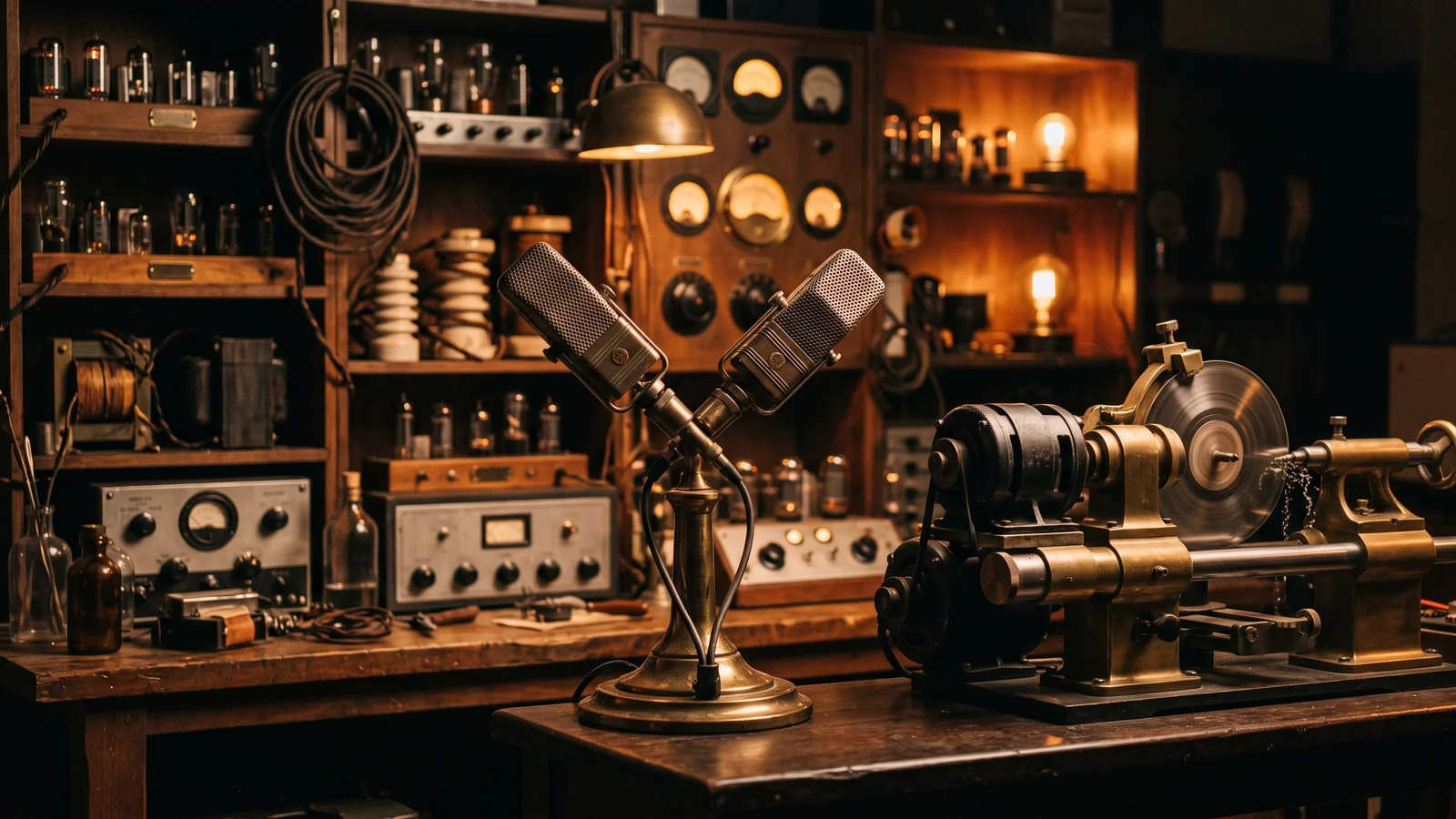
The Blumlein pair is a stereo recording technique using two figure-8 ribbon microphones crossed at plus and minus 45 degrees, positioned as close together as possible, and it remains a working standard in professional recording nearly a century after Blumlein described it in his 1931 patent, as the EMI Archive Trust details. Walk into a serious studio today and someone knows this trick.
The genius is in the coincidence. Because both mics sit at essentially the same point, the pair captures direction purely as differences in level, not timing, which gives a stable, natural stereo image. That's the whole game. Blumlein's patent also laid out Mid-Side, or M/S, matrixing, and a clever "shuffling" circuit that converts timing differences between your ears into the level differences a two-speaker system can actually reproduce, as Wikipedia summarizes. Recording engineers still argue about these techniques. He settled the questions before they were asked.
Let me be precise about one thing engineers love to muddle. Blumlein's famous moving-coil work was on the disc-cutting head and the microphone, the recording end of the chain, not on loudspeaker drivers, as the ETHW biography clarifies. He shaped how sound got captured and carved into the groove. What comes out the other end is still our job. And every time we voice a pair of towers so the image locks dead-center between them, we're building on geometry he wrote down in 1931. That's the invisible inheritance behind every custom stereo speaker we hand-build in our Arizona workshop.
What else did Alan Blumlein invent besides stereo?
Stereo alone would earn Blumlein a statue, but it was maybe a fifth of his output. He held 128 patents total, and one of his biggest contributions was helping build the Marconi-EMI 405-line television system that the BBC launched from Alexandra Palace in November 1936, the world's first regular high-definition TV service, per Wikipedia's history of the 405-line system. He helped invent television and stereo. Same guy.
His fingerprints are on circuits you've never heard of that run everything you own. Blumlein's name appears on one of the earliest patents for the differential pair, often called the "long-tailed pair," a circuit dating to around 1936 that became a fundamental building block of analog electronics and op-amps, as the ETHW biography notes. It sits inside amplifiers, radios, and measuring gear to this day. Quiet, essential, everywhere.
Then the war came, and it pulled him into work that would eventually kill him. Blumlein led EMI's development of H2S airborne radar, a ground-mapping system that let bombers navigate and find targets through cloud and darkness, as the Alan Blumlein archive records. It was some of the most important and most secret technology of the war. He was exactly the man you'd assign to it. That was the problem.
How did Alan Blumlein die?
Alan Blumlein died on 7 June 1942, aged 38, when the Handley Page Halifax II bomber V9977 caught fire and crashed near Welsh Bicknor in Herefordshire during a classified H2S radar test flight from RAF Defford, killing all 11 people aboard, as the Defford Airfield Heritage Group documents. An engine and maintenance fault brought it down. In one afternoon, British science lost one of its sharpest minds.

The loss landed hard on the people who knew what he was worth. Wartime accounts and later historians have counted Blumlein among the most serious scientific losses Britain suffered in the conflict, as Cambridge's Cavendish Laboratory has noted in surveying wartime scientist casualties. He wasn't a soldier. He was a civilian engineer doing dangerous work because it mattered, and it cost him everything.
Here's the part that turns tragedy into obscurity. Because H2S was so secret, the government suppressed Blumlein's role, and even the fact of his death, for security reasons that stretched on for decades, as Wikipedia's account of the 1942 Herefordshire crash records. No headlines. No public mourning. The single biggest reason he became "the greatest engineer you've never heard of" is that his own country classified him into silence.
Why is Blumlein called the greatest engineer you've never heard of?
Recognition finally arrived, decades too late for him to enjoy it. In 2015 the IEEE unveiled a Milestone plaque honoring Blumlein at Abbey Road Studios in London, marking his stereo work at the very place his ideas still echo, as documented in the IEEE Milestone record. It only took the profession about eighty years to bolt his name to a wall.
The music industry eventually caught up too. In 2017 Blumlein received a posthumous Technical Grammy Award for his contributions to stereo sound, as the IET's Engineering & Technology magazine reported. To be clear, he never held that award in his hands. It came 75 years after he died, honoring a man most Grammy viewers had never heard of. Imperial College, his old school, marked the same posthumous honor, as the college noted.
So why does he stay obscure? Blame the secrecy, and blame timing. Stereo records didn't ship until 1957, long after his death, so the public never connected the format to a name, as Wikipedia's biography explains. His TV work was corporate and shared. His radar work was classified. A man this important should be a household name. Instead he's a footnote most audiophiles have to go looking for. That's the injustice this whole series exists to fix.

Frequently Asked Questions
Who invented stereo?
Alan Blumlein, a British engineer at EMI, invented stereo sound and filed the foundational patent, UK Patent 394,325, in December 1931, according to the EMI Archive Trust. He called it "binaural sound." The patent's 70 claims covered stereo microphones, the two-channel record groove, and matrixing techniques still used in professional recording today.
When was stereo invented?
Stereo was invented in 1931, when Alan Blumlein applied for UK Patent 394,325 on 14 December, granted in June 1933, per Wikipedia's account of his work. He cut experimental stereo discs in 1933 and shot a stereo test film in 1935. Commercial stereo records did not reach consumers until 1957 and 1958, about 25 years later.
Who was Alan Blumlein?
Alan Dower Blumlein (1903-1942) was a British electronics engineer who held 128 patents and invented stereo sound, as the ETHW engineering archive documents. He also helped build the world's first HD television system, the 405-line service the BBC launched in 1936, and led EMI's H2S radar work during World War II before his death at 38.
How did Alan Blumlein die?
Alan Blumlein died on 7 June 1942, aged 38, when the Halifax bomber V9977 caught fire and crashed near Welsh Bicknor, Herefordshire, during a secret H2S radar test flight, killing all 11 aboard, as the Defford Airfield Heritage Group records. Because the work was classified, his role and death were suppressed for security reasons for decades afterward.
What is the Blumlein pair?
The Blumlein pair is a stereo recording technique using two figure-8 microphones crossed at plus and minus 45 degrees at a single coincident point, as the EMI Archive Trust details. Because the mics share one position, it captures direction as pure level differences, producing a stable, natural stereo image that engineers still rely on nearly a century later.
Sources
- EMI Archive Trust, "Alan Blumlein and the Invention of Stereo": https://www.emiarchivetrust.org/alan-blumlein-and-the-invention-of-stereo/
- EMI Archive Trust, "Videos: Trains at Hayes, the world's first stereo film (1935)": https://www.emiarchivetrust.org/headline/videos/
- Wikipedia, "Alan Blumlein": https://en.wikipedia.org/wiki/Alan_Blumlein
- Wikipedia, "405-line television system": https://en.wikipedia.org/wiki/405-line_television_system
- Wikipedia, "1942 Herefordshire TRE Halifax crash": https://en.wikipedia.org/wiki/1942_Herefordshire_TRE_Halifax_crash
- ETHW / IEEE, "Alan Dower Blumlein": https://ethw.org/Alan_Dower_Blumlein
- Imperial College London, "Alumnus Alan Blumlein honoured with posthumous Grammy": https://www.imperial.ac.uk/news/177832/alumnus-alan-blumlein-honoured-posthumous/
- IET Engineering & Technology, "Alan Blumlein honoured with posthumous Grammy": https://eandt.theiet.org/content/articles/2017/02/alan-blumlein-honoured-with-posthumous-grammy/
- The Conversation, "Alan Blumlein: the prolific British inventor who gave the world stereophonic sound": https://theconversation.com/alan-blumlein-the-prolific-british-inventor-who-gave-the-world-stereophonic-sound-72604
- Cavendish Laboratory, University of Cambridge, "Wartime science and scientist losses": https://www.phy.cam.ac.uk/history/wartime
- The Alan Blumlein Archive, "H2S Airborne Radar": https://www.alanblumlein.com/h2s-airborne-radar/
- Defford Airfield Heritage Group, "Tragic Crash of Halifax V9977": https://dahg.org.uk/stories/tragic-crash-of-halifax-v9977/
- The Alan Blumlein Archive, "IEEE Milestone Plaque for the Invention of Stereo": https://www.alanblumlein.com/ieee-milestone-plaque/
Mike Vincent is the founder of Mike Knows Audio Video and WubWub Audio, where he designs and hand-builds custom loudspeakers and home theaters in Arizona, the old way, for about fifteen clients a year. He has a real soft spot for the quiet geniuses history nearly forgot; if you want a stereo pair voiced to image the way Blumlein intended, start with our custom loudspeakers.
Comments
Leave a Comment