
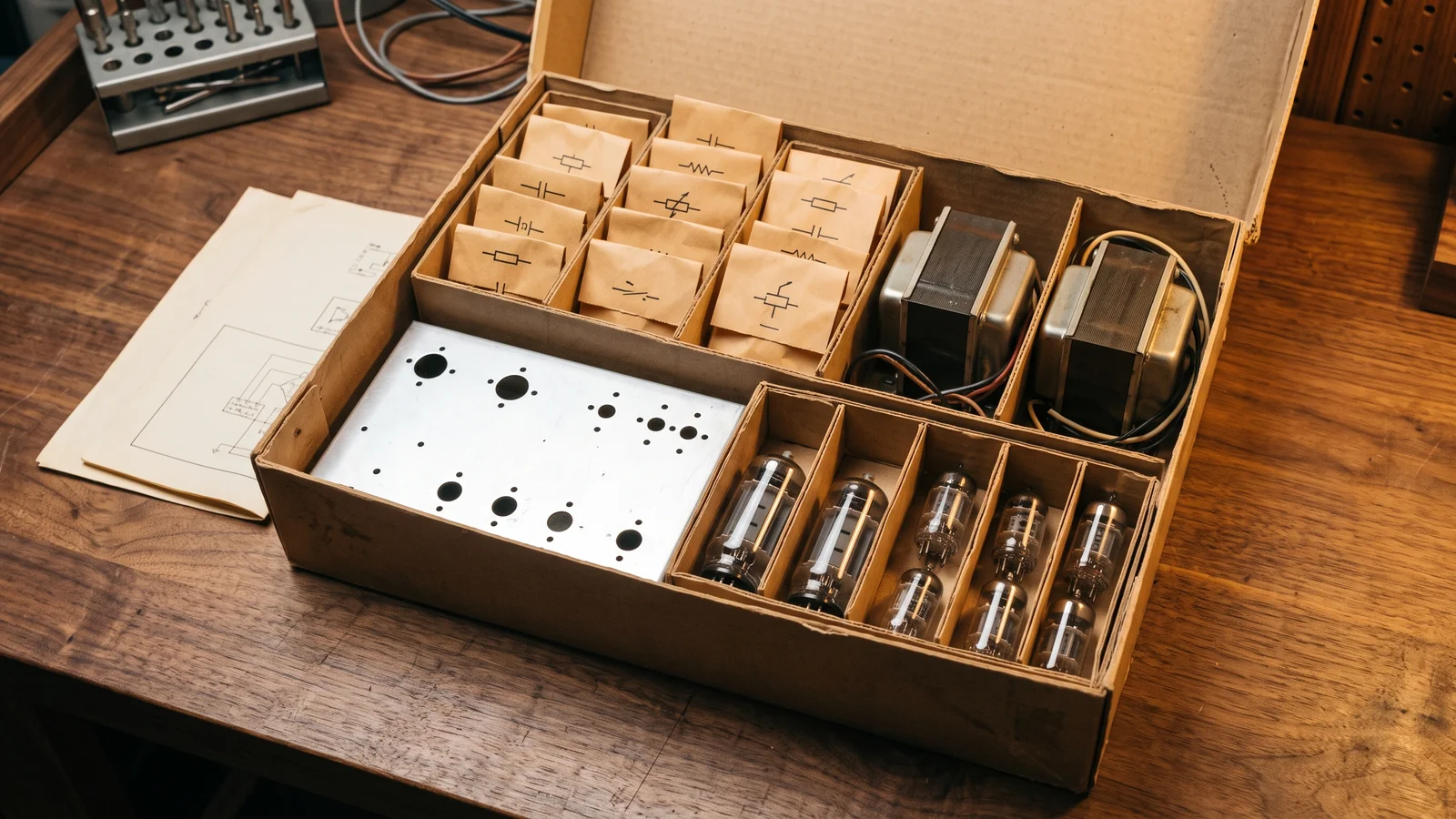
David Hafler believed a working enthusiast could build reference sound at his own kitchen table. Dynakit made it true. This is the story of the poor man's McIntosh.
Most audio legends want you to buy the finished box. David Hafler wanted to sell you the parts and trust you to build it. That's a strange business model for a luxury product, and it worked better than almost anything else in the history of the hobby.
Hafler had a simple, almost radical idea. Great sound shouldn't be a rich man's toy. If a working enthusiast couldn't afford a factory-wired reference amplifier, then sell him the same transformers, the same tubes, the same chassis, add clear instructions, and let him solder it together on his own kitchen table for a fraction of the price. I've spent my whole career hand-building gear, so a man who trusted ordinary people to build excellent electronics is my kind of hero. Let me tell it right.
Key Takeaways
- David Hafler (1919-2003) was a University of Pennsylvania mathematics graduate and WWII Coast Guard communications specialist who devoted his life to democratizing high fidelity.
- With Herbert Keroes at Acrosound, he coined and published the "ultra-linear" output stage in Audio Engineering in November 1951, though the underlying principle predates them.
- Dynaco's Dynakit model let buyers solder reference-grade amps themselves and became known as the "poor man's McIntosh."
- The Dynaco Stereo 70 (1959) is widely called the best-selling tube power amplifier ever made, with an estimated 350,000 to 500,000 units.
- Hafler was inducted into the Audio Hall of Fame in 1984 and kept innovating with the David Hafler Company's MOSFET amps and the Hafler surround hookup.
- After Hafler left, the Dynaco name passed through Tyco, ESS, and Panor before landing with Dynakit, LLC today.
Who was David Hafler, the mind behind the kit?
David Hafler was born February 7, 1919, in West Philadelphia and died May 25, 2003, in Philadelphia at age 84 from complications of Parkinson's disease, according to Wikipedia's biography. He earned a mathematics degree from the University of Pennsylvania and served as a communications specialist in the U.S. Coast Guard during World War II. He was inducted into the Audio Hall of Fame in 1984.
Here's the thing that shaped everything he built. Hafler wasn't chasing the wealthiest buyer in the room. He was, by every characterization of him, value-obsessed and anti-elitist about sound quality, as the Hi-Fi Hall of Fame profile describes. He believed reference-grade playback belonged in the hands of a schoolteacher or a machinist, not just a collector, and he believed those same people could build it themselves if you gave them honest parts and honest directions.
That trust is the whole man. Most of the golden-age founders sold you finished perfection and asked you to admire it from the outside. Hafler handed you a soldering iron and bet you'd do a fine job. He was right hundreds of thousands of times over, and that faith in the ordinary builder is a philosophy I recognize in my own bench every single day.
What is an ultra-linear amplifier, and did Hafler invent it?
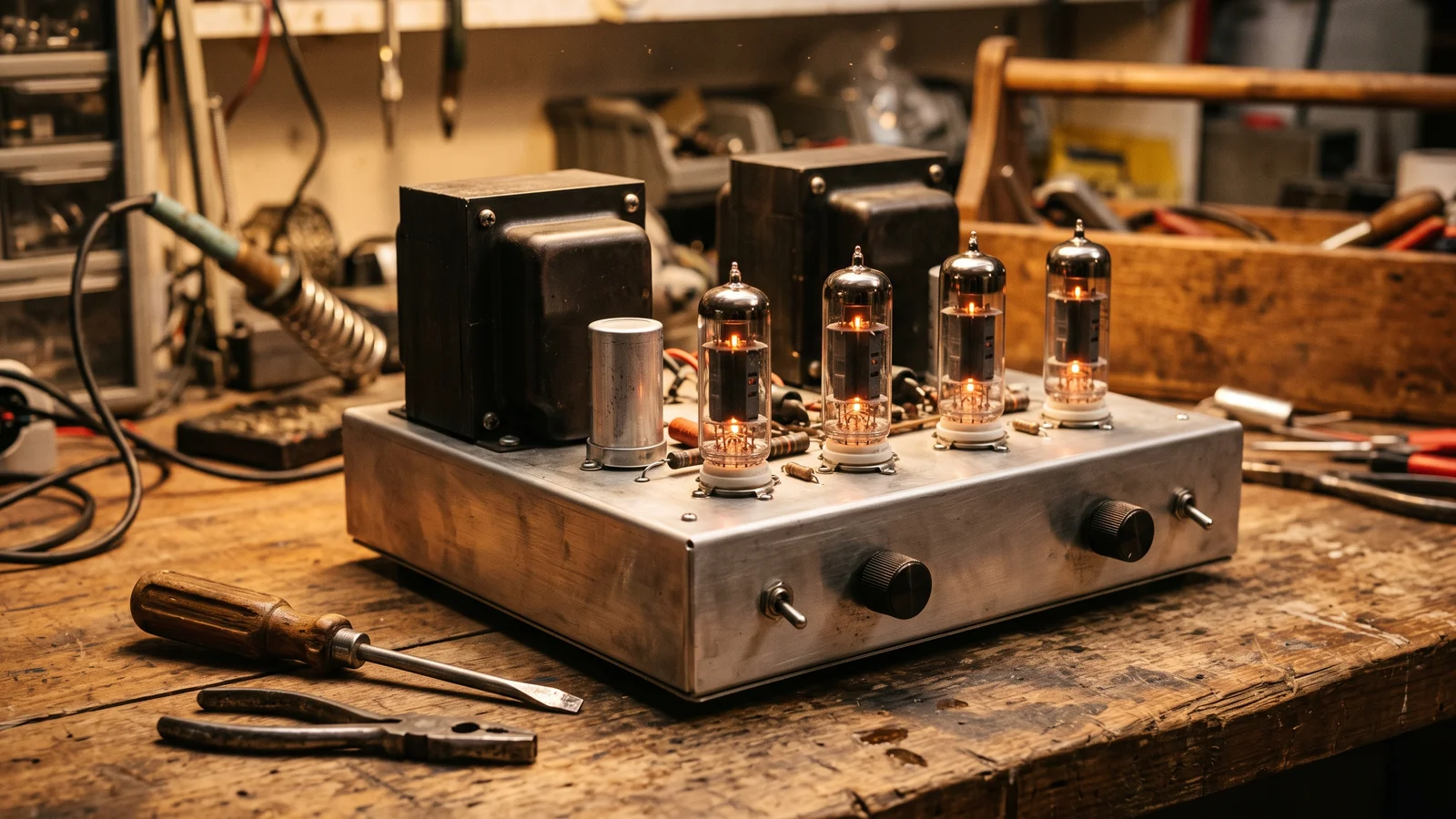
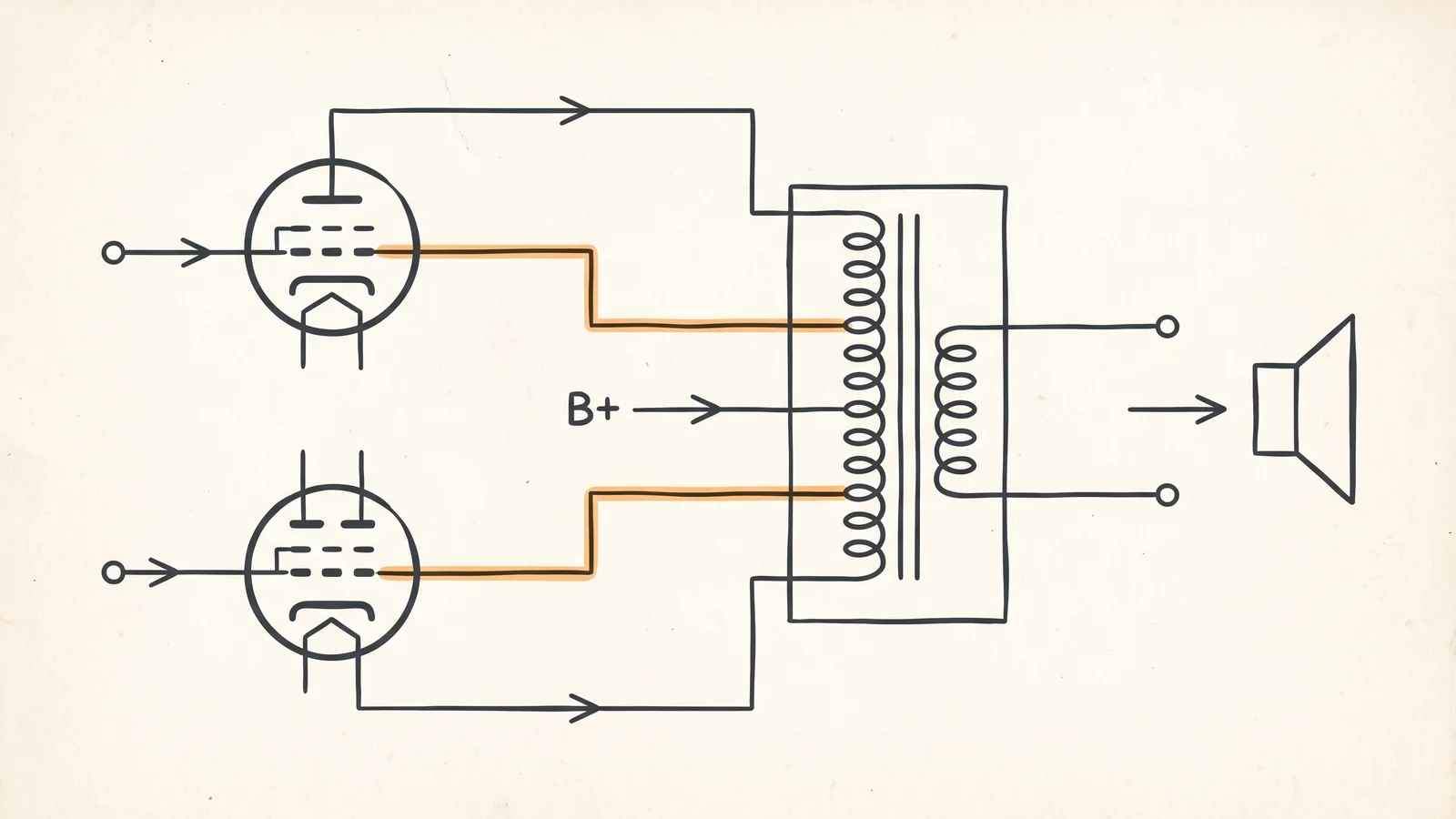
The ultra-linear output stage is a tube amplifier circuit that taps the output transformer to feed part of the plate signal to the tubes' screen grids, blending the low distortion of triode operation with the higher power of pentode operation. David Hafler and Herbert Keroes coined the term "ultra-linear" and published the design in Audio Engineering in November 1951, reprinted in full by Keith Snook. It was later patented and assigned to their company, Acrosound.
Now let me be honest about the credit, because this matters. Hafler and Keroes did not invent the principle itself. A distributed-load arrangement that tapped the transformer to the screen grids was patented by Alan Blumlein back in 1937, and related work traces to the Quad and Peter Walker camp, as Wikipedia's history of the ultra-linear circuit documents. What Hafler and Keroes did was name it, prove it, patent a practical version, and turn an obscure idea into a mainstream circuit that anyone could build.
Acrosound, founded in 1950 in Philadelphia with Keroes, made output transformers for tube amps, per Wikipedia's Acrosound entry. Hafler left Acrosound in 1954. But the ultra-linear circuit outlived his time there and every company he touched after. It's still the standard output topology in tube power amps built today, which is a wild legacy for a design named at a Philadelphia transformer shop seventy-five years ago.
What made Dynaco and the Dynakit so special?
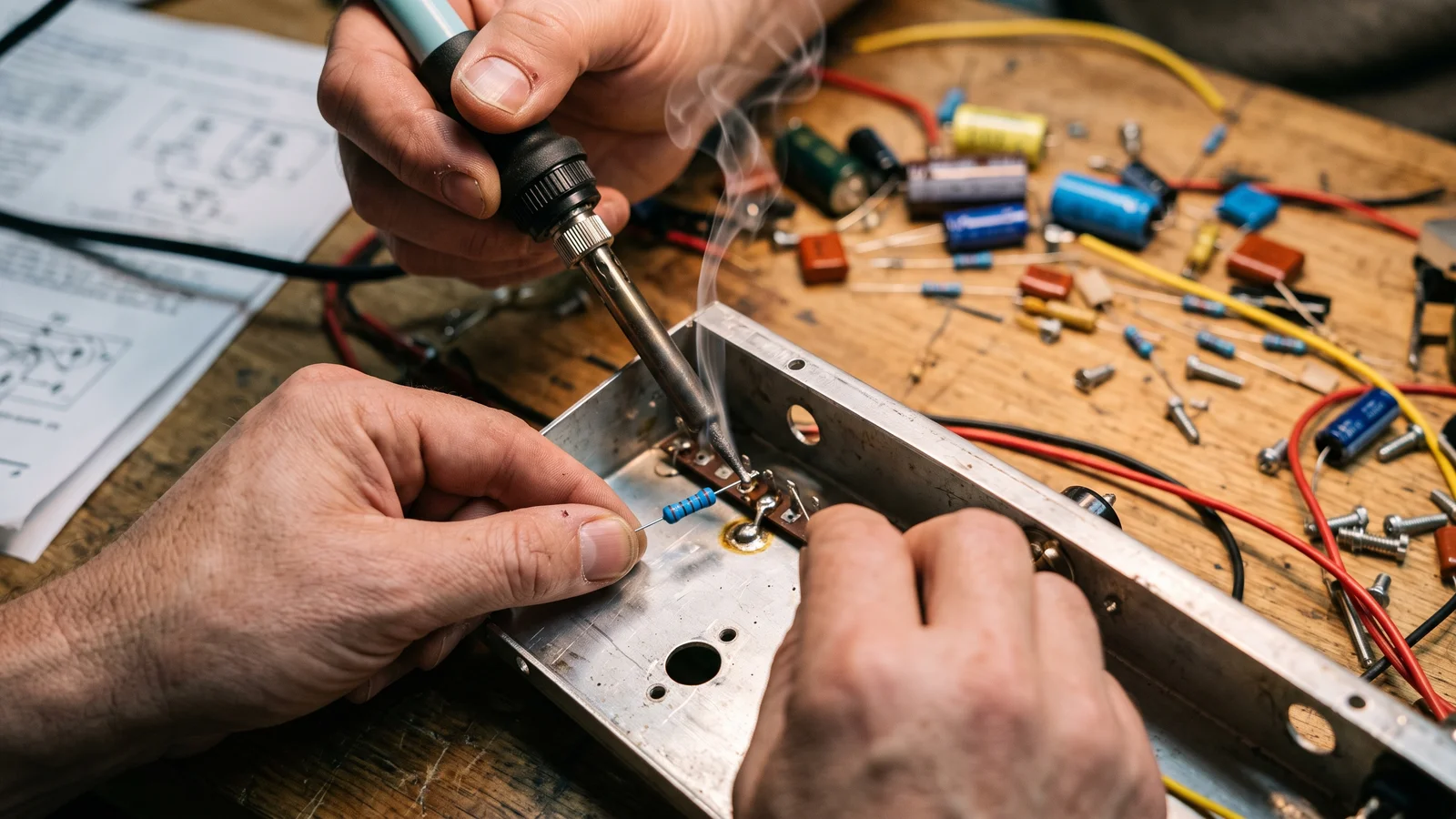
Dynaco, founded in 1954-55 with Ed Laurent, built its empire on one idea: sell the buyer a kit. As Wikipedia's Dynaco entry records, a Dynakit shipped as transformers, chassis, tubes, and parts with clear instructions, and you soldered it together yourself. You saved a big slice of retail on gear that measured and sounded like far pricier amplifiers. Enthusiasts had a nickname for the result: the poor man's McIntosh.
I've had a stack of Dynakit builds across my bench over the years, and the thing that still impresses me is how forgiving and how honest the instructions were. Dynaco assumed you were smart but not an engineer. The manuals walked you through it step by step, and a careful first-timer could end up with an amplifier that held its own against factory gear costing three times as much. That is a genuinely democratic product, and it's rarer than it sounds.
The catalog was deep. The Mark III tube monoblocks arrived in 1957. The PAS series preamplifiers came in 1960, starting with the PAS-2 and then the better-known PAS-3. The SCA-35 integrated amplifier landed in 1964, and the Stereo 120 in 1966 was one of Dynaco's early transistor designs, as the Dynaco history and Vintage Technology Archive catalog it. Then there was the A-25 loudspeaker of the late 1960s, which sold somewhere between roughly 600,000 and 1,000,000 units and proved Dynaco could reach the masses with speakers too.
Why is the Dynaco Stereo 70 the best-selling tube amp ever?
The Dynaco Stereo 70, released in 1959, is widely called the best-selling tube power amplifier ever made, with lifetime production estimated between 350,000 and 500,000 units, as Gear Patrol reports in its history of the amp. Rated at 35 watts per channel and sold as a kit or factory-wired, the ST-70 put real ultra-linear power into ordinary living rooms at a price working people could actually reach.
I want to flag the numbers honestly, because sources disagree. You'll see 350,000, 400,000, and 500,000 cited in different places, so treat "best-selling ever" as a widely-reported claim rather than an audited figure, as the Vintage Technology Archive and other historians note. Whatever the exact total, no other tube amp comes up as often when collectors argue about the all-time volume champion. The range alone tells the story.
Here's why the ST-70 still matters in 2026. People are restoring, re-capping, and outright cloning it right now, and the design has been revived commercially more than once, as The Absolute Sound covered in its review of the modern ST-70 Series 3. Sixty-plus years on, hobbyists still reach for the same circuit. That's not nostalgia doing the work. That's a design that got the fundamentals right the first time and never really needed replacing.
What did David Hafler build after Dynaco?
After leaving Dynaco, Hafler founded the David Hafler Company in 1977 in Pennsauken, New Jersey, and kept right on innovating, as Wikipedia's biography records. The company's DH-101 preamp came first, followed by the DH-200 power amp, which is generally credited as the first amplifier with a MOSFET output stage marketed in the United States. Both were sold as a kit or factory-assembled, staying true to the build-it-yourself gospel.
Two of his later ideas are pure Hafler, meaning clever, cheap, and useful. The first is the "Hafler hookup," a passive matrix surround trick that wires rear speakers to carry the speaker-level difference signal, the left channel minus the right, to pull ambience out of a stereo recording. It needs no extra amplifier and no extra power, just a pair of speakers and some wire. It's the kind of elegant hack that makes engineers grin, and it hints at ideas that later matured into full home theater systems.
The second is the Straight-Wire Differential Test, or SWDT, a real-time null test that subtracts an amplifier's output from its input to reveal all of its distortion at once, as Stereophile discussed in its coverage of Hafler's null-test amplifiers. It was an honest man's measurement: instead of publishing a friendly spec, Hafler built a way to show you everything the amplifier got wrong in one listen. That tells you how he thought.
Who owns Dynaco now, and what happened to the name?
The Dynaco name has changed hands many times since Hafler stepped away, and today the U.S. Dynaco trademark is held by Dynakit, LLC, per Wikipedia's Dynaco history. Hafler left and sold his interest in Dynaco in 1968, with Tyco taking full ownership in 1969. The founder's departure is the hinge the whole later story swings on.
From there the arc bends the way these arcs so often do. Dynaco passed to ESS Labs in 1979, and the Dynaco division was closed and liquidated in 1980. Then in 1991 the Pan Orient/Panor Corporation acquired the Dynaco trademark, as the Dynaco record documents. At that point the name stopped being a mission and became a nameplate, a logo you could license and stamp on a box. That slow hollowing of a beloved name after the builder walks away is what the writer Cory Doctorow calls enshittification, and audio trademarks are textbook cases of it.
But I promised to be fair, and fairness matters here. Hafler himself never stopped building good things. He sold the David Hafler Company to Rockford Corporation of Tempe, Arizona, in 1987, and under Rockford the Hafler name stayed genuinely respected for studio and live-sound amps and reference monitors. Radial Engineering relaunched the Hafler brand in 2014, as audioXpress reported. So this isn't a simple story of a good name ruined. The Dynaco trademark got traded around after Hafler left it, while the Hafler pro-audio name he sold on his own terms kept its dignity.
Here's the lesson I take from it, and it's the reason some of us still work the old way. A brand gets hollowed out when the builder leaves and the logo becomes the asset. A speaker hand-built to order, with the person who tuned it standing behind it, can't be quietly gutted by a trademark sale, because there's no name to sell out from under it. We build custom speakers by hand in our Arizona workshop, one small batch a year, each one signed off by the person whose name is on the shop and shipped with a birth certificate. Same value-first spirit Hafler chased, kept in the hands that make it.
Frequently Asked Questions
Who was David Hafler?
David Hafler (1919-2003) was a University of Pennsylvania mathematics graduate and WWII Coast Guard veteran who founded Acrosound, Dynaco, and the David Hafler Company. He devoted his career to making reference-grade sound affordable, largely through build-it-yourself kits, and was inducted into the Audio Hall of Fame in 1984.
What was the Dynaco Stereo 70?
The Dynaco Stereo 70, or ST-70, was a 35-watt-per-channel ultra-linear tube power amplifier released in 1959, sold as a kit or factory-wired. Widely called the best-selling tube amp ever made, with an estimated 350,000 to 500,000 units, it is still restored, re-capped, and cloned by hobbyists today.
What is an ultra-linear amplifier?
An ultra-linear amplifier is a tube design that taps the output transformer to feed part of the plate signal to the tubes' screen grids, combining triode-like low distortion with pentode power. Hafler and Keroes coined the term and published it in 1951, though the underlying principle was patented earlier by Alan Blumlein in 1937.
What is the Hafler hookup or Hafler surround?
The Hafler hookup is a passive matrix surround technique that wires rear speakers to carry the speaker-level difference signal, left minus right, to extract ambience from a stereo recording. It needs no extra amplifier and no extra power, just a pair of speakers and speaker wire, making it a clever, low-cost way to add surround depth.
Who owns Dynaco now?
The U.S. Dynaco trademark is held today by Dynakit, LLC. After David Hafler left in 1968 and Tyco took full ownership in 1969, the name passed to ESS Labs in 1979, was liquidated in 1980, and the trademark was acquired by the Pan Orient/Panor Corporation in 1991 before reaching its current holder.
Sources
- Wikipedia, "David Hafler": https://en.wikipedia.org/wiki/David_Hafler
- Wikipedia, "Dynaco": https://en.wikipedia.org/wiki/Dynaco
- Wikipedia, "Acrosound": https://en.wikipedia.org/wiki/Acrosound
- Hi-Fi Hall of Fame, "David Hafler": https://hifihalloffame.com/people/david-hafler/
- Stereophile, "David Hafler, 1919-2003" (obituary): https://www.stereophile.com/content/david-hafler-1919-2003
- Stereophile, "Hafler XL-280 Power Amplifier" (Straight-Wire Differential Test): https://www.stereophile.com/content/hafler-xl-280-power-amplifier
- audioXpress, "Radial Engineering Relaunches Hafler Brand": https://audioxpress.com/news/radial-engineering-relaunches-hafler-brand
- Gear Patrol, "The Dynaco ST-70": https://www.gearpatrol.com/tech/audio/a-dynaco-st-70/
- The Absolute Sound, "Dynaco ST-70 Series 3 Power Amplifier": https://www.theabsolutesound.com/articles/dynaco-st-70-series-3-power-amplifier/
- Vintage Technology Archive, "Dynaco Stereo 70": https://vintagetechnologyarchive.com/audio/dynaco/70/
- Keith Snook, "Ultra-Linear Amplifiers" (Hafler & Keroes 1951 reprint): https://www.keith-snook.info/Ultra-Linear-Amplifiers-Hafler-Keroes.pdf
- Vintage Technology Archive, "Dynaco" (model catalog): https://vintagetechnologyarchive.com/audio/dynaco/
- Wikipedia, "Ultra-linear" (Blumlein 1937 prehistory): https://en.wikipedia.org/wiki/Ultra-linear
Mike Vincent is the founder of Mike Knows Audio Video and WubWub Audio, where he designs and hand-builds custom loudspeakers and home theaters in Arizona, the old way, for about fifteen clients a year. He has a real soft spot for builders like Hafler who trusted ordinary people with a soldering iron and honest parts; if you want a speaker built with that kind of care and signed off by hand, start with our custom loudspeakers.
Comments
Leave a Comment