
A night-school teacher invented acoustic suspension in his apartment, shrank the speaker, humbled the giants, then gave the breakthrough away.
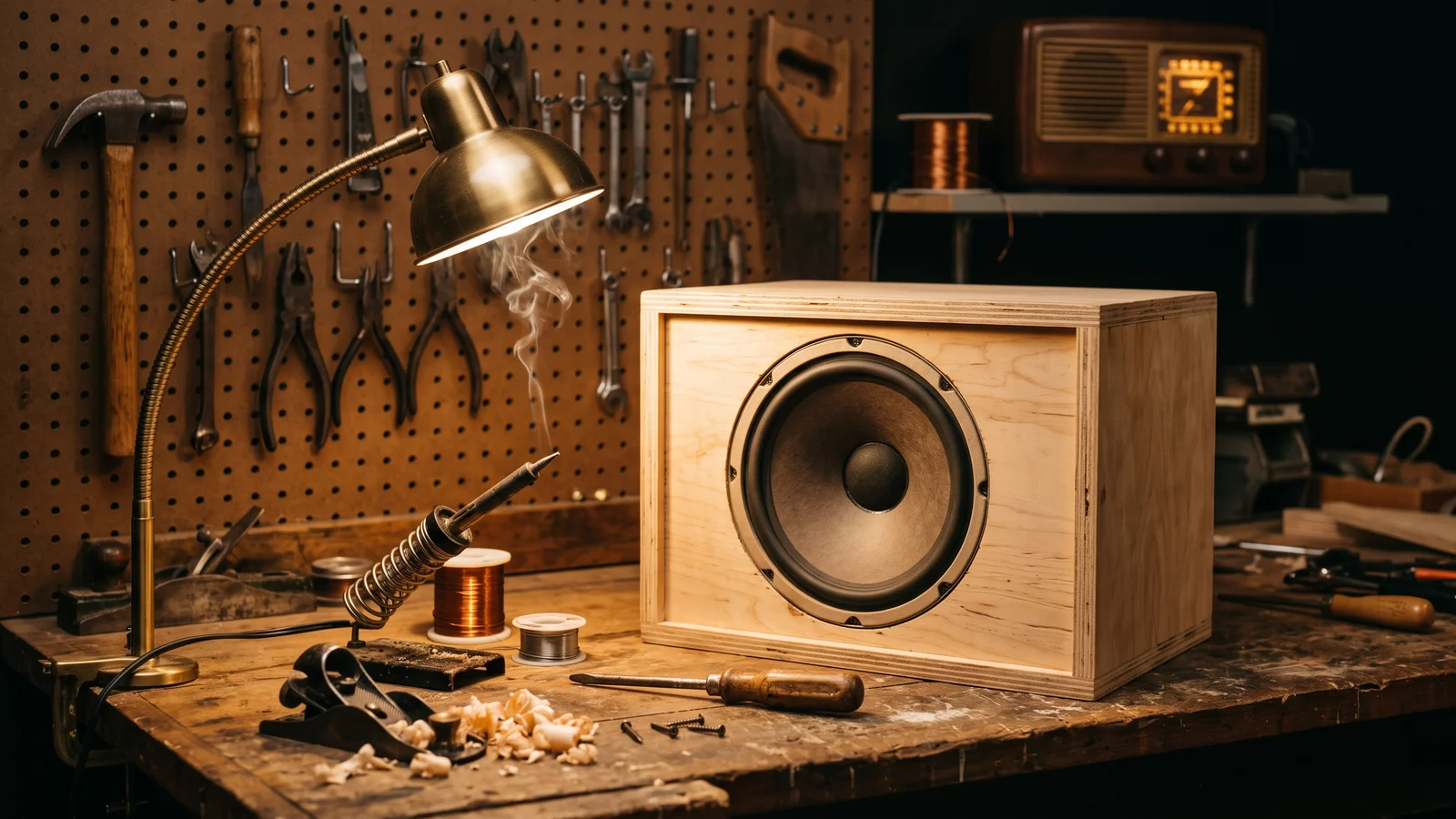
Picture a night-school classroom in Manhattan in the mid-1950s. The instructor up front trained as an art historian. He'd planned to design stage sets for a living. And on the side, in his apartment out in Woodstock, he was quietly building a wooden box that would go on to humble every big speaker company in America.
His name was Edgar Villchur, and the idea he worked out, acoustic suspension, let a small sealed box throw deep, clean bass that refrigerator-sized cabinets couldn't match. I build sealed subwoofers for a living, so I owe this man a beer I'll never get to buy him. Here's how a teacher out-engineered the pros, then handed the breakthrough to everyone who asked.
Key Takeaways
- Edgar Villchur (1917–2011) held a BA and MA in art history, not engineering, yet reinvented the loudspeaker in his spare time.
- His acoustic-suspension design uses the sealed air inside a small box as the spring, producing deep, low-distortion bass from a small woofer.
- He filed the patent in 1954; U.S. Patent 2,775,309 was granted December 25, 1956, and assigned to Acoustic Research.
- By 1966, Acoustic Research held about 32.2% of the US loudspeaker market, the largest share ever recorded.
- When a rival got his patent voided, Villchur chose not to appeal and let the world use the idea for free.
- After audio, he reinvented the hearing aid too, and again published his work instead of locking it up.
Who was Edgar Villchur?
Edgar Marion Villchur (1917–2011) was a New York teacher who reinvented the loudspeaker in his spare time. He earned a BA and an MA in art history from City College of New York and planned to become a scenic designer, according to his Wikipedia biography. Engineering was, at best, a hobby that got out of hand.
The war rerouted him. The US Army trained Villchur on radio, radar, and electronics, shipped him to New Guinea, and he came home a captain, per his Philadelphia Inquirer obituary. That's where the art historian picked up the technical fluency he'd never gotten in a classroom. He later took math and engineering courses at NYU to fill the gaps, but he was mostly self-taught in the field he'd end up leading.
The night class that started everything
Villchur pitched and taught a night course at NYU called "Reproduction of Sound," one of the first university hi-fi courses in the country, as Stereophile recounts in its history of Acoustic Research. Here's the kicker. One of his students was a young furniture builder named Henry Kloss. That classroom connection turned into a company, and that company changed how the whole country listened to music.
What is acoustic suspension, and why did it matter?
Acoustic suspension seals the speaker box and lets the trapped air act as the spring that centers the woofer, instead of relying on the cone's own stiff mechanical suspension. Trapped air pushes back in a nearly straight line, so a small woofer in a roughly 1.7-cubic-foot sealed box can deliver deep, low-distortion bass, as the Wikipedia entry on acoustic suspension explains. That was heresy in 1954.
Understand what everyone believed back then. Big bass meant a big box, full stop. The stiff cloth-and-rubber suspension holding the cone would go non-linear when pushed, and that non-linearity is just a fancy word for distortion. Villchur's move was to let physics do the springing. Air is a beautifully linear spring, so the cone stays honest even when it's working hard.
The trade-off is efficiency, and it's a real one. An acoustic-suspension speaker runs at roughly a tenth the efficiency of a comparable vented design, about 2.9 dB below a vented reference, so it wants a meatier amplifier to keep up, as the acoustic-suspension record notes. In 1954 that was a bargain. Villchur's design demonstrated greater undistorted output at 25 Hz than any speaker type before it, in a sealed box around 1.7 cubic feet, roughly 48 liters. Deep, clean bass from a cabinet you could put on a bookshelf. Nobody had done that.
The plywood box and the mattress ticking
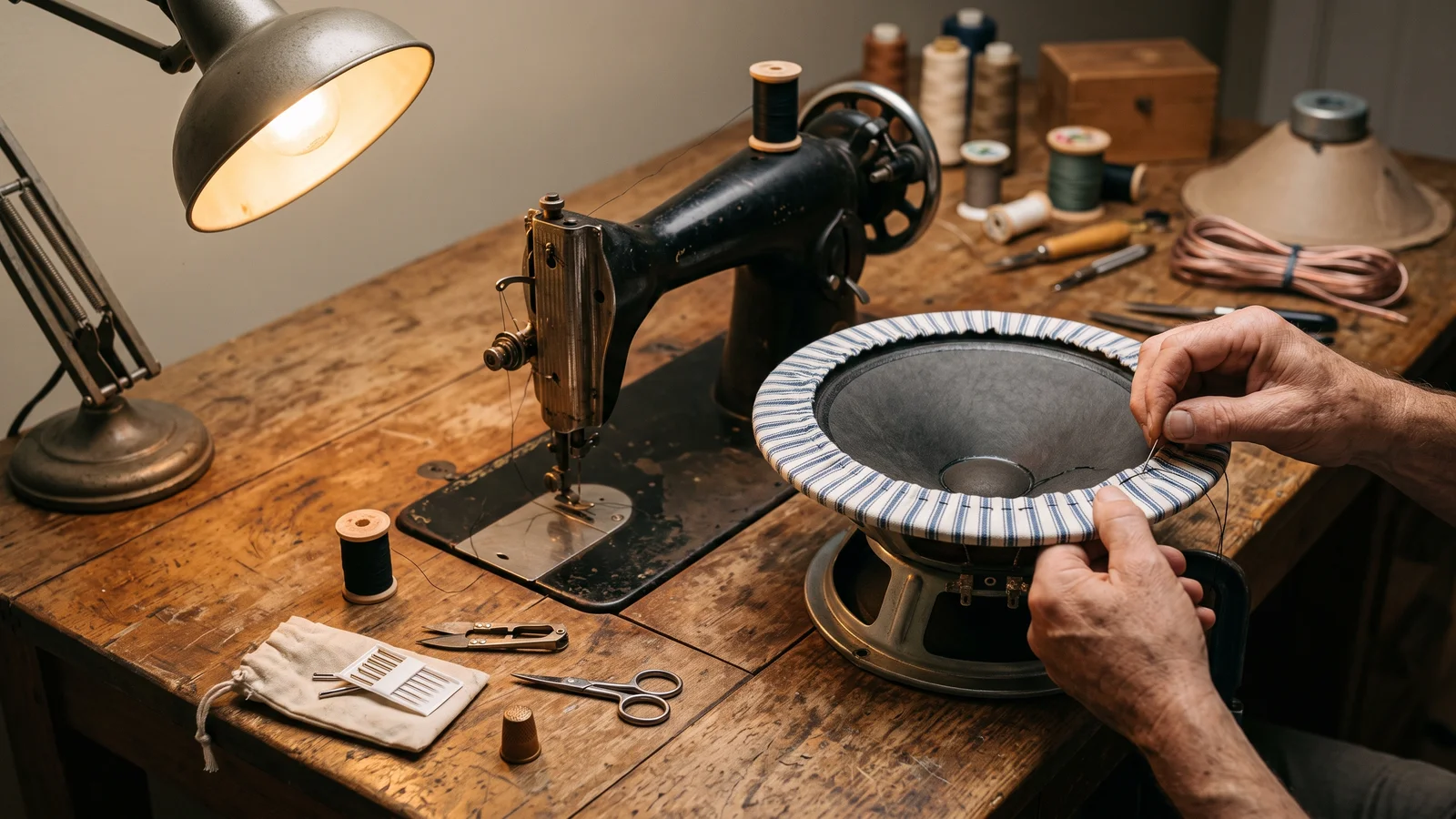
The first prototype was about as humble as it gets. Villchur built it at home from plywood, and his wife Rosemary sewed the woofer's surround out of mattress ticking, Stereophile notes. No lab, no grant, no team of PhDs. Just a teacher, a saw, and a sewing machine.
The patent followed the prototype. Villchur filed in 1954, and U.S. Patent 2,775,309, "Sound translating devices," was granted on December 25, 1956, then assigned to Acoustic Research, as the patent record at DATAMP shows. He wasn't done inventing, either. For the AR-3 he developed the first commercial hemispherical dome tweeter and dome midrange, and domes went on to become an industry standard you'll still find in most speakers today.
How did Acoustic Research take over hi-fi?
Villchur and Henry Kloss founded Acoustic Research in Cambridge, Massachusetts, in 1954, with Kloss providing his loft as the first workspace, per the company's history on Wikipedia. The rise was fast. The AR-1 debuted that year at $185. The cheaper AR-2 landed in 1957 at $87 and earned a Consumer Reports "Best Buy," and AR's sales jumped from $383,000 in 1956 to about $1 million in 1957.
Then came the crown jewel. The AR-3 arrived in 1958, pairing the AR-1 woofer with those new dome drivers, and for roughly a decade it was widely regarded as the most accurate speaker at any price, Stereophile reports. Studios and concert halls used it. One even sits in the Smithsonian's Information Age exhibit. Kloss, for his part, left in 1957 to found KLH, building acoustic-suspension speakers under license from AR, and Villchur served as AR's president from 1954 to 1967.
The demos that fooled a live audience
AR's boldest marketing wasn't advertising. It was proof. In the early 1960s the company staged more than 75 live-versus-recorded demonstrations, alternating a live string quartet, the Fine Arts Quartet, with echo-free recordings played back through AR-3 speakers, as documented in the Acoustic Research history. Listeners largely couldn't tell which was which. The Washington Post later wrote that audiences got "fooled over and over."
That's a mic-drop no spec sheet can match. It's also the standard I still chase on the bench: a speaker that gets out of the way so completely you stop thinking about the box and just hear the players. If you've ever sat in a well-built two-channel listening room and forgotten the gear was even there, you've felt what Villchur was going for sixty years ago.
By 1966, AR held about 32.2% of the US domestic loudspeaker market, the largest share any speaker maker has ever recorded, according to figures cited from Stereo Review. A teacher's apartment project had become the biggest name in American speakers.
What happened when Villchur tried to defend his patent?
He lost the patent, and he chose to let it go. By Villchur's own account, when he tried to enforce the acoustic-suspension patent, rival Electro-Voice refused to pay royalties and countersued, arguing the "air spring" idea was prior art, and the court voided the patent, as recounted in his biography. Villchur decided not to appeal.
Why walk away from your own invention? Because he'd watched litigation destroy a better man. Villchur pointed to Edwin Howard Armstrong, the FM-radio genius who spent his final years and fortune in patent court and died broke and broken. By Villchur's account he knew the ruling against him was "incorrect," but he had "better things to do than to spend his life in litigation" (Wikipedia). I want to be clear about the sourcing here: this story comes from Villchur's own recollection, not a court file I can point you to. But the outcome is well attested, and it's pure Villchur.
And here's the beautiful irony. Losing the patent set the invention free. Most every serious maker adopted acoustic suspension, and Villchur's openness spread the design across the entire industry, SoundStage! Ultra notes in its appreciation of him. He'd rather the world have good bass than have him have a lawsuit.
What did Villchur do after he left audio?
He reinvented the hearing aid. After leaving AR in 1967, Villchur set up a lab in Woodstock and figured out that conventional hearing aids amplified loud and soft sounds equally, which distorted speech, as the Hearing Review's tribute explains. His fix, multiband wide dynamic range compression, is now the standard approach in modern hearing aids.
His landmark 1973 paper has been cited more than 170 times and reshaped an entire field, per the Hearing Review's obituary. Notice the pattern. He published freely instead of patenting and cashing in, exactly like he did with acoustic suspension. Two whole industries run on his ideas, and he mostly just gave them away. On writing, he told people to "make the literal meaning of words and sentences identical to the context meaning. Trim. Shorten. Cut out repetition." The man designed his prose the way he designed a woofer: no waste.
Whatever happened to Acoustic Research?
Acoustic Research did not stay in loving hands. Villchur sold the company to conglomerate Teledyne in 1967, and over the following decades the AR name passed through International Jensen, then Recoton, then Audiovox/VOXX, ending up as a budget nameplate on the kind of gear Villchur spent his life trying to obsolete, as the company's history records. The name that once meant "most accurate speaker at any price" now shows up on cheap accessories.
The word for that is enshittification, the slow hollowing-out of a good name after the people who cared are replaced by people who count, a term coined by writer Cory Doctorow. It's the recurring plot of this whole series. A craftsman builds something honest, a spreadsheet buys the logo, and the soul gets offshored one cost-cut at a time. AR earned 32.2% of the market by out-engineering everyone. It ended up as a sticker.
Here's the part that keeps me hopeful, though. The idea outlived the corporation. Every sealed subwoofer we build in our Arizona workshop is a straight descendant of that plywood box Villchur sealed up in Woodstock, and we still make custom sealed subwoofers by hand, in the USA, because trapped air is still the most honest spring there is. You can buy the name AR off a clearance shelf. You can't buy back what made it great. So we just keep building it the old way, and we tip our hat to the teacher who drew the blueprint.
Frequently Asked Questions
Who invented the acoustic-suspension speaker?
Edgar Villchur (1917–2011) invented acoustic suspension, filing the patent in 1954 (DATAMP). U.S. Patent 2,775,309 was granted on December 25, 1956, and assigned to Acoustic Research, the company he co-founded with Henry Kloss. Villchur was an art-history teacher, not a trained engineer, which makes the achievement even more remarkable.
What is acoustic suspension and how does it work?
Acoustic suspension seals the speaker cabinet so the trapped air acts as the spring that centers the woofer, instead of the cone's stiff mechanical suspension (Wikipedia). Air is a nearly linear spring, so a small woofer in a small sealed box produces deep, low-distortion bass. The trade-off is lower efficiency, so these designs want more amplifier power.
What was the AR-3 speaker?
The AR-3, released in 1958, combined the AR-1 acoustic-suspension woofer with the first commercial dome tweeter and dome midrange (Stereophile). For roughly a decade it was widely considered the most accurate speaker at any price. It saw use in studios and concert halls, and one is displayed in the Smithsonian's Information Age exhibit.
Why did Edgar Villchur lose his patent?
By Villchur's own account, rival Electro-Voice refused to pay royalties and countersued on prior-art grounds, and a court voided the acoustic-suspension patent (Wikipedia). Villchur declined to appeal, citing how patent litigation had ruined FM pioneer Edwin Howard Armstrong. He said he had better things to do than spend his life in court.
What happened to Acoustic Research?
Villchur sold Acoustic Research to Teledyne in 1967, and the AR name later passed through International Jensen, Recoton, and finally Audiovox/VOXX, becoming a budget nameplate (Wikipedia). At its 1966 peak, AR held about 32.2% of the US loudspeaker market, the largest share ever recorded before the brand's long decline.
Did Edgar Villchur do anything besides speakers?
Yes. After leaving audio in 1967, Villchur pioneered hearing-aid research from his Woodstock lab and invented multiband wide dynamic range compression, now standard in modern hearing aids (Hearing Review). His landmark 1973 paper has been cited more than 170 times. As with acoustic suspension, he published the work freely instead of patenting it.
Sources
- Wikipedia — "Edgar Villchur": https://en.wikipedia.org/wiki/Edgar_Villchur
- Wikipedia — "Acoustic Research": https://en.wikipedia.org/wiki/Acoustic_Research
- Wikipedia — "Acoustic suspension": https://en.wikipedia.org/wiki/Acoustic_suspension
- Hearing Review — "Tribute: Edgar Villchur (1917–2011)": https://hearingreview.com/inside-hearing/research/tribute-edgar-villchur-1917-2011
- Hearing Review — "Hearing Aid and Audio Innovator Edgar M. Villchur Dies at 94": https://hearingreview.com/hearing-products/accessories/components/hearing-aid-and-audio-innovator-edgar-m-villchur-dies-at-94
- DATAMP — U.S. Patent 2,775,309, "Sound translating devices": https://www.datamp.org/patents/displayPatent.php?pn=2775309&id=84395
- Stereophile — "A Glorious Time: AR's Edgar Villchur and Roy Allison" (Part 2): https://www.stereophile.com/content/glorious-time-ars-edgar-villchur-and-roy-allison-villchur-part-2
- SoundStage! Ultra — appreciation of Edgar Villchur: https://www.soundstageultra.com/index.php/features-menu/opinion-menu/1051
- Philadelphia Inquirer — "Edgar Villchur, Audio Pioneer, 94" (obituary): https://www.inquirer.com/philly/obituaries/20111019_Edgar_Villchur___Audio_pioneer__94.html
- AURAL HiFi — Acoustic Research history: https://auralhifi.com/pages/acoustic-research
- Wikipedia — "Enshittification": https://en.wikipedia.org/wiki/Enshittification
Mike Vincent is the founder of Mike Knows Audio Video and WubWub Audio, where he designs and hand-builds custom loudspeakers and home theaters in Arizona, the old way, for about fifteen clients a year. He's a sucker for a good sealed box, so if you want bass that stays honest the way Villchur intended, take a look at our custom loudspeakers.
Comments
Leave a Comment