
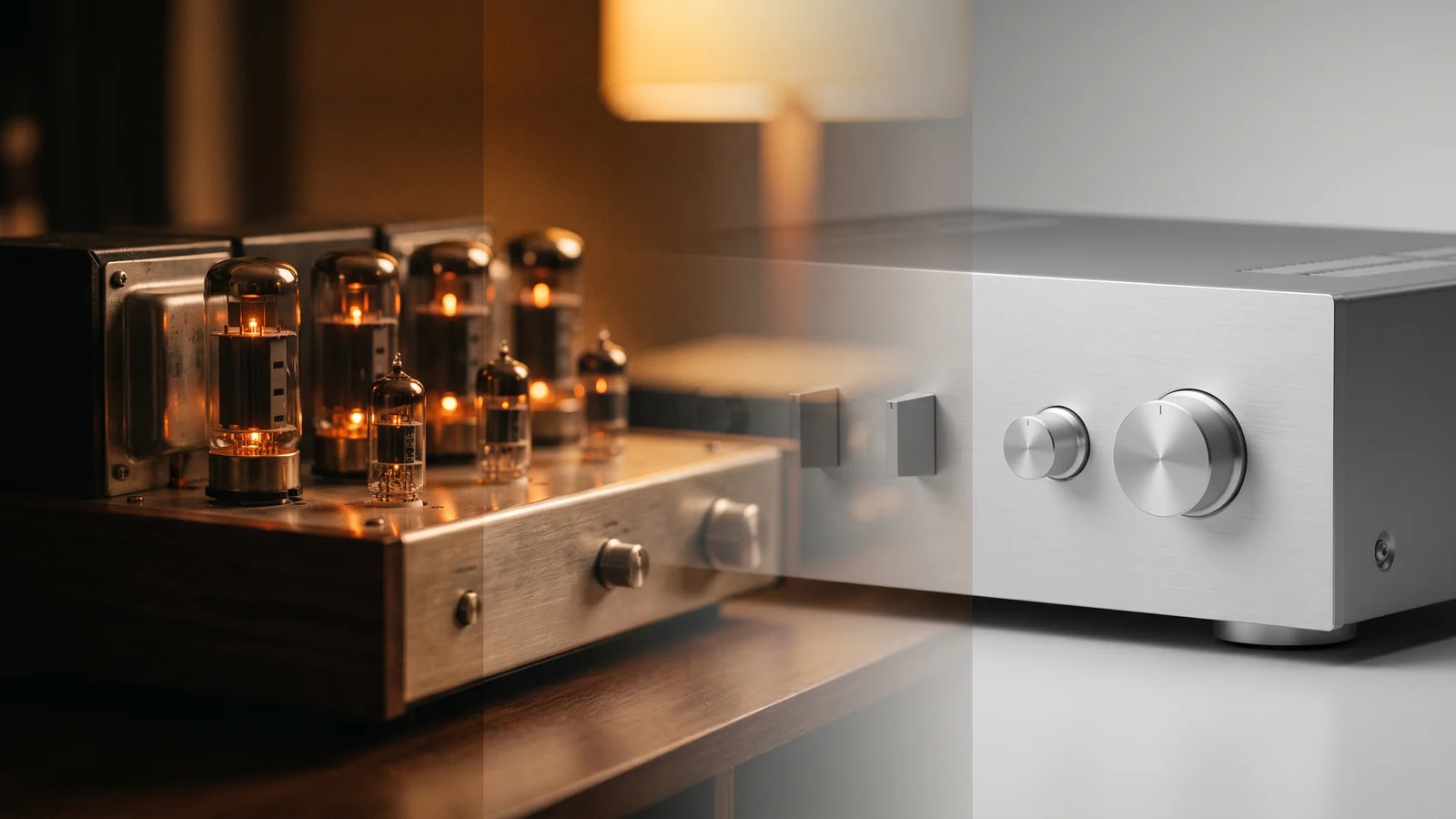
Marantz has passed through six owners since Saul left, ending at Samsung. So is it still good? A builder's honest reckoning with a storied hi-fi name.
Ask an audiophile whether Marantz is still good and you'll start a fight. Half the room points at the tube-era classics and says the magic died decades ago. The other half owns a Model 30 and thinks that take is nonsense. Both are a little right, which is exactly why the question is worth answering carefully.
Here's the thing most people miss. Marantz isn't one company that got worse. It's a name that got handed around like a rare vinyl pressing at an estate sale, from a founder to a distributor to a string of corporations that mostly cared about the balance sheet. What that name means depends entirely on which decade, and which product, you're holding. So let me sort it out the way I'd sort it out on the bench.
Key Takeaways
- Marantz today is owned by Samsung, through its Harman International division, which bought the audio group for about $350 million in September 2025.
- The brand's audiophile credibility after founder Saul Marantz left owes a huge debt to one engineer, Ken Ishiwata, and his hand-tuned KI Signature models.
- Premium Marantz hi-fi like the Model 30 and Model 40n is still built in Japan and still wins real reviews.
- Mass-market Marantz AV receivers share engineering platforms with sister brand Denon under the same parent.
- A badge tells you less than it used to. What matters is whether the person voicing your room actually understands the recording.
Where does the Marantz story start?
Marantz begins with a person, not a corporation. Saul Marantz founded the company in 1953 in Kew Gardens, Queens, and the tube-era classics he commissioned, the Model 7 preamp, the Model 8 and 9 amplifiers, the Model 10B tuner, built a reputation that still moves serious money at auction. Then Superscope acquired Marantz in 1964, and Saul left the company he'd named soon after. I told that whole founding story in a separate piece. This article picks up where he walked out the door, because the brand's next sixty years are a completely different tale.
What happened to Marantz after Saul left?
Within two years of Saul selling out in 1964, Marantz production had crossed the Pacific. By 1966 the company was building gear in Japan through a partnership with Standard Radio Corporation, later renamed Marantz Japan Inc. in 1975, according to the brand's corporate history. The premium name survived. The premium priorities wobbled.

Under Superscope, run from California, Marantz got pushed down-market. The years from 1964 to 1980 are the mass-receiver era, when the champagne-gold faceplate landed on rack after rack of volume-focused stereo receivers aimed at a booming consumer market. Some of those 70s receivers are beloved today, and fairly so. But the company's center of gravity had moved from the perfectionist's bench to the sales chart, and you can feel it in the catalog.
Then the Dutch showed up. Philips bought the Marantz brand and its overseas assets in 1980, and picked up the remaining U.S. and Canada trademark rights in 1992, per the brand history. This is the part that surprises people: Philips, a giant electronics conglomerate, is where Marantz got a lot of its audiophile soul back. Not because a boardroom willed it. Because of one engineer.
Who was Ken Ishiwata, and why does he matter?
For roughly forty years, one man kept Marantz sounding like Marantz. Ken Ishiwata, born in 1947, reportedly joined the company in 1978 and spent decades creating the hand-tuned "KI Signature" models that became the brand's audiophile calling card, as What Hi-Fi recounted. He was part engineer, part brand ambassador, and all ears.
Ishiwata's method was old-school in the best way. He'd take a production component and voice it by hand, swapping capacitors, resistors, and wiring, tuning by listening rather than by spec sheet alone. His first such project was reportedly a tuned version of the CD-45 CD player, and the tradition ran all the way to the PM-KI Ruby, a 2018 integrated amplifier released for the brand's 60th anniversary, per What Hi-Fi's coverage. Those "KI" letters on a faceplate meant a real person had sat with the thing until it sang.
He left Marantz in 2019 and died on November 25 that year, aged 72, as The Ear reported. Some outlets said he was reported to be joining Rotel afterward, though he passed before much could come of it. Here's why any of this matters to a buyer in 2026: Ishiwata is the through-line proving that a "musician's ear plus serious engineering" ethos, the same thing Saul chased, survived the corporate handoffs as long as the right human was in the room. That's the standard to judge modern Marantz against.
Who owns Marantz now?
Marantz belongs to Samsung today, through its Harman International division, which closed its purchase of the Sound United consumer-audio group for roughly $350 million on September 23, 2025, per Masimo's investor announcement and Harman's own completion announcement. That price tells its own quiet story, which I'll get to.
The full chain is a corporate carousel, and I mean that literally. Saul Marantz sold to Superscope in 1964. Production moved to Japan, Marantz Japan formed in 1975, and Philips bought the brand in 1980. Marantz Japan then bought itself back from Philips in 2001, and in 2002 merged with Denon to form D&M Holdings, as the trade press documented at the time. From there the name went to Sound United in 2017, then to the medical-device maker Masimo in 2022 for about $1.03 billion, as later filings and reporting show.
Now sit with those two numbers. Masimo, a pulse-oximeter company that had no obvious business owning hi-fi brands, paid about $1.03 billion for Sound United in 2022, then offloaded the whole group to Samsung's Harman for roughly $350 million three years later, per the sale disclosure. A storied name passed among a startup, a distributor, a Dutch conglomerate, a private-equity-backed roll-up, a pulse-oximeter company, and finally a phone giant's car-audio division, shedding about two-thirds of its paper value in the process. That churn, where a beloved name becomes a portfolio asset traded by people who never listened to a Model 9, is what the writer Cory Doctorow calls enshittification, and consumer-audio nameplates are textbook cases. I traced the Sound United and Masimo mechanics in more detail in a companion piece.
Is Marantz still made in Japan?
Yes, at the top of the range. Marantz's premium two-channel statement components, including the Model 30 integrated amplifier and its matching SACD 30n disc player and streamer, are built at the Shirakawa Audio Works factory in Japan, per Marantz and corroborated in Stereophile's review. This is not a licensed-nameplate operation at that tier.
That distinction matters more than the marketing. When a heritage brand gets bought and sold, the tell is whether it still runs its own factory and does its own engineering, or whether it's just a logo licensed onto someone else's chassis. Marantz keeps a dedicated Japanese audio works and its own voicing tradition at the premium end, which puts it in a genuinely different category from the many old hi-fi names that are now pure stickers. The mass-market gear is a more complicated supply story, and I'll be straight about that next.
What's in the modern Marantz lineup?
Marantz today runs two clearly different families, and lumping them together is how buyers get confused. The premium hi-fi line is engineering-active and Japan-built, as Stereophile's testing confirmed. The home-theater line is a shared-platform operation with sister brand Denon. Same parent, different DNA.
The two-channel statement pieces
This is where the old soul lives. The Model 30 integrated amplifier arrived in 2020 with the matching SACD 30n, as What Hi-Fi covered at launch, followed by the Model 40n streaming integrated in 2022. The Model 40n drew strong reviews, including from What Hi-Fi. SACD players and network streamers remain a real Marantz specialty, and these units carry the KI-era voicing philosophy forward.
The Cinema AV receivers
The home-theater side got a full reboot. Between 2022 and 2023, Marantz retired the old SR-series receivers and launched the Cinema line: the Cinema 40, 50, 60, and 70s receivers, the AV 10 processor, and the AMP 10 power amplifier, with the Cinema 30 later slotting in as flagship. These share engineering platforms with Denon under the same parent, including the HEOS streaming system and room-correction tech. Good gear, genuinely. Just less singular than the badge once implied.
So is Marantz still good in 2026?
Mostly yes, with an honest asterisk. Independent reviewers rate the premium hi-fi highly: the Model 30 and SACD 30n earned praise from Stereophile, and the Model 40n scored well with What Hi-Fi. Modern Marantz still engineers, voices, and builds real high-end audio in its own Japanese factory. The brand is not coasting on nostalgia at that tier.
So the fair verdict is neither "it's dead" nor "it's all still the good old stuff." It's both continuation and badge, depending on which shelf you're shopping. The Model 30, the Model 40n, and the surviving KI legacy show a brand still doing its own thing. The mass-market AV receivers are competent shared-platform products where the name matters less than the spec sheet. Judge the product, not the logo.
And that's the real lesson under all sixty years of this. A nameplate that's been owned by six different corporations can't promise you anything on its own. What it sounds like in your room depends on the components in that specific box and, more than anything, on whether the person setting it up actually understands the recording. We build custom speakers by hand in our Arizona workshop and voice them for the room they'll live in, not for a badge. Saul did it that way in 1958. It still works.
Frequently Asked Questions
Is Marantz still good in 2026?
Yes, at the premium tier especially. Independent reviewers rate current hi-fi like the Model 30 and Model 40n highly, and those units are still engineered and built in Japan. The mass-market AV receivers share platforms with sister brand Denon, so judge the specific product rather than trusting the badge alone.
Who owns Marantz now?
Marantz is owned by Samsung, through its Harman International division, which closed its roughly $350 million purchase of the Sound United audio group on September 23, 2025. Before that, Marantz passed through Superscope, Philips, D&M Holdings, Sound United, and the medical-device maker Masimo, which had paid about $1.03 billion in 2022.
Who was Ken Ishiwata?
Ken Ishiwata (1947-2019) was the engineer and brand ambassador who kept Marantz sounding like Marantz for about forty years. He reportedly joined in 1978 and created the hand-tuned KI Signature models, voicing components by ear. He left the company in 2019 and died on November 25 that year, aged 72.
Is Marantz still made in Japan?
At the premium end, yes. Marantz's statement hi-fi components, including the Model 30 integrated amplifier and the SACD 30n, are built at the Shirakawa Audio Works factory in Japan. That dedicated audio works and its own voicing tradition separate Marantz from heritage names that are now just licensed stickers on outsourced chassis.
What is the Marantz Model 30?
The Marantz Model 30 is a premium integrated amplifier launched in 2020, built at the brand's Shirakawa Audio Works in Japan and designed to pair with the SACD 30n disc player and streamer. Reviewers including Stereophile rated it highly, and it carries the brand's musician's-ear voicing tradition into the modern lineup.
Sources
- Wikipedia, "Marantz": https://en.wikipedia.org/wiki/Marantz
- Wikipedia, "D&M Holdings" (D+M Group): https://en.wikipedia.org/wiki/D%26M_Holdings
- Marantz, Model 30 product page (official): https://www.marantz.com/en-us/product/amplifiers/model-30/300003.html
- What Hi-Fi, "Ken Ishiwata, legendary hi-fi figure, dies aged 72": https://www.whathifi.com/news/ken-ishiwata-legendary-hi-fi-figure-dies-aged-72
- What Hi-Fi, "Marantz Model 40n review": https://www.whathifi.com/reviews/marantz-model-40n
- The Ear, "Ken Ishiwata 1947-2019": https://the-ear.net/news/ken-ishiwata-1947-2019/
- Stereophile, "Sound United Finds a New Home: HARMAN": https://www.stereophile.com/content/sound-united-finds-new-home-harman
- Stereophile, "Marantz Model 30 Integrated Amplifier & SACD 30n": https://www.stereophile.com/content/marantz-model-30-integrated-amplifier-sacd-30n-sacd-player
- Masimo Investor Relations, "Masimo to Sell Consumer Audio Business to HARMAN International": https://investor.masimo.com/news/news-details/2025/Masimo-to-Sell-Consumer-Audio-Business-to-HARMAN-International/default.aspx
- U.S. Securities and Exchange Commission, Masimo Form 8-K filings: https://www.sec.gov/cgi-bin/browse-edgar?action=getcompany&CIK=0000937556&type=8-K&dateb=&owner=include&count=40
- HARMAN, "HARMAN Completes Sound United Acquisition to Expand Premium Audio Leadership": https://news.harman.com/releases/harman-completes-sound-united-acquisition-to-expand-premium-audio-leadership
- Mix, "Marantz, Denon Complete Merger": https://www.mixonline.com/recording/marantz-denon-complete-merger-374527
- What Hi-Fi, "Marantz Model 30 integrated amplifier launches with bold new design": https://www.whathifi.com/news/marantz-model-30-integrated-amplifier-launches-with-bold-new-design
Mike Vincent is the founder of Mike Knows Audio Video and WubWub Audio, where he designs and hand-builds custom loudspeakers and home theaters in Arizona, the old way, for about fifteen clients a year. He's got a lot of respect for the KI-era craft and none at all for the ownership carousel that traded the name six times; if you'd rather buy sound than a badge, start with our custom loudspeakers, voiced by hand for your room.
Comments
Leave a Comment