
JBL built some of the greatest loudspeakers ever made, then became a logo on party speakers and earbuds. Here is the whole arc, from the garage to the app store.
You already know the logo. It's on a speaker at the beach, a speaker at the tailgate, a pair of earbuds in a teenager's ears. Three letters, orange exclamation point, waterproof rubber. That's JBL to most people in 2026.
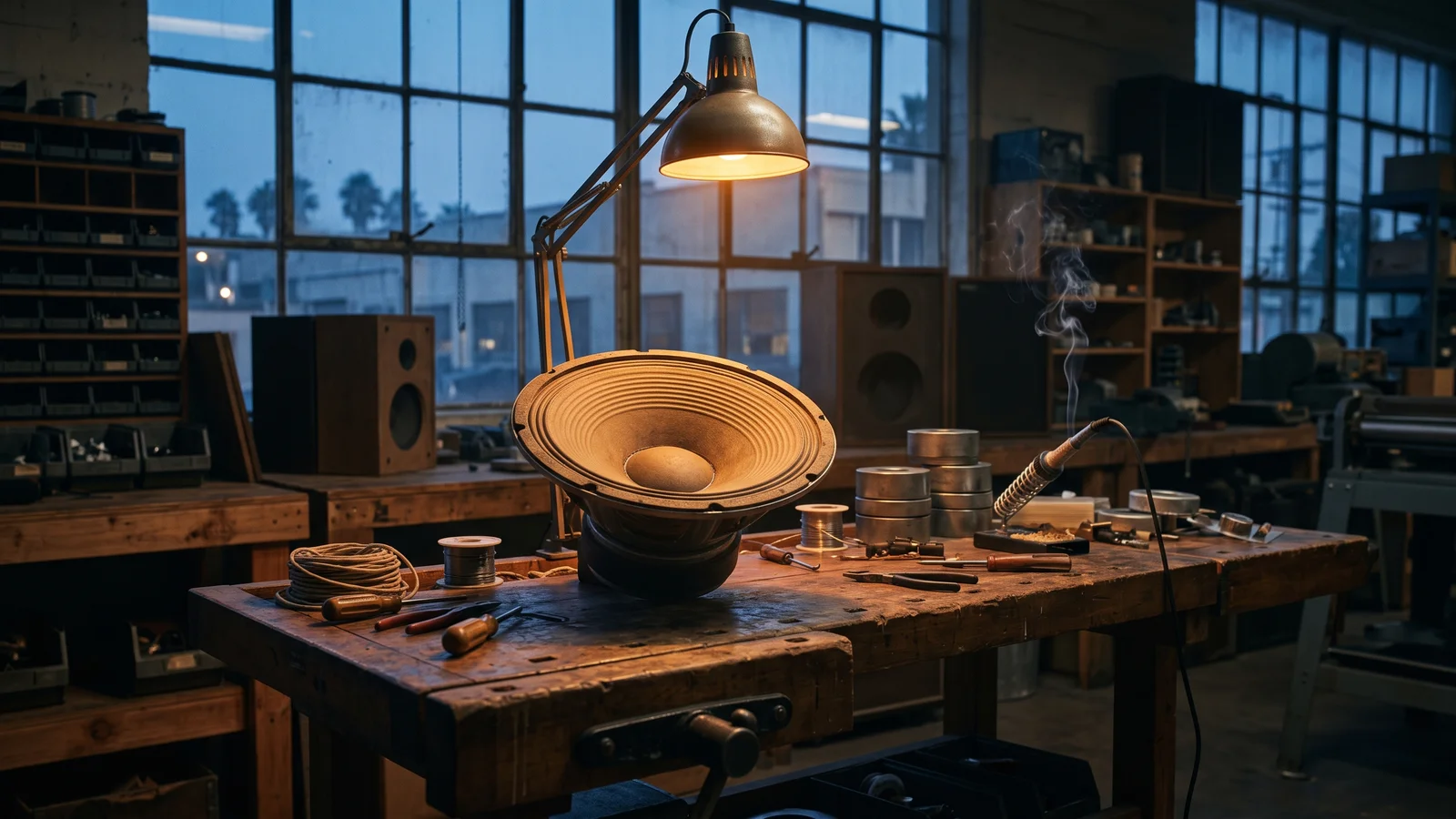
Here's the part that gets lost. Those three letters stand for James Bullough Lansing, and the company he started in a Los Angeles garage in 1946 went on to build some of the finest loudspeakers ever made. Corner horns that filled concert-hall-sized rooms. Studio monitors that mixed most of the records you grew up on. I've had JBL drivers on my bench, and the old ones are gorgeous pieces of engineering. So how did we get from that to a party speaker with a phone app? Let me walk you through the whole arc.
Key Takeaways
- JBL was founded in 1946 by James B. Lansing after he left Altec Lansing; VP William Thomas grew it after Lansing's death in 1949.
- The golden era ran on serious hardware: the D130 driver (1946), the Hartsfield corner horn (mid-1950s), and the nine-foot Paragon, made from 1957 to 1983.
- The L100 bookshelf speaker, launched around 1970, sold more than 125,000 pairs and became one of the best-selling loudspeakers ever.
- JBL was acquired by Sidney Harman in 1969 and is now part of Harman, which Samsung bought for about $8 billion in a deal that closed March 2017.
- JBL Professional in Northridge still builds respected studio, cinema, and touring gear; the consumer brand drifted toward Bluetooth party speakers.
What happened to JBL?
JBL didn't die. It broadened, and hard. The name that once meant reference loudspeakers now spans everything from serious JBL Professional studio monitors to Bluetooth party speakers and earbuds, all under Harman, which Samsung acquired for roughly $8 billion in 2016 (Samsung Global Newsroom, 2016). One logo, two very different worlds.
That split is the whole story. On one side you've got Northridge-built pro gear that recording engineers still trust. On the other you've got a mass-market consumer line engineered for the checkout aisle. Both are legitimately JBL. Understanding how they came to share a badge means going back to a garage in 1946.
How did JBL start in a California garage?
JBL began in 1946 in Los Angeles when James B. Lansing founded Lansing Sound, later James B. Lansing Sound, after leaving the company that still carries his name, Altec Lansing (Wikipedia, 2024). His signature was the driver itself: the cone, the voice coil, the magnet. Lansing was a transducer man to the bone.
I'll keep Lansing's own tragic story short here, because he deserves his own piece and he's getting one. He died in 1949, only three years in, and the company nearly went with him. What saved it was his vice president, William Thomas, who bought out the interest, steadied the books, and grew JBL into a powerhouse over the next two decades. The founder set the standard. Thomas built the business that could deliver it.
The D130 and a happy accident with Leo Fender
The first landmark product was the D130, a 15-inch driver introduced right at the founding in 1946 (Audioheritage, 2007). It was efficient, it was tough, and it moved air like nothing else in its class. Home-audio folks loved it. Then it found a second life nobody planned.
Leo Fender started dropping the D130 into guitar amplifiers, where its efficiency and durability were exactly right for a working musician. So a JBL home-hi-fi driver quietly became a backline legend too. That's the mark of a genuinely great design. It does the job so well that people carry it into rooms its maker never imagined.
What were JBL's golden-era speakers?
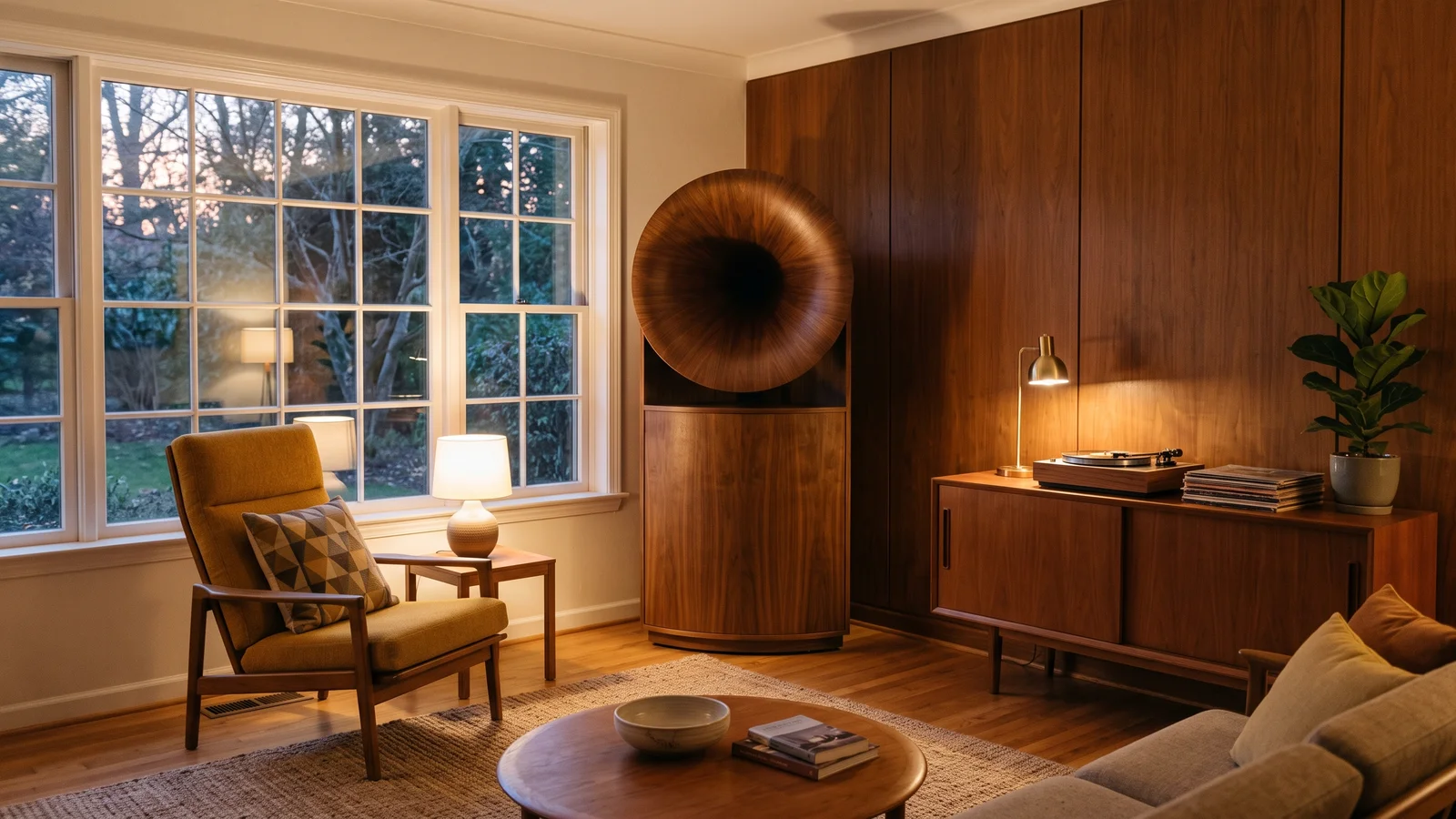
The golden era produced loudspeakers people still chase sixty years later. The standout was the Paragon, a single-cabinet stereo system nearly nine feet wide, produced from 1957 to 1983, the longest-running home model in JBL's history (JBL Paragon, Wikipedia, 2024). It was furniture, sculpture, and speaker in one absurd, glorious object.
The Paragon was designed by Arnold Wolf, and it used a curved reflector panel to throw a coherent stereo image across a wide listening area (What Hi-Fi?, 2013). Before it came the Hartsfield corner horn, JBL's mid-1950s statement piece, dated by most accounts to 1954, though you'll see 1955 cited too, so I won't swear to the year. Both were built to a standard, not a price. When a company will make a nine-foot speaker for twenty-six years, you're looking at people who love the craft more than the spreadsheet.
The studio-monitor dynasty
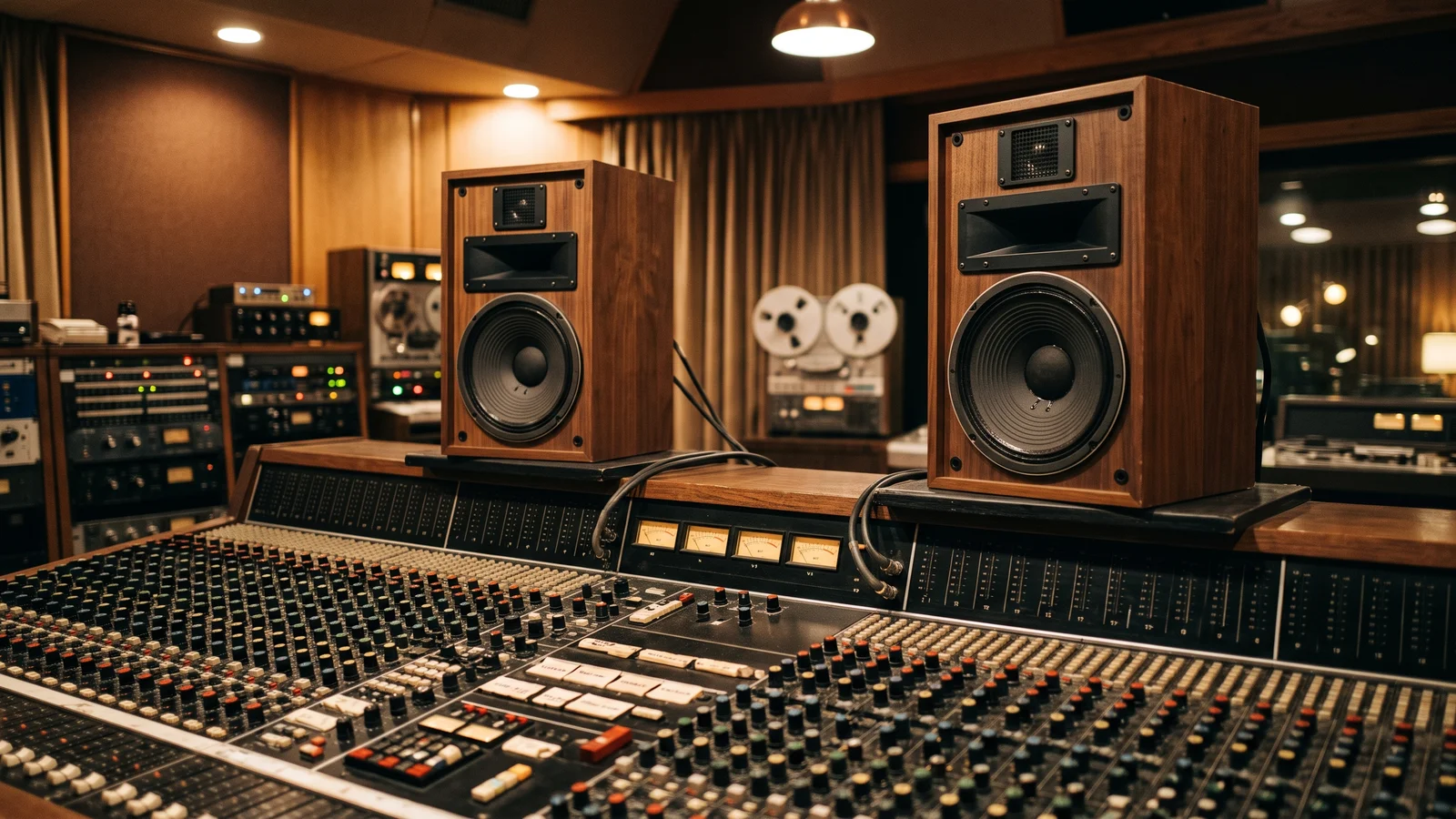
Here's where JBL's influence gets genuinely enormous. The company's 43-series studio monitors, and the 4310 that led to the 4311, became the standard in professional control rooms through the 1970s (Mix, 2018). If you loved a record made in that decade, odds are good it was mixed on JBLs.
The 4310, 4311, and later 4312 formed a lineage that ran for decades and defined what a nearfield monitor sounded like (The Speaker Exchange, 2019). And the numbers back the reputation up. A Billboard survey reported that by 1977, more recording studios used JBL monitors than all other brands combined. That's not a marketing line. That's market share you earn one control room at a time.
How did the L100 become a best-seller?
The L100 is the reason your parents might have owned a JBL. It was the consumer version of the 4310/4311 studio monitor, launched around 1970, and it sold more than 125,000 pairs, making it one of the best-selling loudspeakers ever built (The Speaker Exchange, 2019). Sources split on 1969 versus 1970 for the launch, so take the year loosely.
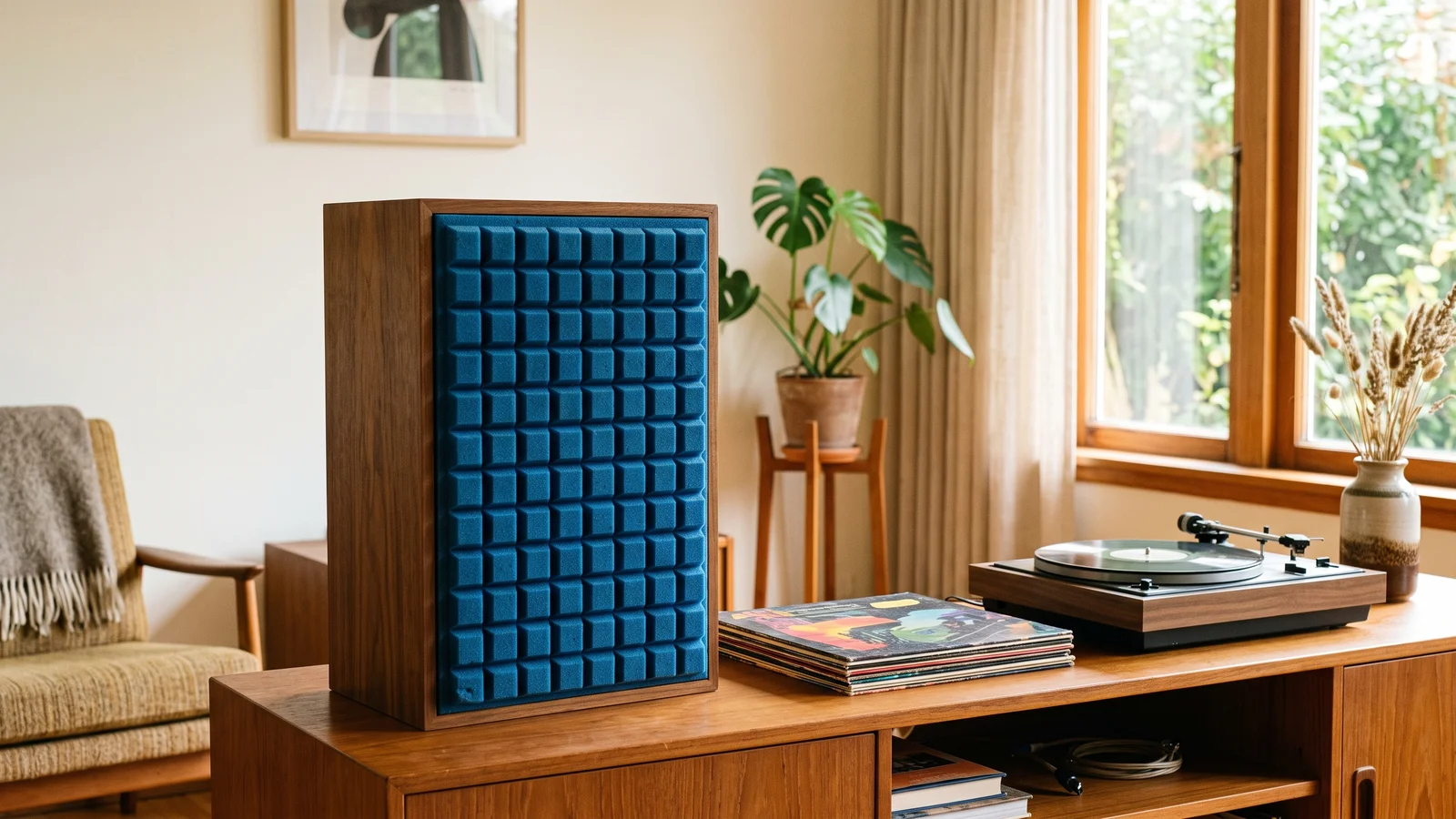
You'd recognize an L100 instantly. Walnut cabinet, and that unmistakable blue foam grille molded into a chunky waffle pattern JBL called Quadrex. It looked like the 1970s and it sounded loud, punchy, and fun. JBL took the exact monitor engineers trusted in the studio, wrapped it in something a living room could love, and sold a mountain of them. That crossover from pro credibility to consumer desire is a trick almost nobody pulls off cleanly, and JBL did it twice.
The pro side, meanwhile, never stopped. JBL Professional's 4331A and 4333A monitors carried the studio dynasty forward, and the modern 4300-series flagships like the 4367 and 4369 show the horn-and-compression-driver DNA is very much alive (Gear Patrol, 2021). This is the thread that stays honest through the whole story.
Who owns JBL now?
JBL is owned by Samsung, which acquired Harman for about $8 billion in a deal announced November 14, 2016 at $112.00 per share and closed March 10, 2017 (Samsung Global Newsroom, 2016). Harman had owned JBL for decades before that. The independent California speaker company has been part of something much larger for a long time.
The ownership chain is short but telling. Sidney Harman, through his Jervis Corporation, acquired JBL in 1969, folding it into what became Harman International alongside the audio brands he was assembling (Harman International, Wikipedia, 2024). Harman grew JBL into a global consumer and pro-audio giant. Then Samsung bought the whole thing, chasing connected-car audio and the consumer-electronics footprint that came with it (KED Global, 2025). So JBL today sits inside one of the largest electronics conglomerates on earth.
Is JBL still good, and what does the name mean now?
Yes, with a caveat that depends entirely on which JBL you mean. JBL Professional in Northridge, California, still designs respected studio monitors, cinema systems, and touring loudspeakers that working engineers genuinely rely on (JBL Professional, 2024). That side of the house earned its reputation and keeps earning it. I won't let anyone tell you otherwise.
The consumer line is a different animal. Somewhere along the way, JBL the household name drifted from reference loudspeakers toward Charge and Flip Bluetooth speakers, PartyBox towers, earbuds, and car audio. A lot of it is good value for what it is. But it's engineered to be bought, used, and eventually tossed, often app-tethered and battery-bound, and that slow slide from a thing you keep to a thing you replace is what the writer Cory Doctorow calls enshittification. The garage that built a nine-foot Paragon now also stamps its logo on a speaker you'll recycle in three years.
Be fair, though. This is brand-broadening, not death. Samsung and Harman kept JBL Professional serious while the mass-market line printed money, and reviewers still praise the current pro flagships (Gear Patrol, 2021). The name got stretched across two worlds, and one of those worlds is still doing real work.
That stretch is exactly why some of us still build the old way. We hand-build custom loudspeakers in our Arizona workshop to be kept and serviced, not cycled to a landfill. No app, no battery to die, no built-in expiration date. A speaker you can hand down, the way a Paragon owner still hands one down today. That's the whole point.
Frequently Asked Questions
What happened to JBL?
JBL grew from a 1946 California loudspeaker company into a global brand now owned by Samsung, which bought parent Harman for about $8 billion in 2017. The name split into two worlds: respected JBL Professional studio and cinema gear, and a huge consumer line of Bluetooth party speakers, earbuds, and car audio.
Who owns JBL now?
JBL is owned by Samsung. Samsung acquired Harman International, JBL's parent since 1969, in a deal announced in November 2016 for roughly $8 billion and closed in March 2017. Harman was built up by Sidney Harman, whose Jervis Corporation first bought JBL in 1969 and folded it into Harman International.
Is JBL still good?
It depends which JBL. JBL Professional in Northridge, California still makes respected studio monitors, cinema systems, and touring loudspeakers that working engineers rely on. The consumer line of Bluetooth and party speakers offers decent value but is built to be replaced, not kept and serviced like the golden-era gear.
What was the JBL L100?
The JBL L100 was the consumer version of JBL's 4310/4311 studio monitor, launched around 1970. It sold more than 125,000 pairs and became one of the best-selling loudspeakers ever made. It is instantly recognizable by its walnut cabinet and chunky blue Quadrex foam grille that came to define 1970s hi-fi style.
Are JBL speakers still made in the USA?
Some are. JBL Professional loudspeakers are still designed and built in Northridge, California, and that pro operation carries the brand's original engineering DNA. The mass-market JBL consumer products, including Bluetooth speakers and earbuds, are manufactured overseas like most consumer electronics today.
Sources
- Wikipedia, "JBL": https://en.wikipedia.org/wiki/JBL
- Audioheritage, "JBL Profile" (D130 history): https://www.audioheritage.org/html/profiles/jbl/jbl.htm
- What Hi-Fi?, "Arnold Wolf (1927-2013): from JBL's Paragon to the best-selling speaker of the 1970s": https://www.whathifi.com/news/arnold-wolf-1927-2013-jbls-monster-paragon-to-best-selling-speaker-1970s
- Wikipedia, "JBL Paragon": https://en.wikipedia.org/wiki/JBL_Paragon
- Mix, "1974 JBL 4311 Studio Monitors": https://www.mixonline.com/technology/1974-jbl-4311-studio-monitors-383603
- The Speaker Exchange, "4310, 4311, 4312 Studio Monitors": https://reconingspeakers.com/4310-4311-4312-studio-monitors/
- JBL Professional (official): https://jblpro.com/
- Gear Patrol, JBL studio-monitor review (4349/4369): https://www.gearpatrol.com/tech/audio/a36512345/jbl-4349-studio-monitor-review/
- Wikipedia, "Harman International": https://en.wikipedia.org/wiki/Harman_International
- Samsung Global Newsroom, "Samsung Electronics to Acquire HARMAN": https://news.samsung.com/global/samsung-electronics-to-acquire-harman-accelerating-growth-in-automotive-and-connected-technologies
- Sound & Vision, "Samsung to Buy Harman for $8 Billion": https://www.soundandvision.com/content/samsung-buy-harman-8-billion
- KED Global, "Samsung's Harman goes from ugly duckling to golden swan" (confirms Samsung's 2017 Harman acquisition for $8 billion): https://www.kedglobal.com/electronics/newsView/ked202502180006
- JBL Professional, "Recording & Broadcast" (Northridge studio monitors): https://jblpro.com/en-US/product_families/recording-broadcast
Mike Vincent is the founder of Mike Knows Audio Video and WubWub Audio, where he designs and hand-builds custom loudspeakers and home theaters in Arizona, the old way, for about fifteen clients a year. He has a real soft spot for the golden-era JBL gear people still restore and cherish; if you want a speaker built to be kept and serviced instead of recycled, start with our custom loudspeakers.
Comments
Leave a Comment