

A great British loudspeaker house changed hands four times in nine years, from a Facebook CFO's startup to a pulse-oximeter maker to Samsung. Here's the whole strange story.
Say Bowers & Wilkins to most people and they picture the yellow-coned monitors in the Abbey Road control room. Fair enough. But here's the twist almost nobody sees coming: the company that makes them is now owned by Samsung, by way of its Harman division. And the chapter right before Samsung? A medical-device firm best known for pulse oximetry, the little clip they put on your finger at the doctor's office.
That's not a joke. One of Britain's great speaker houses spent nearly three years owned by a Nasdaq-listed maker of blood-oxygen sensors. It's the strangest chapter in a strange run, and it's brief. To understand how a loudspeaker built for Abbey Road ended up as a line on a pulse-oximeter company's balance sheet, you have to start in a shop in Worthing in 1966. I've built speakers my whole life, so I'll tell it straight, with the receipts.
Key Takeaways
- Bowers & Wilkins was founded in 1966 in Worthing, England, by John Bowers and Roy Wilkins, funded partly by a roughly £10,000 bequest from a customer named Miss Knight.
- The brand's landmarks include the yellow Kevlar cone (1976), the 801 (1979), the cost-no-object Nautilus (1993), and the diamond-dome tweeter (2005).
- Abbey Road Studios has used B&W monitors for what the company calls more than 45 years.
- From 2016 to 2025 the company had four owners: EVA Automation, Sound United, Masimo, and finally Samsung's Harman.
- Masimo paid $1.025 billion for the audio group in 2022 and sold it to Harman for $350 million in 2025, a markdown of about two-thirds in under three years.
- The flagship 800 Series Diamond is still hand-assembled in Worthing, England.
Who owns Bowers & Wilkins in 2026?
Bowers & Wilkins is owned by Harman International, a Samsung subsidiary, which closed its $350 million purchase of the Sound United audio group on September 23, 2025, as Forbes reported when the deal sealed. That makes Samsung the brand's fourth owner in nine years. The independent company that started in a small English shop in 1966 is now one asset inside a global electronics portfolio, sitting next to phones and car audio.
If that sounds like a lot of turnover, it is. B&W stayed independent for fifty years, then changed hands four times in under a decade, as Stereophile traced when the last sale went through. Each buyer had less to do with British loudspeakers than the last. We'll walk the whole carousel in a minute. First, the shop that started it.
How did Bowers & Wilkins begin in Worthing?
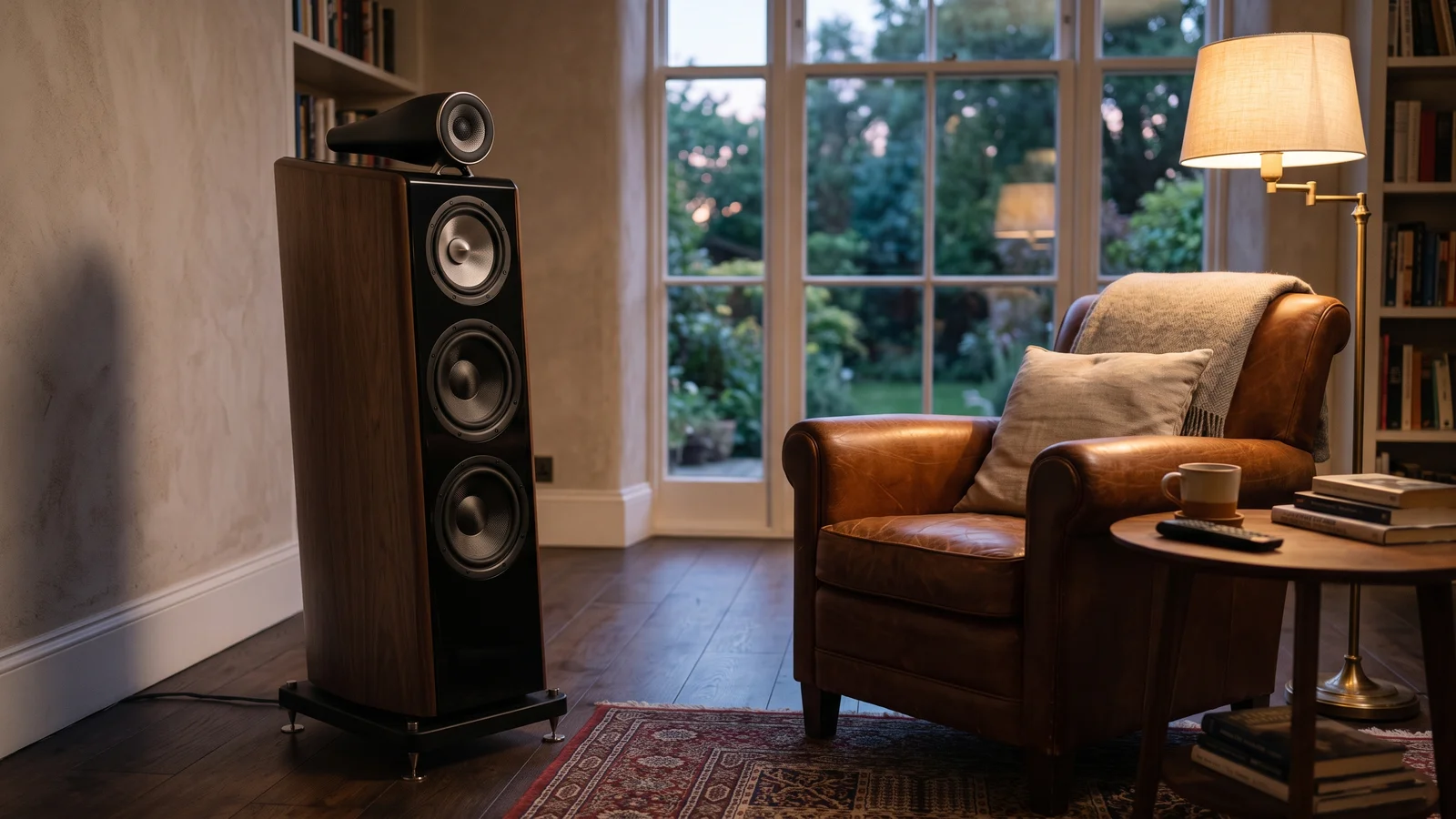
Bowers & Wilkins was founded in 1966 in Worthing, West Sussex, by John Bowers and Roy Wilkins, funded in part by a bequest of about £10,000 from a music-loving customer named Miss Knight, as the company's own history tells it. The two men had met in the Royal Corps of Signals during World War II. That legacy bought something rare for a startup: the freedom to build speakers properly instead of cheaply.
John Bowers ran a radio and electrical shop and sold hi-fi on the side, but he cared more about accurate reproduction than retail margins, according to Wikipedia's account of the company. Miss Knight, a regular customer, left him the money specifically so he could pursue better sound. I've never had a benefactor hand me seed capital, but I understand the instinct behind it. Somebody heard what this man was chasing and decided the world needed more of it.
The yellow cone, the 801, and Matrix bracing
B&W's engineering signatures came fast. The DM70 arrived in 1970 with a hybrid electrostatic design, and in 1976 the DM6 introduced the woven-Kevlar cone in that unmistakable yellow, per Wikipedia's brand history. The 801 landed in 1979 and became a studio reference. In 1986 the company added Matrix bracing, an internal honeycomb that stiffens the cabinet so the box stops singing along with the music.
Each of those is a real engineering idea, not a marketing badge. The Kevlar cone controlled how the cone flexed. Matrix bracing attacked cabinet resonance, which is one of the quiet killers of clean sound. When I brace a cabinet in our Arizona workshop, I'm chasing the same demon B&W was chasing in 1986. A cabinet that stays quiet lets the driver do its job.
The Nautilus, the snail that never dies
Then came the halo product. In 1993 B&W released the Nautilus, nicknamed "the snail" for its coiled tapering tubes, a cost-no-object statement speaker meant to show what the company could do with no budget limit, as Wikipedia records. It's still the brand's flagship trophy. In 2005 the 800D brought the diamond-dome tweeter, and in 2007 the Zeppelin iPod dock launched the whole consumer and lifestyle side of the business.
Why did Abbey Road Studios adopt the B&W 801?
Abbey Road Studios began using the Bowers & Wilkins 801 as a reference monitor around 1979 to 1980, and B&W now describes the partnership as spanning more than 45 years, per the company's Abbey Road account. I'd treat that "45 years" as B&W's own framing rather than a hard adoption date. Some histories put the Matrix 801's studio arrival later, in 1988, as HiFiGear notes.
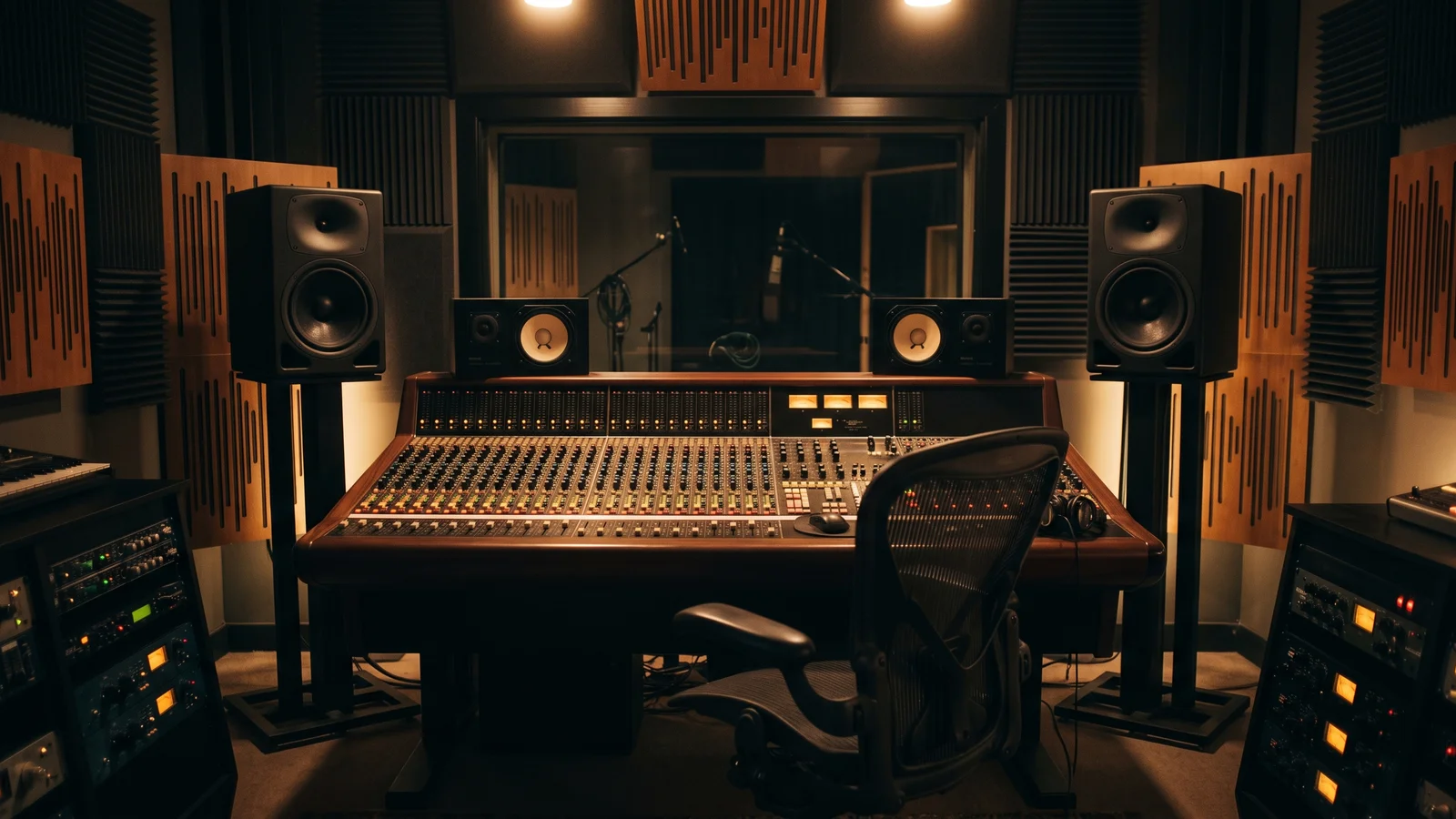
Either date, the point holds: the 801 became the speaker engineers trusted to hear what was actually on the tape. A mastering monitor can't flatter the music. It has to tell the truth, including the ugly parts, so the people mixing know what to fix. B&W's monitors earned that job and became a fixture in classical recording studios, which is about the highest compliment a speaker can get. Studios don't buy on brand loyalty. They buy on accuracy.
Four owners in nine years: how did the carousel spin?
For fifty years Bowers & Wilkins stayed independent, then sold four times between 2016 and 2025, as Sound & Vision reported when the first deal broke. The buyers had almost nothing to do with British loudspeakers. A Silicon Valley home-automation startup, a US audio conglomerate, a medical-device maker, and finally a Samsung subsidiary. Watch the logic drift further from sound with every handoff.
It started in May 2016 with EVA Automation, a home-automation startup led by Gideon Yu, the former CFO of Facebook and YouTube, as Engadget covered at the time. That deal also swept in the sister brands Rotel and Classé, as The Absolute Sound noted. A finance guy from social media now owned a loudspeaker legend. In October 2020 the group passed to Sound United, the US owner of Denon, Marantz, Polk, and Definitive Technology.
Then it got genuinely weird. On April 12, 2022, the medical-device maker Masimo Corporation, a Nasdaq company best known for pulse oximetry, bought Sound United for $1.025 billion, as ecoustics reported and Masimo confirmed on closing. Blood-oxygen sensors and Abbey Road monitors, under one roof. It made no sense to audiophiles, and it didn't last.
The bought-high, sold-low math
Here's the number that tells the whole story. Masimo paid $1.025 billion for the audio group in 2022 and sold it to Samsung's Harman for $350 million in 2025, as Masimo disclosed on completing the sale and filed with the SEC on September 23, 2025. That's a markdown of about two-thirds in under three years. Both the $1.025 billion buy price and the $350 million sale are on the record.

Sit with that. A group of storied engineering houses lost two-thirds of its paper value in thirty-three months, not because the speakers got worse but because a medical company decided audio wasn't its business after all. When a storied engineering house becomes a line item to be flipped for a resale multiple, you get what the writer Cory Doctorow calls enshittification, the slow hollowing of a good thing once it's owned by people optimizing a spreadsheet instead of a sound. To B&W's real credit, the flagship has so far resisted that fate. The 800 Series didn't get cheapened to juice a quarter. That matters, and it's rarer than it should be.
Are Bowers & Wilkins speakers still made in England?
The flagship 800 Series Diamond is still hand-assembled at the Bowers & Wilkins factory in Worthing, England, which the company redesigned specifically for 800-Series Diamond production, as What Hi-Fi found on a factory tour. The latest 800 Series Diamond generation is current and genuinely high-end. So no, the "all made in China now" story doesn't fit here, at least not at the top of the range.
The mass-market lines are a different matter, and that's normal. The Zeppelin, the Px headphones, the Pi earbuds, and the 600 and 700 Series are built in Asia, like most consumer audio, as the brand's history and product record show. That split, halo product made at home and volume product made offshore, is how nearly every surviving audio name works now. What impresses me is that four ownership changes in nine years didn't move the flagship out of Worthing.
That's the difference an owner-operator makes, and it's the whole reason some of us still build the hard way. B&W's best work survives because a factory full of people still care how it sounds. We take that a step further. Our speakers aren't one asset in a portfolio that gets marked up and sold every thirty months. The speaker is the entire business. When we build custom speakers by hand in our Arizona workshop, one small batch a year, the person whose name is on the shop signs off on every pair. Nobody's flipping us to a pulse-oximeter company.
Frequently Asked Questions
Who owns Bowers & Wilkins?
Bowers & Wilkins is owned by Harman International, a subsidiary of Samsung, which completed its $350 million purchase of the Sound United audio group on September 23, 2025. Before Samsung, the brand had passed through the startup EVA Automation in 2016, Sound United in 2020, and the medical-device maker Masimo in 2022.
Are Bowers & Wilkins speakers still made in England?
Yes, the flagship 800 Series Diamond is still hand-assembled at the Bowers & Wilkins factory in Worthing, England, which the company redesigned for that production. The mass-market lines, including the Zeppelin, Px headphones, Pi earbuds, and the 600 and 700 Series, are built in Asia, like most consumer audio gear today.
What is the B&W Nautilus?
The B&W Nautilus, nicknamed "the snail" for its coiled tapering tubes, is a cost-no-object statement loudspeaker Bowers & Wilkins introduced in 1993. It was built to show what the company could do with no budget limit, and it remains the brand's halo product and design icon more than thirty years after its release.
Why did Abbey Road use the B&W 801?
Abbey Road Studios adopted the Bowers & Wilkins 801 as a reference monitor around 1979 to 1980, valuing its accuracy for hearing exactly what was on the tape. B&W now describes the relationship as spanning more than 45 years, though some histories date the Matrix 801's studio adoption later, to 1988. Either way, it became a studio fixture.
Is Bowers & Wilkins still good?
Yes, by most accounts. The flagship 800 Series Diamond is still hand-assembled in Worthing, England, and remains a genuine high-end reference. The honest caveat is about ownership, not sound. After four owners in nine years, the brand is now one asset in Samsung's Harman portfolio rather than an independent house.
Sources
- Wikipedia, "Bowers & Wilkins": https://en.wikipedia.org/wiki/Bowers_%26_Wilkins
- Bowers & Wilkins, "How it all began" (official company history): https://www.bowerswilkins.com/en-us/blog/products/bowers-wilkins-how-it-began.html
- Bowers & Wilkins, "Abbey Road Studios" (official 801 story): https://www.bowerswilkins.com/en-us/blog/products/801-abbey-road-limited-edition-story.html
- HiFiGear, "The History of Bowers & Wilkins": https://www.hifigear.co.uk/blog/the-history-of-bowers-wilkins
- Sound & Vision, "Bowers & Wilkins Acquired by Silicon Valley Startup EVA Automation": https://www.soundandvision.com/content/bowers-wilkins-acquired-silicon-valley-startup
- Engadget, "EVA Automation buys Bowers & Wilkins": https://www.engadget.com/2016-05-03-bowers-and-wilkins-acquired-by-automation-startup.html
- The Absolute Sound, "Bowers & Wilkins Acquired by EVA Automation": https://www.theabsolutesound.com/articles/bowers-wilkins-acquired-by-silicon-valley-based-eva-automation/
- ecoustics, "Sound United Acquired by Masimo Corporation": https://www.ecoustics.com/news/masimo-acquires-sound-united/
- Masimo Investor Relations, "Masimo Completes Acquisition of Sound United" (2022): https://investor.masimo.com/news/news-details/2022/Masimo-Completes-Acquisition-of-Sound-United/default.aspx
- Masimo Investor Relations, "Masimo Completes Sale of Sound United to HARMAN" (2025): https://investor.masimo.com/news/news-details/2025/Masimo-Completes-Sale-of-Sound-United-to-HARMAN/default.aspx
- U.S. Securities and Exchange Commission, Masimo Form 8-K filings (September 23, 2025): https://www.sec.gov/cgi-bin/browse-edgar?action=getcompany&CIK=0000937556&type=8-K&dateb=&owner=include&count=40
- Forbes, "Harman Seals Sound United Deal": https://www.forbes.com/sites/marksparrow/2025/09/23/harman-seals-the-deal-and-buys-up-denon-marantz-bower--wilkins-polk-and-more/
- What Hi-Fi, "Inside Bowers & Wilkins: a tour of the Worthing factory": https://www.whathifi.com/features/inside-the-bowers-and-wilkins-factory-to-see-the-new-800-d4-speakers
- Stereophile, "Sound United Finds a New Home: HARMAN": https://www.stereophile.com/content/sound-united-finds-new-home-harman
Mike Vincent is the founder of Mike Knows Audio Video and WubWub Audio, where he designs and hand-builds custom loudspeakers and home theaters in Arizona, the old way, for about fifteen clients a year. He roots for the engineers in Worthing who kept the flagship honest through four owners in nine years; if you'd rather own a speaker that will never be flipped to a pulse-oximeter company, start with our custom loudspeakers.
Comments
Leave a Comment