
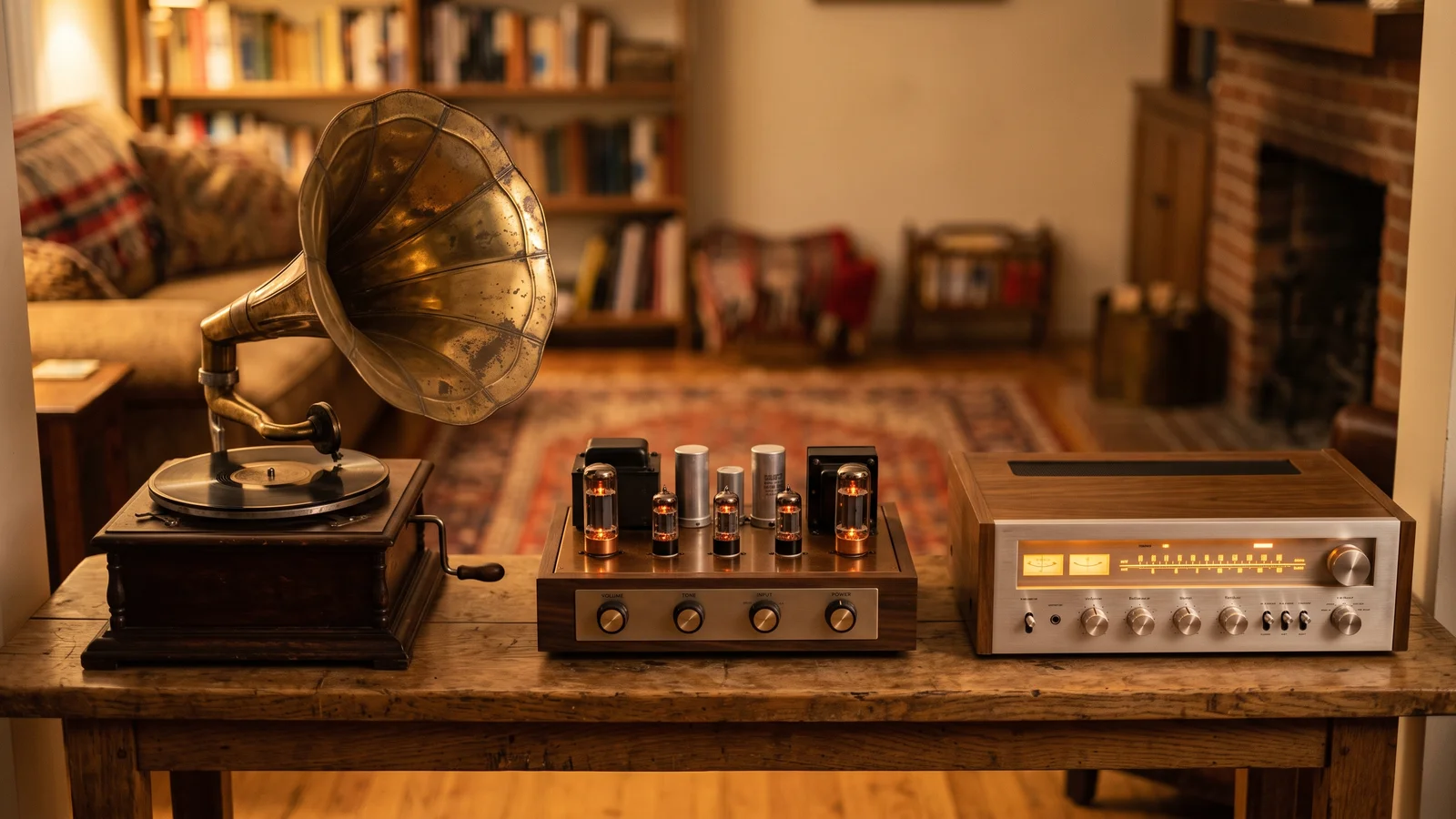
One hundred and fifty years of obsessed people chasing sound, from the 1877 phonograph to streaming's 84% of 2024 revenue, and who owns the legendary names now.
Here's a thing that keeps me up at night in the best possible way. Every speaker I build in our Arizona workshop, every driver I glue and every crossover I hand-solder, traces straight back to a guy in New Jersey who shouted a nursery rhyme into a piece of tinfoil in 1877. That's the whole lineage. One hundred and fifty years of obsessed people trying to catch sound and let you hear it again in your living room.
This is the grand tour. Phonograph to radio to the hi-fi boom to the stereo wars to the receiver era to streaming. It's a story full of geniuses who died broke and corporations that bought their names and shipped the soul overseas. I'll name names. I'll cite everything. Let's go.
Key Takeaways
- Recorded sound started with Thomas Edison's tinfoil phonograph in 1877, per the Smithsonian National Museum of American History.
- The moving-coil driver Chester Rice and Edward Kellogg designed at General Electric in 1925 is still inside nearly every speaker made today.
- Alan Blumlein patented stereo in 1931, decades before the record industry was ready for it.
- Streaming hit 84% of US recorded-music revenue in 2024, roughly $14.9 billion of a $17.7 billion total, according to the RIAA.
- Vinyl outsold CD in both dollars and units for the third straight year in 2024, per the RIAA.
- Most of the legendary brands you remember are now owned by conglomerates and private equity that kept the logo and left the craft behind.
Who Actually Invented Recorded Sound?
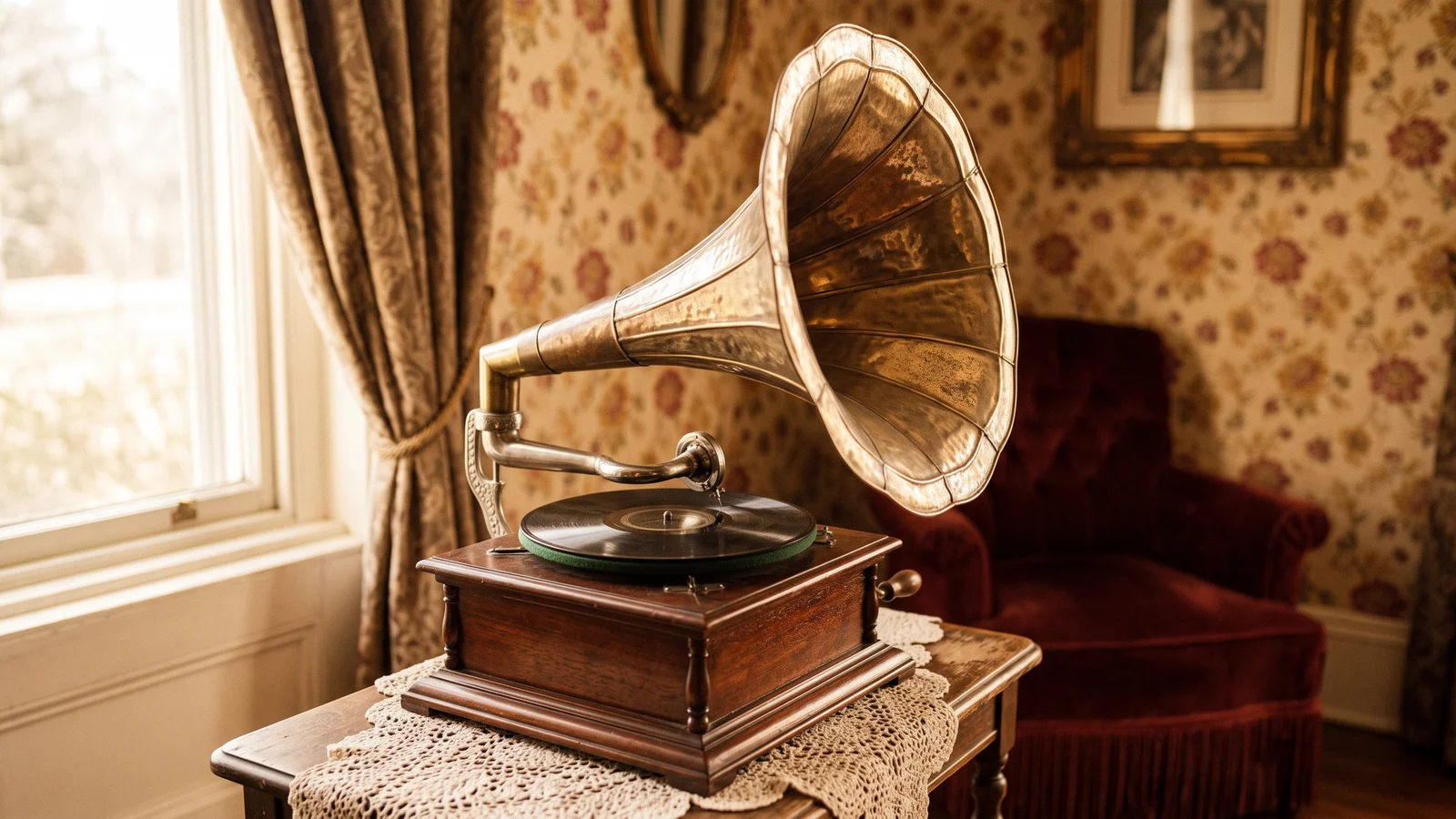
Thomas Edison invented recorded sound in 1877, and his machinist John Kruesi built the working phonograph, according to the Smithsonian National Museum of American History. Edison shouted "Mary Had a Little Lamb" at a tinfoil-wrapped cylinder, cranked it back, and heard his own voice. It was the first machine that could both record and play back.
Think about how insane that must have felt. Before that moment, every sound a human ever made vanished the instant it happened. Edison built a box that could keep one. He wasn't even chasing music at first. He was tinkering with telegraph and telephone signals and stumbled into something bigger.
The tinfoil didn't last. You could play a recording a handful of times before it shredded. But the idea was loose in the world now, and the race to capture sound properly was on.
Citation capsule: Recorded sound began in 1877 when Thomas Edison, working with machinist John Kruesi, built the first phonograph and captured a recitation of "Mary Had a Little Lamb" on tinfoil, per the Smithsonian National Museum of American History. It was the first device capable of both recording and playing back sound.
How Did Sound Become a Business?
Sound became an industry in the late 1880s and 1890s, when Emile Berliner's flat-disc gramophone and Edison's improved wax cylinder gave people something durable to buy and replay. The flat disc was the fork in the road. Discs were easy to stamp out by the thousands, and that's what turned a lab curiosity into a record business.
Edison's wax cylinders sounded good and hung on for years. But Berliner's disc won the format war, and every LP and 45 you've ever held is its grandchild. The disc could be mass-produced from a master. Cylinders had to be recorded more or less one at a time in the early days. Copies matter when you're building an industry.
By the turn of the century, ordinary homes had a machine that played music on demand. No sheet music, no piano lessons, no live band in the parlor. You just cranked the handle. That shift, from making your own music to playing back someone else's, changed the culture more than the gadget ever did.
Who Turned Radio Into Home Furniture?
Radio moved into the home in the early 1920s, and it started on November 2, 1920, when KDKA in Pittsburgh went on the air as the first licensed commercial station, per the IEEE's Engineering and Technology History Wiki. Two years later, more than 500 stations were broadcasting. The living room got a new center of gravity fast.
None of it works without one component. In 1906, Lee de Forest invented the Audion, a triode vacuum tube that could actually amplify a weak signal. Before the triode, you couldn't make a faint sound loud. After it, you could. Every amplifier I've ever repaired owes that man a beer.
The radio music box
David Sarnoff at RCA had pitched the idea of a "radio music box" as a home appliance, and the RCA Radiola line of 1921 and 1922 made it real. The first commercial version of the moving-coil speaker, the RCA Radiola 104, arrived in 1926. Radio wasn't a hobbyist's crystal set anymore. It was furniture, and families gathered around it the way they'd later gather around the TV.
What Was the Single Most Important Invention in Speaker History?
The moving-coil dynamic loudspeaker is the most important speaker invention ever, and Chester Rice and Edward Kellogg designed it at General Electric's Schenectady lab in 1925, publishing their landmark paper through the American Institute of Electrical Engineers that September. Nearly every speaker built in the last century is a descendant, according to Audio Engineering Society historical records.
I want you to sit with that. The tweeter in your soundbar, the woofer in a $200,000 reference tower, the drivers I hand-build in Arizona, they're all the same basic idea Rice and Kellogg drew up. A coil of wire in a magnetic field, a cone attached, current in, cone moves, air moves, you hear it. A hundred years later, we've refined the materials to death and the core physics hasn't budged.
The first commercial version rode inside the RCA Radiola 104 in 1926. That's the moment the modern speaker was born inside a piece of home radio gear. We've refined the cone materials, the magnets, and the voice coils for a hundred years, and the drawing Rice and Kellogg made in 1925 still wins.
Citation capsule: The moving-coil dynamic loudspeaker was invented in 1925 by Chester Rice and Edward Kellogg at General Electric, who presented their design to the American Institute of Electrical Engineers that September. It appeared commercially in the 1926 RCA Radiola 104 and remains the basis for nearly every loudspeaker made today, per AES historical records.
Who Actually Invented Stereo?
Stereo was invented in 1931 by Alan Blumlein, a British engineer at EMI who filed UK Patent 394,325 covering the "Blumlein pair" microphone technique and the 45/45 stereo disc, according to the EMI Archive Trust and Imperial College London. He worked it out decades before the record industry had any way to sell it.
Blumlein is the most important audio pioneer almost nobody has heard of. He held 128 patents by the time he died in 1942, killed in a secret wartime radar test flight, his name classified for years afterward. He figured out how to put two channels of sound on one groove and trick your two ears into hearing width, depth, a soundstage. The man invented the thing your whole system is built to reproduce, and he never lived to hear a stereo LP.
His idea sat mostly dormant for 27 years because there was no consumer format ready for it. Genius is often early. The industry catches up when it's good and ready, and usually someone else gets rich. Blumlein's full story deserves its own telling, and it's one I'll come back to.
What Kicked Off the Hi-Fi Boom?
The hi-fi boom took off after World War II, powered by two breakthroughs in short order: Columbia's 33⅓ RPM long-playing record in 1948, developed by Peter Goldmark, and Edgar Villchur's acoustic-suspension speaker in 1954. Suddenly you could play a whole symphony without flipping a disc every four minutes, and you could get real bass from a box that fit on a shelf.
Let me set the table. Paul Klipsch (1904 to 2002) built his corner-loading Klipschorn in 1946 and incorporated in Hope, Arkansas. It's the longest continuously produced loudspeaker in history, per Klipsch's own company records and the Encyclopedia of Arkansas. Saul Marantz founded his company in 1948, building amplifiers at his kitchen table in Kew Gardens. The pieces of a real home audio industry were snapping into place.
The schoolteacher who shrank the speaker
Edgar Villchur (1917 to 2011) and his student Henry Kloss founded Acoustic Research on August 10, 1954. Their AR-1 bookshelf used a sealed "acoustic suspension" cabinet, protected by US Patent 2,775,309, to pull deep bass out of a small box, according to Acoustic Research's documented history. Before AR, deep bass meant a giant cabinet. Villchur proved you could trap air in a sealed box and let it act like a spring. That's still the principle behind the sealed subs I build, because tight, accurate bass beats loud-and-loose every time.
Kloss went on to help found four legendary companies, and I'd argue he did more than anyone to put genuinely good sound in normal people's homes. His whole story deserves its own telling down the line.
The receiver arrives
In 1954, Harman Kardon released the Festival D1000, credited as the first integrated hi-fi receiver, per the documented history of co-founder Sidney Harman. One box, tuner and preamp and amplifier together. Hold that name, Harman. It comes back later as both the great consolidator and, eventually, the consolidated.
When Did Stereo Records Finally Arrive?
Stereo records arrived in 1958, after the Westrex 45/45 stereo disc was demonstrated at an AES meeting on October 11, 1957, and the RIAA adopted it as the industry standard on March 25, 1958, according to documented histories of stereophonic sound. The first mass stereo LPs followed that year from labels like RCA Living Stereo, Mercury Living Presence, and Decca ffss.
Blumlein's 27-year-old idea finally had a home. Two channels, two speakers, and a soundstage that put the orchestra in your room. If you've ever closed your eyes and pointed at exactly where the singer is standing between your speakers, thank the engineers who standardized this format in 1958. This is the era that made serious two-channel listening a lifelong obsession for a lot of us, and it's why a well-set-up high-end two-channel system in Scottsdale still moves people the way it does.
The American high end grows up
Saul Marantz (1911 to 1997) defined what "high end" meant in America across a few short years. The Model 7 preamp in 1958, the Model 9 monoblock amplifier in 1960, and the Model 10B tuner in 1964, per documented histories of Marantz. A graphic artist who was so obsessed with playback he built the world's best amplifier at his kitchen table. That's the recurring hero of this whole story. One obsessed person, no committee.
Who Won the War on Tape Hiss?
Ray Dolby won the war on hiss. He founded Dolby Laboratories in London in 1965, and in 1968 released Dolby B noise reduction, which made the home cassette actually listenable by cutting the tape hiss that plagued the format, according to documented histories of Ray Dolby (1933 to 2013). Anyone who ever made a mixtape owes him.
Here's why Dolby matters beyond the tech. Ray Dolby is the counter-example to this whole series. He built a company that licenses its technology invisibly, never chased a quick sale, and kept its engineering soul intact. His noise-reduction work led directly into surround sound and eventually the audio format on nearly every movie and streaming service you use. One good idea, protected and nurtured for decades instead of flipped for parts. That whole arc is a story worth telling on its own.
What Was the Golden Age of Receivers?
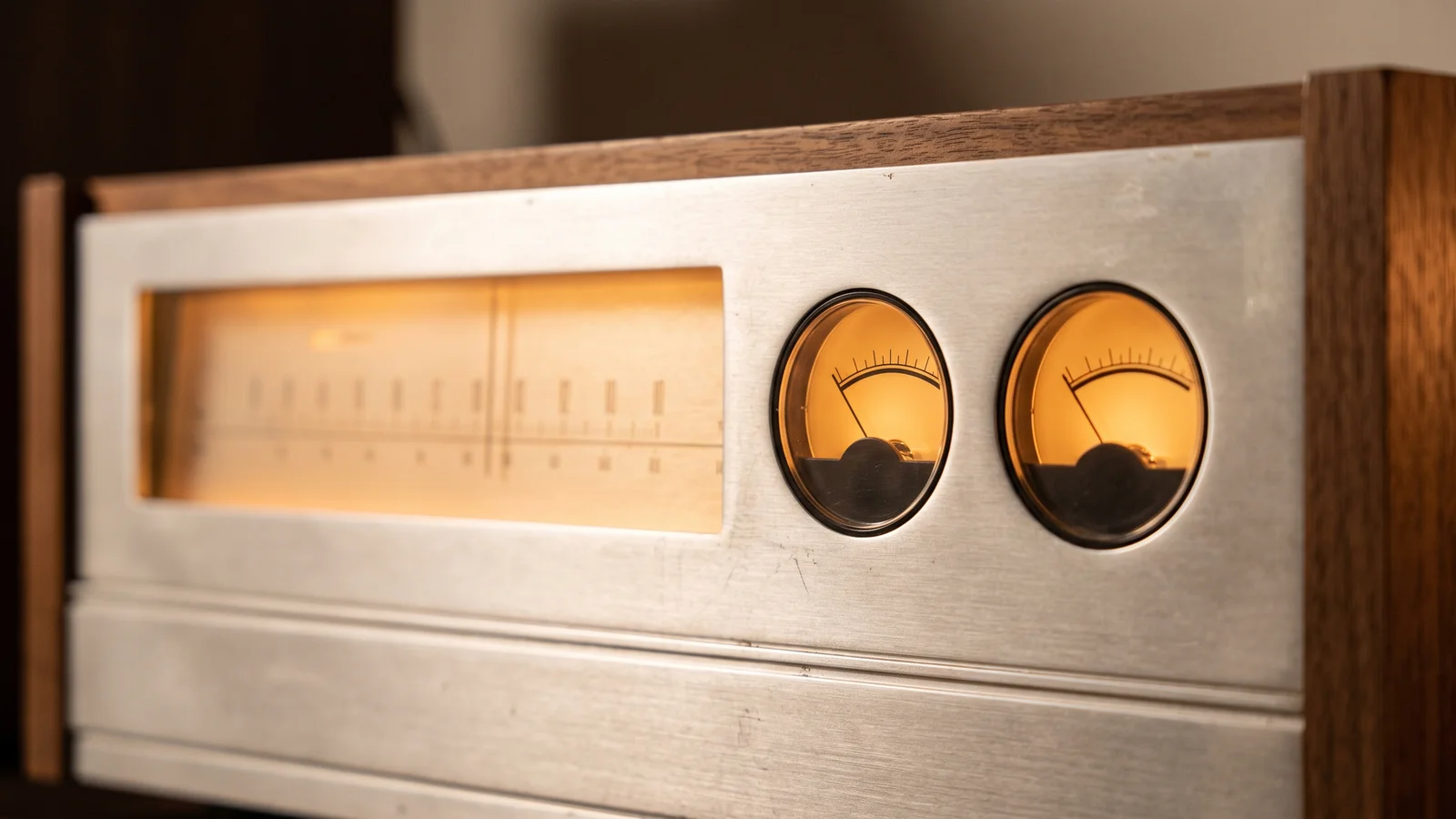
The golden age of the receiver ran from roughly 1974 to 1979, a period collectors call the "Receiver Wars," when Pioneer, Marantz, Sansui, Technics, and Kenwood competed on raw power and build quality. The peak was the Pioneer SX-1980 in 1978, rated at 270 watts per channel, according to documented histories of the SX-1980.
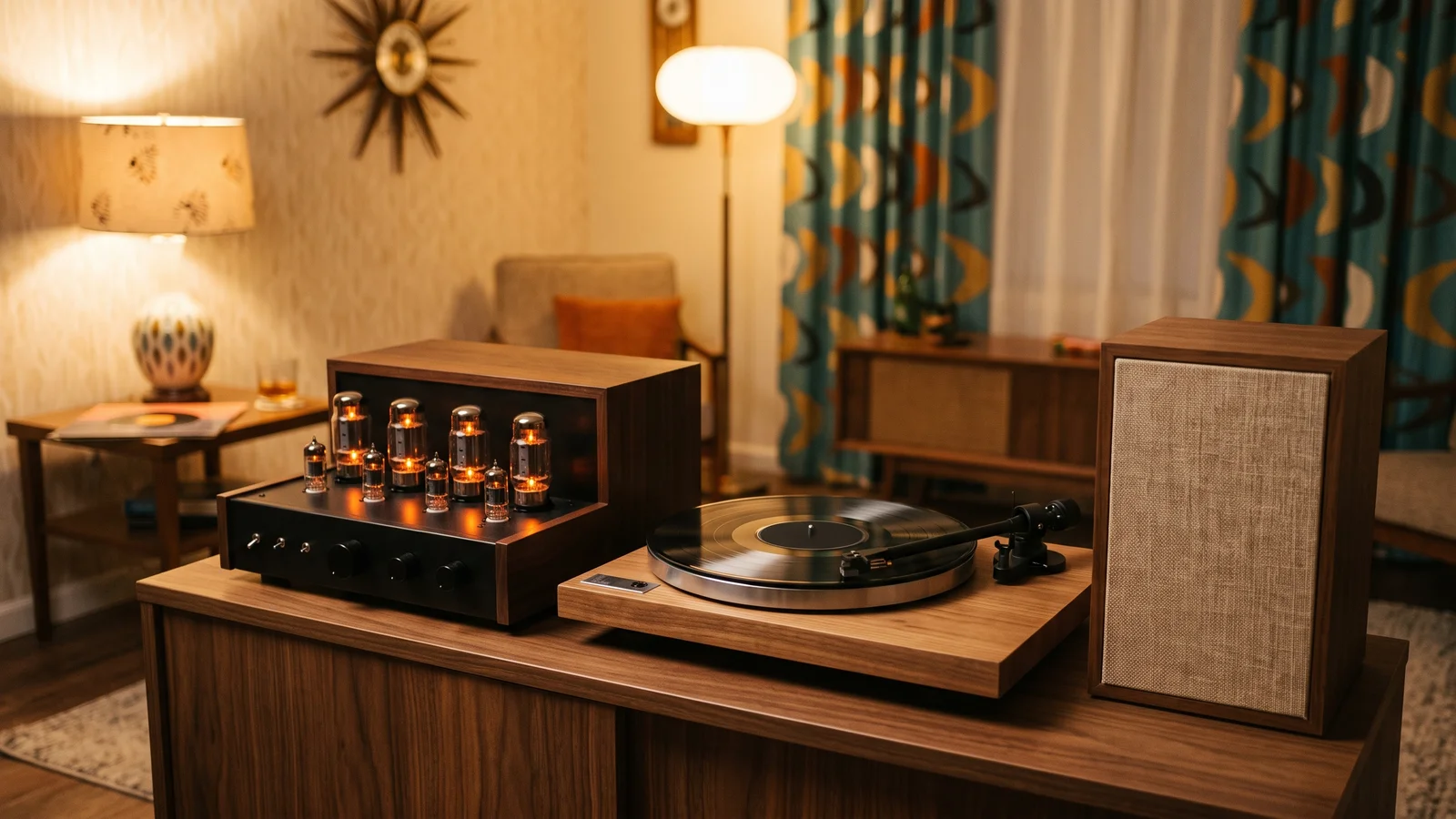
I've had a few of these monsters on the bench. They weigh as much as a bag of concrete because they're stuffed with real transformers, real heatsinks, and honest engineering. The chase for more watts got a little silly, sure. But the build quality was no joke. These companies were still run by people who cared what the thing sounded like and how long it would last.
That's the part worth remembering. When engineers ran these companies, the gear was overbuilt on purpose. A lot of these silver-faced receivers still power on and sound glorious 45 years later. Try that with a mass-market soundbar in 2069.
Did the CD Really Deliver Perfect Sound?
The compact disc arrived on October 1, 1982, when Sony released the CDP-101, the first commercial CD player, in Japan, according to documented histories of the CDP-101. Marketed as "perfect sound forever," the CD sold convenience and a noise floor you couldn't hear. It also kicked off the digital era that still runs everything.
Was it perfect? No. Early CDs and early converters could sound thin and clinical, and vinyl diehards weren't wrong to complain. But the format was clean, tough, and skip-anywhere convenient, and the public loved it. By the 1990s the CD had shoved vinyl into the closet. The record store rebuilt itself around a little silver disc.
Funny how these things go in circles, though. We'll get to who's winning the format war now, and it might surprise you.
When Did the Movies Move Into the Living Room?
Home theater began in 1982, when Dolby brought its surround technology to the living room, followed by Dolby Pro Logic in 1987, which decoded four channels from a stereo signal. The first Dolby Surround receiver was the Yamaha RX-4600 in 1986, according to Yamaha's own music history archive. That's the moment a movie could wrap around you at home.
Suddenly your living room wasn't just for music. It could throw a jet across the room from back to front, put dialogue dead center, and drop an explosion in your chest. The enthusiasts who wanted the cinema at home were finally getting the tools. Everything since, digital 5.1, TrueHD, object-based Atmos, is a refinement of that 1982 leap.
Building a real theater is its own craft, and it hasn't gotten simpler. If you're curious what actually goes into one from first drawing to final calibration, I laid out the full custom home theater timeline start to finish. The gear changed. The goal, making your room disappear so the movie takes over, never did.
How Did Streaming Take Over Everything?
Streaming took over in stages, starting with Napster in 1999, which let people trade MP3s for free until it was shut down in 2001, followed by Apple's iPod in 2001 and the iTunes Store in 2003. Spotify, founded in 2006 and launched publicly in 2008, turned the whole catalog into a monthly subscription. By 2024, streaming was the industry.
Napster was the earthquake. It proved people wanted music unbundled and instant, and it terrified the labels into court. Apple showed them the legal version: buy one song for pocket change, carry a thousand in your pocket. Then Spotify asked the real question. Why buy anything when you can rent all of it?
The numbers today
Streaming made up 84% of US recorded-music revenue in 2024, roughly $14.9 billion of a $17.7 billion total, with more than 100 million paid subscriptions, according to the RIAA's 2024 Year-End Report. Here's the plot twist nobody saw coming. Vinyl brought in $1.4 billion and outsold the CD, which managed $541 million, in both dollars and units, about 44 million records to 33 million discs, for the third straight year, per the same RIAA report.
The format Edison's disc descended from, the one the CD supposedly killed, is back on top of physical media. People wanted something they could hold, something with a ritual. Turns out the artifact matters.
What Happened to All the Legendary Brands?
Here's the pattern that runs under this entire story, and it's not a happy one. Nearly every legendary audio name was built by an obsessed founder, then sold to a conglomerate or private equity firm that kept the logo and offshored the craft. The receipts are documented, brand by brand, and once you see the shape of it you can't unsee it.
Take Klipsch. Paul Klipsch hand-built his first dozen Klipschorns in Hope, Arkansas in 1946. In 1989 he sold to his cousin Fred Klipsch, and in 2011 the company was acquired by Audiovox, now VOXX International, per public corporate records. The Heritage line still ships from Hope. A lot of the rest ships from overseas.
JBL and the $8 billion goodbye
James B. Lansing (1902 to 1949) put his initials on both Altec Lansing and JBL, then died by his own hand in 1949, broke, before either name became a household word. The company thrived after him. It sold to Jervis Corporation in 1969, which became Harman International, and in March 2017 Samsung closed its acquisition of Harman for about $8 billion, according to reported corporate filings. Lansing's garage speaker company is now a line item on an electronics giant's balance sheet.
Marantz, Acoustic Research, and the churn
Saul Marantz built his company in his home in 1948. It passed to Superscope in 1964, moved manufacturing to Japan, and in 1980 Superscope sold the name and the Japanese plants to Philips. Marantz Japan bought itself back in 2001, then merged with Denon into D&M Holdings in 2002, per documented company history. Acoustic Research, the little company that changed everything, went to Teledyne in 1967, then to International Jensen, then Recoton, and finally landed at Audiovox in 2003. The names survived. The founders' hands did not.
And Harman, the great consolidator that swallowed JBL, Infinity, Mark Levinson, and AKG? It got consolidated itself when Samsung wrote that check in 2017. The eater got eaten. There's a word for what this does to the gear, and it's not a kind one.
Citation capsule: Many golden-age audio brands passed from their founders to conglomerates: JBL, founded by James B. Lansing, became part of Harman International, which Samsung acquired for about $8 billion in a deal closed in March 2017, per reported corporate filings. Klipsch was acquired by Audiovox, now VOXX International, in 2011.
Frequently Asked Questions
Who invented recorded sound?
Thomas Edison invented recorded sound in 1877 with his tinfoil phonograph, built with machinist John Kruesi, per the Smithsonian National Museum of American History. He recorded and played back "Mary Had a Little Lamb," making it the first device that could both capture and reproduce sound.
Who really invented stereo?
Alan Blumlein invented stereo in 1931 at EMI, filing UK Patent 394,325 for the Blumlein pair and the 45/45 stereo disc, according to the EMI Archive Trust and Imperial College London. He worked it out 27 years before the record industry standardized stereo LPs in 1958.
What was the first modern loudspeaker?
The first modern loudspeaker was the moving-coil dynamic driver, designed by Chester Rice and Edward Kellogg at General Electric in 1925, per AES historical records. It appeared commercially in the 1926 RCA Radiola 104 and remains the basis for almost every speaker built today.
When did stereo records become standard?
Stereo records became standard on March 25, 1958, when the RIAA adopted the Westrex 45/45 disc format, following its demonstration at an AES meeting in October 1957. The first mass stereo LPs shipped that year from labels including RCA Living Stereo, Mercury Living Presence, and Decca ffss.
What was the first CD player?
The first commercial CD player was the Sony CDP-101, released in Japan on October 1, 1982, according to documented histories of the player. It launched the "perfect sound forever" era of digital audio, and by the 1990s the compact disc had pushed vinyl out of the mainstream.
What was the golden age of receivers?
The golden age ran from about 1974 to 1979, a stretch collectors call the Receiver Wars, when Pioneer, Marantz, Sansui, Technics, and Kenwood competed on power and build. The Pioneer SX-1980 of 1978, rated at 270 watts per channel, stands as the era's flagship.
Who was Paul Klipsch?
Paul Klipsch (1904 to 2002) was an American engineer who built the corner-horn Klipschorn in 1946 and founded Klipsch in Hope, Arkansas. The Klipschorn is the longest continuously produced loudspeaker in history, per Klipsch and the Encyclopedia of Arkansas. He was famous for filing patents into his 90s.
What did Ray Dolby invent?
Ray Dolby (1933 to 2013) founded Dolby Laboratories in 1965 and invented Dolby noise reduction, releasing Dolby B for home cassettes in 1968. His work cut tape hiss and later fed directly into surround sound, making Dolby a fixture in cinemas, living rooms, and streaming services worldwide.
Is vinyl bigger than CD now?
Yes. In 2024, vinyl generated $1.4 billion and outsold the CD in both revenue and units, roughly 44 million records to 33 million discs, for the third straight year, according to the RIAA's 2024 Year-End Report. Physical music buyers increasingly want the ritual and the artifact.
The Thread That Ties It All Together
So here's what 150 years of home audio actually teaches you. Every real leap came from a person, not a boardroom. Edison, Blumlein, Rice and Kellogg, Klipsch, Villchur, Kloss, Marantz, Dolby. Obsessed people who cared more about the sound than the spreadsheet. The corporations showed up later, bought the names, and mostly managed the decline.
I think about that every day at the bench. Streaming won, and it's genuinely great to have every song ever recorded a tap away, 84% of the industry per the RIAA. But vinyl came roaring back because people missed holding something built to last. That's the whole lesson in one data point. The craft still matters. The artifact still matters. Somebody still has to give a damn.
That's why we do it the old way. Small batch, by hand, backed by real service, for a handful of people a year. The names on the old gear got sold. The way of building it didn't have to.
Sources
- Smithsonian National Museum of American History — "Meet Edison's Tinfoil Phonograph (1877)": https://www.americanhistory.si.edu/explore/stories/meet-edisons-tinfoil-phonograph-1877
- UCSB Cylinder Audio Archive — "The History of the Tinfoil Phonograph": https://cylinders.library.ucsb.edu/history-tinfoil.php
- IEEE Engineering & Technology History Wiki — "KDKA, First Commercial Radio Station": https://ethw.org/KDKA,_First_Commercial_Radio_Station
- Mix — "1925: Chester Rice, Edward Kellogg and the Modern Dynamic Loudspeaker": https://www.mixonline.com/technology/1925-chester-rice-edward-kellogg-general-electric-co-modern-dynamic-loudspeaker-377962
- Wikipedia — "Edward W. Kellogg": https://en.wikipedia.org/wiki/Edward_W._Kellogg
- Audio Engineering Society — "Rice & Kellogg" (recording-technology history), archived: https://web.archive.org/web/20260103020320/https://www.aes-media.org/historical/html/recording.technology.history/rice-kellogg.html
- Wikipedia — "United Kingdom patent 394325" (Blumlein stereo patent): https://en.wikipedia.org/wiki/United_Kingdom_patent_394325
- EMI Archive Trust — "Alan Blumlein and the Invention of Stereo": https://www.emiarchivetrust.org/alan-blumlein-and-the-invention-of-stereo/
- Imperial College London — "Posthumous Grammy Award for inventor of stereo sound": https://www.imperial.ac.uk/news/177582/posthumous-grammy-award-inventor-stereo-sound/
- Wikipedia — "Paul Wilbur Klipsch": https://en.wikipedia.org/wiki/Paul_Wilbur_Klipsch
- Klipsch — "The Founder": https://www.klipsch.com/founder
- Encyclopedia of Arkansas — "Klipsch Audio Technologies": https://encyclopediaofarkansas.net/entries/klipsch-audio-technologies-2764/
- Hearing Review — "Hearing Aid and Audio Innovator Edgar M. Villchur Dies at 94": https://hearingreview.com/hearing-products/accessories/components/hearing-aid-and-audio-innovator-edgar-m-villchur-dies-at-94
- Wikipedia — "Acoustic Research": https://en.wikipedia.org/wiki/Acoustic_Research
- Wikipedia — "Sidney Harman": https://en.wikipedia.org/wiki/Sidney_Harman
- Wikipedia — "Stereophonic sound": https://en.wikipedia.org/wiki/Stereophonic_sound
- Wikipedia — "Saul Marantz": https://en.wikipedia.org/wiki/Saul_Marantz
- Wikipedia — "Marantz": https://en.wikipedia.org/wiki/Marantz
- National Inventors Hall of Fame — "Ray Dolby": https://www.invent.org/inductees/ray-dolby
- Wikipedia — "Ray Dolby": https://en.wikipedia.org/wiki/Ray_Dolby
- Wikipedia — "Pioneer SX-1980": https://en.wikipedia.org/wiki/Pioneer_SX-1980
- Wikipedia — "Sony CDP-101": https://en.wikipedia.org/wiki/Sony_CDP-101
- Yamaha — "The History of Yamaha AV Receivers": https://hub.yamaha.com/audio/a-history/the-history-of-yamaha-av-receivers/
- RIAA — "2024 Year-End Music Industry Revenue Report": https://www.riaa.com/reports/2024-year-end-music-industry-revenue-report-riaa/
- PR Newswire — "Audiovox Announces Definitive Agreement to Acquire Klipsch": https://www.prnewswire.com/news-releases/audiovox-announces-definitive-agreement-to-acquire-klipsch-115219889.html
- Wikipedia — "James Bullough Lansing": https://en.wikipedia.org/wiki/James_Bullough_Lansing
- Wikipedia — "JBL": https://en.wikipedia.org/wiki/JBL
- HARMAN — "Samsung Electronics Completes Acquisition of HARMAN": https://news.harman.com/releases/samsung-electronics-completes-acquisition-of-harman
Mike Vincent is the founder of Mike Knows Audio Video and WubWub Audio, where he designs and hand-builds custom loudspeakers and home theater systems in Arizona the old way, for about fifteen clients a year. He's spent enough time with vintage gear on the bench to know exactly what got lost when the suits took over, and he builds to bring it back.
Comments
Leave a Comment