James B. Lansing: The Tragic Founder Behind Both Altec Lansing AND JBL
By Mike Vincent • August 19, 2026
His initials are on millions of speakers. He died broke by his own hand in 1949, and the company only thrived after he was gone.
His initials sit on more loudspeakers than almost any name in audio. Flip over a studio monitor, a stadium rig, a Bluetooth speaker on somebody's kitchen counter, and there they are: JBL. James Bullough Lansing. The man behind those three letters died broke and by his own hand in 1949, at just 47. And here's the cruel twist that runs through this whole story: the company only became a giant after he was gone.
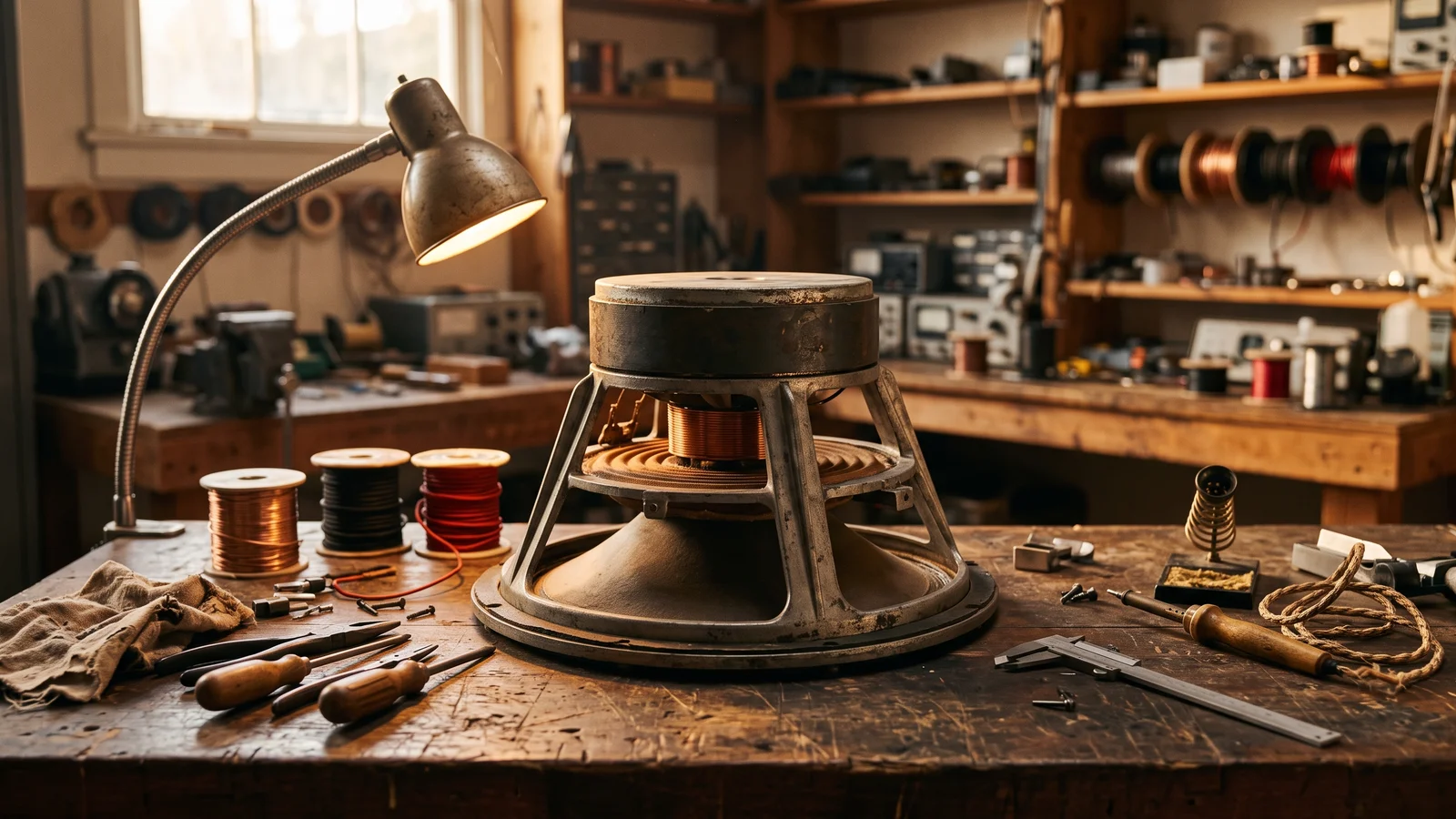
I've had plenty of his descendants on my bench over the years, old Alnico compression drivers that still sing after seventy years. So I feel like I owe the guy a straight telling. Lansing founded not one legendary company but two, Altec Lansing and JBL, and never got to enjoy either one. This is the founding tragedy of the hi-fi business, and it deserves to be told with some care.
Key Takeaways
James B. Lansing was born James Martini in January 1902 in rural Illinois, the ninth of fourteen children, and changed his surname to Lansing in 1927.
He founded Lansing Manufacturing in 1927; his compression drivers powered the Shearer Horn, which won an Academy Scientific and Technical Award in 1936.
Altec bought his company in 1941, creating Altec Lansing, home of the "Voice of the Theatre" cinema speaker.
He founded James B. Lansing Sound (JBL) in 1946; a trademark dispute pushed the young firm toward the initials we know today.
Lansing took his own life on September 24, 1949, amid mounting debt; JBL reached dominance only under his successor, Bill Thomas.
JBL is now owned by Samsung, which bought Harman International for roughly $8 billion in 2017.
Who was James B. Lansing, the man behind the initials?
James B. Lansing was born James Martini in January 1902 near Nilwood, Illinois, the ninth of fourteen children of a coal-mining engineer, according to the IEEE's engineering-history archive. He was a self-taught prodigy who reportedly built a working crystal radio and transmitter before he turned thirteen. Brilliant with a coil. Hopeless with a ledger. That combination shaped his whole life.
After his mother died in 1924, Martini moved west, landing in Salt Lake City around 1925, where he worked as a radio-station engineer and met his future wife, Glenna Peterson, as biographical accounts record. He'd earlier lived with a family named Bullough back in Illinois and took "Bullough" as a middle name. In 1927 he changed his surname from Martini to Lansing outright. Nobody has authoritatively explained why, so I won't pretend to. He simply became James B. Lansing, and the name stuck to an industry.
A note on the record. Lansing's dates get muddy, and any honest history should say so. His birthday is variously given as January 2 or January 14, 1902, so I've left it at "January." His death is usually dated September 24, 1949, though at least one reference lists September 29. When the sources disagree, I've flagged it rather than pick a winner. For an audiophile crowd, that beats false precision every time.
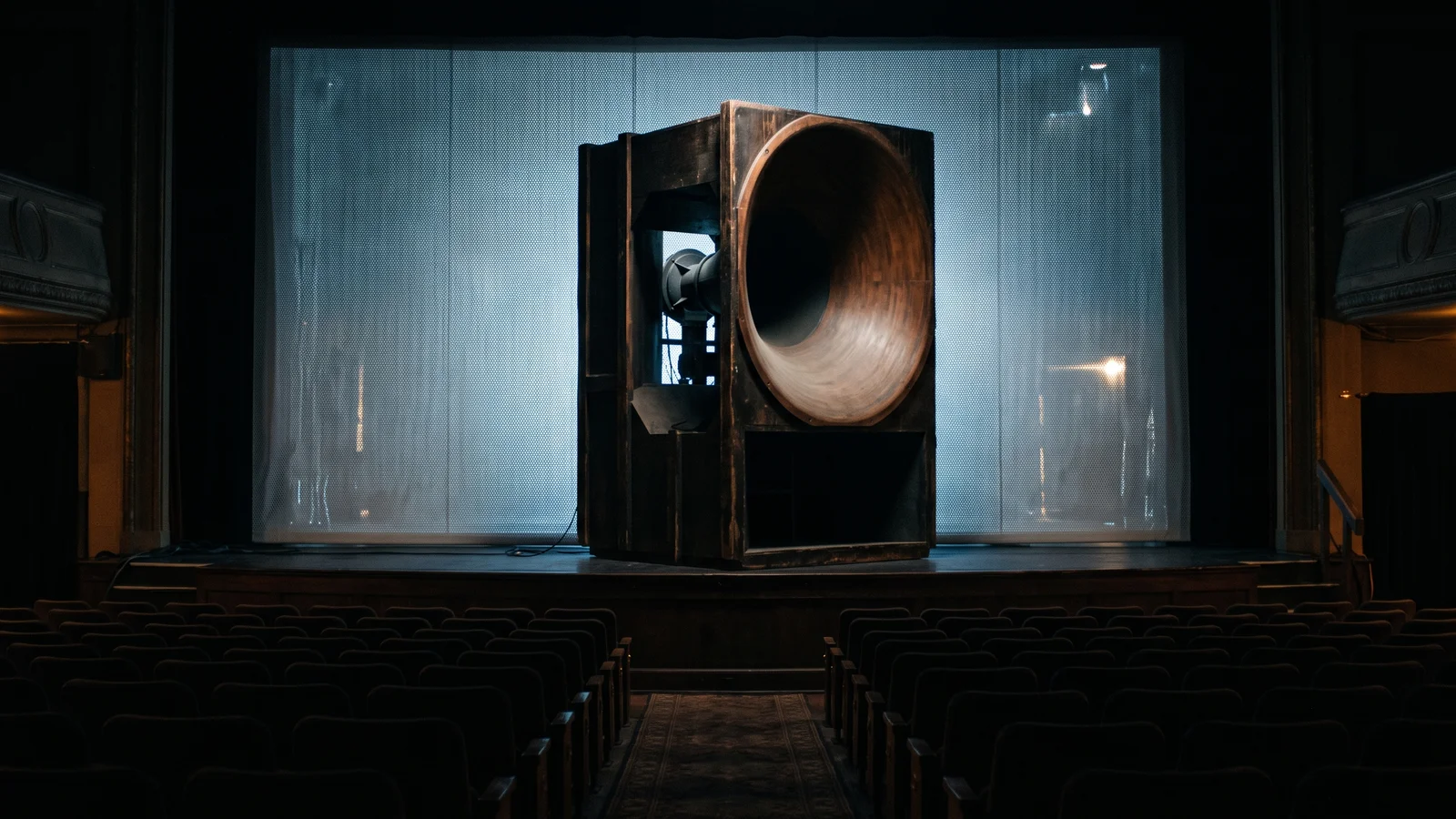
The folded-horn cinema loudspeaker that defined movie sound in the 1940s
How did the Shearer Horn make Lansing famous in Hollywood?
Lansing's big break came from the movies. In the mid-1930s his shop supplied the compression drivers for the Shearer Horn, a massive theater loudspeaker developed at MGM, and the system earned an Academy Scientific and Technical Award in 1936, per the sound-technology record at Mix. That gold-plated nod put a small Los Angeles workshop on the industry map overnight.
Lansing had founded Lansing Manufacturing Company in 1927 with a partner named Ken Decker, building field-coil cone drivers out of Los Angeles, as the IEEE archive notes. Decker ran the business side; Lansing ran the physics. The Shearer project, developed around 1933 to 1935 with MGM's John Hilliard and Douglas Shearer, was the collaboration that proved his drivers could fill a movie palace, as horn-history accounts document. Out of that work came the Lansing Iconic studio monitor in the late 1930s.
Then the roof fell in. Ken Decker died in a plane crash in 1939, Wikipedia records, and the company lost the one man who kept its books honest. Lansing was a genius who needed a business partner, and he'd just lost his. The shop drifted into financial trouble almost immediately.
What was Altec Lansing, and why did Lansing walk away?
In 1941, the Altec Service Corporation bought the struggling Lansing Manufacturing and created Altec Lansing, as JBL's own heritage history recounts. The "Altec" part came from "All Technical Services." Lansing signed on as vice president of engineering on a five-year contract. Out of that partnership came the "Voice of the Theatre," the cinema speaker that defined the sound of the movies for decades.
The Voice of the Theatre, best known in its A-4 form, arrived in the mid-1940s and became the reference for theatrical sound, as loudspeaker histories document. If you've ever heard a big folded-horn system behind a movie screen and felt the dialog land in your chest, that's the lineage Lansing helped set. It's the same theatrical bigness a good home theater installer still chases today, just scaled down to a living room.
Here's the thing about restless engineers, though. When his five-year contract expired in 1946, Lansing didn't re-sign. He wanted his own shop again, his name over the door. So he left the very company that carried his name and set out to start over. That decision would cost him more than he could have known.
Why does JBL carry his initials instead of his name?
When his Altec contract expired in 1946, Lansing founded Lansing Sound Incorporated, soon renamed James B. Lansing Sound, Incorporated, according to JBL's heritage history. There was a catch, and it's the reason the company isn't just called "Lansing" today. Altec still held the rights to the "Lansing" name, so the new outfit was pushed toward his initials instead: JBL.
That trademark bind is the whole answer to "what does JBL stand for." It's James Bullough Lansing, chosen partly because the corporate divorce from Altec left him few other options, as brand histories explain. The famous exclamation-point logo came later, around 1955, well after Lansing himself was gone. His early driver line even carried the name "Signature," the sound of a man trying to sign his work again.
But a great engineer running his own small company still needs someone minding the money. History rhymes cruelly here. By 1948 and 1949 the young firm was running at a loss and carrying debt, as accounts of the period note. The exact dollar figures come from thin sourcing, so I'll leave them vague. What's clear is that Lansing, once again, was drowning on the business side while doing brilliant work on the bench.
How did James B. Lansing die?
James B. Lansing took his own life on September 24, 1949, near San Marcos, California, at age 47, as biographical records state. His young company was carrying heavy debt, and those who knew him pointed to deteriorating business conditions and personal strain. He was buried at Inglewood Park Cemetery. It is the saddest chapter in a series full of hard ones.
I want to be careful here, because the man deserves dignity, not a headline. Lansing was, by every account, a gifted and self-taught engineer who was simply never suited to running a business, as the industry-pioneer record puts it. Twice in his life the money side collapsed around him, and the second time he could not climb out. There's a reported detail worth sharing only because it matters to what came next: a life-insurance policy on Lansing helped keep the company solvent after his death. The founder's final act, in the coldest financial terms, is part of why JBL survived at all.
How did Bill Thomas turn JBL into a giant?
Here's the paradox at the heart of the story: JBL thrived only after Lansing was gone. His vice president, William "Bill" Thomas, bought the company from the estate and steered it toward dominance, as JBL heritage accounts record. The life-insurance payout reportedly kept the doors open long enough for that turnaround to happen. The engineer built the greatness; the businessman finally made it pay.
And the products under Thomas were genuinely great. The D130, a 15-inch transducer from around 1947, introduced a four-inch flat-wire voice coil and Alnico V magnet that made it a legend among guitarists and hi-fi builders alike, per loudspeaker histories. The Model 375 compression driver followed in 1954. The Hartsfield corner horn of the mid-1950s got nicknamed the "Dream Speaker." Every one of those started with the obsessions Lansing baked into the shop: hand-wound voice coils, Alnico magnets, drivers built like machine tools. It's the same obsession that still drives how we build custom loudspeakers by hand.
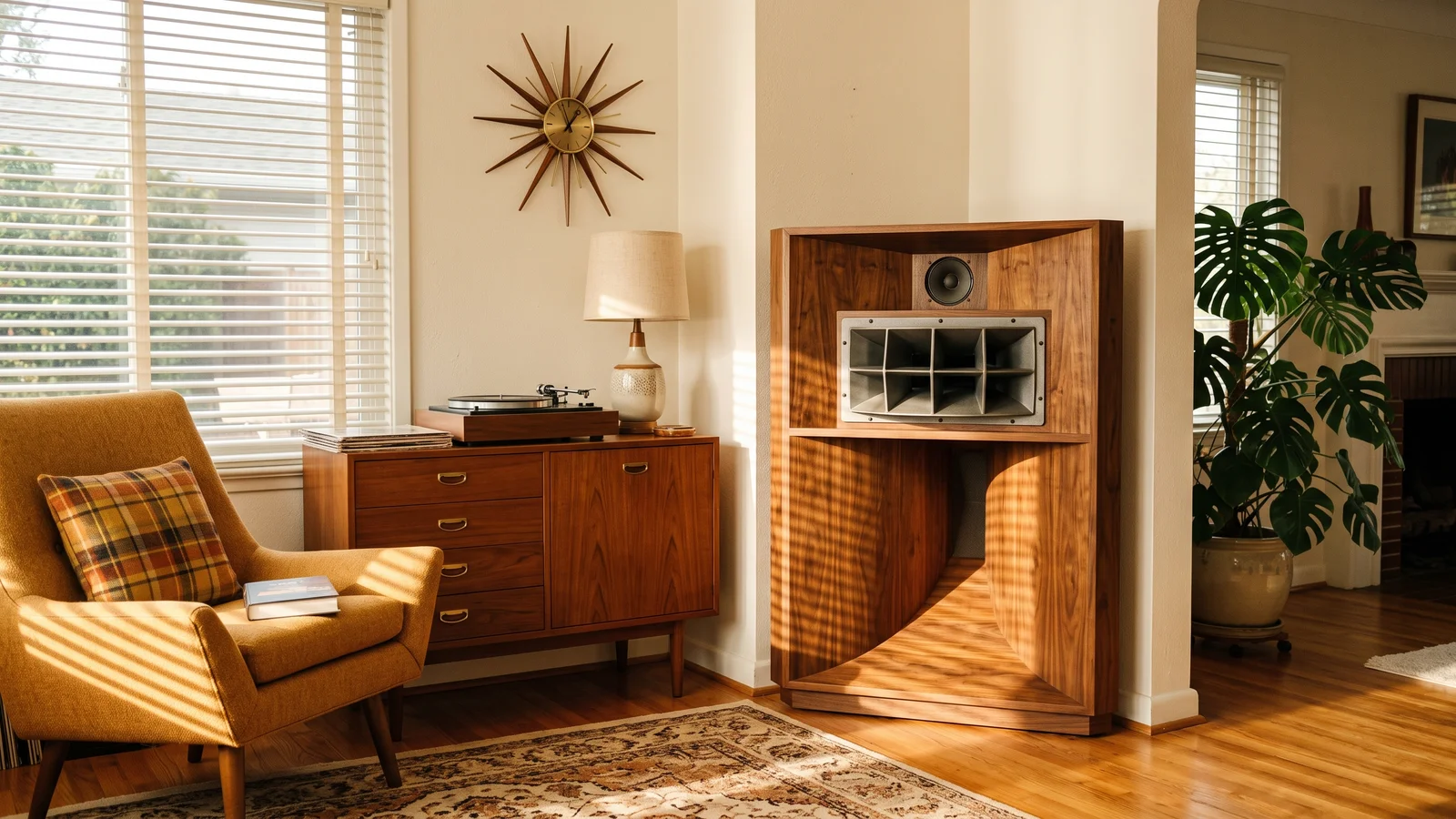
The corner-horn hi-fi speaker of the 1950s golden age
Then came the show-stoppers. The JBL Paragon (D44000) ran from 1957 to 1983, a single-cabinet stereo system with a curved reflecting panel and the longest production run in JBL history, as the model's record documents. And the L100 Century of 1970, a consumer version of the 4310 studio monitor with that unmistakable orange Quadrex foam grille, became the best-selling speaker of the decade at roughly $273 each in period pricing, according to review histories and surviving JBL price lists. Lansing never saw a single one of them ship.
Who owns JBL now, and what happened to it?
JBL passed out of American hands in stages. In 1969 Bill Thomas sold the company to the Jervis Corporation, run by Sidney Harman, which became Harman International, as brand histories record. Then in 2017, Samsung bought Harman International for roughly $8 billion, its largest acquisition ever, per Samsung's own announcement. That deal, completed and confirmed in Harman's press release, swept up JBL alongside Harman Kardon, Infinity, Lexicon, Mark Levinson, and AKG.
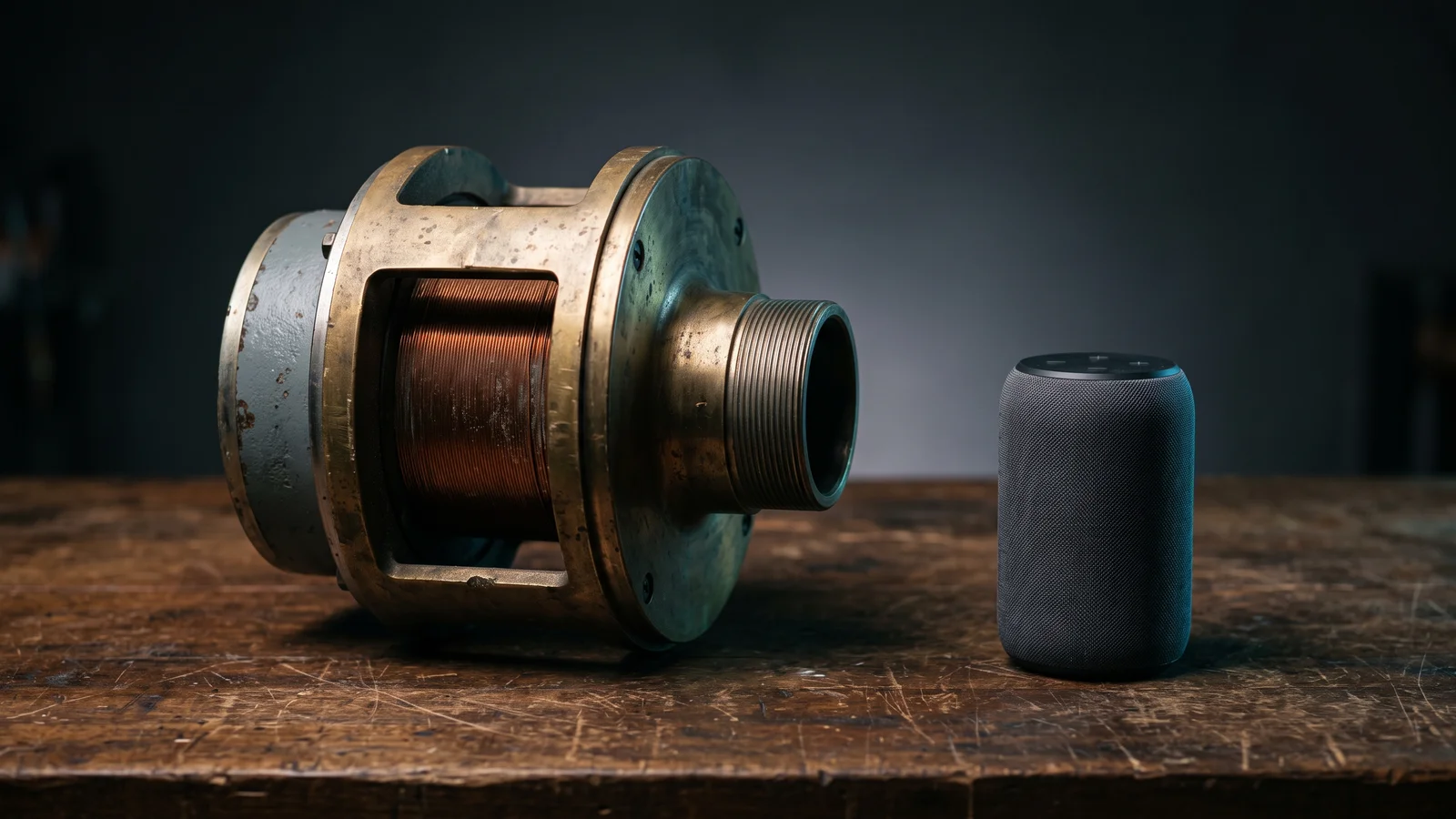
So here's the honest reckoning. The mass-market JBL most people know today is a wall of Bluetooth speakers, the Charge and the Flip, built offshore and sold on price, a long way from the hand-built compression drivers and studio monitors that were Lansing's whole reason for being, as audio-history writers have noted. That slow slide from a craftsman's mission to a logo stamped on cheap gear has a name now. The word is enshittification, and the JBL nameplate is a textbook case.
Now for the nuance that keeps this fair, because it matters. JBL Professional, the cinema, studio-monitor, and tour-sound side, is still genuinely serious gear that carries the engineering seriously. That branch of the family tree never lost the plot. It's the consumer side that got hollowed out, which is the pattern all over this series: the real work survives in a corner while the famous name gets sold by the pallet.
And that's exactly why some of us still do it the old way. Lansing hand-wound his own voice coils and cast his own magnets because he cared how the thing actually sounded, not how cheaply it could be shipped. That's the same reason we still build speakers by hand in Arizona, with real drivers and real magnets, for a handful of clients a year. It's a small tribute to a man who got the sound right and the business wrong.
Frequently Asked Questions
Who founded JBL?
JBL was founded by James B. Lansing, born James Martini in January 1902, as JBL's heritage history records. He started James B. Lansing Sound, Incorporated in 1946 after leaving Altec Lansing, the earlier company that also bore his name. He died in 1949, and the firm reached dominance only afterward under his successor, Bill Thomas.
Hand-wound compression driver versus a modern portable Bluetooth speaker
What does JBL stand for?
JBL stands for James Bullough Lansing, the founder's full name, per JBL's official history. The company used his initials rather than "Lansing" because Altec still held the rights to the Lansing name after he left. The familiar exclamation-point logo came later, around 1955, well after Lansing had died.
Who founded Altec Lansing?
Altec Lansing was formed in 1941 when the Altec Service Corporation bought James B. Lansing's struggling Lansing Manufacturing Company, as company heritage records show. "Altec" came from "All Technical Services." Lansing joined as vice president of engineering, and the company went on to build the famous "Voice of the Theatre" cinema loudspeaker.
How did James B. Lansing die?
James B. Lansing took his own life on September 24, 1949, near San Marcos, California, at age 47, according to biographical records. Those close to him cited deteriorating business conditions and personal strain. A brilliant self-taught engineer, he was never comfortable running a business, and a life-insurance policy reportedly helped his company survive after his death.
Who owns JBL now?
JBL is owned by Samsung, which acquired Harman International for roughly $8 billion in 2017, per Samsung's announcement. Harman had owned JBL since 1969, when Sidney Harman's Jervis Corporation bought it. The Samsung deal, its largest ever, also brought in Harman Kardon, Infinity, Lexicon, Mark Levinson, and AKG.
Is JBL still American?
Not really, in ownership or manufacturing. JBL's mass-market consumer speakers are now largely offshore-built Bluetooth products under Samsung-owned Harman, as audio-history writers note. That said, JBL Professional, the cinema, studio, and tour-sound division, remains a genuinely serious engineering operation. The famous name lives on; the founder's hand-built ethos survives mostly on the professional side.
Sources
IEEE Engineering & Technology History Wiki, "James Lansing": https://ethw.org/James_Lansing
Sound & Communications, "Industry Pioneers #17: James B. Lansing, A Legacy in Sound": https://www.soundandcommunications.com/industry-pioneers-17-james-b-lansing-a-legacy-in-sound/
Mix, "1935: The Shearer Horn": https://www.mixonline.com/technology/1935-shearer-horn-383651
Nordost, "The Evolution of HiFi: The Shearer Horn": https://nordost.com/blog/the-evolution-of-hifi-the-shearer-horn/
Sound & Vision, "JBL L100 Century Speaker": https://www.soundandvision.com/content/jbl-l100-century-speaker
Lansing Heritage, JBL price lists (1970 to 1999): https://www.lansingheritage.org/html/jbl/reference/price-lists/1970-1999-prices.htm
Samsung Newsroom, "Samsung Electronics to Acquire Harman": https://news.samsung.com/global/samsung-electronics-to-acquire-harman-accelerating-growth-in-automotive-and-connected-technologies
HARMAN, "Samsung Electronics Completes Acquisition of Harman": https://news.harman.com/releases/samsung-electronics-completes-acquisition-of-harman
U.S. Securities and Exchange Commission, HARMAN Form 8-K exhibit (2017): https://www.sec.gov/Archives/edgar/data/0000800459/000119312517078968/d184457dex991.htm
Mike Vincent is the founder of Mike Knows Audio Video and WubWub Audio, where he designs and hand-builds custom loudspeakers and home theaters in Arizona, the old way, for about fifteen clients a year. He has a soft spot for old Alnico compression drivers and the people who wound them by hand; if you want a speaker built with that kind of care, start with our custom loudspeakers.
Stay Updated
Get notified when we publish new articles about home theater and custom speakers.

Comments
Leave a Comment