
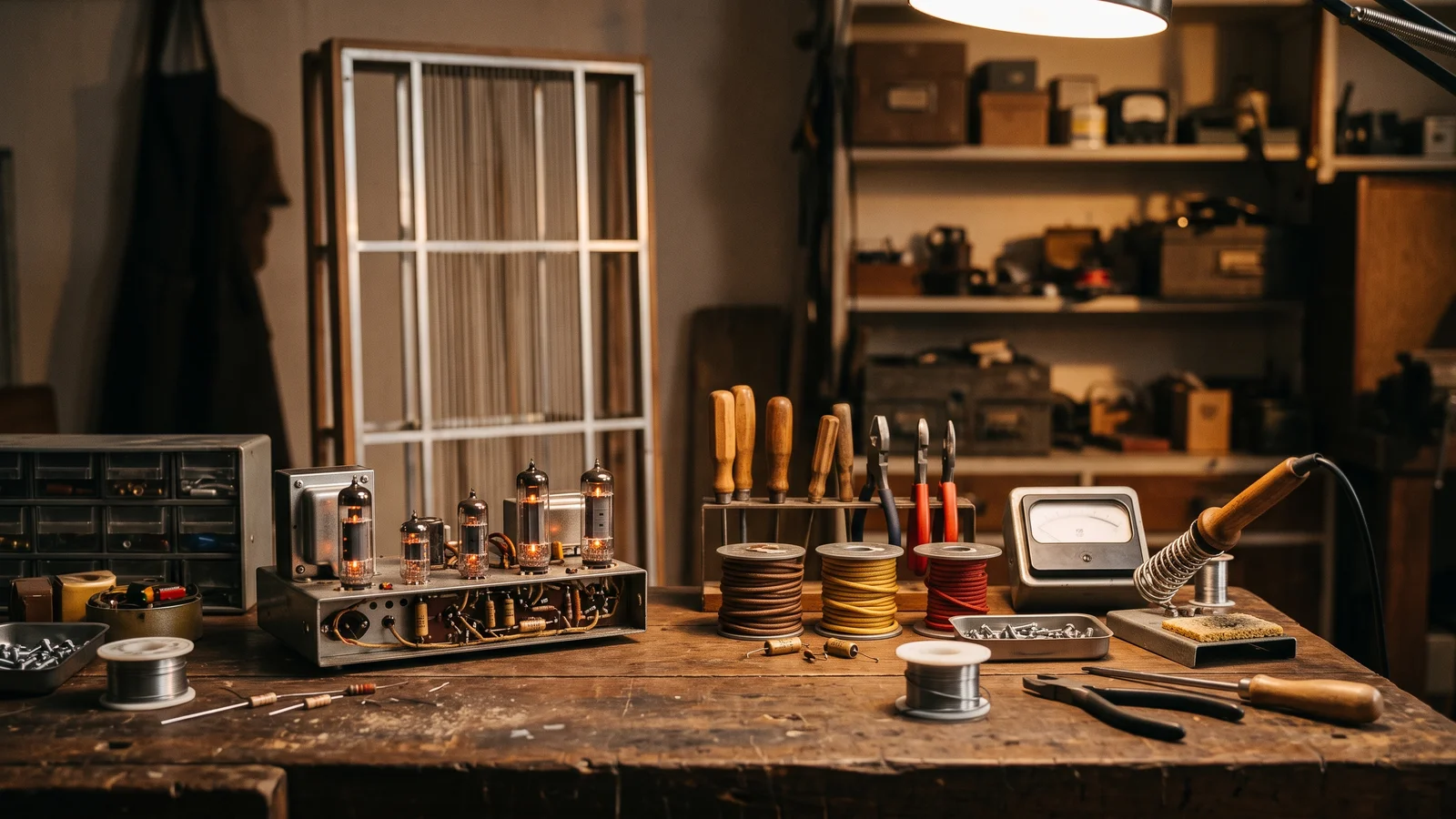
The gentleman engineer whose 1957 Quad ESL is still a reference speaker more than 65 years later. Understatement as a design philosophy.
Some engineers built empires. Peter Walker built a speaker so right that we're still using it as a yardstick almost seventy years later. He didn't shout about it. He didn't chase awards or trade on his own name. He just decided that a loudspeaker should get out of the way of the music, and then he spent his life making that happen with as little drama as possible.
That speaker is the Quad ESL, launched in 1957, and I've heard enough of them to tell you the fuss is earned. The midrange still humbles gear that costs ten times as much. Walker was the sort of modest, physics-first English gentleman the industry doesn't really make anymore. So let me introduce you to the man behind the panel.
Key Takeaways
- Peter James Walker (1916–2003) founded The Acoustical Manufacturing Company in London in 1936 and ran it for decades under the design credo "the closest approach to the original sound."
- QUAD stands for "Quality Unit Amplifier Domestic," a name coined for the company's 1951 domestic amplifier.
- The Quad ESL of 1957 was the world's first production full-range electrostatic loudspeaker, nicknamed "Walker's Wonder," and remains a midrange reference more than 65 years on.
- Roughly 54,000 original ESLs were built between 1957 and 1985, though sources disagree on whether that figure counts units or pairs.
- Quad passed to the Verity Group in 1995 and to China's International Audio Group in 1997, yet the electrostatic Walker invented is still made under the Quad name today.
Who was Peter Walker, the quiet man behind Quad?
Peter James Walker (1916–2003) was an English electronics engineer who founded The Acoustical Manufacturing Company in London in 1936 and led it for the next half-century, according to his Stereophile obituary. He died on 10 December 2003 at the age of 87. He was, by every account, a modest and understated man who let his engineering do the talking.
Walker played the flute in the Huntingdon Philharmonic, which tells you something. This was a man who knew what live instruments actually sound like, and he built his whole design philosophy around chasing that truth. His credo was simple and unglamorous: "the closest approach to the original sound," as Quad still frames its own story. Not the biggest sound. Not the flashiest. The most honest.
He had no patience for hype, either. Asked once why Quad didn't chase subjective reviews and glowing pull-quotes, Walker reportedly said, "Whatever for. No point. We leave our customers to do that," as recalled in the audioXpress tribute by Reg Williamson. Imagine a modern audio brand saying that out loud. It's the opposite of everything the industry became.
What does QUAD stand for, and where did it start?
QUAD stands for "Quality Unit Amplifier Domestic," a name Walker coined for the company's first domestic amplifier in 1951, per Grace's Guide. The parent firm stayed The Acoustical Manufacturing Company on paper for decades. It wasn't officially renamed QUAD Electroacoustics Ltd until 1983, once the brand had eclipsed the corporate name entirely.
The beginning was humbler than the legend suggests. Walker started out in 1936 selling sound systems under the name S.P. Fidelity Sound Systems, as the company's own history recounts. Then the war intervened. The London premises were bombed out, and in 1941 the whole operation relocated to Huntingdon, the quiet Cambridgeshire town that would stay Quad's home for the rest of Walker's life and beyond.
What made the Quad amplifiers so good?
The QUAD II valve amplifier of 1953 became the anchor of the range: a modest 15 watts per channel, yet around 90,000 units were built before production ended in 1970, according to Grace's Guide. That's a staggering run for a serious hi-fi amp. It tells you the design was right the first time, which is the whole Walker method.
The Quad I arrived first, in 1951, and gave the brand its name. Then came the QUAD II, and later the solid-state Quad 33 preamp and 303 power amp in 1967, a pairing so cleanly designed that examples ended up in the Museum of Modern Art's collection. Walker's ideal for an amplifier was famously blunt: it should be "a straight wire with gain," as the audioXpress tribute records. Add nothing, subtract nothing, just make it bigger.
His most celebrated circuit came in 1975. The Quad 405 introduced "current dumping," a clever way to combine a tiny, ultra-accurate amplifier with a big, powerful one and get the best of both, as detailed in this technical history of the design. Walker developed it with his colleague Michael Albinson, and the work earned Quad the Queen's Award for Technological Achievement in 1978. Genuine innovation, quietly delivered.
I've had a few of these amps on the bench over the years, and the thing that always strikes me is how serviceable they are. Nothing exotic, nothing designed to fail so you'll buy the next one. Walker built gear you could keep alive, which is partly why so much of it still works today. That's not nostalgia talking. It's just good engineering that respected the person who paid for it.
Why is the Quad ESL-57 called Walker's masterpiece?
The Quad ESL, later nicknamed the ESL-57, launched in 1957 as the world's first production full-range electrostatic loudspeaker, as Sound & Vision documents in its look back. Enthusiasts called it "Walker's Wonder." Sound & Vision has since called it one of the most important speakers of the 20th century, and more than 65 years later it's still used as a midrange reference.
Credit here needs an honest footnote. Wikipedia describes the ESL as designed by "Theo Williamson and Peter Walker," building on the electrostatic principles in Chester Rice and Edward Kellogg's era of patents, in its entry on the speaker. Most histories credit Walker alone. What's fair to say is that Walker was the driving force and the public face of the project, while D.T.N. "Theo" Williamson is sometimes named as a co-designer. Worth noting, that's a different Williamson from Reg, who wrote the obituary I keep quoting.
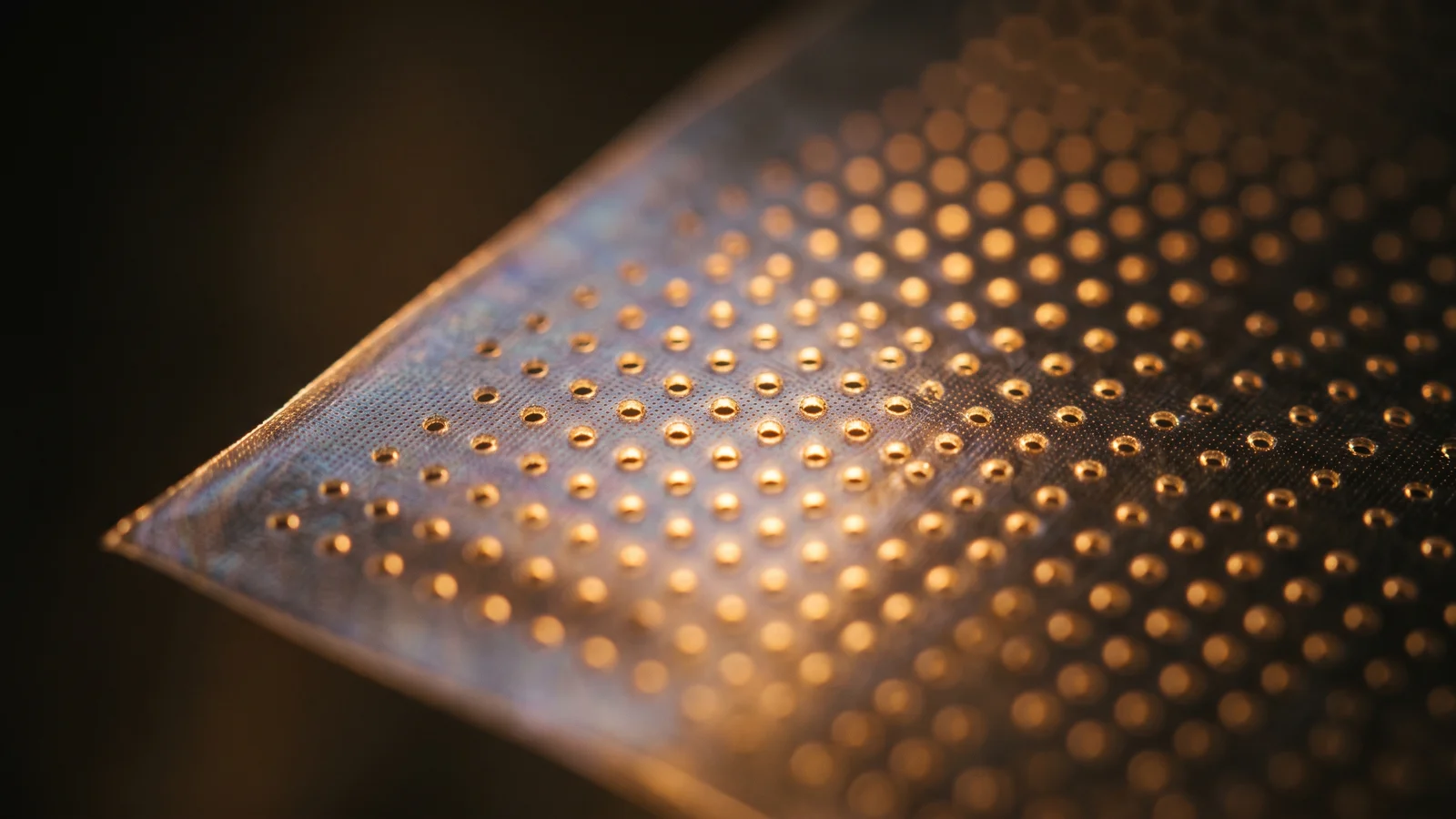
I'll keep the deep physics for the sibling piece on the electrostatic loudspeaker, because it deserves its own article. The short version: the ESL replaces the heavy paper cone with a whisper-thin charged film, and that near-massless diaphragm is why the thing sounds so eerily transparent. Walker built it to last, too. Quad made the original ESL from 1957 all the way to 1985, in numbers usually given as "roughly 54,000," per Wikipedia's Quad entry. Fair warning: sources argue over whether that count means individual units or pairs.
What did the Quad ESL-63 do differently?
The Quad ESL-63, introduced in 1981, was Walker's second act: a full-range electrostatic that used a delay-line arrangement of concentric electrodes to behave like a single point source sitting about 30 centimeters behind the panel, as PS Audio explains. The "63" doesn't mark its release year. It honors 1963, the year Walker first worked out the concept.
That point-source trick solved one of the original ESL's real headaches. A big flat panel tends to spray sound unevenly depending on where you sit, but the ESL-63's staggered electrodes fire in a ripple that mimics a small sphere of sound expanding outward. The result was better imaging and a wider sweet spot. A few sources list the launch as 1982 rather than 1981, so if you see that date floating around, it isn't wrong so much as a matter of when you count from.
What did the ESL-63 sound like? Even more of what made the first one special. Sit down in front of a good pair and the speakers seem to vanish, leaving a voice hanging in the air between them. That disappearing act is the whole point of a well-made electrostatic, and Walker chased it for a quarter century. Reviewers still argue about which Quad panel is the true masterpiece, and honestly, both answers are defensible.
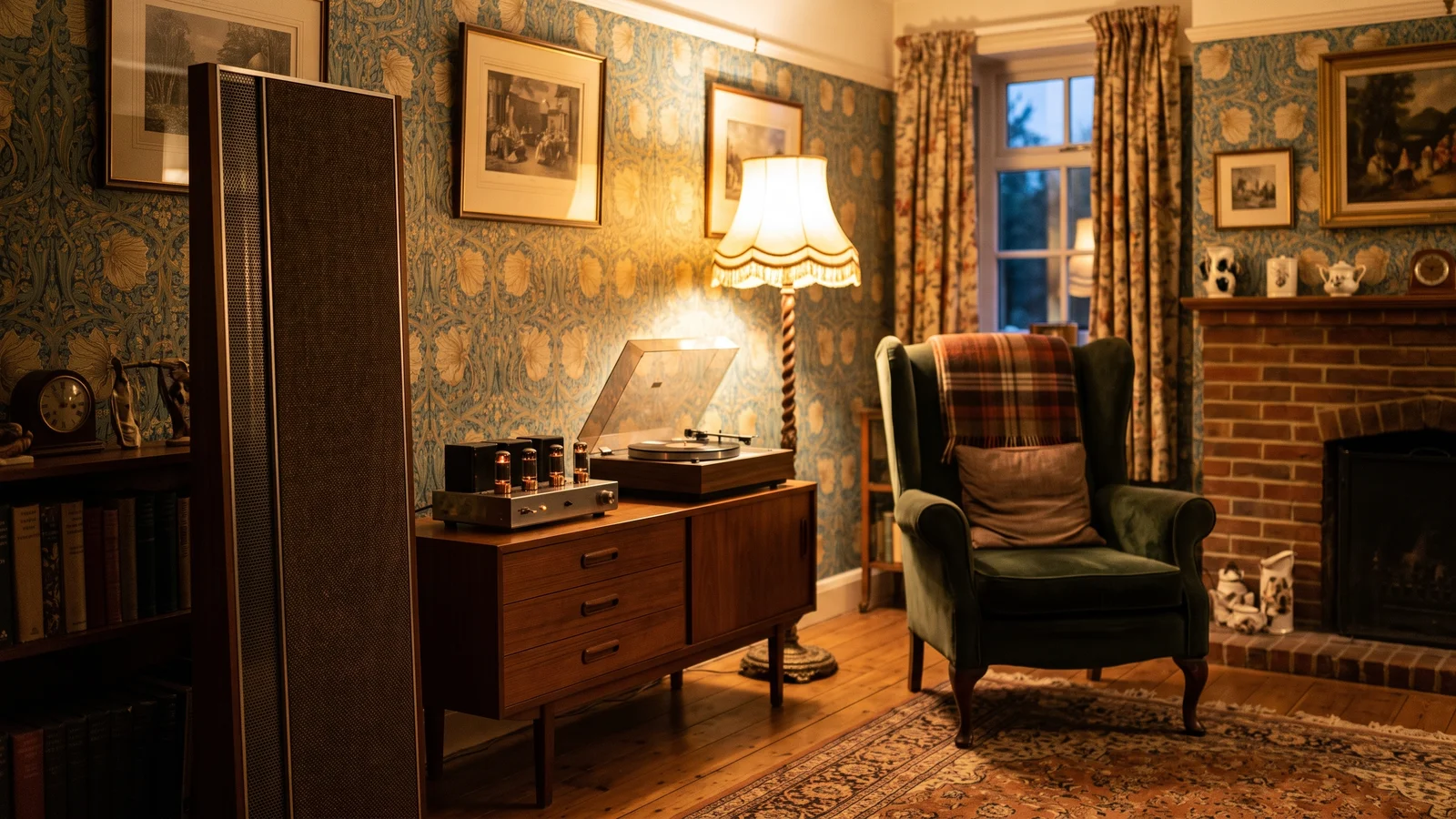
Here's what I respect most about it. Walker sat on that idea for nearly two decades before he shipped it. No rush to market, no half-baked version to grab headlines. He waited until the manufacturing could actually deliver what the concept promised. The descendants of the ESL-63 are still in production today, which is a rare thing to be able to say about any speaker.
Who owns Quad now, and what happened to Walker's legacy?
Quad is now owned by China's International Audio Group, or IAG, which acquired it in September 1997 after the brand had briefly passed to the Verity Group in 1995, according to Wikipedia's IAG entry. IAG was founded by the brothers Bernard and Michael Chang and is based in Shenzhen, with a large factory in China. Manufacturing moved east; design, management, and service stayed, at least nominally, in Huntingdon, England.
You know the pattern from the rest of this series. A passionate British engineering house gets sold, then swallowed by a bigger group, then the factory work heads offshore to China, as What Hi-Fi confirmed on a visit to IAG's operation. The polite industry word for what usually follows is decline. The blunter one is enshittification: the slow hollowing-out of a great name into a logo. When it happens, it deserves to be named.
But honesty cuts both ways, and Quad complicates the story. IAG didn't strip the brand and cash out. It kept the electrostatic in continuous production and has genuinely kept developing it, and the ESL-57's legacy has been carried forward rather than buried. Today's ESL-2812 and ESL-2912 trace their design lineage straight back to Walker's panels. The speaker one modest Englishman invented in 1957 is still being made and sold under the Quad name in 2026. That's continuity as much as decline, and it's fair to say so.
Walker himself was honored properly in his lifetime: an OBE, election as an AES Fellow in 1980, the AES Silver Medal in 1989, and an honorary doctorate from Keele University, per his Stereophile obituary. His son Ross Walker ran the company and carried the work forward. The name on the corporate paperwork changed. The idea did not.
That idea is one I build by, even if I'll never build an electrostatic. Walker's whole life was proof that a small shop obsessed with getting the sound right can make something that outlives every spreadsheet that later owns it. In our Arizona workshop we hand-build custom loudspeakers the same stubborn way, one client at a time, over six to twelve weeks or more, because built-to-last still means something. Walker would have understood that. He'd probably have told me to stop talking and go check my measurements.
Frequently Asked Questions
Who was Peter Walker?
Peter James Walker (1916–2003) was an English engineer who founded The Acoustical Manufacturing Company in London in 1936, the firm that became Quad. He designed the Quad valve amplifiers, the 405 "current dumping" amp, and the 1957 Quad ESL, working under his credo "the closest approach to the original sound." He died in 2003, age 87.
What is the Quad ESL-57?
The Quad ESL, later called the ESL-57, was the world's first production full-range electrostatic loudspeaker, launched by Peter Walker in 1957 and nicknamed "Walker's Wonder." It uses a wafer-thin charged film instead of a cone, giving famously transparent midrange. Quad built it from 1957 to 1985, and it's still treated as a reference today.
What does QUAD stand for?
QUAD stands for "Quality Unit Amplifier Domestic," a name Peter Walker coined for the company's first domestic amplifier in 1951. The parent firm stayed The Acoustical Manufacturing Company until 1983, when it was officially renamed QUAD Electroacoustics Ltd, since the brand name had long outgrown the corporate one.
Who owns Quad now?
Quad is owned by China's International Audio Group (IAG), which bought it in September 1997 after a brief spell under the Verity Group from 1995. IAG, founded by brothers Bernard and Michael Chang, moved manufacturing to China while keeping design and service in Huntingdon, England. The electrostatic speaker remains in continuous production.
Why is the ESL-57 still revered?
The ESL-57 is revered because its near-massless charged diaphragm reproduces the midrange with a clarity and speed that most cone speakers still can't match. More than 65 years after its 1957 launch, engineers and reviewers keep using it as a reference. Sound & Vision has called it one of the most important speakers of the 20th century.
Sources
- Stereophile — "Peter J. Walker" (obituary): https://www.stereophile.com/news/121503walker/index.html
- audioXpress — Peter Walker tribute by Reg Williamson (mirror): https://www.gammaelectronics.xyz/ax_03-2004_walker.html
- QUAD — "Our Story": https://quad-hifi.co.uk/pages/our-story
- Grace's Guide — "Quad": https://www.gracesguide.co.uk/Quad
- Wikipedia — "Quad Electroacoustics": https://en.wikipedia.org/wiki/Quad_Electroacoustics
- Wikipedia — "Quad Electrostatic Loudspeaker": https://en.wikipedia.org/wiki/Quad_Electrostatic_Loudspeaker
- Sound & Vision — "Quad ESL-57 Electrostatic Speaker": https://www.soundandvision.com/content/quad-esl-57-electrostatic-speaker
- PS Audio — "The Original QUAD ESL": https://www.psaudio.com/blogs/copper/the-original-quad-esl/
- AudioHead — "The History and Continuing Legacy of the Quad ESL-57": https://audio-head.com/the-history-and-continuing-legacy-of-the-quad-esl-57-loudspeaker/
- hifisonix — "Peter Walker's Current Dumping Amplifier From 1975": https://www.hifisonix.com/articles/peter-walkers-current-dumping-amplifier-from-1975/
- Wikipedia — "International Audio Group": https://en.wikipedia.org/wiki/International_Audio_Group
- What Hi-Fi — "China: behind the scenes at IAG": https://www.whathifi.com/news/china-behind-scenes-iag
Mike Vincent is the founder of Mike Knows Audio Video and WubWub Audio, where he designs and hand-builds custom loudspeakers and home theaters in Arizona, the old way, for about fifteen clients a year. He has a soft spot for physics-first engineers who let the sound do the arguing; if you want speakers built to that same standard, start with our custom loudspeakers.
Comments
Leave a Comment