
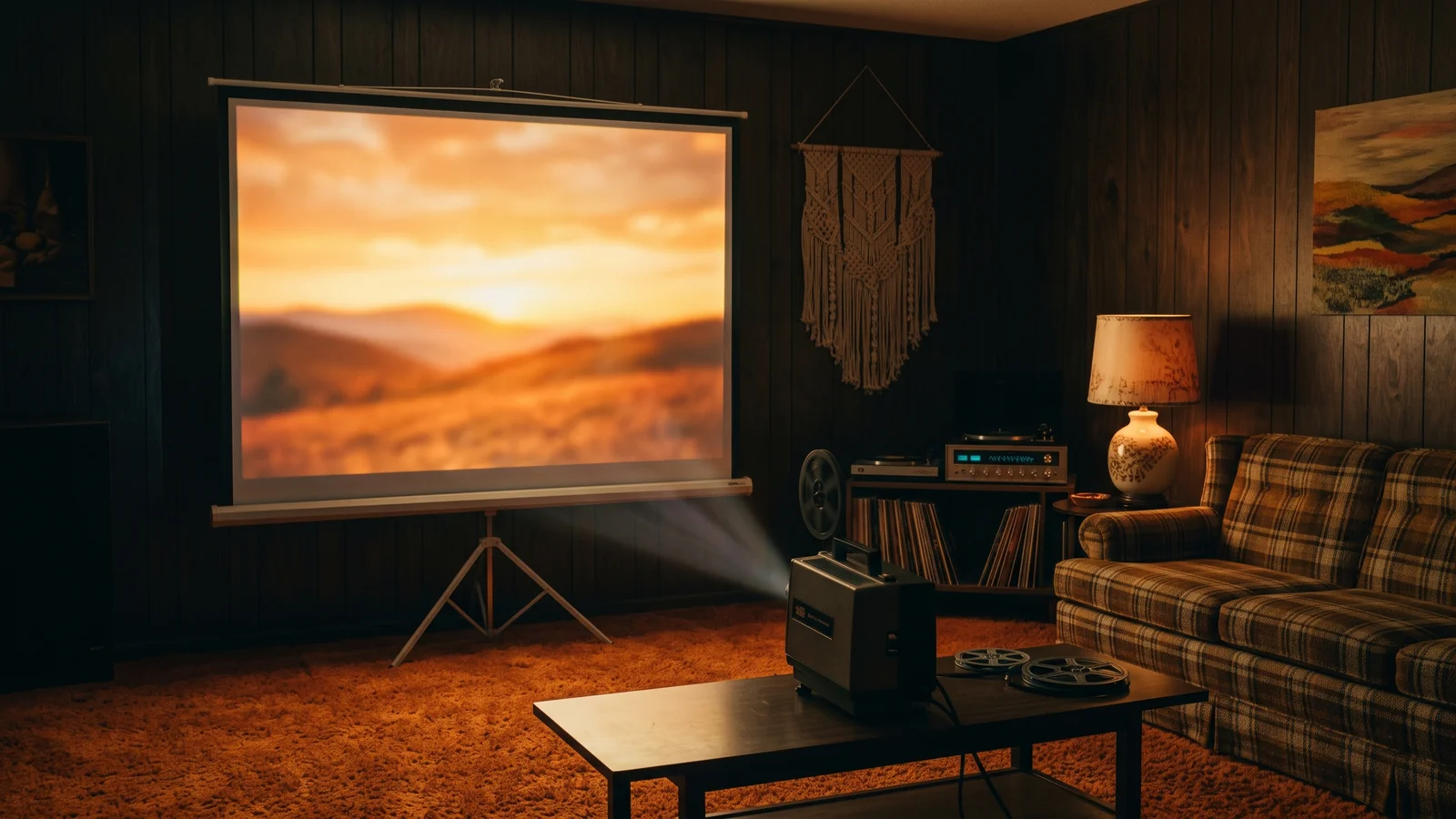
From projection TVs that lost money on every unit to LaserDisc nerds, DVD, the Blu-ray war, and Atmos overhead: how the cinema moved into the living room.
In 1973, a movie-sized screen for your living room cost about $2,500, and the company that built it lost money on every single unit it sold. That machine was the Advent VideoBeam 1000, and Advent stayed afloat by selling speakers to cover the bleeding, as Sound & Vision recounts. The mainstream thought a seven-foot screen at home was lunacy.
A handful of obsessives thought it was the future. They were right. The whole history of home theater is a story of enthusiasts, engineers, and a few stubborn hobbyists dragging the movie experience into the house years before the industry believed anyone wanted it. It went from "TV in a box" to a room designed around the picture and the sound. I build those rooms for a living, so let me walk you through how we got here.
Key Takeaways
- Home theater has no single birthday, but 1982 is the year most cite: Dolby Surround pulled cinema surround into the living room (Teufel).
- The Advent VideoBeam 1000 (1973) was the first consumer big-screen projector, and it lost money per unit (Sound & Vision).
- LaserDisc launched in 1978 with Jaws, and became the format for picture-and-sound obsessives (Wikipedia).
- Tomlinson Holman created THX in 1983 and is credited with naming "5.1" in 1987 (USC).
- DVD (Toshiba SD-3000, 1996) became the fastest-adopted consumer electronics device to that point (Variety).
- Blu-ray beat HD DVD in February 2008, and Dolby Atmos reached the home in 2014 (NPR).
When did home theater actually start?
Home theater has no clean birthday, but 1982 is the year most historians land on. That is when Dolby Surround brought cinema-style surround into the living room using a passive three-channel matrix that decoded a surround signal off VHS tapes and broadcasts, as Teufel documents in its history of home-cinema sound. Before that, the pieces lived apart.
Citation capsule: Home theater is most often dated to 1982, the year Dolby Surround brought cinema-style surround sound into the living room, using a passive matrix that decoded a surround channel from VHS tapes and broadcasts, per Teufel's history of home-cinema sound. It was the first time the sound in a living room wrapped around the listener instead of sitting only in front of them.
Here is the thing about the early days. The technology arrived in scattered parts long before anyone stitched them together into "home theater." You could buy a big screen in 1973, decent stereo speakers in the '60s, and a movie on disc by 1978. What nobody had was the whole experience in one room, working together, wrapping the sound around your head. The hobbyists assembled it themselves, garage by garage, receiver by receiver, years ahead of the market.
And it started even earlier than the screen. Watching movies at home is nearly a century old. Kodak sold its first 16mm Ciné-Kodak home movie outfit in 1923 for $335, per Kodak's own centennial history. Kodak followed with cheaper 8mm film in 1932 and Kodachrome color in 1935 (Wikipedia). The dream of the movies at home is old. The tools to do it properly just took fifty more years.
How did the big screen come home before anyone believed in it?
The first real consumer big screen arrived in 1973 with the Advent VideoBeam 1000, a front-projection set with roughly a seven-foot screen that sold for about $2,500, according to Sound & Vision. It was the brainchild of Henry Kloss, one of the great "great sound for regular people" engineers in this whole story. Advent reportedly lost money on every unit and covered it with speaker sales.
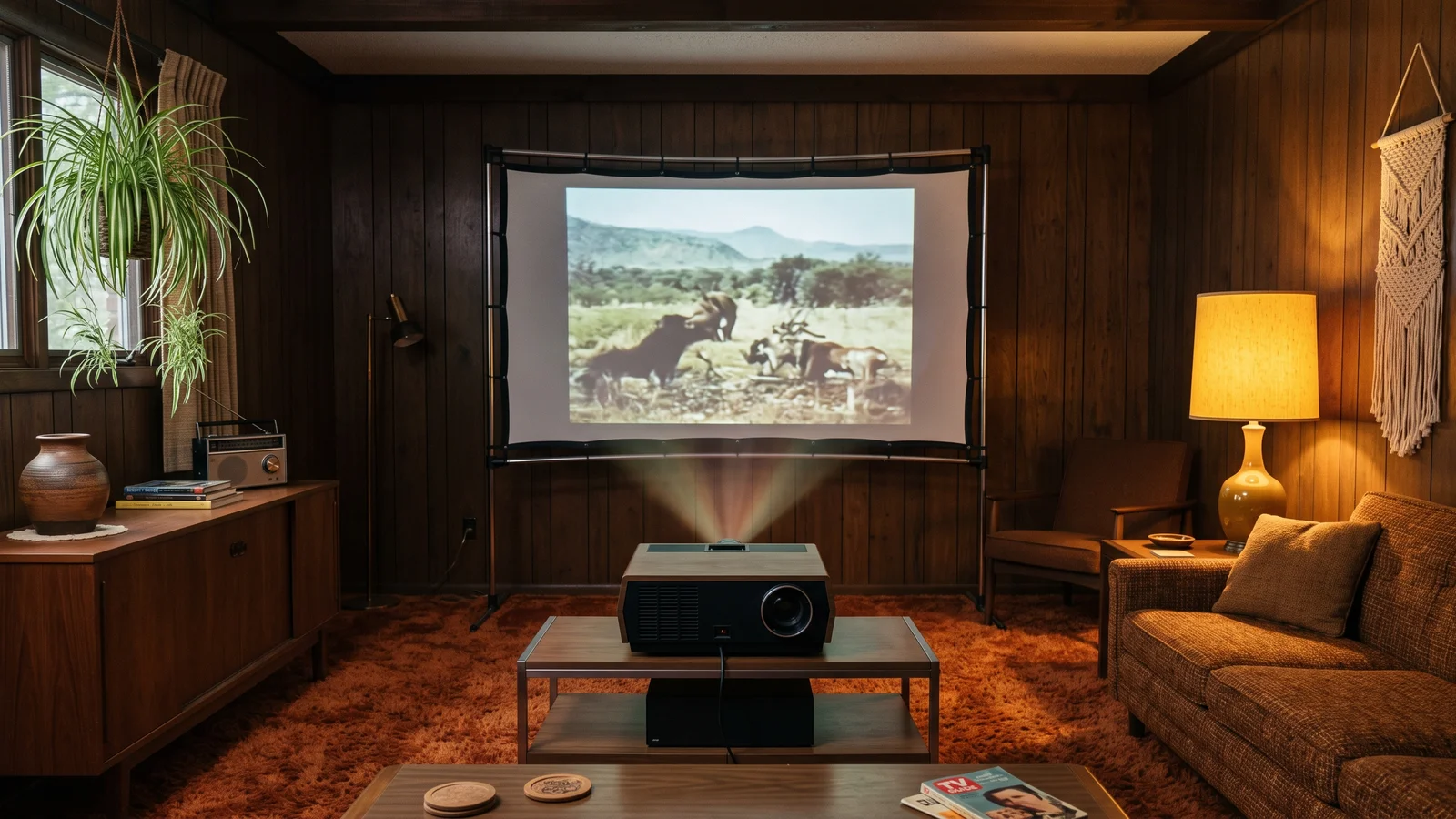
Think about the guts that took. Kloss looked at a market that did not exist, built a projector nobody had asked for, and sold it at a loss because he believed the living-room screen was coming. He was early by a decade, maybe two. The picture was dim, the room had to be dark, and the thing was enormous. But it planted the flag. The big screen belonged at home, and once people saw it, they wanted it.
I have a soft spot for the money-losing pioneers, because they are the reason any of this exists. The suits never build the first one. They wait until an obsessive proves the market, then they show up with a spreadsheet. Kloss was the obsessive. If you have ever sat in a properly dark dedicated home theater room and felt the picture swallow the wall, you are enjoying the thing he bet his company on.
What made LaserDisc the format for obsessives?
LaserDisc launched in Atlanta on December 15, 1978, under the DiscoVision name from MCA and Philips, with Jaws as the first title and the Magnavox Magnavision Model 8000 as the first player, as the format's history records. It never went mainstream. It never tried very hard to. LaserDisc was the format for people who cared more about picture and sound than convenience.
Here is why the nerds loved it. Those twelve-inch platters delivered sharper analog video than VHS could dream of, plus room for better soundtracks. In 1980 Pioneer took a majority stake and rebranded the system LaserVision, then LaserDisc, and pushed it hard to enthusiasts and collectors (Magnavox History). You did not stumble into LaserDisc at the grocery store. You sought it out because you had opinions about black levels.
And LaserDisc kept beating the mainstream to the punch. The first home Dolby Digital 5.1 mix arrived on the LaserDisc of Clear and Present Danger in 1995, and the first home DTS soundtrack showed up on the Jurassic Park LaserDisc in January 1997 (DTS). Discrete surround reached obsessive living rooms on LaserDisc before DVD even existed. That is the whole pattern in one format: the enthusiasts got there first.
When did surround sound come home?
Surround sound came home in 1982 with Dolby Surround, a passive matrix system that decoded a single rear surround channel from stereo sources, as Teufel's history of home-cinema sound explains. It was crude by modern standards, one shared surround channel behind you, but it was the first time the sound in a living room did something more than sit in front of you.
Then it got smart. In 1987 Dolby Pro Logic added a steered, discrete center channel and proper surround steering, giving home systems a 4.0 layout (Teufel). This matters more than it sounds. The center channel is where movie dialog lives, and locking it to the screen instead of floating it between two speakers is the single biggest upgrade in home-theater audio. Get the center right and the whole room clicks into place.
I will die on this hill: the center channel is the most important speaker in the room, and Pro Logic is where that idea got real for the home. We spend more time positioning and voicing the center than almost anything else on a build. Dialog is the movie. Everything else, including the overhead layers we handle in a modern Atmos install, is decoration wrapped around a voice you need to understand.
What is THX, and why is it a standard and not a format?
THX is not a sound format. It is a certification standard for how a room reproduces sound, created at Lucasfilm by engineer Tomlinson Holman and debuting in 1983 with Return of the Jedi, according to Lucasfilm's own account. The "H" in THX comes from Holman's name. It grew out of a reference mixing theater Lucasfilm built in 1982, and it set targets for frequency response, dialog intelligibility, and consistency.
This is the part people get wrong constantly. Dolby Digital and DTS decide what is on the disc. THX decides whether the room plays it back correctly. Holman's insight was that a great mix means nothing if the theater butchers it, so he wrote a spec that theaters, and later home gear, had to meet to earn the logo (Wikipedia). It was quality control for the whole playback chain.
Holman is one of the quiet giants of this story. He was Advent's chief electrical engineer under Kloss, joined Lucasfilm in 1980, created THX, and is widely credited with developing and naming "5.1" in 1987, as USC notes in its profile of him. He taught at USC from 1987 to 2011, won an Academy Scientific and Technical Award in 2001, and later worked at Apple (Wikipedia). The man named the surround layout most of us still run.
Who invented 5.1, and how did discrete sound reach the living room?
Discrete 5.1 arrived with Dolby Digital, also called AC-3, which debuted in cinemas on Batman Returns in 1992 as the first true discrete 5.1 soundtrack: five full-range channels plus a dedicated low-frequency effects channel, per the format's technical record. Tomlinson Holman is credited with naming the "5.1" layout back in 1987 (USC). "Discrete" is the key word: every speaker finally got its own real signal.
The rival showed up fast. DTS launched theatrically in 1993 with Jurassic Park, backed by Steven Spielberg, using a separate disc synced to the film instead of squeezing the audio onto the print, as Wikipedia's DTS company history records. DTS and Dolby Digital have been trading punches ever since. Two formats, one goal: get discrete, full-quality surround to your ears.
Keep two dates straight, because the internet muddles them. Batman Returns (1992) was the first theatrical Dolby Digital film. Clear and Present Danger (1995) was the first home Dolby Digital 5.1 mix, and it landed on LaserDisc, not DVD (DTS). Discrete 5.1 reached the living room through the enthusiast format before the mass-market one even shipped. There is that pattern again.
How did DVD change everything?
DVD turned home theater from a hobby into a household norm. The first home DVD player, Toshiba's SD-3000, launched in Japan on November 1, 1996 for ¥77,000, according to Toshiba's press release. The US model, the SD-2006, followed in early 1997 at around $600, as Sound & Vision's flashback records. DVD went on to become the fastest-adopted consumer electronics device to that point (Variety).
Why did it explode when LaserDisc never did? Size and price. DVD put near-LaserDisc picture and discrete 5.1 sound on a disc the size of a CD, at a price normal families would pay. The enthusiast wish list from the LaserDisc era, sharp picture and real surround, suddenly fit in a slim box under the TV. The obsessives had proven the demand for a decade. DVD made it affordable, and the mainstream finally showed up.
This is also the era when the custom-install trade grew up. CEDIA, the trade group for custom home electronics installers, was founded in November 1989, and its first Expo in 1990 at Amelia Island drew roughly 500 attendees, per CEDIA's own history. Today it has more than 30,000 members (Sound & Vision). Home theater had become a real profession, not just a hobby.
Who won the Blu-ray vs HD DVD war?
Blu-ray won. Both high-definition disc formats launched in 2006, and the war ended on February 19, 2008, when Toshiba abandoned HD DVD after Warner went Blu-ray exclusive in January, as Al Jazeera reported. Sony, Panasonic, and the Blu-ray Disc Association carried the format forward (NPR). It was the format war that finally settled in the streaming era's shadow.
Citation capsule: Blu-ray won the high-definition disc war on February 19, 2008, when Toshiba abandoned HD DVD after Warner Bros. went Blu-ray exclusive that January, per NPR. Blu-ray went on to carry lossless 7.1 surround, Dolby TrueHD and DTS-HD Master Audio, into the home, delivering studio-master audio quality on disc.
Blu-ray was worth winning for the audio nerds. It added 7.1 surround plus lossless soundtracks, Dolby TrueHD and DTS-HD Master Audio, which reproduce the studio master bit for bit (Wikipedia). For the first time, the disc in your player held exactly what the mixing engineer signed off on. No compression compromises. If you cared about sound, Blu-ray was not a small upgrade over DVD. It was the whole point.
The war matters less than what it delivered. Toshiba, ironically the company that gave us the first DVD player, lost this one. But the winner brought lossless surround into the home, and that container would soon carry something bigger overhead.
When did streaming and HD broadcast take over?
Streaming crept in while everyone argued about discs. Netflix launched its "Watch Now" streaming service on January 16, 2007 with about 1,000 titles, according to Britannica. A thousand titles sounds quaint now. At the time it looked like a nice bonus to the DVD-by-mail business. It quietly became the future of how most people watch anything.
Broadcast went high-definition and digital around the same window. US digital HDTV broadcasts began in 1998, and the country shut off analog television for good on June 12, 2009, as the transition record shows. Between HD broadcast, HD discs, and early streaming, the picture in a normal living room jumped a generation in about a decade. The screen finally caught up to the sound.
Here is my builder's take. Streaming made movies effortless and, for a while, made picture and sound quality worse, because bandwidth got compressed to fit the pipe. The convenience won. But convenience and quality are not the same thing, which is exactly why a purpose-built home theater still beats a soundbar and a stream. The obsessives never stopped chasing the best version. They just had to work around the compression.
How did sound go 3D, and why does that need a designed room?
Sound went vertical in 2014, when Dolby Atmos came home on the first consumer receivers, the Denon AVR-X5200W and AVR-X4100W, as Engadget reported. Atmos broke from channel-based thinking entirely. Instead of assigning sound to fixed speakers, it treats sounds as objects placed in three-dimensional space, including overhead, then renders them to whatever layout your room actually has.
That is a genuine change in how sound works. Older formats said "put this in the surround channel." Atmos says "put this here, twelve feet up and to the left," and lets the system figure out which speakers make it happen. Picture caught up too. Ultra HD Blu-ray launched on February 14, 2016, with 4K resolution, mandatory HDR10, optional Dolby Vision, and the Samsung UBD-K8500 as the first player (Wikipedia). Reference-quality picture and object-based sound, both at home.
Now here is why any of this pushes toward a designed room instead of a box on a shelf. Object-based audio only works if the speakers are actually where the geometry needs them, overhead included, and the room is not fighting the sound. That is the difference between "TV in a box" and a room built around the experience. I will keep the sales pitch to one line: the reason we build dedicated theater rooms with a real design process is that Atmos, HDR, and lossless sound reward a room that was planned for them, and punish one that was not.
Why build a dedicated room?
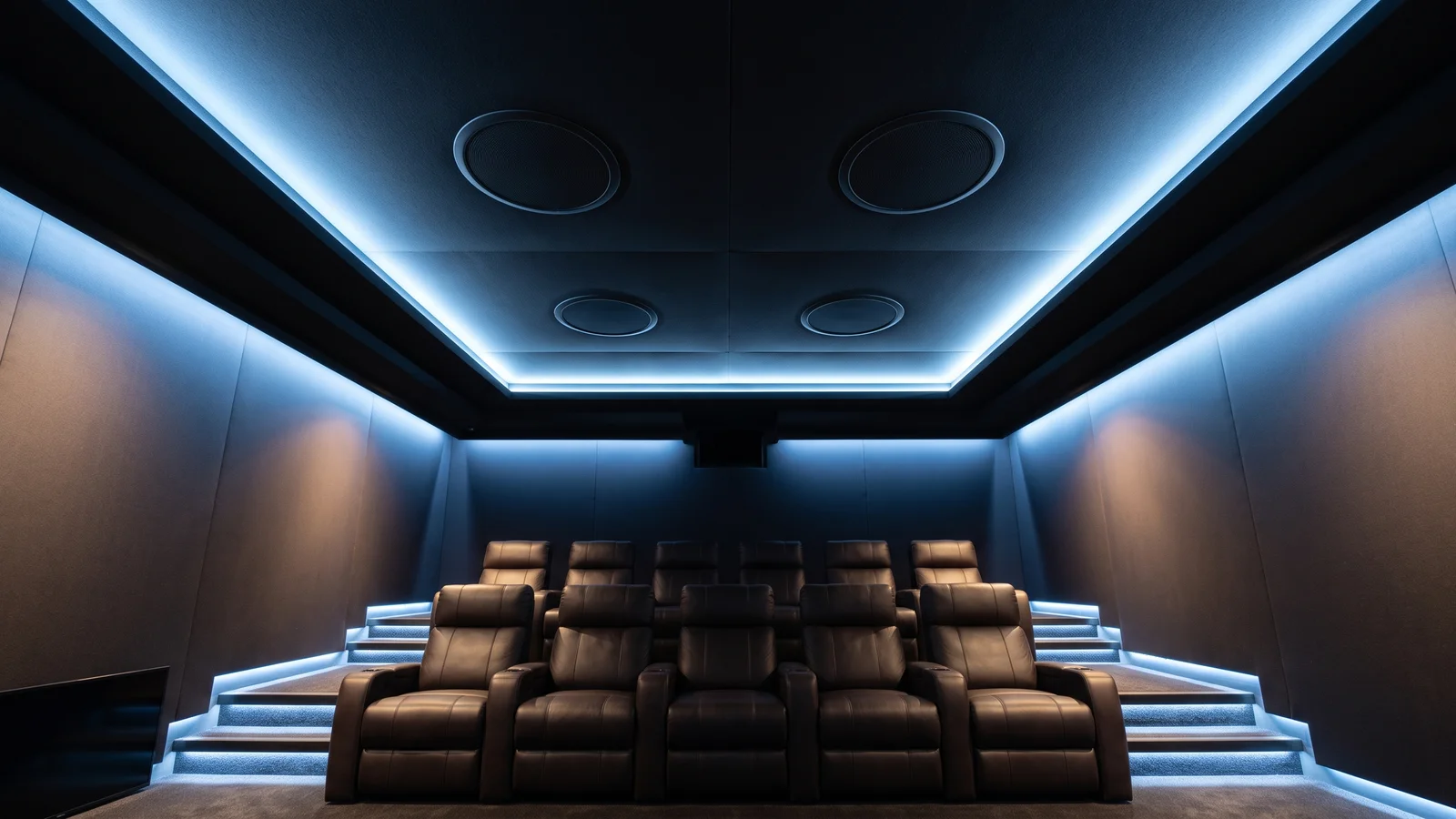
A dedicated room exists because every advance in this ninety-year story assumed one. From THX in 1983 onward, the whole point of the standards was reproduction in a controlled space, as Lucasfilm's THX history makes clear. The mix, the surround layout, the height channels, the calibrated levels, all of it presumes a room that plays fair with the sound. That is what "designed room" means.
Home theater was built by obsessives who wanted the cinema at home before the industry agreed it was possible. Kloss lost money proving the screen belonged in the house. LaserDisc collectors chased picture quality nobody else cared about. Holman wrote a standard so the room would not wreck the mix. Every one of them was early, and every one of them was right. Building a proper room today is just finishing the job they started.
Frequently Asked Questions
When did home theater start?
Home theater has no single start date, but 1982 is the year most cite, when Dolby Surround brought a matrixed surround channel into the living room (Teufel). Earlier milestones matter too: the Advent VideoBeam 1000 big screen arrived in 1973, and LaserDisc launched in 1978.
What is THX?
THX is a certification standard for how a room reproduces movie sound, not an audio format. Lucasfilm engineer Tomlinson Holman created it, and it debuted in 1983 with Return of the Jedi (Lucasfilm). It sets targets for frequency response, dialog clarity, and consistency so a theater or home system plays a mix correctly.
Who invented 5.1 surround sound?
Tomlinson Holman is widely credited with developing and naming the "5.1" layout in 1987 (USC). The format means five full-range channels plus a dedicated low-frequency effects channel. It first reached cinemas as a discrete digital soundtrack with Dolby Digital on Batman Returns in 1992 (Wikipedia).
Who won the Blu-ray vs HD DVD war?
Blu-ray won. Both formats launched in 2006, and Toshiba abandoned HD DVD on February 19, 2008, after Warner went Blu-ray exclusive that January (NPR). Blu-ray added 7.1 surround and lossless Dolby TrueHD and DTS-HD Master Audio soundtracks, delivering studio-master quality at home.
What was the first DVD player?
The Toshiba SD-3000 was the first home DVD player, launched in Japan on November 1, 1996 for ¥77,000 (Toshiba). The US model, the SD-2006, followed in early 1997 at around $600 (Sound & Vision). DVD became the fastest-adopted consumer electronics device to that point.
What was the first LaserDisc?
Jaws was the first LaserDisc title, released when the format launched in Atlanta on December 15, 1978 under the DiscoVision name from MCA and Philips (Wikipedia). The first player was the Magnavox Magnavision Model 8000. LaserDisc never went mainstream, but it became the format of choice for picture-and-sound enthusiasts.
What is the difference between 5.1, 7.1, and Atmos?
5.1 uses five speakers plus a subwoofer; 7.1 adds two more surround speakers for eight total; both are channel-based. Dolby Atmos is object-based, placing sounds in 3D space including overhead, then rendering them to your actual speaker layout (Engadget). Atmos adds height that channel formats do not.
When did Dolby Atmos come home?
Dolby Atmos reached the home in October 2014 on the first consumer receivers, the Denon AVR-X5200W and AVR-X4100W (Engadget). It added height information through ceiling or upward-firing speakers, letting home systems place sound overhead for the first time using an object-based approach.
What was the first DTS movie?
Jurassic Park was the first film released with a DTS soundtrack, debuting on June 11, 1993 with backing from Steven Spielberg (Wikipedia). DTS used a separate disc synced to the film rather than encoding audio onto the print, and it has competed with Dolby Digital ever since.
Why build a dedicated home theater room?
Every home-theater standard, from THX in 1983 to Atmos in 2014, assumes a controlled room for correct playback (Lucasfilm). Object-based sound and overhead channels only work when speakers sit where the geometry needs them and the room does not fight the audio. A designed room is what lets modern formats perform as intended.
Sources
- Kodak — "100 Years of 16mm Film": https://www.kodak.com/en/motion/page/100-years-of-16mm-film/
- Wikipedia — "Ciné-Kodak": https://en.wikipedia.org/wiki/Cin%C3%A9-Kodak
- Sound & Vision — "Advent VideoBeam 1000 Projection System": https://www.soundandvision.com/content/advent-videobeam-1000-projection-system
- Wikipedia — "LaserDisc": https://en.wikipedia.org/wiki/LaserDisc
- Magnavox History — "1978 Magnavision": https://magnavoxhistory.com/showcases/1978-magnavision/
- Teufel — "Dolby Pro Logic and the Origins of Home Cinema Sound": https://blog.teufelaudio.com/dolby-pro-logic-and-the-origins-of-home-cinema-sound/
- Lucasfilm — "Lucasfilm Originals: THX": https://www.lucasfilm.com/news/lucasfilm-originals-thx/
- Wikipedia — "THX": https://en.wikipedia.org/wiki/THX
- USC School of Cinematic Arts — Tomlinson Holman profile: https://cinema.usc.edu/news/article.cfm?id=9696
- Wikipedia — "Tomlinson Holman": https://en.wikipedia.org/wiki/Tomlinson_Holman
- CEDIA — "Our History": https://cedia.net/about-cedia/our-history
- Sound & Vision — "CEDIA: The Early Days": https://www.soundandvision.com/content/cedia-early-days
- Wikipedia — "Dolby Digital": https://en.wikipedia.org/wiki/Dolby_Digital
- DTS — "DTS:X, The Legacy Beyond Sound": https://dts.com/insights/dtsx-the-legacy-beyond-sound/
- Wikipedia — "DTS, Inc.": https://en.wikipedia.org/wiki/DTS,_Inc.
- Toshiba — SD-3000 DVD player press release (1996): https://www.global.toshiba/ww/news/corporate/1996/09/pr2603.html
- Sound & Vision — "Flashback 1997: DVD Players Go on Sale": https://www.soundandvision.com/content/flashback-1997-dvd-players-go-sale
- Variety — "How DVDs Became a Success": https://variety.com/2007/digital/features/how-dvds-became-a-success-1117963617/
- Al Jazeera — "Toshiba Drops Out of DVD Format War": https://www.aljazeera.com/features/2008/2/19/toshiba-drops-out-of-dvd-format-war
- NPR — "Blu-ray Wins High-Def Battle, For Now": https://www.npr.org/2008/02/19/19174580/blu-ray-wins-high-def-battle-for-now
- Britannica — "Netflix, Inc.": https://www.britannica.com/money/Netflix-Inc
- Wikipedia — "Digital television transition in the United States": https://en.wikipedia.org/wiki/Digital_television_transition_in_the_United_States
- Engadget — "Denon's Dolby Atmos Receivers": https://www.engadget.com/2014-07-23-denon-dolby-atmos-receivers.html
- Wikipedia — "Ultra HD Blu-ray": https://en.wikipedia.org/wiki/Ultra_HD_Blu-ray
Mike Vincent is the founder of Mike Knows Audio Video and WubWub Audio, where he designs and hand-builds custom loudspeakers and home theaters in Arizona, the old way, for about fifteen clients a year. He has spent enough time chasing the picture-and-sound obsession the LaserDisc crowd started to know it deserves a room built for it; if you want the movies to actually come home, start with a custom home theater.
Comments
Leave a Comment